
There is a certain amount of drama taking place on my guava tree these days.
The Rose-ringed Parakeets arrive in noisy pairs, settle among the branches and get to work. The Coppersmith Barbets are quieter visitors, but no less interested. Between them, they can make a considerable dent in the morning’s guava harvest.
What puzzles me is what happens next.
Guavas fall to the ground, some barely touched, others with chunks missing. A perfectly good-looking fruit may have a hole in it and be abandoned. Another has been pecked open and left hanging precariously from its stalk. And there is a constant barrage of small fruit pieces from the tree as the parakeets feast.
Why, I wonder, do they throw so much of it down?
Perhaps I am looking at it from entirely the wrong end of the telescope.
The parakeets’ breakfast
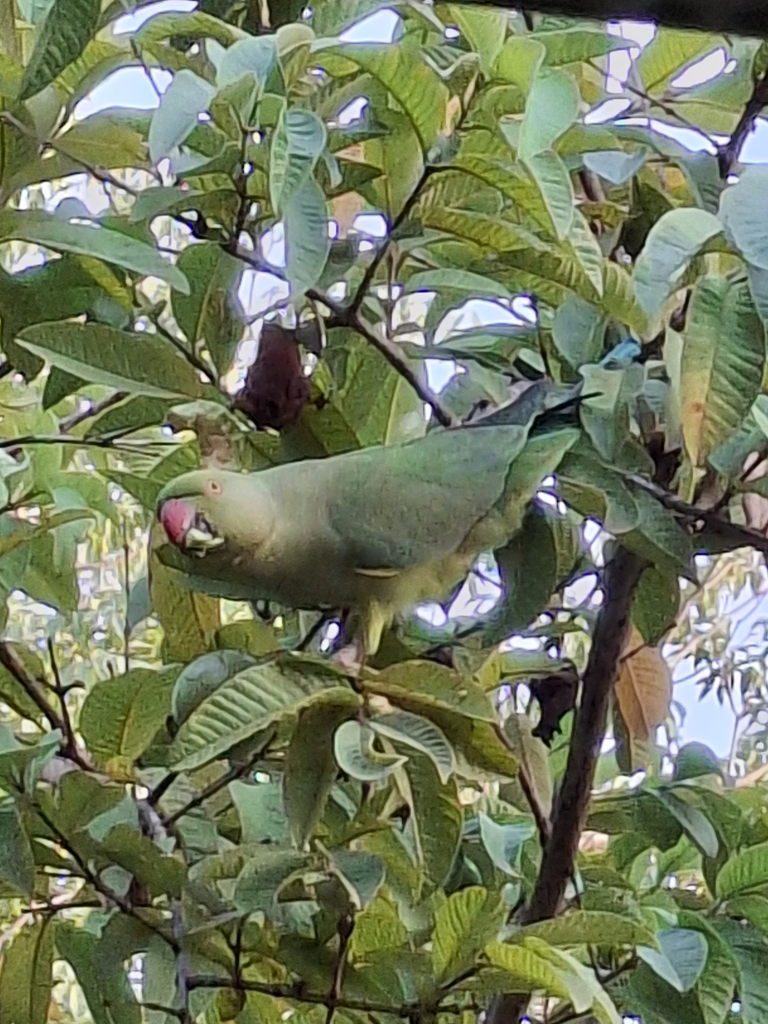
Rose-ringed Parakeets are wonderfully equipped for attacking fruit. That large, curved red bill is not just for making an impressive entrance. It is a powerful cutting and gripping tool, and the bird can hold food with its foot while working on it with its bill.
A parakeet may bite into a guava, take several mouthfuls and then move on. It may be looking for the softer, riper flesh, avoiding a harder portion or simply deciding that another fruit looks more attractive.
And when you are sitting in a tree full of guavas, there is little reason to persevere with a disappointing one.
The next guava is only a beak-length away.
Enter the Coppersmith
The Coppersmith Barbet is a very different personality. Smaller, stockier and beautifully marked, it is much less conspicuous than the parakeet. Its name comes from its extraordinarily persistent call, which sounds remarkably like a tiny coppersmith hammering away at metal.
Barbets are fruit-eaters, and a guava is clearly an attractive proposition. They can make a small opening in the fruit and work their way into the flesh, leaving behind something that looks as though a miniature woodworker has been at it.
Watching the two species together makes one thing clear: birds don’t necessarily approach a fruit as a human would.
For us, a guava is one object. For a bird, it is skin, flesh, seeds, texture, ripeness and energy—all of which can be assessed in a matter of seconds.
The tree has its own plan
There is another player in this little drama: the guava tree itself.
The tree has invested energy in producing fruit because fruit is one of the ways plants persuade animals to transport their seeds. The flesh attracts the animal; the seeds get a chance to travel.
A seed that simply falls beneath its parent tree has to compete with that parent for light, water and nutrients. A seed carried elsewhere has a chance of finding a little patch of ground of its own.
Birds are excellent seed couriers because they move from tree to tree and garden to garden. Some seeds pass through their digestive systems; others may simply fall or be carried away with pieces of fruit.
Not every seed will become a tree, of course. Nature is not in the business of giving every seed a happy ending. It works through numbers, chance and a great deal of trial and error.
And then there are the leftovers
The story does not end when a guava falls.
Ants may discover it. Fruit flies certainly might. Beetles and other insects can take advantage of the exposed flesh. Squirrels may investigate. Eventually fungi and bacteria will break it down and return its nutrients to the soil.
The guava tree is therefore feeding a much larger community than the two birds that first attracted my attention.
This is something we often forget when we look at nature through human eyes. We tend to see individual transactions: the bird ate the guava; the rest was left behind.
Nature sees a chain.
Birds have always been opportunists
The same principle can be seen all around us.
Bulbuls peck at berries. Mynas investigate fruit and food scraps. Squirrels take enthusiastic bites from mangoes and guavas. Crows carry food away, tear it apart and sometimes abandon pieces.
Other birds have developed completely different strategies. Woodpeckers drill into wood in search of insects. Kingfishers plunge into water for fish. Bee-eaters catch insects in flight. Sunbirds probe flowers for nectar.
Each has evolved a way of getting the nutrients it needs without spending more energy than necessary.
So perhaps the Rose-ringed Parakeets and Coppersmith Barbets are not being careless at all.
They are simply being birds.
A poem about birds and a guava tree
And then I came across a poem that seemed to have wandered straight into my garden.
In “Birds on the Guava Tree,” A. P. Govindankutty describes waking to the sounds of birds feeding on almost-ripe guavas in the backyard of his home. There is a crow on the mango tree, squirrels nearby and the general soundtrack of an Indian morning.
But the poem takes the observation somewhere beyond birds and fruit. The poet watches the birds and thinks about what nature gives us—and about what human beings do with what they have been given.
His conclusion is particularly lovely.
It is but fair that the birds eat,
Year after year, all the fruits,
Leaving none for me to pluck,
For they do not rob, hoard or trade
Nor do they kill each other
For power or pelf.
Indeed it must be for them
The trees grow on earth,
Flower and bear fruit,
For they never cut them down.
— A. P. Govindankutty, Birds on the Guava Tree
I like the poem because it changes the question.
I began by wondering why the birds were leaving so many guavas on the ground. The poet asks us to look at the relationship between birds and trees in a completely different way.
After all, the guava tree is not really my tree.
The parakeets don’t think so. The barbets certainly don’t. And judging by the insects, squirrels and other visitors who turn up for whatever is left behind, they are not the only ones with a claim on it.
I may continue picking up the fallen guavas.
But the next time I see a Rose-ringed Parakeet tearing into one, or hear the Coppersmith Barbet calling from the branches, I think I shall be a little less possessive.
After all, as Govindankutty reminds us, it is for them that the trees flower and bear fruit!
–Meena


