Patient Observations

In the past few months I have had occasion to visit three hospitals, as a patient. A small private hospital, a medium-sized corporate hospital, and a public hospital. Each one had its standard procedures and code of conduct. It was interesting to observe and experience the similarities, and the differences. It was also an opportunity to think about a subject that would not normally feature in my list of ‘explore and discover’ topics.

Perhaps the biggest trail of exploration was triggered by my visit to the Civil Hospital in Ahmedabad. Locating the building that we had to reach was the first step. The real eye opener was the sight of hundreds and hundreds of people going and coming, and waiting…One would imagine that such a huge moving population would end up in a railway station-kind of melee with noise, jostling, shoving, and seeming chaos. Here however, there was no unnecessary noise, people (patients as well as their accompanying members) were seated in an orderly fashion on chairs as they awaited their turn to reach one of the several registration desks. This was the first step in what would become the ‘case file’ that would be the key document for their future treatment. This process certainly involved a great deal of filling of forms, and being sent off from section to section to go through the numerous steps required. It was heartening to see that most of the staff were helpful in guiding a large number of people who were from all walks of life, some obviously from distant rural areas who had come here for treatment. This was creditable considering that the continuous stream of people certainly could have tried the patience of a saint. All said and done, things were moving. We too joined the flowing mass of humanity, as we were directed from counter to counter and building to building, over a large part of the day; experiencing how a large part of India’s population encounters the public health system, but also discovering some fascinating facts about the civil hospital.

The Civil Hospital as it is loosely described, is in fact a complex of a number of large medical institutions spread over area of 110 acres in the Asarva area of Ahmedabad. The complex includes facilities for specialized diagnostic, therapeutic and rehabilitative care starting with the general outpatient department to dedicated institutions providing medical and surgical treatment for specific diseases including cancer, TB, kidney and heart, and dental ailments. The campus also houses the BJ medical college, the Gujarat  Medical Council, Gujarat State Pharmacy Council and Gujarat Nursing Council.

No wonder then that this complex, familiarly called Civil Hospital is Asia’s largest public hospital, and possibly the oldest. It’s unique history and heritage goes back 168 years.

 It origins as an institution can be traced back to 1841 when it started operating from the Collector’s Office. The brick and mortar building of the hospital was constructed in 1858 at a cost of Rs. 96,000. This was an immense sum in those days, and the then colonial government had no role in its funding. But Ahmedabad also has a long history of philanthropy, when the affluent merchants of city contributed generously to public causes. Two prominent citizens Shri Hutheesing and Shri Premabhai were among the key donors for establishing the hospital, along with an Englishman, D. Wyllie, who was the Surgeon General at the time. A block of the hospital was named the Wyllie Ward after him. The objective was to provide free health services, aid and treatment to the people. The Old Civil Hospital was located at the Collector’s Office in Gheekanta. There were 12 wards and rooms for 92 in-patients. A medical school attached to the hospital was started in 1871 with 14 students who were designated as Hospital Assistants. As patients continued stream in, there was a need for expansion of space and facilities. Once again, the philanthropists of the city stepped in. Over the few decades, donations helped to open a Medical College, an eye hospital, outdoor patients section, and construct a maternity unit and women’s and children’s wards. The common people of Ahmedabad also contributed. From funds collected by the public, a well-equipped surgical ward was created; it was named the Mary Lambert Operation Theatre.

Despite these extensions and expansions, the hospital could not meet the huge need and demand for its services. Thus work, funded by the government, began on new premises in the Asarva area, starting in 1952. The New Civil Hospital as it was called shifted here in November 1953. Over the years, the campus has grown and spread to earn its distinction as the largest public hospital in Asia. The New Civil Hospital has more than 2000 beds and 44 wards for indoor patients. Over 1 lakh indoor patients are treated here every year. And over 9 lakh patients avail of the OPD facilities annually. And all treatments and investigations are provided free of charge, or at minimal charges. Mind boggling, to say the least.

No doubt, the system is not without its flaws and issues. And an equal number of stories may be shared about harrowing experiences. But the fact that such a complex of facilities continues to function, where even a common person can avail of medical treatment at minimal cost, is certainly worthy of commendation. Yes, there are crowds, there are long waits, there are points of confusion and frustration. But then, one hears of months-long wait in Britain’s NHS system to get a bed for a routine surgery; and the American system where one needs to wait months before one can get an appointment to see a specialist, or an MRI when quick diagnosis and treatment are of the essence…

In our own quest to be leaders in ‘medical tourism’ today we are seeing an upsurge of huge corporate hospitals springing up. These are bewildering concrete and glass jungles in themselves, where even a critically-ill patient cannot be admitted until the Billing Desk declares them “fit to pay”. Where every breath, and every procedure and pill is billed, and from where it is a challenge to emerge sound in body, mind, and bank balance!

In such greatly changed times, and certainly in the face of huge challenges, it is humbling to know that the Civil Hospital continues to adhere to its original mission of “Providing the best healthcare services to all sections of society at free of cost through unrelenting strategy of motivation, quality improvement, value addition and dedication towards humanity with selflessness.”

–Mamata

A Month for Pain

Pain is one of those things we know intimately but understand surprisingly little. We know it when we stub a toe, burn a finger, bite our tongue, pull a muscle or discover that the corner of the coffee table has been lying in wait for our little toe. We know exactly what to say: “Ouch!”

But what exactly is happening when we say it?

September is Pain Awareness Month, an annual campaign dedicated to improving understanding of pain, pain management and the experience of people living with pain. It was established in 2001 and is now marked internationally. This September, the International Association for the Study of Pain (IASP) is particularly focusing on understanding, advocating, partnering and advancing pain science, with 2026 also being its Global Year on Neuropathic Pain.

Which seems like a good time to ask a rather basic question: why does pain hurt?

The body’s alarm system

The old-fashioned explanation was wonderfully simple. Something goes wrong in the body, nerves send a message to the brain, and the brain says: That hurts.

There is some truth in this, but modern pain science has made the story considerably more interesting.

When we touch something dangerously hot or injure ourselves, specialised nerve endings called nociceptors detect potentially damaging stimuli. They send electrical signals through nerves and the spinal cord towards the brain. But pain itself is not simply the signal travelling along a nerve. It is the brain’s interpretation of those signals, influenced by a whole set of factors including context, memory, mood and expectation. This is why pain is both remarkably useful and remarkably complicated.

People born with rare conditions that prevent them from feeling pain demonstrate just how important that unpleasant sensation is. Without the warning system, burns, fractures and other injuries can go unnoticed, sometimes with devastating consequences.

When the alarm refuses to switch off

Acute pain generally has a useful purpose. You injure yourself, the area hurts, the body repairs itself and, eventually, the pain subsides.

But pain does not always follow this tidy script.

It can persist long after an injury has healed, or occur without an obvious injury. Chronic pain can become a problem in its own right, while neuropathic pain arises from damage or disease affecting the somatosensory nervous system. It can feel burning, shooting, electric or stabbing, and can be extraordinarily difficult to treat.

There is another fascinating category: nociplastic pain, in which altered pain processing is involved without clear evidence of ongoing tissue damage or a lesion of the somatosensory system. In other words, pain is not always a faithful reporter standing at the scene of the crime.

But can pain actually be measured?

This is where things get delightfully strange.

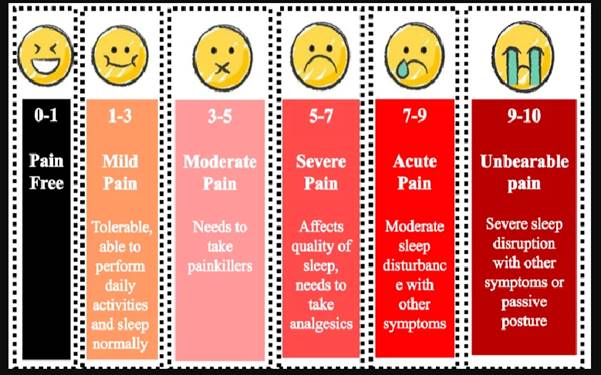
If someone tells you their pain is 7 out of 10, what does that really mean? Is your 7 the same as my 7? And is either of us using the same scale as the person who describes childbirth, a broken bone or a paper cut as “about a five”?

Pain is subjective, which makes it notoriously difficult to measure objectively. As an article in National Geographi article explains, scientists still do not have a reliable physiological instrument that can simply be attached to a human being and announce: “Your pain is 6.73.”

Enter Justin O. Schmidt, the American entomologist who apparently looked at the problem and decided that the obvious solution was to get himself stung by lots of insects– more than 150 species.

Schmidt spent decades studying insects and recording the character and intensity of their stings. His work eventually produced the Schmidt Sting Pain Index, a scale from 0 to 4 that ranks the relative pain of insect stings. The honeybee, familiar to many people, scores 2 and became a reference point for comparison. Schmidt also asked other experts to provide their assessments.

The Pain Olympics

At the bottom end are relatively mild stings. Fire ants and paper wasps score 1. Then comes the upper end of the scale. The tarantula hawk wasp, warrior wasp and bullet ant all reach 4. The bullet ant is particularly notorious, and Schmidt’s description of its sting is so dramatic that it sounds less like entomology and more like a rejected line from an action movie.

Schmidt’s descriptions are one of the most entertaining features of the index. He did not merely write “pain = 3.” He attempted to describe what the pain felt like. His yellowjacket entry compares the sensation to a hot, smoky experience involving a cigar. The warrior wasp, at the top of the scale, provoked the wonderfully candid question: “Why did I start this list?”

One can only admire the commitment to science.

Pain is not the same as damage

Schmidt’s work also illustrates something important about pain: the intensity of pain does not necessarily correspond directly to the amount of physical damage caused.

Venom has multiple effects. Some components can trigger intense pain, while others contribute to toxicity and tissue damage. These are related but not identical phenomena. A sting can hurt spectacularly without producing equivalent lasting tissue damage.

There is an evolutionary reason for this. For many stinging insects, the purpose of venom is not necessarily to kill a predator. A predator that survives a painful encounter can learn a valuable lesson: perhaps don’t eat that particular insect again.

As one of the scientists quoted by National Geographic puts it, a painful experience can be more useful as a defence if it leaves the predator alive to remember it.

Which brings us back to us humans.

We tend to think of pain as the enemy. But pain is actually one of the body’s oldest protective systems. It tells us when to withdraw, when to protect an injured part, when something may be wrong and, sometimes, when we need to seek help.

The trouble begins when the alarm becomes the illness itself.

Pain Awareness Month is therefore not simply about telling people that pain exists. It is about recognising that pain is real even when it cannot be seen, that different people can experience the same stimulus differently, and that persistent pain deserves to be understood rather than casually dismissed. IASP’s 2026 campaign puts this neatly into a broader framework of understanding, advocacy, partnership and better care.

And as for the Schmidt Sting Pain Index, there is a final lesson.

You can measure pain comparatively. You can describe it, investigate it and study the biology behind it. But there is still no universal “pain-o-meter” that tells us exactly what another person is feeling.

Perhaps that is why pain requires not only science, but empathy.

And perhaps, when somebody says, “This really hurts,” we should resist the temptation to reply, “It can’t be that bad.”

Unless, of course, they are volunteering to test the bullet ant!

And perhaps we should occasionally thank pain.

Preferably after it has gone away.

–Meena

I Am a Tree

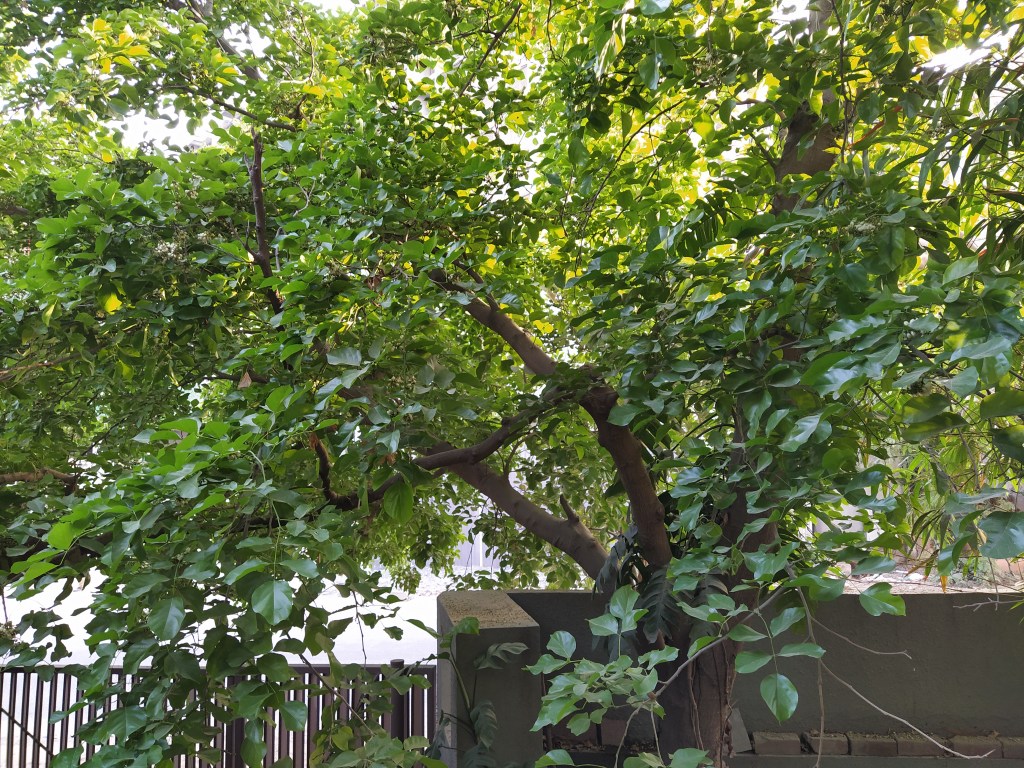
Meena’s recent musings on “her’ guava tree took me back to my early days as an environmental educator. One of our first assignments was to develop a series of worksheets for children which would help to spark curiosity, interest, and appreciation of the natural world. This meant that we ourselves needed to experience what we expected the children to experience. We decided to start small, with a single tree, rather than a forest. The exercise began with our own observations of a single tree.

Over days, as we began to explore the numerous dimensions of a single tree, we got caught up in a fascinating journey of observing, exploring, and discovering. Putting together our notes, and engaging in refreshing discussions, the worksheets and activities for guided observation began to evolve. Preliminary try-outs of these with teachers and students added new dimensions that enriched our own understanding.

One of the unplanned spin-offs from this experience was a poem that I wrote; an attempt to capture the wonderful web of life that a single tree nurtures.

Decades later, the poem about the guava tree evoked many memories, and led me back to these words, penned long ago.

I Am a Tree

I am a tree

so straight and free

all branches and twigs and trunk am i

but i stand alone

bare to the bone

i am a tree

so tall and free

who will come and be with me?

WE are the roots

from us will sprout the shoots

we dig deep and wide

spread out on every side

under the earth we hide

food and water we gather it all

to help the tree stand strong and tall.

WE are the leaves

we dance in the breeze

so many are we, different ones for every tree

some long, some short, some large some small

some yellow, some red, some grow some fall

we cover the branches and twigs like a screen

making a beautiful dress of green

to help the tree to breathe and dine

there’s lots to be done

but for that we need the sun.

WE are the insects

we live on the tree

we crawl, we creep, we hop, we fly

in cracks and hollows, some damp, some dry

we take our fill of fruit and flower

leaf and bark we lay our eggs and spin our webs

if you look hard you’ll see our mark.

WE are the birds of different feathers

we flock to the tree in all kinds of weather

we stitch, or weave, or build our homes

from twigs, on branches, in trunks with holes

we coo, we caw, we chirp, we chatter

we rest, we roost, we flutter, we patter.

WE are the children

we love the tree

in village, in city, town, and country

it gives us shade and fruit for free

it plays with us when we make believe

that we are a squirrel, a hawk, tarzan

up we go on it, one…two…three

look at the world like a monkey.  

A tree i am

so happy and free

so many friends are part of me

they make me a world of colour and sound

we help each other

from sky to ground.

I was a tree

once proud and free

i lived, i grew, i got i gave

some rain i brought, some soil i saved

i was a world for living things.

i am now a stump, just left to dry

cut up for wood. oh, how i cry

a table, a chair, a window, a door, a pencil, a paper, something more

a bonfire has been lit of me.

I that was tree

once tall and free  

While poets continue to wax eloquent about trees, no human can ever create a tree. That is exclusively Nature’s miracle and gift.

Joyce Kilmer reminded us of this in 1913.

   I think that I shall never see

  A poem lovely as a tree.

  Poems are made by fools like me,

  But only God can make a tree.

–Mamata

The Great Guava Heist: Rose-ringed Parakeets, Coppersmith Barbets and a Guava Tree

There is a certain amount of drama taking place on my guava tree these days.

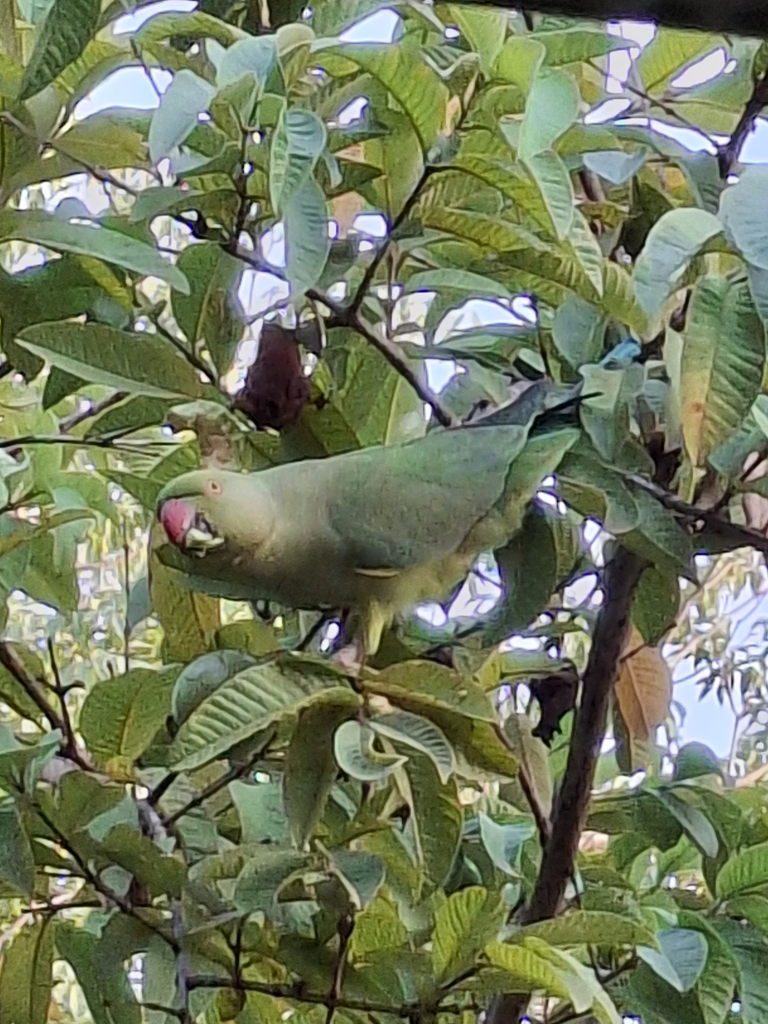
The Rose-ringed Parakeets arrive in noisy pairs, settle among the branches and get to work. The Coppersmith Barbets are quieter visitors, but no less interested. Between them, they can make a considerable dent in the morning’s guava harvest.

What puzzles me is what happens next.

Guavas fall to the ground, some barely touched, others with chunks missing. A perfectly good-looking fruit may have a hole in it and be abandoned. Another has been pecked open and left hanging precariously from its stalk. And there is a constant barrage of small fruit pieces from the tree as the parakeets feast.

Why, I wonder, do they throw so much of it down?

Perhaps I am looking at it from entirely the wrong end of the telescope.

The parakeets’ breakfast

Rose-ringed Parakeets are wonderfully equipped for attacking fruit. That large, curved red bill is not just for making an impressive entrance. It is a powerful cutting and gripping tool, and the bird can hold food with its foot while working on it with its bill.

A parakeet may bite into a guava, take several mouthfuls and then move on. It may be looking for the softer, riper flesh, avoiding a harder portion or simply deciding that another fruit looks more attractive.

And when you are sitting in a tree full of guavas, there is little reason to persevere with a disappointing one.

The next guava is only a beak-length away.

Enter the Coppersmith

The Coppersmith Barbet is a very different personality. Smaller, stockier and beautifully marked, it is much less conspicuous than the parakeet. Its name comes from its extraordinarily persistent call, which sounds remarkably like a tiny coppersmith hammering away at metal.

Barbets are fruit-eaters, and a guava is clearly an attractive proposition. They can make a small opening in the fruit and work their way into the flesh, leaving behind something that looks as though a miniature woodworker has been at it.

Watching the two species together makes one thing clear: birds don’t necessarily approach a fruit as a human would.

For us, a guava is one object. For a bird, it is skin, flesh, seeds, texture, ripeness and energy—all of which can be assessed in a matter of seconds.

The tree has its own plan

There is another player in this little drama: the guava tree itself.

The tree has invested energy in producing fruit because fruit is one of the ways plants persuade animals to transport their seeds. The flesh attracts the animal; the seeds get a chance to travel.

A seed that simply falls beneath its parent tree has to compete with that parent for light, water and nutrients. A seed carried elsewhere has a chance of finding a little patch of ground of its own.

Birds are excellent seed couriers because they move from tree to tree and garden to garden. Some seeds pass through their digestive systems; others may simply fall or be carried away with pieces of fruit.

Not every seed will become a tree, of course. Nature is not in the business of giving every seed a happy ending. It works through numbers, chance and a great deal of trial and error.

And then there are the leftovers

The story does not end when a guava falls.

Ants may discover it. Fruit flies certainly might. Beetles and other insects can take advantage of the exposed flesh. Squirrels may investigate. Eventually fungi and bacteria will break it down and return its nutrients to the soil.

The guava tree is therefore feeding a much larger community than the two birds that first attracted my attention.

This is something we often forget when we look at nature through human eyes. We tend to see individual transactions: the bird ate the guava; the rest was left behind.

Nature sees a chain.

Birds have always been opportunists

The same principle can be seen all around us.

Bulbuls peck at berries. Mynas investigate fruit and food scraps. Squirrels take enthusiastic bites from mangoes and guavas. Crows carry food away, tear it apart and sometimes abandon pieces.

Other birds have developed completely different strategies. Woodpeckers drill into wood in search of insects. Kingfishers plunge into water for fish. Bee-eaters catch insects in flight. Sunbirds probe flowers for nectar.

Each has evolved a way of getting the nutrients it needs without spending more energy than necessary.

So perhaps the Rose-ringed Parakeets and Coppersmith Barbets are not being careless at all.

They are simply being birds.

A poem about birds and a guava tree

And then I came across a poem that seemed to have wandered straight into my garden.

In “Birds on the Guava Tree,” A. P. Govindankutty describes waking to the sounds of birds feeding on almost-ripe guavas in the backyard of his home. There is a crow on the mango tree, squirrels nearby and the general soundtrack of an Indian morning.

But the poem takes the observation somewhere beyond birds and fruit. The poet watches the birds and thinks about what nature gives us—and about what human beings do with what they have been given.

His conclusion is particularly lovely.

It is but fair that the birds eat,

Year after year, all the fruits,

Leaving none for me to pluck,

For they do not rob, hoard or trade

Nor do they kill each other

For power or pelf.

Indeed it must be for them

The trees grow on earth,

Flower and bear fruit,

For they never cut them down.

— A. P. Govindankutty, Birds on the Guava Tree

I like the poem because it changes the question.

I began by wondering why the birds were leaving so many guavas on the ground. The poet asks us to look at the relationship between birds and trees in a completely different way.

After all, the guava tree is not really my tree.

The parakeets don’t think so. The barbets certainly don’t. And judging by the insects, squirrels and other visitors who turn up for whatever is left behind, they are not the only ones with a claim on it.

I may continue picking up the fallen guavas.

But the next time I see a Rose-ringed Parakeet tearing into one, or hear the Coppersmith Barbet calling from the branches, I think I shall be a little less possessive.

After all, as Govindankutty reminds us, it is for them that the trees flower and bear fruit!

–Meena

An Ode to Letters

I recently read a book that resonated with me. The Correspondent by Virginia Evans is a novel narrated entirely through letters. The protagonist Sybil is a mother and a grandmother, divorced, retired from a distinguished career in law. Every morning at half-past ten, Sybil Van Antwerp sits down to write letters. Letters to family, letters to friends, even letters to authors whose books she has read, to share her own thoughts on these.  Sybil uses her letters to make sense of the world. And by the end of the novel, it is her letters that unfold the story of her own life.

As a person who has been a letter writer most of my life. And who persisted with writing on real paper with real ink, although by part-necessity, succumbed to emails, much after the rest of the world around, this book was the reiteration of the enduring value of ‘real’ letters.

Coincidentally, just a few days later, I read that in an already-packed Calendar of “Days” there is a day which celebrates the disappearing art of putting pen to paper. World Letter Writing Day is marked on 1 September every year, as a reminder of the appreciation of handwritten correspondence. How ironic, and so sad that people need reminding of this. And yet, there is a new generation that has probably never sat down with a clean sheet of paper, a pen of their choice, and enough time to open their minds and hearts to a loved one. In this day of instant sharing of bullets of information, written in abbreviated code, and shot off with the tip of a finger, what are we losing?

Sybil, in one of her letters to a sceptic who wonders why she still writes each letter by hand explains: You also asked after the meaning of my practice of letter writing, calling it quaint and impractical. Imagine all that you have said to one another, all the commentary you have exchanged with friends over drinks, over the phone with colleagues and distant relatives, all the prattle sent quickly, mindlessly over the email, messages typed into your cellular phone, and really, the sum of this interpersonal communication is the substance of your life, relationships being, as we know by now in our old ages, the meat of our lives, but all of that is gone.  Vanished!

This mode of communication has been replaced by what another member of the letter-writers club describes as “relinquishing the post the envelope, a pen, a slower cerebral whirring, the use of our whole hands and not just the tips of our fingers.”

And yet, even more ironically, although electronic forms of communication have now largely taken over from the handwritten letter, perhaps even Gen Z secretly yearns to receive the kind of letters that their parents and grandparents talk about with nostalgia. A survey discovered that while 64% of people would not sit down and hand write a single letter over the course of a year, 69% said that receiving something handwritten through the post would mean more to them than a text, tweet or Facebook message.

The first ever personal handwritten letter was thought to have been sent by the Persian Queen Atossa in around 500 BC, according to the ancient Greek historian Hellanicus. The popularity of letters as a way of sending messages grew as more people became literate. While the exact contents or physical copy of this letter have not survived, letters as a form of communication have withstood the passage of times. Great authors have not just penned works of literature, they have revealed so many personal facets through hundreds of letters that remain timeless windows into another time, and other ways of seeing the world. Thankfully these letters are preserved today in archives, and several published.

What will remain of the ephemeral messages that today whiz across the virtual skies, and disappear like shooting stars? Where will there be the magical experience of joining someone, perhaps hundreds of years later, to peek into their relationships, their thoughts, and, reading between the lines, imagining the additional unpenned words? How will we be able to trace the contours of their lives, discover the greys on the fringes of the more obvious black and white? How will we experience the serendipitous excitement when we discover the words that suddenly connect their experience with ours, and the uncanny sense of bonding with the author?

For this, we need letters. And we need to be able to access these letters. But first, these letters need to be written.

Simon Garfield shares this angst in his book To the Letter: A Celebration of the Lost Art of Letter Writing.

Letters have the power to grant us a larger life. They reveal motivation and deepen understanding. They are evidential. They change lives, and they rewire history. The world once used to run upon their transmission — the lubricant of human interaction and the freefall of ideas, the silent conduit of the worthy and the incidental, the time we were coming for dinner, the account of our marvelous day, the weightiest joys and sorrows of love. It must have seemed impossible that their worth would ever be taken for granted or swept aside. A world without letters would surely be a world without oxygen.

Sybil, in her ruminations reiterates this sentiment:

And yet if one has committed oneself to the page…Imagine, the letters one has sent out into the world, the letters received back in turn, are like the pieces of a magnificent puzzle, or, a better metaphor, if dated, links of along chain, and even if those links are never put back together, which they will certainly never be, even if they remain for the rest of time dispersed across the earth like the fragile blown seeds of a dying dandelion, isn’t there something wonderful in that, to think the story of one’s life is preserved in some way, that this very letter may one day mean something, even if it is a very small thing, to someone?

–Mamata

Finger Wrestling: The Sport Where One Finger Can Make You a Champion

We use our fingers for all sorts of important things these days: typing, texting, scrolling, swiping and, occasionally, pointing out to someone that they have been on their phone too long.

But in Bavaria, one group of people puts a rather different value on their fingers. They wrestle with them.

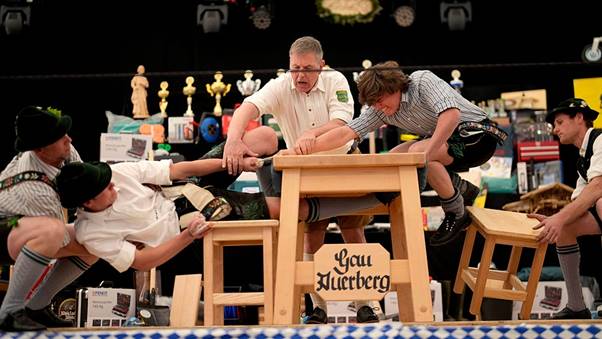
Welcome to Fingerhakeln, or finger wrestling—a wonderfully peculiar traditional sport in which two people sit across a table, hook their middle fingers into a leather loop and try to pull each other towards themselves.

And before you dismiss this as something that happens after too many beers at a German village festival, consider this: it has rules, clubs, training, weight and age categories, referees and national championships.

The rules are almost comically simple. Two competitors sit opposite each other at a specially designed table. Their middle fingers are hooked into a short leather strap. At the signal, they pull. The objective is to drag the opponent’s finger across a marked line.

Except that pulling another person’s finger with maximum force is apparently considerably harder—and more painful—than it sounds.

A bout may be over in just a few seconds, although the toughest can last nearly a minute. That may not sound like long enough to constitute a sporting ordeal, until you remember that the entire time is spent exerting enormous force through one finger. Competitors train specifically for the sport, strengthening their hands and fingers and learning how to use leverage, body position and technique.

So if you are now looking at your own hands and thinking, Surely I could do that, please resist the temptation to challenge your spouse, colleague or unsuspecting dinner companion. This is not an after-dinner game. There are good reasons not to underestimate the sport. The finger is subjected to considerable force during a contest, and injuries can occur. Competitors warm up, condition their hands and fingers and develop techniques for pulling and bracing.

               PIC: https://www.euronews.com/

From Alpine tradition to national championship

Fingerhakeln is particularly associated with Bavaria and the Alpine regions of Germany and Austria. Its precise origins are difficult to establish, but the tradition goes back generations. Like many folk sports, it appears to have started as a simple test of strength. Who was stronger? There was no need for a boxing ring or wrestling arena. Just sit down, hook fingers and find out.

Over time, the pastime became organised competition. Today, finger wrestlers compete in different age and weight categories, with regional championships and a German national championship. The sport has managed to remain both fiercely competitive and closely connected to local culture.

In an age when sporting events can involve billion-dollar broadcasting deals and athletes who are global celebrities, Fingerhakeln remains resolutely local. It is rooted in the Alpine region, but the annual German championship gives its strongest competitors a national stage.

The seriousness of the sport becomes obvious when you watch the competitors. There is very little movement and certainly none of the dramatic action associated with conventional wrestling. The struggle is concentrated in the hands and arms, while the two competitors sit almost motionless, each waiting for the other to give way. And then, often within seconds, it is over.

That combination of stillness and sudden force is part of what makes Fingerhakeln so fascinating to watch. It looks almost absurdly simple, until you realise just how much strength and pain tolerance are packed into those few moments.

For all its eccentricity, Fingerhakeln has the trappings of any serious competitive sport: champions, categories, training and even sporting families. At the 2025 Bavarian championships, Franz Foos won the heavyweight title, Andreas Sturm took the lightweight category, while Gerhard Sturm won the senior category for competitors over 60. The Sturms are a nice example of how traditional sports can become family traditions, with skills and enthusiasm passing from one generation to the next.

The Bavarian championship is a regional competition, however, and is distinct from the German national championship. That was held on August 23 in Pflugdorf-Stadl, where around 150 competitors took part. Ferdinand Seitz won the senior title, and afterwards described the experience of competing as “excruciating”—which seems a fairly convincing endorsement of the seriousness of the sport.

For the competitors, the few seconds at the table represented months and years of preparation. And that perhaps brings us to the more interesting question raised by this wonderfully odd sport: what exactly makes something a sport?

We tend to associate sport with speed, spectacular physical feats, enormous stadiums and global audiences. But strip it down and the essentials are rather simpler: physical effort, skill, training, rules, competition and the determination to win. Fingerhakeln has all of them.

It may never become an Olympic sport, but it does not need to. Its appeal lies partly in its connection to place and tradition. In a world where the same sports are watched from New York to New Delhi, Fingerhakeln remains distinctly Bavarian—a competitive tradition tied to its community and passed from one generation to the next.

There is something rather appealing about that. We spend so much time trying to make everything bigger, faster and more spectacular. Finger wrestling goes in the opposite direction. It strips competition down to its essentials: two people, a leather loop, considerable strength and a very determined finger.

For most of us, fingers are increasingly instruments of the digital age, busy with keyboards and screens. In Bavaria, some people still use theirs to settle a much older question: Who is stronger?

The answer, as it turns out, can be decided by a leather loop, a wooden table and a very determined middle finger.

Who knew one finger could carry so much sporting ambition?

–Meena