
What does karma look like?
It is a difficult question. We can explain karma, discuss it, preach about it and philosophise about it. But how do you actually show it?
Some Jain manuscript makers found an ingenious answer. They turned it into a sequence of pictures: this is what someone did and this is what happened as a consequence. The manuscripts came to be known as Karni Bharni, a phrase meaning “as you do, so you receive”. The Gyan Museum describes them as ‘an illustrated Jain didactic tradition in which actions and their consequences are laid out as a sequence of scenes’. The pictures were important precisely because the argument could be followed even by someone who could not read the accompanying text.
I saw a display of such a book when I visited the Museum of Arts and Photography last week. It is a particularly intriguing subject to encounter around Paryushan, when Jains turn their attention towards self-discipline, reflection, religious study, repentance and forgiveness. At the heart of the festival is the uncomfortable but useful exercise of looking at one’s own actions and their consequences.
Karni Bharni does much the same thing—but instead of asking us to imagine the consequences, it paints them.
These are not quite “picture books” in the modern children’s-book sense. They belong to the long and sophisticated manuscript tradition of Jain communities, particularly in western India. Jain bhandars, or manuscript repositories, preserved texts with remarkable continuity. Their importance goes well beyond religion to contributing to understanding the history of Indian painting, as these are some of the earliest surviving Indian paintings on paper.
And there is something wonderfully practical about the way Karni Bharni works. A page can show an action; another scene shows its result. The sequence does the teaching. The figures are deliberately schematic and punishments quite graphic! Their job is to be recognised and understood.
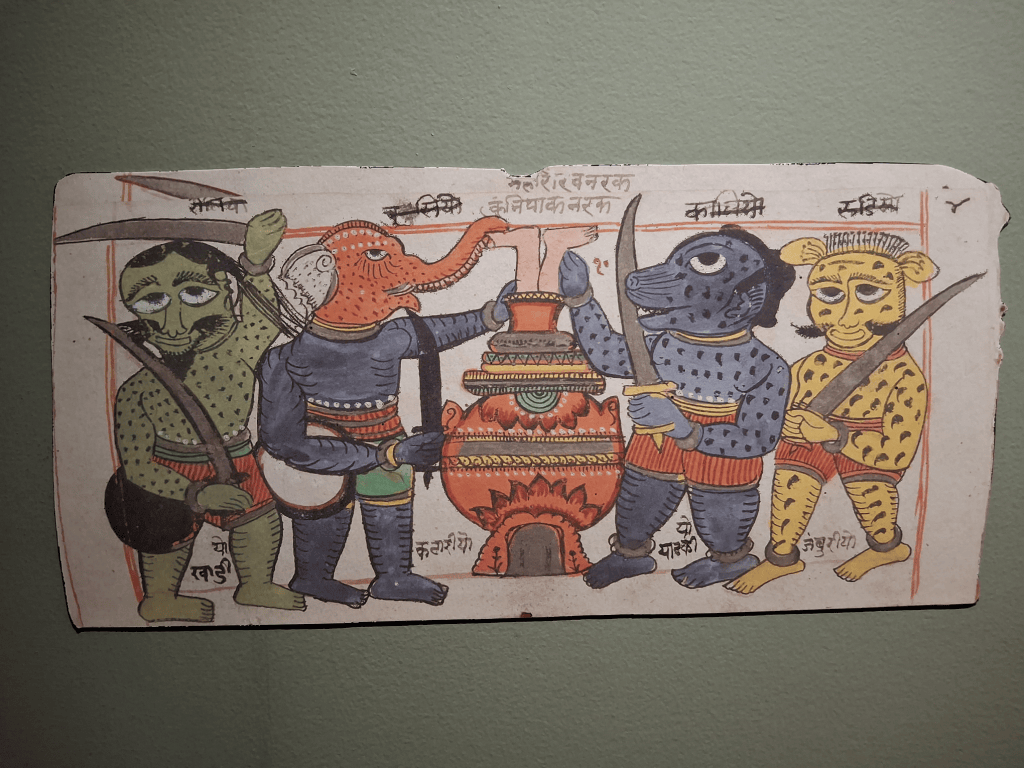
That makes the manuscripts surprisingly contemporary. We live surrounded by infographics, diagrams, animations and explainer videos because we have discovered that complicated ideas can sometimes be grasped more easily when they are visual. The Jain manuscript maker had much the same insight. Instead of writing several pages explaining the workings of karma, why not show the viewer?
Jain cosmology offered an elaborate universe of different realms, including the human world, celestial worlds and hellish realms. Karni Bharni manuscripts could bring this moral universe alive through images of actions, rewards and punishments. A page might therefore be visually dramatic as well as philosophically serious. Heaven and hell were not distant abstractions; they became places that could be imagined through colour, figures and repeated visual motifs.
The striking thing is that these manuscripts were not produced in isolation. Jain merchants and other patrons supported manuscript production, while scribes and artists developed traditions of copying, illustrating and preserving texts. The result was a remarkable interaction between religion, commerce, scholarship and art. The same Jain communities whose members were active in the world of trade were also among the important custodians of India’s manuscript heritage.
It was particularly appropriate that I saw the manuscript during Paryushan. The festival is not simply about fasting. It is a period of pausing long enough to examine how one has lived. Pratikraman involves reflecting upon transgressions and seeking to repair them; Michchhami Dukkadam, traditionally offered at the end of Paryushan, expresses the wish for forgiveness for harm caused knowingly or unknowingly.
The fundamental question these manuscripts answer is universal. Every parent has told a child that actions have consequences. Every schoolteacher has explained cause and effect. Every society has some version of the idea that what we do eventually comes back to us.
But the Jain manuscript tradition did something more ambitious. It made cause and effect visible.
So, during Paryushan, when the emphasis is on reflection, restraint and forgiveness, there is something rather fitting about looking at these old little books.
They remind us that karma was not always something to be explained in a philosophical lecture. Sometimes it was drawn in ink and colour, one scene after another.
If you would like to see some of this remarkable Jain manuscript tradition for yourself, the Gyan Museum in Jaipur offers a wonderful window into India’s rich heritage of art, manuscripts and material culture. Its collection brings together objects that tell stories not just about religion and art, but about the ways in which knowledge, craftsmanship and cultural traditions have been preserved across generations.
And readers, from us to you: Michchhami Dukkadam!
–Meena
Pic taken at MAP of page from late 19th/early 20th century Kharni Bharni book from Gujarat..


