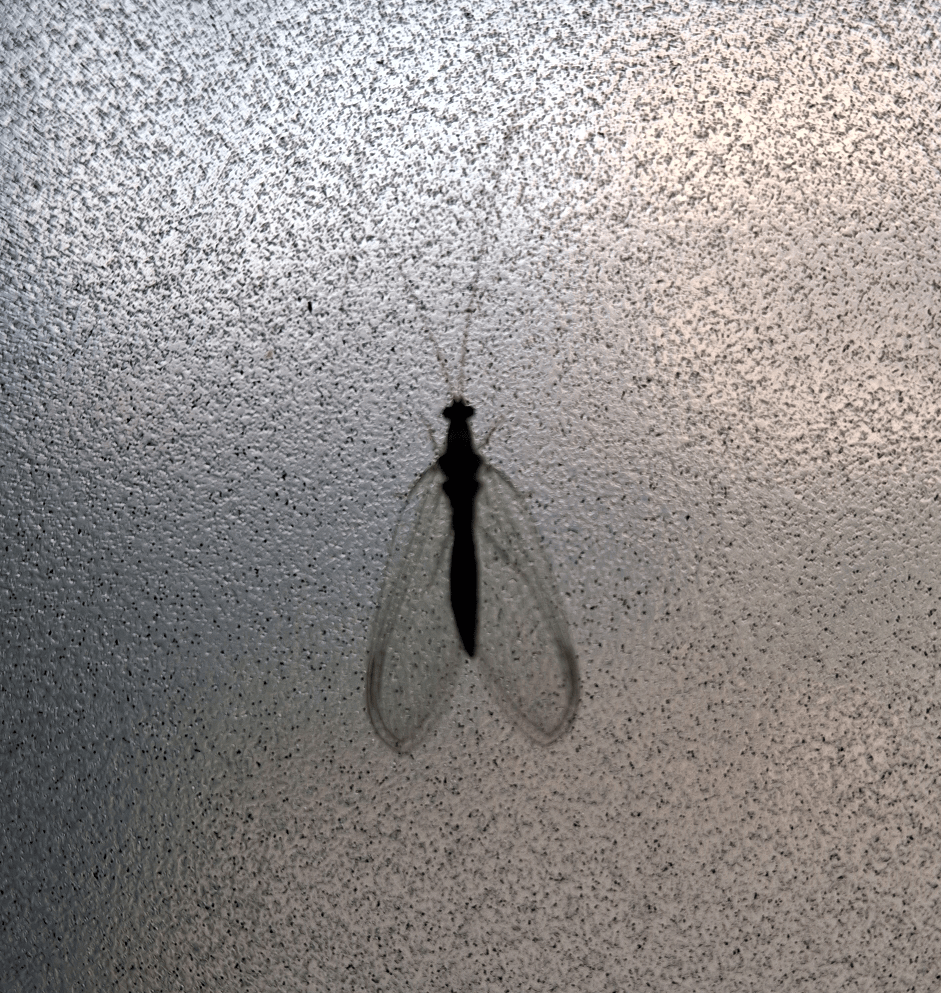
Have you seen a delicate, transparent-winged delicate flier either in the garden or the house? Just 3 cms or so, with an elongated, delicate body, tiny markings in grey or brown, and two pairs of long, translucent, lace-like wings?
And have you seen a plump little prehistoric-looking bug in your garden? It may be in shades of grey or muddy brown. Only about the size of your thumbnail, but with fierce large, hollow, sickle-shaped mandibles protruding from the head.
Well, they are one and the same creature!
The first is the adult antlion, a type of lacewing. And how appropriate that is as a name. Because the wings are as delicate as anything you will ever see—so transparent that you may miss the creature entirely.
The second is the larva of the antlion. It is not easy to sight these sturdy little creatures, because they bury themselves at the very bottom of cone-shaped pitfall traps in dry, loose sand or soil. Usually, only their massive jaws poke out of the sand at the bottom of the funnel.
Antlions belong to family Myrmeleontidae, which consists of about 2,000 species of insects that are named for the predatory nature of the larva, which commonly trap ants and other small insects in pits that they dig into the ground. Antlions are found throughout the world, primarily in dry, sandy regions.
If the common name is based on the more aggressive stage of the creature, the name of the order to which it belongs—Neuroptera—derives from the Latin which means net-wings, due to the lace-like patterns of veins on their wings.
What a hunter!
The life of the antlion larva is not only more exciting and interesting than that of the adult lacewing fly, it is also much longer. The larval stage extends 1 to 3 years spent mainly underground or in sand traps, depending on food and environmental conditions. It then cocoons for 2 to 6 weeks inside a sand-and-silk cocoon. And the lovely flitting adult which emerges lives barely a month, just enough time to mate and lay eggs.
The antlion larva is called ‘doodlebug’ in the US, thanks to the winding, scribbled trails left in the sand by it as it moves backward to build its trap. The doodlebug stage is the only one that eats, so it has to eat enough to support the metamorphosis as well the adult for the one month of its fleeting life.
So in order to do this, it has to eat a lot. And to eat a lot, it has to be a wily hunter. The doodlebug has developed a unique hunting style. The larva moves strictly backwards through dry, sheltered sandy soil leaving winding “doodle” tracks behind. Once it finds a good location, it crawls in backward circles, using its head like a shovel or plough to flick sand outward. It spirals inward until the cone-shaped pit reaches a steep, delicate slope where loose grains easily give way.
Once the trap is dug, the doodlebug buries itself at the very bottom of the pit, leaving only its sickle-shaped jaws exposed or slightly covered. Tiny sensory hairs on its head and mandibles detect vibrations and movement when an ant or any other small prey like small beetles, termites or spiders, walks near the edge. It waits for the prey to fall in, but if it senses that the prey is beginning to slip or trying to climb out, the doodlebug rapidly flicks its head to throw showers of sand upward, causing the walls of the pit to cave in and pull the victim down.
It then grabs the struggling insect with its piercing jaws, injecting paralyzing venom and digestive enzymes that liquefy the prey’s internal tissues. It sucks out the nutrient-rich fluids through its hollow jaws and then flicks the dry, empty carcass out of the pit.
Wow, what a predator!
Antlions in India
India is home to over 110 documented species of antlions, making the subcontinent a major hotspot for these micro-predators. And our antlions have special adaptions. While across the world, these are mainly found in dry, sandy areas, we have some species in humid areas including the Western Ghats. In fact, three giant antlion species (Indopalpares pardus, Palpares contrarius, and Stenares harpyia) have been discovered thriving in the humid, rain-soaked forest ecosystems of Kerala.
And some species here don’t dig traps at all. Larvae from the genus Indophanes (frequently found in southern states like Kerala) live completely hidden beneath loose soil and fallen leaves, relying on pure camouflage to ambush passing ants.
As I learnt about antlions, the thought that came to me was, how much the potential for change is. From a stubby, hungry aggressive hunter to an ephemeral and gossamer-winged flyer. Metamorphosis, and how!
–Meena
Happy Dusshera!


