Last week I wrote about the HUM10a course at Harvard University; a course that involved reading and discussion of physical books. In a world being overshadowed by AI, the word Humanities was the key to the attraction of the programme. It focussed on works by human beings, and the response of other human beings to these timeless classics.
Just a couple of days later, Cambridge Dictionary announced its selection for the Word of the Year 2026. The word is Human. It is defined as “having the qualities, faults, and feelings that people have, as opposed to gods, animals, or machines”. It is somewhat ironic that the world needs to be reminded of the basic elements that make up human beings!
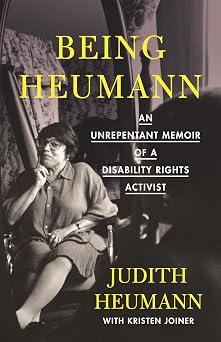
Coincidentally, the same week I also saw a film that raised another aspect of humans and humanity. Being Heumann is based on the work of Judith Heumann, a pioneering activist for the equal rights of people with disabilities. This opened up a new dimension of what it means to be a person with special needs, but nevertheless a human being with “the qualities, faults, and feelings” that all human beings have. And what it takes to stand up for the right to express and press for these basic rights.
Judith Heumann pioneered, and championed the disability rights movement in the United States. Her unwavering commitment to the cause for five decades positively impacted millions of people with special needs around the world.
Judy was born in Brooklyn New York in 1947 to German Jewish immigrants who worked hard to start a new life in America. When she was two years old, Judy contracted polio. At that time there was no vaccine for this disease which had reached epidemic proportions. Judy lost her ability to walk and had to use a wheelchair. Her entry to kindergarten was physically blocked by the Principal who deemed that she was a ‘fire hazard’. For three years Judy was given home tutoring, for one hour, twice a week. While for Judy, using a wheelchair was just a part of who she was, as she grew older she heard other people look upon her with pity, and describe her life as a ‘tragedy’, and how she was a burden on her parents. This led to feelings of confusion and guilt. When she was nine years old, she started attending a special education class for people who could not walk up the stairs, and made friends with others with special needs. In her early teens, Judy found a supportive community of participants and organizers at a summer camp for teenagers. They shared stories and experiences, and began to see that while they were justified in being angry, they did not need to feel guilty about who they were, but rather, create the lives they wanted to lead, and demand that society make the changes that enabled them to do so. This lit the spark for what was to become Judith’s lifelong commitment and mission.
Her mother stood by her every step of the way. She fought so that her daughter could eventually attend a special school, and then a public high school. Judy went on to Long Island University in Brooklyn from where she graduated with a B.A. Her battles did not cease. After passing her qualifying exams, the state of New York denied her a teaching license. At that time there were no unions or other organizations to support people in the disability arena nor lawyers who could represent them. Judy took a bold stand. She sued the New York Board of Education for discrimination. The case received a lot of media attention, throwing Heumann into the center of the disability rights movement. The case was settled without trial, and Heumann became the first person in a wheelchair to teach in New York City.
The 1970s were a period of questioning and protests in America. Judy’s activism led her into a series of demonstrations including shutting down Manhattan traffic to protest President Nixon’s veto of the 1972 Rehabilitation Act; getting hauled off an airplane for insisting she had a right to her seat; and launching a 28-day sit-in at a federal building in San Francisco to get crucial sections of Rehabilitation Act enforced. (The film Being Heumann only covers this part of her life).
With each battle Judy understood that in order to demand change, clear articulation of problems and solutions is the first step. There was a need for groups with different special needs to break the silos and come together as a community. There was a need for advocacy at different levels, especially to the elected representatives who were in a position to influence legislation. There was also a need to work with the broader civil rights communities, labor unions, religious communities, the women’s movement, mayors, state and local representatives.
Judy worked relentlessly on all the fronts. She was instrumental in founding the Berkeley Center for Independent Living and helped launch the Independent Living Movement. She also graduated from the University of California, Berkley with a Master’s in Public Health in 1975. In 1983, Judy co-founded the World Institute on Disability (WID), one of the first global disability rights organizations founded and led by people with disabilities. She worked in both the public and private sectors to ensure that disabled people have equal access to education, employment, transportation, and other essential services.
Moving to Washington, D.C., Heumann served as the Assistant Secretary of the Office of Special Education and Rehabilitation Services in the Clinton Administration from 1993-2001. From 2002-2006 she worked at the World Bank as their first Advisor on Disability and Development. In 2010, Heumann became the first Special Advisor on Disability Rights for the U.S. State Department. Appointed by President Obama, Heumann worked to make disability rights part of the State Department’s agenda and pushed for an international version of the Americans with Disabilities Act (ADA).
Judy Heumann traveled the world in her motorized wheelchair to take part in both national and international conversations promoting the rights of the disabled community. In 2020, she was the star of a documentary, Crip Camp about her time at the teenage camp that lit the spark. She published a memoir, Being Heumann: An Unrepentant Memoir of a Disability Rights Activist. She continued her advocacy until she passed away in 2023.
Considered “the mother” of the disability movement Judy Heumann improved accessibility and opportunities for the estimated 56 million people in the United States and one billion people around the world with disabilities.
This week, and the choice of Human as the word of the year 2026 is a reminder that Being Human is more than recognizing “the qualities, faults, and feelings” that all human beings have. It is about justice and equity for all people irrespective of their qualities, faults and feelings, in a climate where the biggest barriers are prejudice and fear. Pope Leo XIV has also reminded us of our “pressing duty to remain profoundly human”.
Thus a good week to remember the words of Judith Heumann: “I personally have found that I must speak what I believe and feel. Speaking about oppression and discrimination is hard to do, and many people have difficulty listening and looking at what role they play in allowing discrimination to continue. But ableism, racism, sexism, and other forms of discrimination will only end when we, as a society, hold ourselves accountable and no longer make excuses that condone past and current practices. On a daily basis, I try to be aware and take action to make changes in my life that advance justice and equity for all people.”
–Mamata


