My Word of the Week: Human

Last week I wrote about the HUM10a course at Harvard University; a course that involved reading and discussion of physical books. In a world being overshadowed by AI, the word Humanities was the key to the attraction of the programme. It focussed on works by human beings, and the response of other human beings to these timeless classics.

Just a couple of days later, Cambridge Dictionary announced its selection for the Word of the Year 2026. The word is Human. It is defined as “having the qualities, faults, and feelings that people have, as opposed to gods, animals, or machines”. It is somewhat ironic that the world needs to be reminded of the basic elements that make up human beings!

Coincidentally, the same week I also saw a film that raised another aspect of humans and humanity. Being Heumann is based on the work of Judith Heumann, a pioneering activist for the equal rights of people with disabilities. This opened up a new dimension of what it means to be a person with special needs, but nevertheless a human being with “the qualities, faults, and feelings” that all human beings have. And what it takes to stand up for the right to express and press for these basic rights.

Judith Heumann pioneered, and championed the disability rights movement in the United States. Her unwavering commitment to the cause for five decades positively impacted millions of people with special needs around the world. 

Judy was born in Brooklyn New York in 1947 to German Jewish immigrants who worked hard to start a new life in America. When she was two years old, Judy contracted polio. At that time there was no vaccine for this disease which had reached epidemic proportions. Judy lost her ability to walk and had to use a wheelchair. Her entry to kindergarten was physically blocked by the Principal who deemed that she was a ‘fire hazard’. For three years Judy was given home tutoring, for one hour, twice a week. While for Judy, using a wheelchair was just a part of who she was, as she grew older she heard other people look upon her with pity, and describe her life as a ‘tragedy’, and how she was a burden on her parents. This led to feelings of confusion and guilt. When she was nine years old, she started attending a special education class for people who could not walk up the stairs, and made friends with others with special needs. In her early teens, Judy found a supportive community of participants and organizers at a summer camp for teenagers. They shared stories and experiences, and began to see that while they were justified in being angry, they did not need to feel guilty about who they were, but rather, create the lives they wanted to lead, and demand that society make the changes that enabled them to do so. This lit the spark for what was to become Judith’s lifelong commitment and mission.

Her mother stood by her every step of the way. She fought so that her daughter could eventually attend a special school, and then a public high school. Judy went on to Long Island University in Brooklyn from where she graduated with a B.A. Her battles did not cease. After passing her qualifying exams, the state of New York denied her a teaching license. At that time there were no unions or other organizations to support people in the disability arena nor lawyers who could represent them. Judy took a bold stand. She sued the New York Board of Education for discrimination. The case received a lot of media attention, throwing Heumann into the center of the disability rights movement. The case was settled without trial, and Heumann became the first person in a wheelchair to teach in New York City.

The 1970s were a period of questioning and protests in America. Judy’s activism led her into a series of demonstrations including shutting down Manhattan traffic to protest President Nixon’s veto of the 1972 Rehabilitation Act; getting hauled off an airplane for insisting she had a right to her seat; and launching a 28-day sit-in at a federal building in San Francisco to get crucial sections of Rehabilitation Act enforced. (The film Being Heumann only covers this part of her life).

With each battle Judy understood that in order to demand change, clear articulation of problems and solutions is the first step. There was a need for groups with different special needs to break the silos and come together as a community. There was a need for advocacy at different levels, especially to the elected representatives who were in a position to influence legislation. There was also a need to work with the broader civil rights communities, labor unions, religious communities, the women’s movement, mayors, state and local representatives.

Judy worked relentlessly on all the fronts. She was instrumental in founding the Berkeley Center for Independent Living and helped launch the Independent Living Movement. She also graduated from the University of California, Berkley with a Master’s in Public Health in 1975. In 1983, Judy co-founded the World Institute on Disability (WID), one of the first global disability rights organizations founded and led by people with disabilities. She worked in both the public and private sectors to ensure that disabled people have equal access to education, employment, transportation, and other essential services.

Moving to Washington, D.C., Heumann served as the Assistant Secretary of the Office of Special Education and Rehabilitation Services in the Clinton Administration from 1993-2001. From 2002-2006 she worked at the World Bank as their first Advisor on Disability and Development. In 2010, Heumann became the first Special Advisor on Disability Rights for the U.S. State Department. Appointed by President Obama, Heumann worked to make disability rights part of the State Department’s agenda and pushed for an international version of the Americans with Disabilities Act (ADA).

Judy Heumann traveled the world in her motorized wheelchair to take part in both national and international conversations promoting the rights of the disabled community. In 2020, she was the star of a documentary, Crip Camp about her time at the teenage camp that lit the spark. She published a memoir, Being Heumann: An Unrepentant Memoir of a Disability Rights Activist. She continued her advocacy until she passed away in 2023.

Considered “the mother” of the disability movement Judy Heumann improved accessibility and opportunities for the estimated 56 million people in the United States and one billion people around the world with disabilities.

This week, and the choice of Human as the word of the year 2026 is a reminder that Being Human is more than recognizing “the qualities, faults, and feelings” that all human beings have. It is about justice and equity for all people irrespective of their qualities, faults and feelings, in a climate where the biggest barriers are prejudice and fear. Pope Leo XIV has also reminded us of our “pressing duty to remain profoundly human”.

Thus a good week to remember the words of Judith Heumann: “I personally have found that I must speak what I believe and feel. Speaking about oppression and discrimination is hard to do, and many people have difficulty listening and looking at what role they play in allowing discrimination to continue. But ableism, racism, sexism, and other forms of discrimination will only end when we, as a society, hold ourselves accountable and no longer make excuses that condone past and current practices. On a daily basis, I try to be aware and take action to make changes in my life that advance justice and equity for all people.”

–Mamata
A Tree Party

It was Diwali week and we received an invite for a Tree Party from a friend. I for one, read it as Tea Party, and though it seemed unusual to invite people to a tea party at 7 pm, I didn’t give it another thought, assuming it would be Very High Tea. When I reached her home, I realized that many others had also interpreted it the same way. Some had read ‘Tree’ as Tea’. Yet others had only registered the time and venue.

When we had all gathered in her house, she announced that we would need to go up to the terrace at the second level. So we trooped up.

Only then did we realize it was indeed a TREE PARTY. Her Saptaparani tree was in full bloom. There it stood, in all its glory, covered in clusters of tiny, greenish-white flowers. The fragrance was heady, almost intoxicating, and seemed to fill the entire terrace. It was a wonderful way of introducing us to a tree that many of us might have passed by without a second glance, but which has a rather extraordinary story to tell.

The Saptaparani (Alstonia scholaris) is also known as the Blackboard Tree, Devil Tree and Dita Bark Tree. The genus Alstonia honours Charles Alston, an eighteenth-century Scottish botanist, while scholaris refers to the wood being used to make school writing boards and slates. The wood is soft, light and easy to work with, and has also been used for packing cases, plywood and pulp.

The name Saptaparani, meanwhile, comes from Sanskrit: sapta means seven and parna means leaves. The leaves grow in whorls around the stem, usually in groups of four to seven, giving the tree a distinctive, almost geometrical appearance. It is an evergreen tree, and can grow to an impressive 30–40 metres, with branches arranged in tiers. In different parts of India, it goes by names such as Chhatim, Saptaparani, Satwin, Ezhilampala and Shaitan ka Jhaad.

Why is it called the Devil Tree?

And here comes the surprise. The same tree that fills the evening air with an intoxicating fragrance is also known as the Devil Tree or Shaitan ka Jhaad!

In parts of the Western Ghats, the tree has traditionally been regarded as the abode of evil spirits. Some tribal communities were reportedly so wary of it that they would neither sit beneath it nor pass under its branches. Falling asleep under one was believed to invite death at the hands of the spirits inhabiting it.

The botanist H. Santapau recorded these beliefs in his book Common Trees, published by the National Book Trust in 1966. He even suggested that this fear had an unintended conservation benefit: trees that people were reluctant to approach were less likely to be damaged or felled.

In Kerala, the tree is associated with yakshis, female supernatural beings in local folklore. Yakshis are often imagined as beautiful women who inhabit trees and lure unsuspecting travellers. The Saptaparni, with its imposing silhouette and strongly scented flowers, seems to have acquired just the right credentials for such a reputation.

It is tempting to attribute the stories to the tree’s night-time fragrance, which can be overpowering when it flowers. But precisely how these came about is of course not certain.

A spectacular flowering and fruiting act

The Saptaparni is an evergreen tree, but its most dramatic moment comes when it flowers. In Bengaluru, it generally bursts into bloom around October–November, continuing into the winter months. Its flowering season coincides nicely with the festive period.

The tiny, tubular flowers grow in dense clusters at the ends of branches. Individually, they are modest, but collectively they can almost envelop the crown in a creamy-white bloom.

The fragrance is particularly strong in the evening and at night. The flowers attract insects, including moths and other nocturnal pollinators, which help the tree reproduce.

Once the flowers have done their job, the tree produces another spectacle. Its fruits are long, narrow, slender pods, sometimes 30–50 cm in length, which hang down in pairs. When ripe, they split open to release numerous tiny seeds. Each seed has silky tufts of hair that act like miniature parachutes, carrying it away on the wind to find a new place to germinate.

A tree that travels

The Saptaparni is native to a vast geographical region stretching from the Indian subcontinent through Southeast Asia to northern Australia. It is found in India, Nepal, Bangladesh, Sri Lanka, Myanmar, Thailand, Malaysia, Indonesia, southern China, the Philippines and parts of Australasia.

Within India, it occurs in the sub-Himalayan region, the Northeast, the Western and Eastern Ghats, the Andaman and Nicobar Islands and other parts of peninsular India. It grows in moist deciduous and evergreen forests, but is also widely planted along roads, in parks and in institutional campuses. It is adaptable, grows relatively quickly and provides a generous canopy.

It has also been introduced to places outside its native range, including Florida and Trinidad and Tobago.

From the Devil Tree to the Scholar Tree

Perhaps the most charming twist in its story is that the tree associated with ghosts and spirits is also a symbol of scholarship and learning.

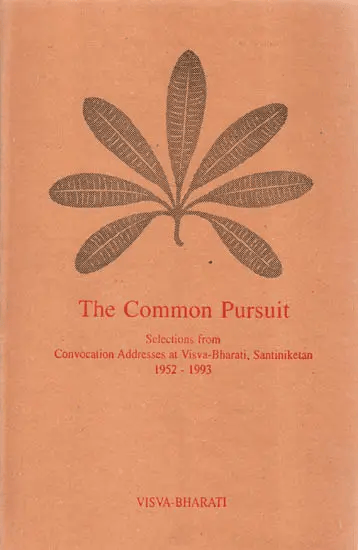
It is the state tree of West Bengal, where it is known as Chhatim. At Santiniketan, Rabindranath Tagore established the tradition of presenting Saptaparani leaves to graduating students at the annual convocation of Visva-Bharati University. This has a hoary history. In 1863, Rabindranath’s father, Maharshi Debendranath Tagore, found spiritual peace while meditating under two Chhatim trees in what was then a barren stretch of land. That exact spot, now known as Chhatimtala, inspired him to establish the ashram that eventually grew into Santiniketan. Tagore himself also wrote parts of Gitanjali under these trees. Since then, the seven leaves have become a symbol of learning and the pursuit of knowledge. The tradition continues, making the tree an enduring part of Santiniketan’s academic identity.

The tree has another useful side. Its bark, known commercially as Dita Bark, has been used in traditional medicine, particularly for fever, malaria and digestive complaints. The bark contains several alkaloids, and the milky latex that oozes out when the tree is injured has also featured in traditional remedies. Modern research has investigated some of its chemical constituents.

So here is a tree that is simultaneously a scholar, a healer, a provider of shade, a host to insects and, according to folklore, a dwelling place for ghosts!

Our Tree Party turned out to be much more interesting than any Very High Tea could have been. We went expecting wonderful food and interesting people, and in addition, found ourselves discovering a tree, its fragrance, its history and its many personalities!

It made me stop, look and smell – quite literally – the trees around me. ‘Thank you’ to our imaginative hostess! I hope this starts a trend where we can celebrate our favourite trees with friends and family!

–Meena

Pic: https://www.exoticindiaart.com/book/

HUM10a: A Colloquium of Books

AI has taken over our lives and times, in every field, including the world of letters. From debates about the validity of award-winning literature being generated by AI, to the bane of professors having to assess assignments written, courtesy ChatGPT, the literary and academic world no longer seems to have time and space for physical books, housed in physical spaces once venerated as libraries.

This is also a time when Humanities have been relegated to the hazy background as a field of choice for students who would rather opt for degrees in more technical fields which have better future “job prospects”.

In such times, it is a pleasant surprise to learn that one of the most popular courses at Harvard University entails the in-depth reading of physical books. The course is Humanities 10a, or Hum 10 as it is known as. It forms the first part of a two-semester course available only to first year students.

Harvard’s Course Catalogue introduces their Humanities courses with an invitation that reads: ‘We know that many students come to Harvard excited about the humanities but aren’t always sure where to begin. These new courses are built to meet you where you are – engaging, expansive, and relevant to the world you live in now. Taught by some of our most passionate and creative faculty, they’re designed to show how humanistic thinking can challenge, inspire, and shape your path forward, no matter what you choose to study.’

Of these courses, the Humanities 10a course is described thus: ‘Six professors! Twelve books! 3000 years! We cover interesting and important books from Homer’s Odyssey to the present. Experts lecture each week, and students meet in seminars led by professors to discuss the text. Students also meet in writing labs, led by specially trained Teaching Fellows’. 

For students who had always intended to “read the classics” someday, to those with secret dreams to be a published author one day, the invitation reads like an Open Sesame password. But having entered the cave of treasures, the course reveals its rigorous demands. Students need to read a hefty book a week, and write regular essays, as well as participate in class discussions. Digital devices are forbidden in the class. Attendance is taken in every lecture, and late arrivals get a pink slip.

If the course demands a lot from the students, it is equally rigorous for the teachers. The idea for the course began with a dinner discussion by two friends, Stephen Greenblatt and Louis Menand, both renowned professors and bestselling authors, as a way to counter the falling interest in Humanities. Now the course has a rotating faculty made up of some of the best in Harvard including historians, novelists, critics and philosophy professors. Each of the six faculty nominates two books to include in the year’s coursework. Each one leads two lectures and a weekly seminar, but they all attend every lecture, and lead seminars on books they may not have previously read, as well as books from other disciplines. The teachers become learners too.

Despite the rigour required, there are many who are eager to be a part of this elite teaching-learning team. For professors teaching the same courses year after year, teaching something that they have not taught before is refreshing, as is interacting with first-year students who enter the university full of enthusiasm and curiosity.

What is it that attracts students to sign up for Hum 10a?

Among those who sign up are the handful that feel somewhat out of place in the current climate that thrives on quick scans, ready-made summaries, and superficial AI generated overviews, which does not leave time and space for slow reading, deep thinking, serious discussions with similar-minded peers, and personal engagement with writing.

For those students who are still readers in the old-fashioned sense of the term, the course provides a setting in which they can read, explore, discover, think, question, and write about books. It provides opportunities to form a view, find supporting evidence and discover where that view fails

The course provides a structure which can help students to do something they value but tend to postpone, always with the excuse that other deadlines take precedence. The students must attend a 75-minute lecture plus a 75-minute discussion seminar led by professors every week. Preceded, of course, by reading the assigned book. The scheduled seminar means that the student must make the time and effort to not only read the book, but prepare cogent arguments which will address the teacher’s questions, as well as stand up in peer-group discussions. As one of the earlier students put it: “You didn’t want to disappoint the seminar by being the one person who didn’t read or whose comment really didn’t add to the discussion. We all felt like we were building something, and that was a remarkable feeling.”

In more academic terms students get to interact directly with professors, who are teaching works that they love, but which are difficult to understand on one’s own. They also get a formal space and time to work on their writing, guided by specially trained staff in the writing labs. Students are encouraged to question what is on the printed page, annotate, identify patterns, contextualize material and compare texts.

It is also an opportunity to be a part of a like-minded community of students, and access to multi-disciplinary faculty.  In more practical academic terms, the course also fulfils Harvard College’s writing requirement.

The course is not an easy walk-in. Admission is based on an application essay. But students take on the challenge because they see relate to the purpose of the course, and receive support in meeting it. And of course, for the freshmen, it is the high reviews from the seniors or Hum Alums that gives the final push to sign up for Hum 10a. The result? There were 180 applications for 90 places on the course for this Fall semester.

Even in this fast-paced AI-dominated place and time, there are still many that want to be challenged by the best minds and the best books. For some reason, parts of the educational system, even the elite parts, seem to have forgotten this. Harvard seems to remember and revive this need.

–Mamata

UNESCO’s Museum of Stolen Art Hopes to Empty Itself!

Every year, 14 November is observed as the International Day against Illicit Trafficking in Cultural Property, proclaimed by UNESCO in 2019. It reminds us that the theft and illegal trade of art and antiquities is not merely a matter of stolen property. When a temple sculpture disappears, a manuscript is smuggled out of a monastery, or an archaeological artefact is dug out and sold clandestinely, a piece of a community’s history and identity goes with it. The trade is global, lucrative and often connected to organised crime. It also raises uncomfortable questions about the journeys of objects that now grace some of the world’s most prestigious museums and private collections.

Among the initiatives to combat this trade is UNESCO’s Virtual Museum of Stolen Cultural Objects, launched in September 2025. It is a museum with a rather unusual ambition: to see its galleries gradually emptied. For every object returned to its rightful home, there is one less exhibit to display. And that, quite literally, would be a measure of its success.

A museum without walls

First, this is a completely virtual museum. There is no physical building, no collection of original artefacts and no objects displayed in glass cases. It is an immersive digital experience, accessible to visitors around the world through its website. (Though quite frankly, I found the virtual experience quite difficult to navigate!).

Designed by Burkina Faso-born architect Francis Kéré, winner of the prestigious Pritzker Architecture Prize, the museum takes its inspiration from the baobab tree. Developed in collaboration with INTERPOL and supported by Saudi Arabia, the museum was launched at the 2025 MONDIACULT conference in Barcelona.

The museum has three principal spaces: a Gallery of Stolen Cultural Objects, an Auditorium and a Return and Restitution Room. The gallery brings together objects reported stolen from countries across the world, ranging from sculptures and paintings to manuscripts. Photographs, 2D digitisation and 3D digital reconstructions help visitors examine the objects and understand their origins, significance and circumstances of disappearance. Narratives from affected communities explain why these objects matter beyond their artistic or monetary value. The Return and Restitution Room documents successful recoveries.

Countries themselves nominate objects for inclusion. For the initial collection, these must be listed in INTERPOL’s Stolen Works of Art Database. UNESCO invites Member States to select objects whose disappearance represents a significant loss to their cultural heritage. This is not intended to be a comprehensive catalogue of everything stolen around the world.Currently, there are 240 items from 46 countries listed.

Importantly, the appearance of an item in the virtual museum does not mean they have been recovered. Their digital presence makes their loss visible; their physical return remains the ultimate objective.

India’s three missing treasures

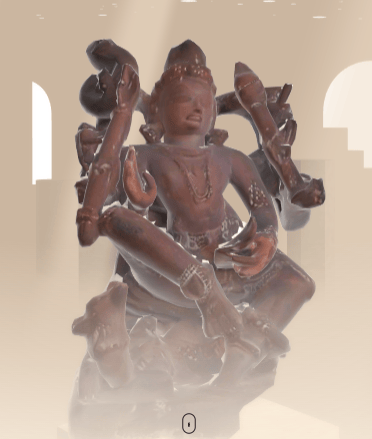
India has nominated three objects for the initial collection, all sculptures from temples in Chhattisgarh.

The first is a ninth-century sandstone sculpture of Shiva as Nataraja, from the Mahadev Temple at Pali. Shiva is depicted in his cosmic dance, with four arms and one foot pressing down upon a demon, symbolising the triumph of knowledge over ignorance. Nandi, sits nearby.

The second is a sculpture of Brahma, the creator, also from the Mahadev Temple at Pali. Depicted with three visible faces and four arms, Brahma is accompanied by his vahana.

The third is Bhairava, a fierce manifestation of Shiva, from the Bhairav Baba Temple at Dantewada, depicted with four arms, dancing on a corpse and carrying a drum and dagger.

Why these three? UNESCO asked countries to nominate objects of particular cultural importance whose disappearance had appreciably impoverished their national heritage. India chose these three rather than attempting to list all its missing antiquities. Their inclusion draws attention to the loss experienced by the communities from which they disappeared.

A worldwide business in stolen heritage

The scale of the problem is enormous, although no one can reliably calculate the total number of stolen cultural objects worldwide. The trade spans continents and centuries. Objects have been taken through colonial plunder, wartime looting, clandestine excavations, and thefts from museums and temples. Some are sold through auction houses and private dealers, sometimes accompanied by forged ownership histories; others disappear into private collections.

INTERPOL’s Stolen Works of Art Database contains descriptions and photographs of almost 57,000 objects, based on information supplied by authorised national authorities. This is only a record of identified and reported cases, not a measure of the entire illicit trade.

India has been particularly badly affected. Temple sculptures, bronze icons, archaeological objects and manuscripts have all been targets. Chola bronzes are especially sought after.

There have, however, been encouraging recoveries. Four idols of Rama, Sita, Lakshmana and Hanuman, stolen from the Rajagopal Vishnu Temple in Anandamangalam, Tamil Nadu, in 1978, were traced to the UK and returned in 2020.

In 2026, the Smithsonian’s National Museum of Asian Art agreed to return three Indian bronzes following research establishing that they had been illegally removed from temples in Tamil Nadu. These included a Chola-period Nataraja, a Somaskanda and a sculpture of Saint Sundarar with Paravai. In April 2026, US authorities also announced the return of 657 antiquities to India, recovered through investigations into international trafficking networks.

These successes are encouraging, but they represent only a fraction of what has disappeared.

Bringing the past back into the present

One of the most interesting things about UNESCO’s initiative is that it changes the way we think about stolen art. An ancient sculpture is not just an object with an estimated market value. It belongs to a particular place, a particular history and often a continuing tradition of worship or community life.

A virtual museum cannot bring these objects home. Nor can a digital reconstruction replace the experience of encountering an original work of art in its rightful setting. But it can make the world aware of what has been lost, help establish provenance, encourage vigilance in the art market and create pressure for restitution.

This museum’s ambition is not to become another great repository of the world’s treasures. It hopes to work itself out of existence, one recovered object at a time.

For a museum, that is a rather interesting aspiration.

–Meena

Pic: https://museum.unesco.org/

Take a Deep Breath: Distress to De-Stress

Around this time every year different dictionaries come out with The Word of the Year. Major publishers—such as Oxford University Press, Dictionary.com, and Collins English Dictionary—analyze language data, search trends, news coverage, and social media activity to choose a term that defines the spirit of the time. A Word of the Year reflects the ethos, mood, social preoccupations, and cultural shifts of a specific period, acting as a linguistic snapshot of history.

If there is one word that over the past several years has consistently reflected all of the above, but which has never made it to the annual selection, it is “Stress”. However, it is this word that seems to dominate not only the vocabulary of the new generations, but seems to have engulfed the physical, mental and emotional lives of millions across the world. A word freely used, and commonly blamed for range of issues and ailments; but also one that seems to have a wide range of interpretations.

It was no surprise then, to discover that International Stress Awareness Week is marked every year in the first week of November. What did come as a surprise was that this has its roots in Stress Awareness Day that has been on the calendar since 1998. Stress Awareness Day was started by Carole Spiers, the chairperson of the International Stress Management Association ISMA). Its objective was to increase public awareness and help people recognize, manage and reduce their stress levels, both personally and professionally. Stress Awareness Week was started in 2018 to mark 20 years of the launch of the Day. The Week is initiated on the first Wednesday of November because it is believed that work and life pressures typically peak in the middle of the week.

What does the word stress really connote? According to the World Health Organization “Stress can be defined as a state of worry or mental tension caused by a difficult situation. Stress is a natural human response that prompts us to address challenges and threats in our lives. Everyone experiences stress to some degree. The way we respond to stress, however, makes a big difference to our overall wellbeing.”

Interestingly, the concept of ‘stress’ originated not in the field of psychology, but in engineering, to describe physical strain on materials.

Going back further, from the 14th to 19th century the word “stress” referred to adversity, hardship, or strain, rather than a mental state.

In the late 19th century, French physiologist Claude Bernard introduced the idea that living bodies maintain a stable internal environment despite external changes.

In 1915, Harvard physiologist Walter Cannon explored the acute “fight-or-flight” response, explaining how the sympathetic nervous system and adrenaline prepare the body to face or flee danger.

In the 1930s, endocrinologist Hans Selye (often called the father of stress research) observed a universal set of physical symptoms in laboratory rats exposed to various physical hardships (cold, injury, and fatigue). He defined stress as the “nonspecific response of the body to any demand” (whether pleasant or unpleasant).

Selye formulated the General Adaptation Syndrome, a three-phase model of how the body reacts to prolonged strain. He discovered that the body reacts to prolonged stress through three distinct phases: alarm (fight-or-flight), resistance (adaptation), and exhaustion (depletion of energy reserves). Selye later differentiated between harmful stress (distress) and beneficial or motivating stress (eustress).

From the late 20th century, researchers like Richard Lazarus expanded stress to include how individuals cognitively perceive and appraise threats. Modern science introduced concepts like allostasis (achieving stability through change) and allostatic load (the wear and tear on the body from chronic, unmanaged stress).

In 1980, Post-Traumatic Stress Disorder was officially recognized to describe the long-term psychological impact of extreme trauma.

In layman’s terms, stress is the body’s natural reaction to challenges or perceived threats. When we face pressure, our body activates the stress response. This means stress hormones like cortisol and adrenaline surge, heart rate increases, and muscles tense up; are of which all designed to help us respond quickly to danger.

In small doses, this response can be helpful. It keeps us alert, motivated, and focused. But when stress becomes constant or unmanaged, the same response can lead to fatigue, anxiety, irritability, and even physical symptoms such as headaches, muscle tension, or sleep problems. Over time, chronic stress can take a toll on our emotional balance and overall health.

There is one school of thought that believes that some amount of stress can be a positive factor. However, this is confusing between ‘pressure’, and ‘stress’. It is true that sometimes pressure can provide the challenge that could motivate us to do better, to push oneself to achieve something, improve performance or creativity, and even add a bit of zing to an otherwise bland task or assignment.

This refers to Richard Lazarus’s explanation that while you have, or perceive that you have the ability and resources both from within yourself and support from around you, to cope with the demands placed on you, you are subject to ‘pressure’ and not ‘stress’. It is when pressure becomes excessive, beyond the individuals coping ability that it leads to changes in the body and stress.

Stress can cause physical issues such as headache, backache, muscle tension, insomnia, indigestion, mood swings, and high blood pressure, building up to anxiety and depression.

For many years, people coped with excessive pressure through the fight or flight response. This is the body’s automatic physical survival reaction when it senses a threat or danger. When the brain perceives a threat (real or imagined), it releases stress hormones like adrenaline. This triggers quick changes to help you either fight the danger or flee to safety. However, fight or flight is a one-off reaction to a perceived challenge or pressure and, as such, is a safety response. It ensures the individual is alerted to possible threats and can take avoiding action.

If someone remains in this heightened state for too long, the body chemicals associated with fight or flight are constantly being stimulated. Over time, this may create symptoms of, or contribute to, ill health. That is where it becomes stress. By recognizing stress early and addressing it, we can prevent it from turning into burnout, anxiety, or depression.

Stress Awareness Week is a reminder that despite all the deadlines, and incessant clamour of demands on us, we owe it to ourselves to step back and look at ourselves objectively, and recognize the warning signs; to slow down, and tread carefully, before you fall over the precipice. Understand that protecting our mental balance and energy are critical to not only our functioning, but to our very survival. So pause, breathe deep, and let it all out!

–Mamata

Sandwiches: A World Between Two Slices of Bread

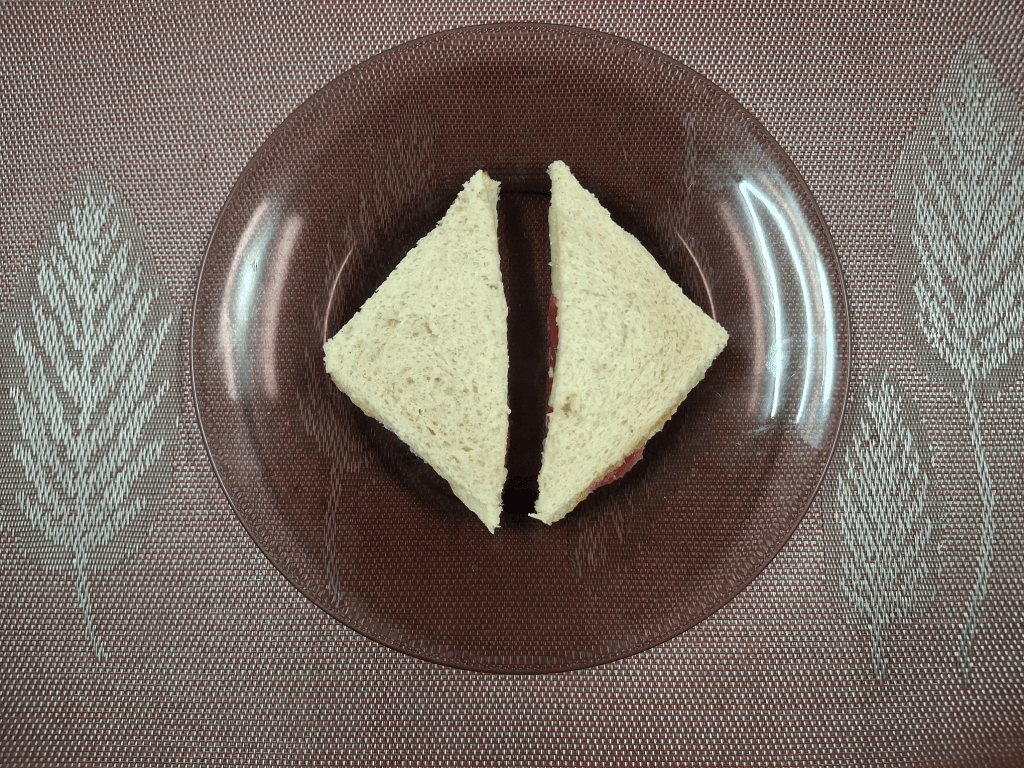
November 3 is National Sandwich Day, and the story behind the name involves an English aristocrat, a gambling table and a convenient way of eating without putting down one’s cards.

John Montagu, the Fourth Earl of Sandwich, lived in eighteenth-century England. According to the popular story, he was so engrossed in gambling that he asked for meat to be served between two slices of bread. He could eat with one hand and continue playing with the other. His fellow gamblers began asking for what Sandwich was having, and a culinary institution was born.

Or so the story goes. The precise circumstances are uncertain, and people had been eating food wrapped in or placed between bread long before the earl came along. The word sandwich, however, acquired its modern culinary meaning in eighteenth-century England.

The earl could hardly have imagined what his name would come to represent. Today, sandwiches range from the simplest buttered-bread snack to elaborate creations served in fashionable restaurants. And each country seems to have interpreted the idea in its own way.

Of Famous Five picnics and midnight feasts

For many of us, the first sandwiches we encountered in literature were not in a cookbook but in the pages of Enid Blyton. If you remember the Famous Five, you will remember the food almost as vividly as the adventures. Julian, Dick, Anne and George seemed to spend as much time eating as solving mysteries. Their picnics were lavish, their appetites enormous, and their thirst for ginger beer seemingly unquenchable. In Five Go Off to Camp, the children tuck into Spam and lettuce, egg and sardine sandwiches. In Five Go on a Hike Together, there are several varieties, including cheese, pork, ham and cream cheese.

Blyton even wrote A Picnic Party with Enid Blyton, a 1951 book that describes the contents of a picnic basket. Along with egg, sardine, tomato and lettuce, jam, and honey sandwiches, there are fruit cake, Swiss rolls and lemonade. Honey sandwiches, she warns, can be rather sticky and messy!

The sandwiches were wrapped in greaseproof paper, packed with boiled eggs and fruit, and eaten on a hillside, beside a stream or in a caravan. They were not gourmet creations, but food that could be carried along on an adventure. Blyton made an ordinary picnic sound like an essential part of an extraordinary childhood.

A world between two slices of bread

The sandwich has acquired some fascinating national identities.

Consider Denmark’s smørrebrød, an open-faced sandwich made with a slice of dense, dark rye bread called rugbrød. It is topped with ingredients such as pickled herring, smoked salmon, prawns, roast beef or liver pâté, often accompanied by pickles and herbs. Traditional smørrebrød can be assembled with extraordinary attention to colour, texture and flavour. Some are miniature works of art.

The Swedish smörgåsbord, despite its similar-sounding name, is something else altogether. It is a spread of assorted dishes, including herring, salmon, cold meats, cheeses and bread. The word has entered English to describe a buffet offering a wide variety of choices. A feast, rather than a sandwich!

Vietnam’s bánh mì tells another story of culinary adaptation. The French introduced baguette-style bread during the colonial period, but Vietnamese cooks made it their own. A crisp, light loaf might contain pork, pâté, pickled carrot and daikon, cucumber, fresh coriander and chilli.

The French have the croque-monsieur, a hot sandwich of ham and cheese, often enriched with béchamel sauce and browned until bubbling and golden. Add an egg on top and it becomes a croque-madame.

Japan has its katsu sando, a crisp, breaded pork cutlet tucked between slices of soft white bread, and the creamy tamago sando, filled with egg.

In Cuba, the pressed sandwich combines roast pork, ham, Swiss cheese, pickles and mustard. Different ingredients, different techniques, but the same ingenious principle.

What America puts between its slices

America has developed its own sandwich favourites, some of which are almost institutions in their own right.

The grilled cheese is simplicity itself: cheese between buttered slices of bread, toasted until golden outside and wonderfully melted inside. It is often served with tomato soup, making a particularly comforting combination.

Then there is the peanut butter and jelly sandwich, or PB&J. One slice is spread with peanut butter, the other with fruit jelly or jam. The combination of salty, nutty and sweet flavours has become a childhood staple in the United States.

The BLT takes its name from its three principal ingredients: bacon, lettuce and tomato, usually with mayonnaise. The club sandwich is more substantial, often layering chicken or turkey, bacon, lettuce and tomato between three slices of bread.

Philadelphia has its famous cheesesteak, with thinly sliced beef and melted cheese in a long roll, while Louisiana offers the po’boy, traditionally filled with fried seafood such as shrimp or oysters.

In a 2024 survey of 2,000 Americans, grilled cheese emerged as the favourite, chosen by 42 per cent of respondents, closely followed by chicken sandwiches at 40 per cent. Turkey, ham, tuna and peanut butter and jelly also featured prominently. Clearly, the sandwich is serious business in America!

And then there is India

India, of course, has made the sandwich very much its own.

Mumbai’s famous vegetable sandwich layers slices of potato, tomato, onion and sometimes beetroot between buttered bread spread with green chutney. A sprinkling of sandwich masala provides the characteristic kick. It may be served cold or grilled, with extra chutney and tomato ketchup on the side.

The masala toast sandwich takes the idea further, often adding spicy potato filling and other vegetables before the bread is toasted on a hot griddle. The humble chutney sandwich, meanwhile, is a fixture in many Indian homes. Butter, green chutney and perhaps a few slices of cucumber can transform ordinary bread into an afternoon snack.

Egg sandwiches have acquired their own Indian personality, too. An omelette seasoned with onion, green chillies and coriander, tucked between slices of bread, makes a quick breakfast or evening meal.

And what about vada pav and dabeli? Strictly speaking, these are not conventional sandwiches made with two slices of bread. Both, however, belong to the larger family of portable bread-based foods. Mumbai’s vada pav combines a potato bonda with a soft bread roll, chutneys and often a fried green chilli. Gujarat’s dabeli packs a sweet-spicy potato filling into a pav, adding peanuts, chutneys and sometimes pomegranate seeds.

Indeed, the Indian sandwich is less a fixed recipe than an invitation to improvise. Leftover potato sabzi, paneer bhurji or yesterday’s vegetables can all find a second life between two slices of bread. A little chutney, some butter and a turn on the tava can work wonders.

What makes a sandwich?

That brings us to the key question, what makes a sandwich? Is it the bread? Must there be two slices? Does a filling in a roll count? And can a single slice with an elaborate topping qualify?

There are no universally satisfying answers. The open-faced Danish smørrebrød challenges the two-slice rule, while vada pav and dabeli invite us to look beyond the conventional sandwich.

Perhaps the sandwich’s greatest strength is precisely this flexibility. It can be breakfast, a school lunch, an office meal or a midnight indulgence. It can be frugal or extravagant, vegetarian or non-vegetarian, cold or toasted. It requires neither fine crockery nor cutlery, and is equally at home in a five-star hotel, a school lunchbox or a roadside stall.

This November 3, you could celebrate with a Bombay vegetable sandwich, a Japanese katsu sando or a Danish smørrebrød. Or you could make a batch of egg sandwiches, pack some cake and lemonade, and set off on a Famous Five-style picnic. I will be celebrating with my favourites–cucumber and tomata, and grilled cheese.

Happy Sandwich Day!

–Meena