Multi-faceted Lexicographer: Samuel Johnson

October 16 is celebrated as Dictionary Day in the United States to mark the birth anniversary of Noah Webster who was born on this day in 1758. Noah Webster is known as the Father of the American Dictionary. Until the publication, in 1806, of his A Compendious Dictionary of the American Language, the authoritative English language resource in America was Samuel Johnson’s 1775 Dictionary of the English Language. However, America had declared freedom from British rule in 1776, and a section of the American population wanted that the newly independent nation should have its own national dictionary. While Noah Webster’s long labour eventually produced such a dictionary, the story of the one of the most famous dictionaries in the history of the English language is equally a tale of another labour of love. 

Samuel Johnson

Samuel Johnson’s Dictionary of the English Language, first published in 1755, took over eight years to compile, required six helpers and listed over 40,000 words. It was a more extensive and complex dictionary than any of its predecessors, a huge scholarly achievement. Each word was defined in detail, and the definitions illustrated with quotations covering every branch of learning.

For nearly a century before Johnson embarked upon his Dictionary there had been a growing feeling within the upper echelons of English society that there should be some sort of standardisation within the English language. In the preface to the Dictionary, Johnson wrote how he felt that the English language was in desperate need of some discipline. In his view, he had found the language to be “copious without order, and energetick without rules”. But it took a whole century before he got his chance to bring some order to the language.

Samuel Johnson was born in Lichfield, Staffordshire, on 18 September 1709. His father was a bookseller. He was educated at Lichfield Grammar School and spent a brief period at Oxford University, but was forced to leave due to lack of money. Unable to find teaching work, he drifted into a writing career. In 1735, he married Elizabeth Porter, a monied widow, more than 20 years his senior. He then moved to London to seek fame and fortune, as well as to further his efforts as a poet. However, he spent several years as a hack writer trying his hand at all kinds of writing, just to make ends meet. The turning point in his fortunes came in 1746.

Over his time in London, Samuel had gradually acquired a literary reputation, and a syndicate of printers commissioned him to compile a ‘Dictionary of the English Language’. This was a lengthy and perilous project, funded by a partnership of booksellers. The booksellers invested in the project because they foresaw good sales, as dictionaries and encyclopedias had a good market in the general public. The partnership shared the costs and the risks, while the copyright of such items usually belonged to the publisher. Thus once the compiler had been paid the agreed sum, he was not entitled to any form of royalty on the sales, while the booksellers made a hefty profit.

In 1746, Samuel Johnson entered into the agreement with the booksellers to write an English dictionary. He began work the same year with only six assistants to aid him. Samuel projected that the scheme would take about three years.  A year later, he was only able to publish a plan for the dictionary in which he outlined his reasons for undertaking the project, and explained exactly how he intended to compile his work. However, he seriously underestimated the scale of the work involved, and in the end it took him three times his estimated length of time to complete his magnum opus.

In the process of compiling the dictionary, Samuel Johnson recognised that language is impossible to fix because of its constantly changing nature, and that his role was to record the language of the day, rather than to form it. Thus he used citations for the words listed, using quotations from a number of literary sources including Shakespeare, Milton, and Spenser. For this he scoured ‘great works’ dating back to the sixteenth century. He managed to select 114,000 illustrative quotations from every field of learning and literature. Albeit, Samuel was also not averse to twisting or rewriting some of the original words to fit the meaning he was trying to convey. However, Samuel Johnson was the first English lexicographer to use citations in this way, a method that greatly influenced the style of future dictionaries.

Samuel Johnson’s dictionary was far from comprehensive, even by mid-eighteenth-century standards. It contained 42,773 entries; but even during Johnson’s time, there were at least 250,000 words in the English language. Samuel Johnson was certainly selective in his choice of words to include. The story goes that several cultivated ladies of London society congratulated the great Doctor for having left all indecent words out of his Dictionary, to which Johnson is said to have retorted, ‘Ah, ladies, so you have been looking for them?’

The dictionary was published in two large volumes on 15 April 1755. The full title was was A dictionary of the English Language: in which the words are deduced from their originals, and illustrated in their different significations by examples from the best writers. To which are prefixed, a history of the language, and an English grammar.

It was not the first such dictionary, but was certainly the most important for that time. In Johnson’s lifetime five further editions were published, and a sixth came out when he died.

From then on Samuel Johnson’s fame was assured. He became known as Dictionary Johnson; but he never made a fortune. Even today, Samuel Johnson is the second most-quoted Englishman according to the Oxford Dictionary of Quotations. Among the quotes attributed to him are: “Patriotism is the last refuge of a scoundrel” and “When a man is tired of London, he is tired of life”. He himself never tired of London where he died at the age of 75 in 1784.

Poet, playwright, essayist, satirist, moralist, literary critic, biographer, editor, and lexicographer–This was the multi-facted “Dr Johnson”, as he was often referred to.

Read more about Noah Webster and his Dictionary https://millennialmatriarchs.com/2021/07/22/from-colour-to-color/

–Mamata
From Digging Deadly Traps, to Flitting on Gossamer Wings: The Story of the Antlion

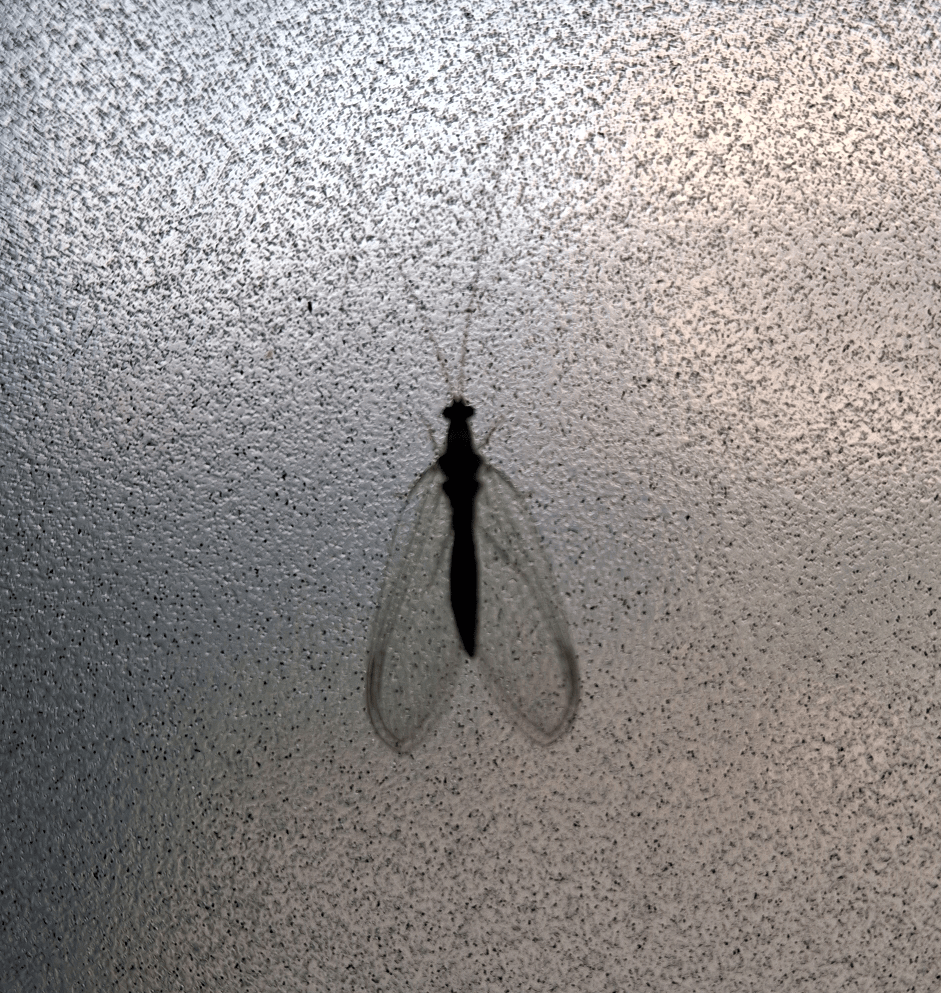
Have you seen a delicate, transparent-winged delicate flier either in the garden or the house? Just 3 cms or so, with an elongated, delicate body, tiny markings in grey or brown, and two pairs of long, translucent, lace-like wings?

And have you seen a plump little prehistoric-looking bug in your garden? It may be in shades of grey or muddy brown. Only about the size of your thumbnail, but with fierce large, hollow, sickle-shaped mandibles protruding from the head.

Well, they are one and the same creature!

The first is the adult antlion, a type of lacewing. And how appropriate that is as a name. Because the wings are as delicate as anything you will ever see—so transparent that you may miss the creature entirely.

The second is the larva of the antlion. It is not easy to sight these sturdy little creatures, because they bury themselves at the very bottom of cone-shaped pitfall traps in dry, loose sand or soil. Usually, only their massive jaws poke out of the sand at the bottom of the funnel.

Antlions belong to family Myrmeleontidae, which consists of about 2,000 species of insects that are named for the predatory nature of the larva, which commonly trap ants and other small insects in pits that they dig into the ground. Antlions are found throughout the world, primarily in dry, sandy regions.

If the common name is based on the more aggressive stage of the creature, the name of the order to which it belongs—Neuroptera—derives from the Latin which means net-wings, due to the lace-like patterns of veins on their wings.

What a hunter!

The life of the antlion larva is not only more exciting and interesting than that of the adult lacewing fly, it is also much longer. The larval stage extends 1 to 3 years spent mainly underground or in sand traps, depending on food and environmental conditions. It then cocoons for 2 to 6 weeks inside a sand-and-silk cocoon. And the lovely flitting adult which emerges lives barely a month, just enough time to mate and lay eggs.

The antlion larva is called ‘doodlebug’ in the US, thanks to the winding, scribbled trails left in the sand by it as it moves backward to build its trap. The doodlebug stage is the only one that eats, so it has to eat enough to support the metamorphosis as well the adult for the one month of its fleeting life.

So in order to do this, it has to eat a lot. And to eat a lot, it has to be a wily hunter. The doodlebug has developed a unique hunting style. The larva moves strictly backwards through dry, sheltered sandy soil leaving winding “doodle” tracks behind. Once it finds a good location, it crawls in backward circles, using its head like a shovel or plough to flick sand outward. It spirals inward until the cone-shaped pit reaches a steep, delicate slope where loose grains easily give way.

Once the trap is dug, the doodlebug buries itself at the very bottom of the pit, leaving only its sickle-shaped jaws exposed or slightly covered. Tiny sensory hairs on its head and mandibles detect vibrations and movement when an ant or any other small prey like small beetles, termites or spiders, walks near the edge. It waits for the prey to fall in, but if it senses that the prey is beginning to slip or trying to climb out, the doodlebug rapidly flicks its head to throw showers of sand upward, causing the walls of the pit to cave in and pull the victim down.

It then grabs the struggling insect with its piercing jaws, injecting paralyzing venom and digestive enzymes that liquefy the prey’s internal tissues. It sucks out the nutrient-rich fluids through its hollow jaws and then flicks the dry, empty carcass out of the pit.

Wow, what a predator!

Antlions in India

India is home to over 110 documented species of antlions, making the subcontinent a major hotspot for these micro-predators. And our antlions have special adaptions. While across the world, these are mainly found in dry, sandy areas, we have some species in humid areas including the Western Ghats. In fact, three giant antlion species (Indopalpares pardus, Palpares contrarius, and Stenares harpyia) have been discovered thriving in the humid, rain-soaked forest ecosystems of Kerala.

And some species here don’t dig traps at all. Larvae from the genus Indophanes (frequently found in southern states like Kerala) live completely hidden beneath loose soil and fallen leaves, relying on pure camouflage to ambush passing ants.

As I learnt about antlions, the thought that came to me was, how much the potential for change is. From a stubby, hungry aggressive hunter to an ephemeral and gossamer-winged flyer. Metamorphosis, and how!

–Meena

Happy Dusshera!

A Hundred Years of Friendship: Winnie-the-Pooh & Co.

It is common to mark the milestone centenary of a popular personality or a historical event, but not so common to celebrate a book and its fictional characters for reaching the hundredth birthday. This week, a centenary celebration marks the debut of a timeless favourite character Winnie-the-Pooh, and his motley band of friends, who have been delighting and comforting generations of children, as well as much older ‘children at heart’.

The little bear and his small gang of Hundred Acre Wood have captivated children’s imagination for a hundred years. Pooh, along with Tigger, Eeyore, Piglet, Rabbit, Kanga, Roo, Owl, and the little boy Christopher Robin were the literary creations of English writer AA Milne.

Alexander Alan Milne was born in London on 18 January 1882. He studied at Henley House School, a small independent school run by his father. One of the teachers at the school was HG Wells. After earning a degree in mathematics from Cambridge University, AA Milne moved back to London where we worked as assistant editor of the humour magazine Punch for eight years. Despite being a staunch pacifist he was drafted in World War 1 and served for the British army. He was injured in the Battle of Somme; and returned to England suffering from post-traumatic stress caused by his experience in the war. He could not take the busy life of London and moved his family to the countryside outside of East Sussex. As he slowly recovered, he spent a lot of time in the woods in the area with his only son Christopher Robin, nicknamed Billy Moon. These woods became the setting for the forthcoming adventures of the Hundred Acre Wood gang of friends.

How did the woods become populated with these characters whose charm has remained undiminished for a hundred years? Christopher Robin himself was introduced by his father in a poem titled Vespers which was published in 1923. Another poem mentions a Mr Edward Bear, which was the name of the toy bear that Milne had given his son on his first birthday. But a visit to London Zoo where Christopher saw a black bear rescued from Winnipeg in Canada, led to the renaming of Edward the toy bear as Winnie. The christening was complete when Christopher told his father about a swan that he fed every morning, and how, if the swan did not come, Christopher would say “pooh” implying ‘I don’t care!’ Thus, on Christmas Eve 1925, AA Milne’s short story The Wrong Sort of Bees formally introduced Winnie-the-Pooh, the teddy bear often dragged down the stairs by his owner Christopher Robin. In no time, the big-hearted, but slightly slow-witted bear won the hearts of all children, and the child-at-heart. In the stories that followed, the little boy and his bear were joined in their woodland adventures by their equally quirky, but loving, furry and feathered friends.

The characters were brought to life by pencil illustrations by Ernest H Shepard. Milne and Shepard were old friends; they had also served together in World War I. The writer and illustrator continued their association through all the books.

Shepard based his drawings on some stuffed toys that Christopher played with in his childhood. However, Pooh bear was based on his own son’s teddy bear named Growler. The original stuffed toys that gave form to Tigger, Eeyore, Piglet, and Kanga are still preserved in the New York Public Library, a bit bedraggled over time, but still tugging at heartstrings.

The first collection of stories Winnie the Pooh was published on 14 October 1926. It was a huge success and helped to introduce the characters to audiences beyond England. The stories with their innate innocence, childhood joys, and idyllic countryside provided comfort in times that still echoed with the brutality of World War I. They also touched upon universal sentiments of friendship and bonding.

In the hundred years since, the books have sold millions of copies worldwide; the characters remain evergreen, and their stories embrace us in a warm reassuring hug. Why do they still tug at our hearts?

The characters are relatable. From the innocent simplicity of Pooh, to the melancholic realism of Eeyore; Piglet’s anxious loyalty, to Tigger’s boundless enthusiasm, we find ourselves comparing these with our own self, and our friends. Wouldn’t it be so boring if all our friends were exactly like us?!

Distinct personalities, each with their own quirks that can be so irksome! But wouldn’t it be so boring if all our friends were exactly like us?! That diversity is what makes the pot pourri so charming. Quibbles and squabbles, all part of life and times in the Hundred Acre Wood. And yet, despite the differences, these friends stand by each other through adventures and mishaps. The friend in need, indeed!

There is no one-upmanship, no one tries to be ambitious, or grand or perfect. The friends accept each other as they are. Cantankerous, timid, scared, anxious, pessimistic, scatterbrained…who is judging here? These traits are not highlighted or analysed, just accepted as an integral part of what makes your friend your friend.  

Life in the Hundred Acre Wood may have its little moments of drama and adventure, but the real “high” for its residents comes from everyday joys—an impromptu picnic; sharing a jar of honey; a walk in the woods, or simply sitting in silence with a friend.

But, to get to this point does require effort. As Pooh reminds us, you cannot just wait in your corner of the forest for friends to come to you; you have to reach out.

Simple and timeless truths. These are being celebrated in different ways this week to remind us, and refresh us. The New York Public Library is hosting a special exhibition featuring the original illustrations by Shepard, the first editions of the 1926 book, and the original stuffed animals that inspired the characters in the stories. The Ashdown Forest in England which inspired the Hundred Acre Wood is planning walking trails and a redesigned visitor centre that looks like a life-sized pop-up book. Perhaps for those of us who have fond memories of Pooh and pals, it is a good time to revisit Winnie-the- Pooh, and savour once again the simple innocence of childhood.

The original books, published following the horrors of World War I, provided a much-needed solace in a time of great sadness, a connection to the innate wonder of childhood. Today as we are inundated with images of hundreds of thousands of children in the world’s many war-ravaged zones; children deprived not only of the basic necessities for survival, but the very innocence and joy of childhood, we need reminders of these very gifts that make life and living worthwhile.

–Mamata

The Ants Go Marching… Except When They’re Spiders!

Ants have a surprisingly good public image. School textbooks extoll their industry, teamwork and ability to carry loads many times their own weight. They have inspired management lessons, children’s stories and endless moral tales. Aesop gave us the Ant and the Grasshopper, and the ant has been a role model ever since.

Spiders, on the other hand, have a public relations problem. The popular nursery rhyme has Ms. Muffet running away from her tuffet on sighting one. Their eight legs, multiple eyes and sudden appearances tend to inspire shrieks rather than admiration. Even people who know that most spiders are harmless to humans may prefer not to share a room with one.

Our reactions are not universal, of course, but ants’ visible cooperation makes their achievements easy to appreciate, while spiders’ unfamiliar appearance and hunting habits can make them seem threatening. Humans also have a long cultural history of associating spiders with danger and mystery.

Which makes the ant-mimicking spider a particularly intriguing character. Imagine being a spider in a world where humans admire ants but recoil from you. Why not borrow the ant’s wardrobe?

Nature, of course, is not concerned with human opinion. And that is not the reason why some spiders mimic ants. But evolution has produced some extraordinary impersonators, and these tiny spiders are among its most accomplished.

The art of being somebody else

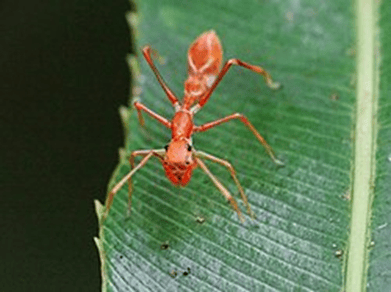
That ant marching purposefully across a leaf may not be an ant at all. It could be a spider dressed up as one.

This is called myrmecomorphy, from the Greek myrmex, meaning ant. Some spiders have evolved narrow, elongated bodies that resemble an ant’s segmented form. But there is one inconvenient problem: spiders have eight legs, whereas insects, including ants, have six.

The solution is wonderfully ingenious. Some ant-mimicking spiders hold up their front pair of legs and wave them like antennae. They move in jerky, stop-start bursts, rather than with the more familiar gait of a spider. Their body shape and movements together create a convincing illusion. A casual observer who has not stopped to count the legs can be thoroughly taken in.

This disguise can offer protection. Many predators avoid ants because they can bite, sting or deploy chemical defences. By resembling an ant, a spider may persuade a potential predator to look elsewhere. This is a form of mimicry. One particularly well-known example is Myrmaplata plataleoides, which resembles the Asian weaver ant (Oecophylla smaragdina), found in India. Weaver ants are formidable for their size: they have powerful jaws, bite readily when threatened, and can spray formic acid, an irritating chemical, at an attacker. They are also aggressive defenders of their colonies. A predator that has learnt to avoid these ants may hesitate before attacking something that looks like one. The spider’s disguise can therefore offer protection—but it is not foolproof, and the degree of protection depends on which predators encounter it.

The disguise can also help some spiders hunt. Ant-mimicking jumping spiders are active predators with excellent vision, and their appearance and behaviour may help them approach prey without immediately revealing their identity. In nature, impersonation can be both a defensive strategy and a hunting advantage.

Fooled in my own garden?

You do not need to travel to an exotic rainforest to look for these remarkable creatures. Ant-mimicking spiders are found in several parts of India. Studies and observations have recorded them in southern India as well as in regions such as Assam and Jharkhand. Interestingly, they do not all impersonate the same ant. The Asian weaver ant (Oecophylla smaragdina) is one model, while other spiders mimic ants belonging to genera such as Camponotus, Tetraponera and Polyrhachis. The particular disguise varies with the spider species and its habitat. This makes ant mimicry a fascinating example of how evolution produces different solutions to the same challenge: surviving in a world full of predators.

Bengaluru’s gardens, parks, hedges and green spaces provide opportunities to observe spiders and ants in close proximity.

So next time you are watering plants or cleaning your windows (that’s where I sighted mine), look carefully at the ants going about their business. Is one unusually elongated? Does it keep waving its front legs? Does its movement seem just a little different? You may have found an eight-legged impostor among six-legged OGs.

Of course, not every ant-shaped creature is an ant-mimicking spider, and a reliable species identification may require a good photograph or expert examination. But that is part of the pleasure of observing nature: the first answer may not always be the right one.

The next time you see an ant, count the legs before deciding.

–Meena

Johnny Appleseed of the Himalayas: Samuel Stokes

In the days before cold storage and “imported” made all kinds of fruits and vegetables available in all seasons, there was a strong seasonal association with these. There were distinct summer fruits, reigned over by King Mango, and bitter karela that matched well with the pungent jamuns in the rainy season. There were the winter favourites ushered in by carrots and peas, and fruits like custard apple and guava.

Growing up in Delhi in those days, for us October was always associated with the Apple season. It was around Dussera time that the Golden Delicious variety of apples made their way from Himachal Pradesh to the markets of the plains. The smooth green crunchy apples had a distinct personality from the red apples from Kashmir. Today these are not easily seen, and not many would even bother to know the difference. An apple is an apple, after all.

The history of apples in Himachal Pradesh is linked with a person whose life and work was a curious journey that took many turns. This was a man who was born in the United States as Samuel Evans Stokes, and died as Satyananda, in the service of the poor in India.

Samuel Stokes was the son of a wealthy American businessman. It was expected that he would continue the family business, but even from his early youth, it was not profit but service that motivated him. This quest led him to join the Christian Quakers religious movement which led him to India as missionary at the age of 22 years. His father initially indulged what he believed was his son’s youthful quest, and even financed his trip.

Stokes arrived in India  in 1904. He began work in a leprosy home in Solan district of Himachal Pradesh. His parents were afraid that he would get leprosy and never return home. Samuel survived, but did not return home.

As he started work with leprosy patients, Samuel realised that he would always be seen as a ‘white outsider’. While he could not change his skin colour, began to dress like the local people and learnt the Pahari dialect so that he could directly communicate. Gradually he integrated with the local community and culture.

In 1912, he fell in love with Benjamin Agnes, a daughter of a first-generation Rajput Christian. Together, they bought a large plot of land in the foothills of the Himalayas and settled there. Harmony Hall became the centre of his new passion–horticulture. However, the poverty of the local people and the need to support them was always on his mind. As Samuel decided to turn to farming and embarked on several experiments in cultivating pear, plum and apples, he began to feel that large-scale fruit growing in the area could help to boost the local economy.

In 1914, Samuel went to America carrying soil samples from his land, and returned with saplings of apples of various varieties that he believed would be suited to the climate and terrain of Himachal. After experimenting with these for a year or two, he found that the Red Delicious variety worked best. Then his mother sent him saplings of the Golden Delicious variety which he added to the mix. While apples were not unknown on the Indian subcontinent, they were mainly grown in Kashmir. The few varieties that grew in Himachal were wild, small, and sour. Once Samuel’s apples were doing well, he started distributing saplings to encourage local farmers to start apple cultivation. They were initially reluctant to replace food crops with fruit which took seven years to yield fruit, but Samuel supported them in the sale and export of the produce as they made the transition. Stokes also built a school for children who worked for him in his orchards in lieu of the fee.

By 1928 apples from Harmony Hall had taken over the Himachal valleys. Samuel also set up a training school for future horticulturists on his estate. Himachal Pradesh officially became the Apple State of India.

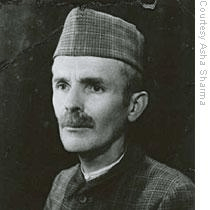
Stokes had always fought for the rights of the local labourers in Himachal, and fought against injustice. In the meanwhile, Stokes’ close friendship with CF Andrews led him to Gandhi. The Jallianwala Bagh incident which brutally exposed British violence against people led him to join the freedom movement. He attended the Nagpur session of the Indian National Congress in 1920, and was the only non-Indian signatory to the declaration urging Indians to shun government service. He travelled with Gandhi around the United Provinces to spread the message of swadeshi and soon took to wearing khadi kurtas and churidars, topped with a Gandhi cap. His articles in support of non-cooperation and against British rule led to his arrest for sedition in December 1921. In prison, he protested against the preferential treatment accorded him as a European – he considered himself a British Indian and a Congressman.

Stokes officially gave up politics in 1924 but continued to correspond with Gandhiji. He described himself as more of a philosopher than a politician. He devoted himself to working for the land and the people of Himachal. His own life journey then took a spiritual turn. In a simple conversion ceremony, he embraced Hinduism in 1932, and took the name Satyananda Stokes. His desire to serve remained the guiding principle of his work and life till the very end. He died on 14 May 1946 at the age of 64, and is buried in Kotghar, Shimla.

This season, as we savour the Delicious Apples from Himachal Pradesh, it is a good time to remember Samuel Stokes who can be aptly described as the Johnny Appleseed of the Himalayas.   

–Mamata


Went for the Botticelli, Stayed for the Harappan Figurine

There are few relationships as universal as that between a mother and her child. Yet the ways in which we imagine, represent and revere motherhood vary enormously across cultures and centuries. This is the idea at the heart of One Mother, Many Mother Tongues, an exhibition at the National Gallery of Modern Art (NGMA), Bengaluru, curated by Naman P. Ahuja and Andrea Anastasio. Bringing together works from India and Italy, the exhibition spans more than two millennia, inviting us to look beyond familiar images of the mother as nurturer and caregiver. Here, motherhood encompasses protection, fertility, sacrifice, regeneration and even ferocious power. The striking juxtaposition of an Italian Renaissance painting with ancient Indian sculptures makes this more than an exhibition about mothers: it is a conversation between civilisations about what the maternal represents.

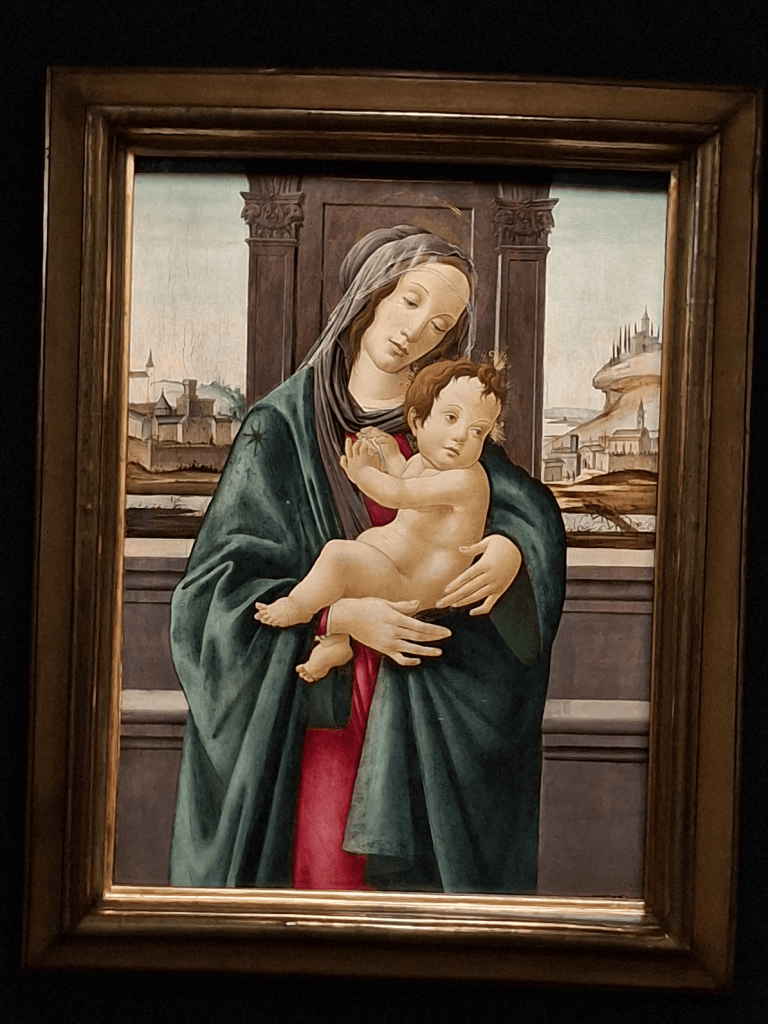
The star attraction was billed as Botticelli’s Madonna and Child, but honestly, there were so many works more jaw dropping.

The Italian Attraction

Not to diss the Madonna and Child, painted around 1490 by Sandro Botticelli, one of the great masters of the Italian Renaissance. Seeing a work by Botticelli in Bengaluru is an occasion in itself. The painting depicts the Virgin Mary with the infant Jesus, a subject that Botticelli returned to repeatedly during his career. As per historians, this is not simply a tender portrait of a mother and baby. Look closely, and the relationship seems weighed with foreknowledge. Mary’s red robe evokes her earthly presence, while her blue veil suggests the celestial. Her expression is melancholy, and her hands appear to be opening rather than clasping the child to herself. The infant, meanwhile, seems to gaze beyond the immediate moment, towards a future that his mother may already understand.

In Christian tradition, the infant Jesus is destined for sacrifice, and the painting can be read as a meditation on a mother’s love shadowed by the loss she must eventually endure. It is an image of motherhood in which love does not mean possession: the mother must ultimately release the child to a purpose larger than herself.

The Harappan Mother and Child

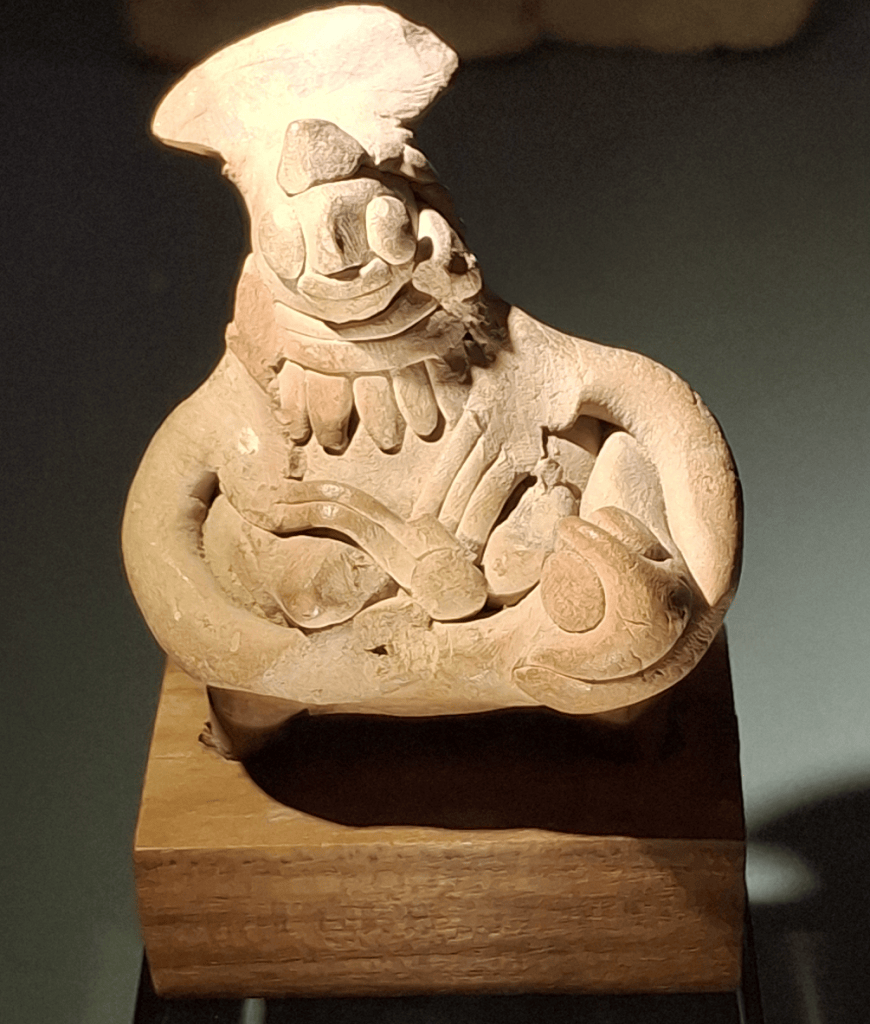
But the most goose-bumpy moment was a small terracotta Mother and Child figurine from the Indus Valley civilisation, dating back to around 2500 BCE, loaned by the National Museum, New Delhi. It is modest in scale and material. Yet its emotional appeal is immediate. The mother cradles her baby. The simple act of holding a child is enough.

We cannot know precisely what the maker intended, whether the figurine had a domestic, ritual or other purpose, or whether it represented a particular deity. But the image does invite us to reflect on the enduring human experience of motherhood. Across the vast gulf of time, a small piece of baked clay brings us face to face with a familiar gesture: the holding of a baby close.

Baby in a Basket

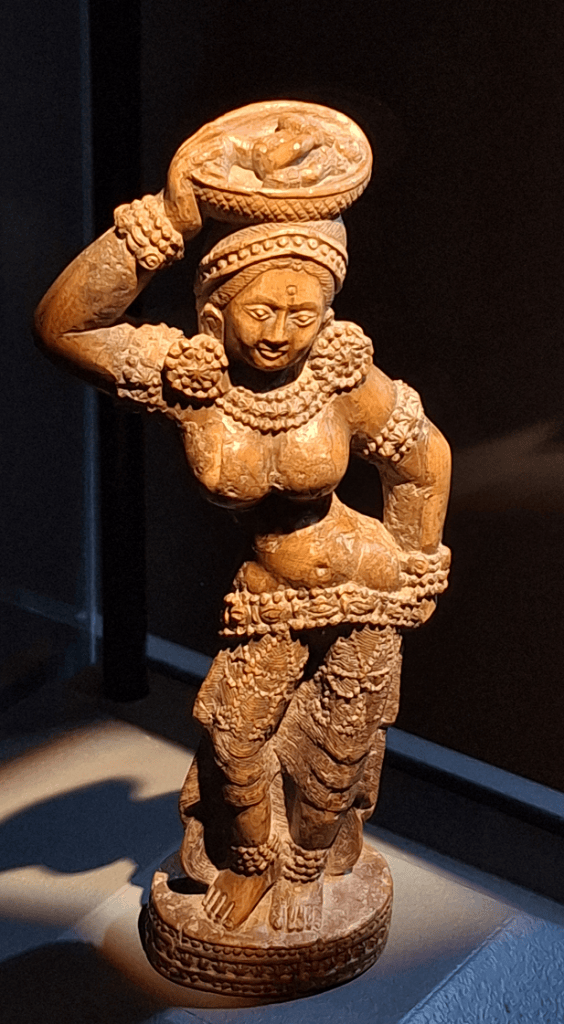
Perhaps the most charmingly matter-of-fact image of motherhood in the exhibition is the small (less than 6 inches high) ivory/bone figure from the Shunga–Kushan period, around the 1st–2nd century CE. A mother carries a basket on her head, with her baby girl (yes, you can make out the sex of the baby on such a tiny figure!) safely tucked inside it. If the detailing of her clothes and jewels is intricate, what I found more intriguing was, why was she carrying the baby in a basket on her head? Where was she going? Again, we have no clue about the situation or the artist’s intentions.

The Yogini: Motherhood Beyond the Human

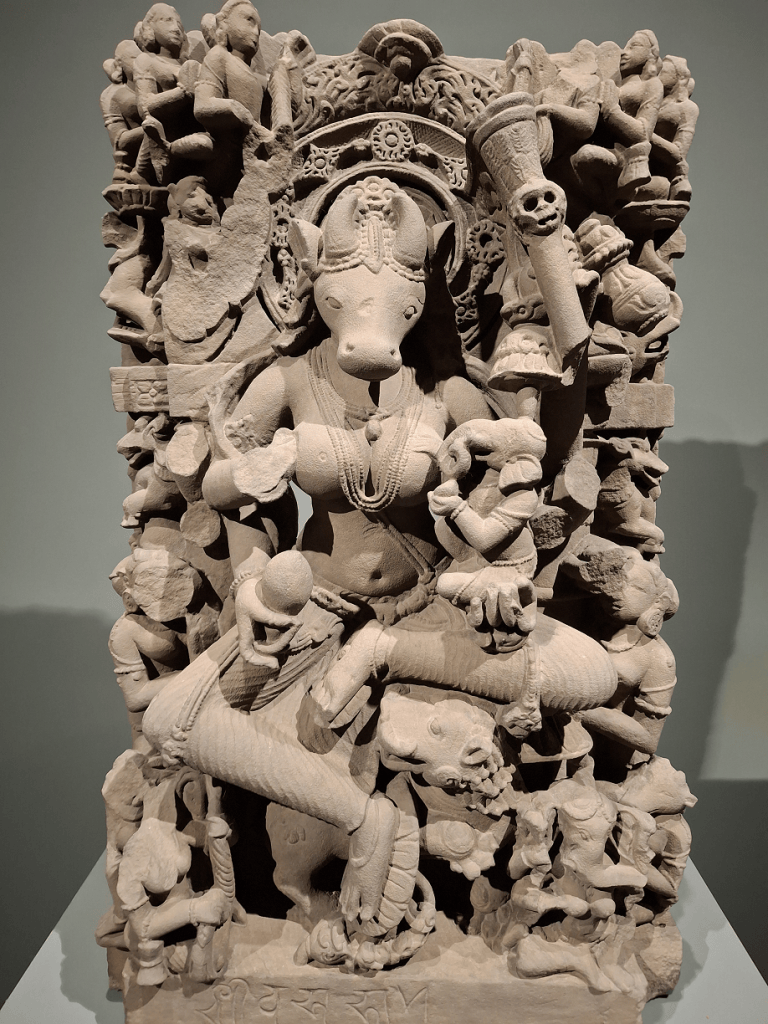
The exhibition becomes particularly intriguing when it moves beyond the conventional mother-and-child image to the world of Indian goddess traditions. The Yogini tradition, associated with powerful female divinities and Tantric practices, does not always fit neatly into familiar categories of motherhood. One of the works highlighted in the exhibition is Vrishabhayogini, a reminder that these figures are not merely idealised representations of feminine beauty or domestic care. The Yoginis belong to a complex religious and artistic world in which female power can be mysterious, unsettling and difficult to contain within a single definition. Their forms and attributes invite us to think about the sacred feminine as something more expansive than the familiar image of a mother holding a baby.

Beyond the Familiar Mother

The exhibition’s other highlights include ancient Etruscan representations of Mater Matuta, a goddess associated with the protection of children, fertility, dawn and renewal, offer a compelling parallel with Indian mother-goddess traditions. The Buddhist goddess Hariti has an especially remarkable story: once depicted in Buddhist narratives as a demoness who abducted and ate children, she was transformed into a protector of children after the Buddha confronted her with the loss of one of her own. Also striking are the Indian Matrikas, or mother goddesses, and the fierce Chamunda, whose fearsome appearance stands at the opposite end of the spectrum from Botticelli’s sorrowful Madonna. A sculpture of Skandamata, the mother of Skanda, adds another dimension to the many ways maternal divinity has been imagined.

One Mother, Many Mother Tongues succeeds in showing us that motherhood is not one fixed image. It is a multitude of stories, beliefs and artistic expressions, each shaped by its own culture.

The juxtapositioning of mothers across geographies and time helps us to see how the mother-and-child motif travelled through different societies and acquired different meanings. Civilisations may differ in their beliefs and artistic conventions; the human bond between parent and child is enduring.

All in all, a wonderful experience!

–Meena