
Purple looks like grapes
Purple sounds like crunch, squish and squash
Purple smells like April
Purple tastes like sugar and tang
Purple turns my yogurt pink!
Purple
–Mamata
Musings on Life and Times: Views, Reviews, Previews, Interviews..and Advice
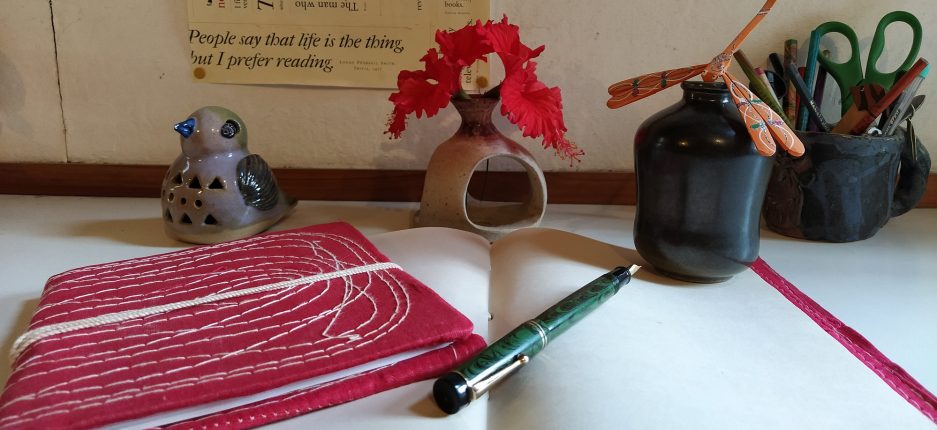
Purple looks like grapes
Purple sounds like crunch, squish and squash
Purple smells like April
Purple tastes like sugar and tang
Purple turns my yogurt pink!
Purple
–Mamata
The Indian summer is when our trees put up the most spectacular flower shows. Flame of the Forest—Butea monosperma whose flowers arrive in blazing orange. Different in tone, is the gulmohar—Delonix regia, with its wide, umbrella-like canopy and bright red blooms. The golden counterpart to these reds is the amaltas—Cassia fistula. Long cascades of yellow flowers hang down in late spring and early summer. The ubiquitous neem–Azadirachta indica has small white flowers which are easy to miss, but their scent. And they are an important part of New Year celebrations in many states.
Among all these are the purples. Three of them are commonly seen–the Pride of India, the loosely termed Indian Princess Tree, and the jacaranda form a quiet sequence of lilac and violet. Less flamboyant, but with gravitas.
The Pride of India or Lagerstroemia speciosa, is both widespread and rooted. Native to the subcontinent, it thrives across peninsular and eastern India, and is deliberately planted in northern cities. It is a familiar presence along older avenues, institutional campuses, and residential roads—part of an earlier approach to urban planting that valued seasonal change as much as shade.
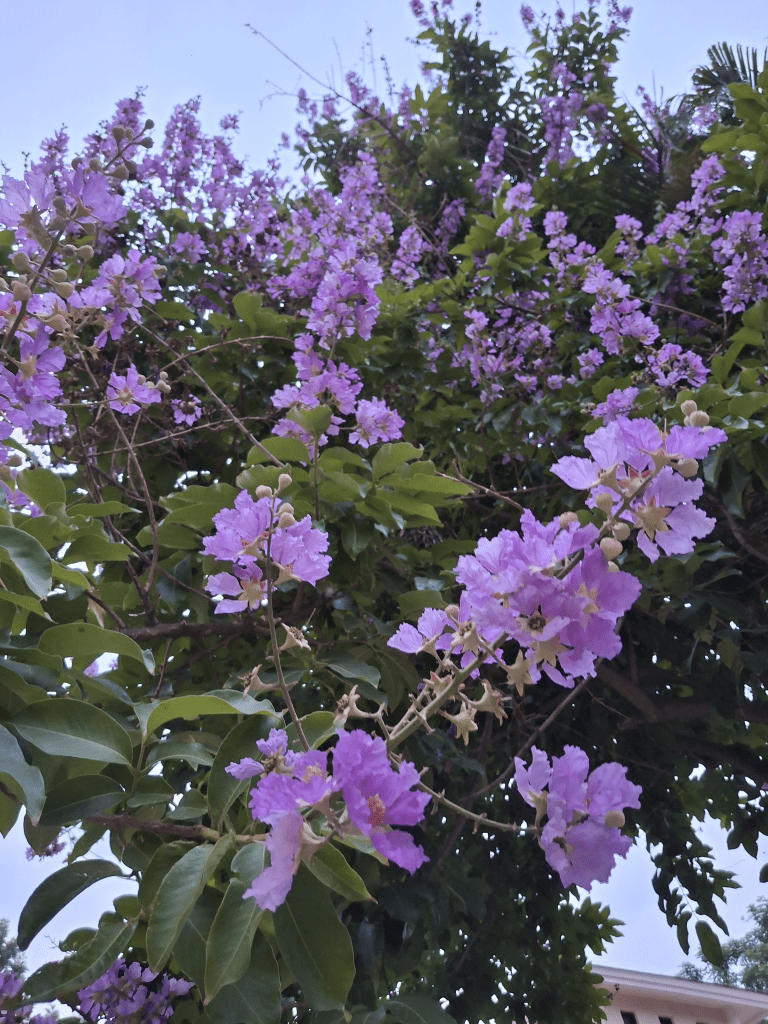
It flowers in dense clusters of lilac, mauve, and pink when most trees recede. The effect is immediate. A single tree can alter the look of a street. The name reflects thatm rather than any scientific classification—an attempt to capture abundance and presence.
After flowering, it produces dry capsules that split open to release light, winged seeds, dispersed by wind. The process is largely unnoticed but effective, allowing the tree to regenerate in suitable conditions. Its flowers attract insects; in turn, birds move through its branches while foraging. Species such as the Red-vented Bulbul and Common Myna are frequent visitors, while others use it as a perching and nesting site, especially in dense urban areas where such cover is limited. In peak summer, its canopy becomes a resting space—shade functioning as habitat.
There is another layer to its presence. The leaves of Lagerstroemia speciosa—often called banaba—are used in traditional medicine, particularly in managing Type 2 Diabetes. They are associated with blood sugar regulation, as well as anti-inflammatory and antioxidant properties. This makes the tree unusual among urban ornamentals: it is not only seen and inhabited, but also used.
The Indian Princess Tree, often linked to Paulownia tomentosa, sits less comfortably in place. Despite the name, it is not native to India and is only sporadically seen—mainly in cooler hill regions or curated landscapes. The “Indian” prefix reflects randomness in naming rather than origin.
Its appeal lies in its restraint. Pale violet flowers, broader leaves, and a more open form create a softer effect than the Pride of India. The “princess” is probably drawn from this visual delicacy.
Its biology, however, is less restrained. After flowering, it produces capsules filled with thousands of fine, papery seeds, designed for long-distance wind dispersal. Given open ground and the right climate, these seeds germinate quickly. The tree grows fast, which explains both its horticultural appeal and its reputation, in some regions, as invasive. In India, its presence fortunately remains controlled and limited.
Ecologically, it plays a lighter role, probably because it is non-native. Its flowers attract insects, and birds may use it for cover or occasional nesting, but it is not a significant food source.
Between these two sits the Jacaranda—Jacaranda mimosifolia—not native, but now visually embedded in cities such as Bengaluru. Its lavender-blue flowers arrive earlier, often bridging spring and summer. For a brief period, roads are edged and sometimes carpeted with fallen blooms, before other trees come into flower.
Jacaranda’s role is largely aesthetic, but not only. Its spreading canopy provides filtered shade, and like the others, its flowering attracts insects, drawing in birds that follow.
Together, these trees complicate their own names. One is called “of India” and is largely at home. One is called “Indian” and is not. One carries no such label and yet feels entirely part of the Indian landscape. Naming suggests belonging; ecology tells a more precise story.
These three trees also differ in how they are encountered. The Pride of India tends to define a street, its flowering visible from a distance. The Princess Tree, where it appears, is noticed more gradually—through proximity, through shade. Jacaranda sits between the two, its colour spreading outward, often first seen on the ground before it is traced back to the tree.
What they share is timing. Each blooms when the landscape offers little else. Their flowering is staggered, creating a sequence rather than a single event. Jacaranda fades as the Pride of India strengthens; elsewhere, other species take over. The effect is not continuous bloom, but continuity of change.
In older Indian neighbourhoods especially in Bangalore, such trees point to a different planning logic. Streets were planted not just for shade but for variation—for shifts in colour, density, and light across months. As urban density increases and tree cover becomes more functional than expressive, these older plantings remain as records of that intent.
A shift in colour. A canopy that briefly interrupts heat. And, overhead, a dry capsule opening—unseen, but already carrying the next season forward. That is the Indian summer.
–Meena
Most prizes are given to those who have already changed the world: the Nobel, the Magsaysay, any number of national recognitions. These prizes are ways in which the world recognizes a lifetime’s work, a breakthrough discovery, timeless writing, selfless humanitarian aid. The awards in these instances are however collateral benefits. For these greats, often the wok is their own reward.
But in some cases, the prize itself is the motivator, it is the way to spur developments to change the world. Some of the most transformative technologies in human history were sparked by something deceptively simple: a prize.
A problem recognized. A deadline set for its solution. A reward announced for the solution.
And then—an open invitation to anyone bold enough to try.
Take the British Parliament’s Longitude Prize of 1714. Navigation at sea was perilous because sailors could not accurately determine longitude. The reward on offer was up to £20,000—an astronomical sum at the time. The solution did not come from a celebrated astronomer, but from a self-taught clockmaker, John Harrison. His marine chronometer worked—but recognition did not come easily. Payments were staggered, disputed, and delayed. Even when innovation succeeds, institutions do not always know how to respond.
A century later, war catalysed innovation. Napoleon Bonaparte, seeking to feed his armies, offered 12,000 francs for a reliable food preservation method. The result? Nicolas Appert’s pioneering work on canning. With his innovation, food for armies could be preserved for months and years, and could keep armies fed on long campaigns to distant lands. Explorers and sailors started depending on them, opening up new frontiers of discovery. Canned food gave a fillip to farmers, now that their produce could have extended lives. And brought convenience to dining. One competition, one process, many benefits!
These early contests reveal something important: prizes work best when the problem is urgent, the goal is clear, and the reward is meaningful enough to sustain effort over time.
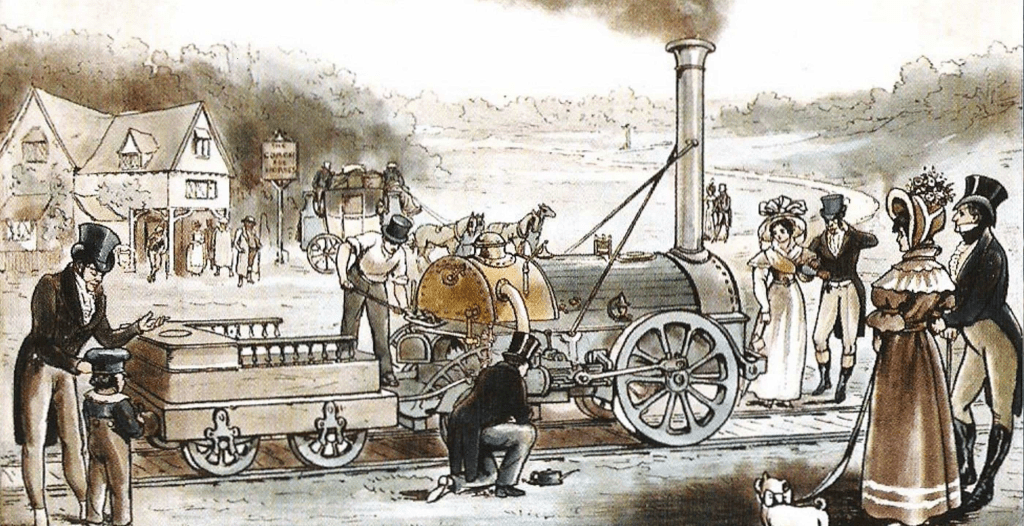
Rainhill Trials
Fast forward to the industrial age. The directors of the Liverpool and Manchester Railway had originally intended to use stationary steam engines to pull trains along the railway using cables. However, their engineer George Stephenson strongly advocated for the use of steam locomotives instead. As the railway was approaching completion, the directors decided to hold a competition to decide whether locomotives could be used to pull the trains. The Rainhill Trials of 1829 offered a prize of £500 for the best way to haul the trains. George Stephenson’s Rocket won decisively, and its design quickly became the standard for locomotives. Here, the feedback loop between competition and adoption was almost immediate.
Then came the age of flight. The Raymond Orteig Prize promised $25,000 for a nonstop transatlantic flight. Charles Lindbergh claimed it in 1927—but only after multiple failed attempts and fatal crashes by others. The prize went to Lingberg, but more importantly, it accelerated aviation as an industry.
By the late 20th century, competitions had evolved into global innovation platforms. The XPRIZE Foundation’s Ansari X Prize offered $10 million for private human spaceflight—and catalysed over $100 million in investment before it was eventually won. The DARPA Grand Challenges, with prizes of $1–2 million, helped lay the groundwork for self-driving cars.
And in the digital age, contests have become even more distributed. The Netflix Prize offered $1 million to improve its recommendation algorithm—successfully claimed, and now foundational to digital platforms. Competitions on Kaggle for machine learning and data science challenges are designed to solve complex, real-world problems using crowdsourced predictive modelling. They routinely offer prizes ranging from a few thousand dollars to over $1 million, with winning models often deployed in real-world systems.
Not all prizes, however, are claimed. The Google Lunar X Prize, sponsored by Google, famously went unawarded when no team met the deadline. And yet, several participating teams went on to become serious space ventures. More recently, the rebooted Longitude Prize on antibiotic resistance—run by Nesta with a purse of £10 million—was eventually awarded after years of global effort.
Enter the Hackathon: The New-Age Contest
If prizes defined earlier centuries, hackathons define ours.
From college campuses to corporate offices, hackathons have become the default format for innovation challenges. India, in particular, has embraced them at scale through initiatives like the Smart India Hackathon, where winning teams typically receive ₹1–5 lakh, along with visibility and recognition.
At first glance, hackathons look like a natural continuation of the prize tradition. But look closer, and a crucial distinction emerges.
Hackathons are built for speed. Typically compressed into 24 to 72 hours, they excel at generating ideas, prototypes, and energy. They uncover talent and encourage collaboration. But they are not designed for depth.
The breakthroughs that defined earlier prize competitions were the result of years of iteration, backed by incentives large enough to justify sustained commitment. Even modern competitions on Kaggle run for months, allowing refinement and optimisation. Hackathons, by contrast, often end at the stage of a promising prototype.
This is not a weakness. It is a different role.
Hackathons are the sparking mechanisms of the tech world.
Lessons for India: Moving from Events to Ecosystems
India is no stranger to ingenuity—though often of the jugaad class. We could surely use the powerful lever of structured, sustained innovation contests.
1. Define Grand Challenges That Matter Locally
India’s problems—air pollution, water scarcity, affordable healthcare—require sharply defined challenges and serious prize money. Rewards must be large enough to sustain effort beyond a weekend.
2. Open Participation Beyond Credentials
Breakthroughs often come from unexpected quarters. Platforms must include informal innovators, practitioners, and non-traditional problem-solvers.
3. Build a Pipeline, Not One-Off Events
Hackathons should be the starting point, not the endpoint. Without this pipeline, ideas from initiatives like the Smart India Hackathon risk fading away.
4. Shift from Inputs to Outcomes
Prize systems reward results, not proposals—encouraging creativity and reducing bureaucratic inertia.
5. Invest in Follow-Through
Mentorship, funding, and testing environments are what convert prototypes into deployable solutions.
6. Measure Success Beyond Winners
India must move beyond a binary view of success. Even if a prize is not claimed, the ecosystem it builds can be valuable.
Because sometimes, all it takes to change the world…is not just a prize—but a prize large enough, a timeline long enough, and a system strong enough to turn ideas into impact.
–Meena

Pope Leo XIV’s recent visit to Algeria had a special personal significance for His Holiness. The current Pope is the first Augustinian Pope; he is a member of the Order of St. Augustine. The Pope visited the archaeological site of ancient Hippo, (modern day Annaba) where once stood the Basilica of Peace church where St Augustine was Bishop was 34 years. He described it as “a profoundly emotional and spiritual moment”.
Who was St Augustine, and why is he significant even today, even though he lived 16 centuries ago?
St. Augustine of Hippo was a theologian, writer, preacher, rhetorician, and bishop. Before he became a saint, Augustine’s life saw many different phases. He was born in 354 AD in Thagaste, presently called Souk Ahras in modern-day Algeria, which was then a part of the Roman Empire. He was African, and not white, as later depicted. His mother Monica was a devout Christian, and his father, a tax collector who converted to Christianity only on his deathbed.
Augustine was bright student, and he had great rhetorical skills; he travelled to Carthage to study rhetoric. But in his teenage years he was irreligious and led a wild life, in spite of his mother’s prayers and counselling. In his twenties Augustine was restless and in his quest to discover ‘the truth’ he experimented with the cult of Manichaeism, a concoction of Christian, Buddhist, astrological and pagan elements. He then became influenced by Neo-Platonism, which drew from Plato. Augustine was still lost and wandering, much to his mother’s despair.
His wandering led him to Milan, where an encounter with the bishop of Milan, Ambrose, changed his life path. The bishop, who was considered one of the greatest orators in the Roman world influenced Augustine, at the age of 33, to convert to Christianity in AD 347. Augustine was ordained a priest in 391 and he became Bishop of Hippo (today’s Annaba, Algeria) in 395.
After his conversion, Augustine used his skills as a thinker and writer in service to the church. He moved back to North Africa and eventually became bishop of a town named Hippo. He continued not only to speak eloquently, but was also a prolific writer. His personal journey, the story of his spiritual quest, formation and conversion, is documented in The Confessions. Written in 401, this work is a model for modern autobiography as it depicts the formation of a mind and character.
St. Augustine also wrote several other noteworthy books. Perhaps the most relevant today, are his thoughts and writings on war and peace. He was one of the first people to articulate a philosophical statement of war and justice. Augustine drew upon Christian teachings as well as Greek and Roman philosophy to propose a set of principles that defined a ‘just’ versus an ‘unjust’ war. He laid the groundwork for what became known as the Just War Doctrine.
St. Augustine lived in volatile times. In a period when there was a race to expand Empires, St. Augustine questioned the value of such expansion, comparing it to a human body, arguing that a moderate stature with good health is preferable to an oversized, unhealthy body (and by extension, empire).
He viewed war with deep sorrow and profound skepticism regarding its ultimate value. Acknowledging that war is inevitable in some situations, he laid down certain criteria under which war is a permissible recourse.
Just Cause: to confront “a real and certain danger” to protect innocent life.
Competent Authority: declared by those with responsibility for public order.
Comparative Justice: Are the values at stake critical enough to override the presumption against war?
Right Intention: War can only be conducted to satisfy the just cause.
Last Resort: All peaceful alternatives have already been exhausted.
Probability of Success: The outcome cannot be disproportionate or futile.
Proportionality: inflicted damage must be proportionate to the good expected.
St. Augustine also drew upon earlier Roman conventions about war. For example, that it must be declared by proper authorities and not by angry mobs. The Empire also had a policy — not always followed — of allowing conquered people to keep their own customs, religions, and local laws.
Which wars are not just? These would be wars marked by selfish intent. Wars to seize territory, wealth, or power are not just. Wars fought for personal glory or out of vindictiveness are not just.
While he agreed that a ‘just war’ could be fought to restore peace or punish injustice, he viewed it as a ‘necessary evil’ rather than a good. He maintained a fundamental belief in the futility of war for achieving lasting, meaningful human happiness.
As early as the fifth century St. Augustine was considering the moral consequences of war. For Augustine, any conflict that does not have the final establishment of a stable, just peace as its sole purpose, is useless and immoral.
Writing in 418 A.D., he wrote: “Peace should be the object of your desire; war should be waged only as a necessity…in order that peace may be obtained. Therefore, even in waging a war, cherish the spirit of a peacemaker, that, by conquering those whom you attack, you may lead them back to the advantages of peace…As violence is used toward him who rebels and resists, so mercy is due to the vanquished or captive.”
In his book City of God, he noted that even a ‘just war’ is characterized by cruelties and miseries. He viewed the brutality of war with profound lament and often expressed a “deep hatred of war” and contempt for those who glorified military victories. The Just War doctrine emphasizes that a set of rules for military combat must be followed. This means treating non-combatants such as women, children, elderly, wounded, and prisoners of war humanely.
The Just War theory has become an integral part of Western philosophy. Even today it is reflected in international humanitarian law.
St. Augustine regarded the power-seeking know-it-alls of the day as ‘dangerous fools armed with the pretense of knowledge’. In our current turbulent period of history, we are witness to how international and humanitarian law is being flouted with arrogance and impunity by exactly the same kind of people.
It is a time to remember another valuable insight from St Augustine–The idea that you were bigger or better, or more self-righteous, or somehow immune from the rules that govern others — the absence of humility, in other words, gave you license to do unto others what you would never allow them to do unto you.
Just War? Or A Just War?
–Mamata
We mark days for everything—as we have seen over the last few weeks, serious ones like World Environment Day or International Women’s Day, and then the quirkier ones that sneak into our calendars and make us pause, smile, or wonder. Tucked quietly among them is World Breathing Day—observed each year on April 11th—a day that, at first glance, feels almost unnecessary. After all, breathing is the one thing we do without reminders.
But that is precisely the point.
Breathing is so automatic that we rarely stop to notice how we breathe. Or that something as ordinary as your nose is quietly running a sophisticated system in the background. One of its most fascinating features? The nasal cycle—a built-in rhythm that ensures your two nostrils are never quite doing the same thing at the same time.
The Nose That Works in Shifts
Try this: close one nostril and breathe, then switch sides. Chances are, one side feels clearer than the other. That’s not a cold coming on—it’s your nasal cycle at work.
The nasal cycle is a natural, unconscious process in which airflow alternates between nostrils every few hours. At any given moment, one nostril is “dominant,” allowing more air in, while the other is slightly more congested and handling less airflow. This swap happens throughout the day without you noticing.
Think of it as a relay race. One nostril takes the lead while the other steps back—not idle, but recovering, recalibrating, and preparing to take over again.
Why Two Nostrils, Not One?
It may seem redundant—why not one efficient airway instead of two? But evolution, as always, prefers nuance over simplicity.
Your nose isn’t just a passage for air. It’s a full-fledged processing unit. Before air reaches your lungs, it is filtered, warmed to body temperature, and humidified. Without this preparation, the air would irritate your airways and make breathing far less comfortable.
Having two nostrils allows this system to work continuously without burnout. While one nostril handles the bulk of airflow, the other gets a chance to restore moisture and recover from constant exposure to dust and microbes. This explanation is widely accepted, though the exact mechanisms are still being studied.
It’s like having two alternating air-conditioning units—one working, one servicing.
The Secret to Better Smelling
Here’s where it gets even more interesting: your nostrils don’t just alternate breathing—they may also influence how you perceive smells.
Air moves faster through the dominant nostril and slower through the less active one. This difference in speed can affect how odour molecules dissolve and interact with receptors.
Your brain combines these signals into a single perception, giving you a richer sense of smell than you might expect from something so routine.
Built-In Backup (and Defence)
If you’ve ever had a cold, you’ve probably noticed how one nostril feels completely blocked while the other carries on. That’s not entirely a flaw—it’s partly a reflection of how your system already works.
Because of the nasal cycle, your body is used to relying more on one side at a time. So when one nostril becomes congested due to infection, the other can often compensate more effectively.
There is also a suggestion that this alternating congestion may help in dealing with infections—for instance, changes in airflow and temperature might influence how certain viruses behave.
So your nose isn’t just breathing—it may also be quietly supporting your body’s defences, even if the details are still being understood.
What Yoga Figured Out Long Ago

Long before modern physiology described the nasal cycle, practices like pranayama in yoga had already drawn attention to the idea that the two nostrils behave differently.
In techniques such as alternate nostril breathing (often called Nadi Shodhana), practitioners consciously switch airflow between nostrils, believing it balances energy, focus, and calm. Interestingly, this mirrors the natural alternation your body is already doing on its own.
Some modern studies suggest that breathing through one nostril versus the other may have subtle effects on heart rate, attention, or relaxation. But—and this is important—these effects are often small, context-dependent, and sometimes overstated in wellness spaces.
So while yoga didn’t “discover” the nasal cycle in a scientific sense, it certainly noticed something real—and built a practice around paying attention to it.
A Rhythm You Never Notice
What makes the nasal cycle so remarkable is how invisible it is. Unlike your heartbeat after a sprint or your lungs during a yoga session, this system operates entirely under the radar.
Most of us go through our days unaware that we are breathing unevenly—that one nostril is doing more of the work at any given time before switching later.
It’s a reminder that the body is full of such quiet rhythms—processes that don’t demand attention, but deserve appreciation.
So when World Breathing Day comes around, it might be worth pausing—not for a grand gesture, but for a small awareness.
Take a breath. Then another.
Notice which nostril feels clearer. Notice how the air feels as it enters—cool, filtered, softened. Notice that what feels effortless is actually the result of a finely tuned biological system working in shifts, balancing efficiency with care.
In a world that celebrates constant output, the nasal cycle offers a quieter lesson: even the body alternates between effort and recovery.
And perhaps that’s something worth marking on the calendar too.
–Meena
Among the many days, significant or silly, that are being celebrated, this week marked a special day in India’s maritime history. April 5 is celebrated annually as National Maritime Day.
India, a peninsular subcontinent with more than 7000 km of coastline, has a long maritime history, dating way back to the Indus Valley Civilization. Since ancient times Indian sailors ventured out to sea thanks to their deep understanding of the ocean patterns and the monsoon winds. This allowed them to travel safely and efficiently, opening up trade routes to distant lands. It is speculated that the English word “navigation’ may have its roots in the Sanskrit ‘navgati’, a combination of ‘nav’ meaning ship or sailing vessel, and ‘gati’ meaning speed or progress. There are many stories in Indian mythology about the seas and oceans, and proof of Indian maritime operations can be found in Indian literature, sculpture, painting and archaeology.
The advent of the colonial powers replaced the traditional trade and trading vessels with what became a European monopoly. Over the next few centuries British companies dominated the shipping industry. In the early 1900s a far-sighted group of Indian industrialists, led by Walchand Hirachand, and including Narottam Morarji, Kilachand Devachand, and Lallubhai Samaldas dreamed of creating India’s own mercantile fleet—a swadeshi shipping enterprise.
They formed a company called the Scindia Steam Navigation Company, and purchased a steamer from the Gwalior royal family. The ship, the RMS Empress, originally purchased from the Canadian Pacific Railway had been used as a hospital ship for wounded Indian soldiers in World War I. It was a challenge to set up and sustain a marine mercantile enterprise in the face of the long-running British companies.
RMS Empress was renamed the SS Loyalty. On 5 April 1919, the now totally swadeshi SS Loyalty made its maiden voyage from Bombay to London. It carried 700 passengers and cargo. This was significant as it marked the beginning of breaking the British monopoly on maritime trade. This event continues to be commemorated as National Maritime Day on 5 April every year.
What makes the subsequent story of the founding company, the Scindia Steam Navigation Company more significant, is also the story of a remarkable woman who steered this company to exemplary success.
Sumati Morarji was born in 1909 in an affluent, and conservative, merchant family of Bombay. Named Jamuna by her parents, at the age of 13, she was married, with an extravagant wedding, to Shanti Kumar Morarjee, the only son of Narottam Morarji. Narottam Morarji, an eminent industrialist, was one of the co-founders of the Scindia Steam Navigation Company.
The young bride was extremely bright, and displayed a great thirst for learning. She was also keen on understanding more about her marital family’s business and its working. Her father-in-law Narottam Morarji recognised in the newly-wed teenager a sharp mind, and hidden potential.
He renamed her Sumati (a woman with superior wisdom), and invited and respected her insights into the family business. She equally demonstrated her management skills when she took over running of the household following her mother-in-law’s early demise. By the time she was 20, Sumati had demonstrated her capabilities in all spheres. Thus her husband Shanti nominated her to the Managing Board of Scindia Steam Navigation Company.
This was a time when the company was still in its infancy, having a few cargo ships running between India and Europe. With Sumati at the helm, the company’s strength and reputation increased greatly over the next few decades. As India was on the cusp of Independence, Sumati quietly assumed complete charge of the company, leading it from strength to strength as the newly independent nation began its journey to self-reliance and progress.
Sumati was deeply influenced by Gandhii, and despite her business commitments took an active part in the underground operations of the freedom movement. In the aftermath of Partition, she used her ships to help safely transport Sindhis from Pakistan to India. She remained close to Gandhiji, with whom she corresponded regularly.
After Independence as Indian maritime trade was increasingly handled by Indian ships, Sumati’s insights, expertise, and experience in the field played a crucial part. She set a precedent as being the first woman in the world to head the Indian National Shipowners Association, a pioneer organisation of ship owners. She was globally recognised and elected as Vice President of World Shipping Federation in London in 1970.
Sumati Morarji managed the Scindia Steam Navigation Company for 69 years, and steered the company’s great success, until she passed away in 1998. She contributed in many national endeavours, and was a deeply spiritual person who helped in propagating Indian culture across many countries. But her primary passion was her ships, that she regarded as her daughters. No wonder, then, that she is called the Mother of Indian Shipping in every sense of the phrase.
National Maritime Day is a fit occasion to honour Sumati Morarji, a lady who quietly made waves across the oceans.
–Mamata
One day we’re marking World Environment Day with a clean-up drive, or organizing a panel discussion for International Women’s Day. These “days” exist for good reason—they shine a spotlight on important causes, create opportunities for collective action, and remind us, at least once a year, to pay attention to things that might otherwise slip through the cracks.
And then, almost without warning, the calendar develops a personality. Not a dignified, solemn type anymore, but the slightly quixotic, overenthusiastic kind that insists everything deserves a moment in the spotlight.
Because once you stray beyond the serious list, you enter a parallel universe of observances—one where seriousness gives way to sheer creativity. Days that I call ‘Silly Days’.
The original of course is All Fools Day, April 1, which has a hoary past, though the precise origin is unknown. Common explanations link it to France’s 1564 Edict of Roussillon, which shifted New Year’s Day to January 1—those who continued celebrating near April 1 were mocked as “April fools.” Other scholars trace it to ancient spring festivals such as the Roman Hilaria, marked by masquerades and mirth. But it continues to be celebrated across the world as a day of hoaxes and pranks.
But now there a day for every crazy cause! There’s ‘International Talk Like a Pirate Day’, which asks otherwise respectable adults to say “Arrr” in meetings. There’s ‘World Emoji Day’, a tribute to the tiny icons substituting so conveniently for words. ‘International Caps Lock Day’ is marked each year on October 22 that humorously celebrates—or mocks—the use of the Caps Lock key. It originated as a light-hearted internet tradition highlighting the overuse of all-caps text online. ‘World Beard Day’ celebrates facial hair. ‘International Day of No Dieting’ offers a brief rebellion against restraint.
‘International Talk Like Shakespeare Day’ is celebrated annually on April 23, honouring the birthday and death date of playwright William Shakespeare. On this day, participants imitate Shakespearean English in speech, writing, and social media, celebrating his linguistic influence and dramatic legacy.
There is ‘International Left-Handers Day’, finally giving lefties their moment in a right-handed world. There’s ‘World Sleep Day’, which feels less like a celebration and more like a universally shared aspiration. On the opposite end of the energy spectrum sits ‘Global Running Day’—a day that divides humanity neatly into those who lace up enthusiastically and those who scroll past quietly.
There are also the ‘International Day of Happiness’ and ‘International Joke Day’. And then, just when you think it can’t get more niche, along comes ‘International Day of Awesomeness’!
Food is a major part of this landscape. There is ‘International Pancake Day’, ‘World Nutella Day’, and ‘International Sushi Day’—as if these foods were at risk of being forgotten without formal intervention. There is even International Coffee Day—arguably redundant, given that many already observe it daily, without prompting. In India, we have ‘World Idli Day!’
As are animals—’International Cat Day’ celebrates creatures that barely acknowledge our existence, while ‘World Penguin Day’ honours birds most of us will never meet.
There are some days which feel like gentle nudges toward better behaviour. ‘World Kindness Day’ and ‘World Compliment Day’ ask us to be just a little nicer, a little more generous with our words.
And then there are the truly puzzling ones. ‘World UFO Day’ invites us to look skyward–just in case. ‘International Day of Failure’ encourages us to celebrate our missteps—a concept that feels admirable in theory and mildly uncomfortable in practice. ‘World Password Day’ is perhaps the only observance that comes with an implicit to-do list.
But the day that has fast become my favourite is the one suggested by my 7-year old grandchild. She has the gift of being able to burp at will, and a few weeks ago, she was exercising the gift incessantly. When told that it was very rude, she countered saying that it was ‘International Burping Day’, and that she was obligated to burp. She followed this up by making a poster for the day!
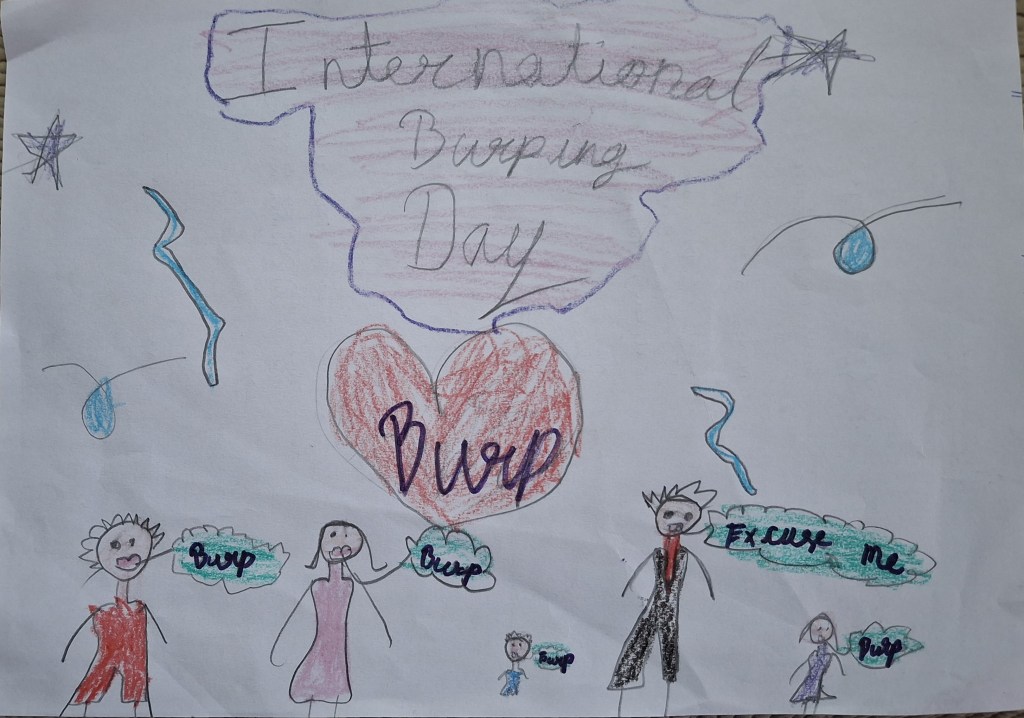
My calendar now feels less like a schedule and more like a collage of human quirks—earnest, excessive, occasionally absurd. And perhaps that’s the point. In trying to give everything its day, we reveal not just what we value, but also what makes us smile, pause, or raise an eyebrow and think: really, this too?
–Meena
Art by Barnalee
Just over a month ago, the name Hormuz did not mean much for a large population of the world. Today the word is making headlines across the globe. The blockade of the Strait of Hormuz is having a ripple effect far from the waters of the Persian Gulf. Sadly, its claim to fame is rooted in the fall-out of a war that the world did not, and does not need.
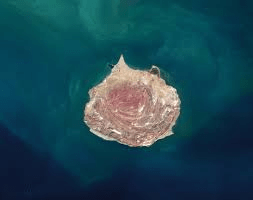
For centuries ships have been sailing through the waters of the Persian Gulf, carrying people and cargo, and perhaps, not as visibly, culture. These waters are not just transporters, they are also the space for small land formations, many of which are unique in their geology and biogeography. One such island is the island of Hormuz.
Hormuz Island is a part of the Hormozgan Province of Iran. Located about eight kilometres from Bandar Abbas on the coast of Iran, and 18 km from Qeshm Island in the Persian Gulf, it is strategically perched where the Persian Gulf and the Gulf of Oman meet. Hormuz island covers an area of approximately 42 square kilometres.
The ancient Greeks called it Organa; during the Islamic period it was known as Jarun, and later took the name Hormuz from a significant mainland port of Ormus. It is believed that around 1300 A.D. the ruler of this town and its inhabitants shifted to the island in order to evade attacks by Mongolian and Turkish troops. Thus they called their island home New Hormuz. Today it continues to be recognized simply as Hormuz.
Its strategic location at the entrance of the Persian Gulf has historically made Hormuz Island a key trading post. It was an important stop for traders on the Silk Road. In the 15th century a Russian merchant described it as “a vast emporium of all the world”.
It was part of a flourishing kingdom during the medieval period. This attracted the attention of the European powers. In the early 16th century it was taken over by the Portuguese who established a fort there, which helped the Portuguese to control strategic trade routes between Europe, India, and the Far East, and dominate the spice trade.
It remained a Portuguese colony for almost a century and a half, before being taken over in 1622, by the Safavid Empire, run by a powerful Iranian dynasty. It has been a part of the Persian empire since then, and is today a part of Iran.
Even today the island’s culture and customs reflects a blend of the Arab influences from neighbouring countries, as well as past interactions with Portuguese, English, and Indian merchants. The island today is home to Persians Arabs, and the indigenous Hormuzis, each contributing to the rich cultural mosaic.
What makes Hormuz Island unique are its dazzling geological features. It is one of the biggest salt domes—where a mound of salt layers rises up through overlying layers of rock. The formation glows with brilliant shades of red, yellow and orange. This palette is created by the deposition of minerals which constitute the layers of shale, clay, and volcanic rock. Geologists believe that hundreds of million years ago shallow seas formed thick layers of salt around the margins of the Persian Gulf. These layers gradually collided and interlayered with mineral-rich volcanic sediment in the area, leading to the formation of the brilliantly coloured soil and mountains. The high percentage of minerals, including iron, gypsum, oligiste, apatite and quartz has given colour to all the geographical features—ochre-coloured streams; beaches with sand ranging from white, silver and gold, to crimson; the Rainbow Mountains whose vibrant colours range from deep reds and oranges to purples and yellows, and natural salt caves that resemble vibrant works of art. The beaches are covered in crimson sand, and when the waves wash over these, the water also takes on reddish and pink hues. Because the beach’s red glow could be spotted from far out at sea, sailors once used it as a natural navigation marker in the Strait of Hormuz.
The geological formations on the island include the Valley of Statues, a surreal landscape with natural rock formations; Silence Valley which is has an eerie landscape of salt formations and is completely silent; and the Cave of the Salt Goddess formed over thousands of years by water erosion and salt crystals, the walls of which shimmer with vibrant shades of whites, blues, purple and pinks.
In this stunning landscape, the Red Mountain stands tall. This is even more unique because not only is its soil is bright red, it is also edible!
The red soil is caused by haematite, an iron oxide which comes from the islands volcanic rocks. The mineral is valuable in the production of cosmetics, paper, plastic, stainless steel, ceramics, tiles, pottery and glass, and was exported for this, but the exports have now been reduced to prevent overexploitation. This soil is found nowhere else in the world; however it is not permitted to carry any samples out of the island, even as a souvenir.
The soil plays an equally important part in local cuisine! Known as Gelack, it is an important ingredient, in local cuisine. It is used as a spice, especially in the traditional fish curry called sooragh. A rare edible soil that is a valued spice in itself!
If Hormuz Island is renowned for its geological features, it is equally rich in biodiversity. A patch of mangroves at its northern end adds a touch of green to the vibrant palette. The island ecosystem harbours a rich variety of bird species, and the waters are home to thriving marine life.
With its kaleidoscope of natural colours, Hormuz aptly deserves the title of Rainbow Island. Sadly the rainbow is today eclipsed by the dark clouds of war.
-Mamata
 Millennial Matriarchs