
At a recent visit to a local farmer mela my attention was drawn to some lovely pinkish orange berries neatly packed in a plastic box. The farmer told me that these were a variety of local berries called gunda in Gujarat. While I was familiar with the slightly bigger and green varieties of this fruit which our aunts used to pickle in brine, I had not seen these smaller differently-coloured versions.
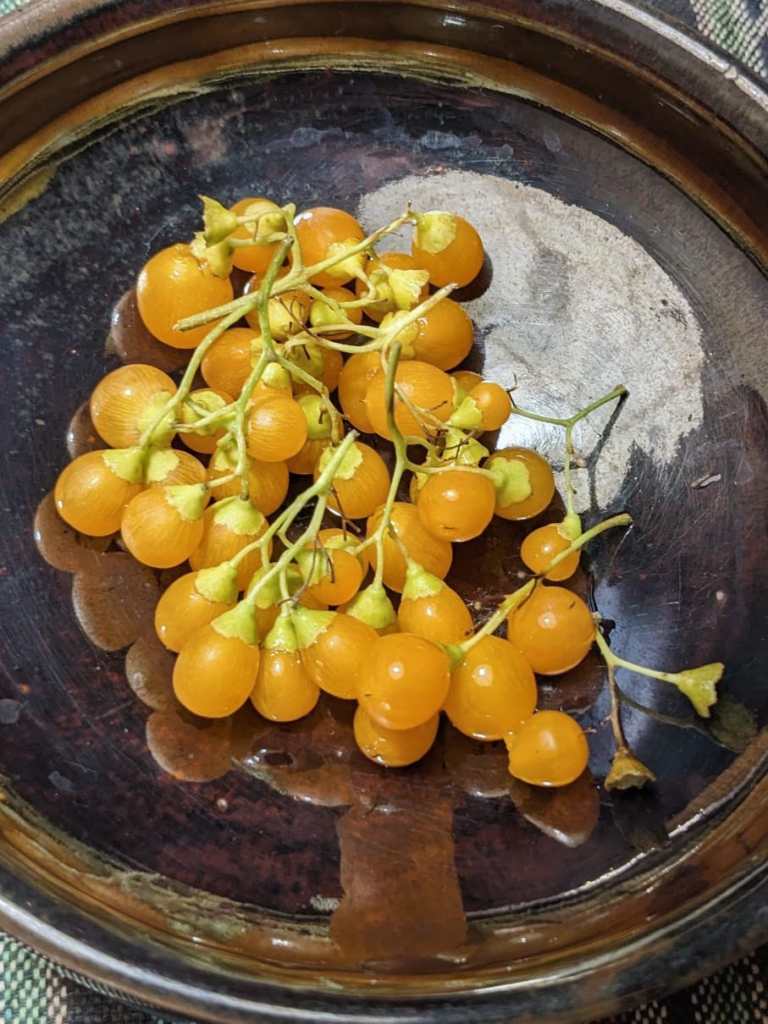
I brought home a box and my husband was most amused to see the packaged product. He recalled picking these in the wild in his childhood, and also how it was a bit of a pain to eat these as they were extremely sticky from the inside and did not make for a pleasant gustatory experience (at least not from him). The fun was in the picking, as part of the summer adventures in a small town. But he did remember that the sticky goo was effective in mending kites (which was a real passion).
Now I was curious. I discovered that the berry was in fact commonly known as glueberry! Its statelier botanical name was Cordia dichotoma, a tree of tropical and subtropical regions. Native to China, the tree is also found in parts of Japan, Pakistan Sri Lanka, Cambodia, and stretching across the South East region all the way to Australia and Vanatua. In India it is found in a variety of forests ranging from the dry, deciduous forests of Rajasthan to the moist deciduous forests of Western Ghats. The tree’s fast growth and tolerance for harsh, arid environments make it excellent for windbreaks, agroforestry, and animal fodder
This is a small to moderate-sized deciduous tree with a short crooked trunk, with a greyish brown bark and spreading crown. The white short-stalked flowers open only at night. The fruit is yellow or pinkish-yellow, shining and spherical, which turns black on ripening.
The bark and the leaves, as well as the fruit have medicinal values. They have been traditionally used in the treatment of stomach aches, coughs, and chest complaints, as well as diarrhea. The nutrient-dense berries are used in Ayurveda and Unani systems to soothe respiratory issues, promote digestion, and treat skin ailments.
The fruit—glueberry, also known as lasoda, gunda or bhokar is used when it is green, as well as when it ripens. The fruit can be eaten fresh, pickled or used as a vegetable. In South Asian cooking the green fruits are prized for making tangy pickles and chutneys. The ripe translucent berries are sweet and edible with a taste described by some as a combination of pineapple and mango.
The fruit pulp contains a sticky, natural mucilage which was traditionally used as a natural adhesive or a binding agent much before the advent of synthetic glues. Its historical significance as a natural, plant-based adhesive is well-documented.
The fruit was commonly rubbed on envelopes to seal them. Its sap was used to bind various materials together. The sticky pulp was also used to trap birds, hence it was also called Bird Lime Tree. And the sticky mucilaginous pulp of the fruit served as a reliable natural glue and was used to bind books, scriptures and manuscripts. And in the less documented uses, children used it to securely repair torn kites.
No wonder then, that the Glueberry truly lives up to its name!
Today this free-growing fruit is travelling from its native habitats, neatly packed and marketed in urban markets. An indigenous fruit sold for its exotic taste!
–Mamata


