
This week we have been exploring quaint expressions that describe human situations using animal analogies. Sometimes these become ‘bees in our bonnet’ as new analogies and comparisons buzz around in our imagination! One of these analogies is our description of someone as a “pest”, and our irritated response to such a person “Don’t pester me!”
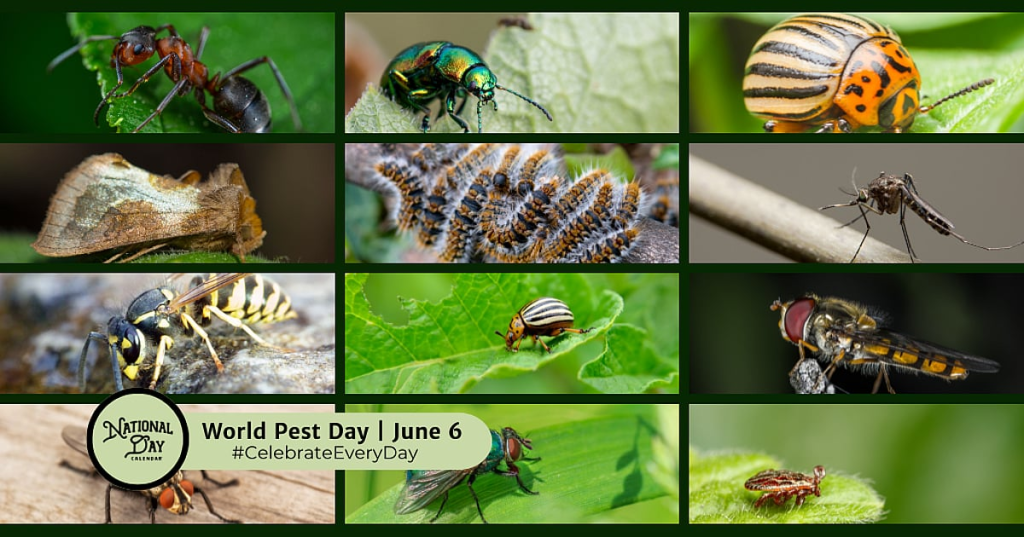
Why is the word associated with persistent irritating behaviour in human beings? For that we need to go back to nature.
A pest is defined as any living thing which humans consider troublesome to themselves, their possessions, or the environment. This includes plants, pathogens, invertebrates, vertebrates or any organism that harms an ecosystem. In its broadest sense a pest is a competitor to humanity. Pests can cause issues with crops, human, or animal health, buildings, and wilderness areas.
Looking at insects alone, it is estimated that 900 million insect types can be ‘pests’ not in nature, but in a world where humans have modified nature to suit their own requirements. And the human species has always found ways, though not wise at times, to tackle insects and other living organisms that they did not like, or want around them. From the earliest times, the battle between humans and ‘pests’ has taken many forms.
Cave dwellers probably swatted mosquitoes or used smoke to ward off the bloodsuckers. As far back as 2500 BC, people used sulfur compounds to control mites and insects. In 1200 B.C., the Chinese deployed predatory ants against pests such as beetles and caterpillars.
With growing populations, and crowded and insanitary living conditions bed bugs and rats proliferated. One of the first publicly advertised pest control companies was the 1690 company H. Tiffin and Son Ltd. in London. The company promoted rat and bed bug control using methods and chemical compounds they invented. Their trademark was “Bug Destroyers to Her Majesty and the Royal Family.”
Probably one of the hardest pests to control are rats. Over the ages, methods to control rats have tried everything from chemicals, plant extracts, prayers, chants, terrier dogs, and music. Ratsbane was one of the first chemicals used. Barbers sold it in the Middle Ages. Then it became a popular item sold by street vendors. Vermin exterminators became a legitimate and in-demand profession. Till date, rats continue to pose a cheeky challenge to every counter measure to control them, and proliferate even in the most sophisticated cities of the world (New York has a serious rat infestation issue).
Pests are a major threat to health worldwide. Many insects are the primary or intermediate hosts or carriers that transmit debilitating human diseases, ranging from malaria, to Lymes Disease, to Zika. Rodents and birds are also secondary hosts for a large number of diseases transmitted by the parasites that they carry into the human environment — ticks, lice, fleas and mites.
Crops are also at risk from pests which include aphids, caterpillars, whiteflies, locusts and mites. These insects cause damage by feeding on foliage, sucking plant sap, or transmitting diseases. These pests can devastate agricultural yields, reducing quality and quantity, and leading to significant food shortages.
Pests are equally threatening in human habitations. Termites, wood-boring beetles, carpenter ants, and rodents Termites, wood-boring beetles, carpenter ants, and rodents are the primary pests that destroy buildings by compromising structural integrity.
The universal frustration to successfully manage and control pests in every sphere of life, spurred a global effort to increase awareness about pest-related challenges and professional pest control solutions.
On 6 June 2017 the Chinese Pest Control Association hosted 300 participants including industry experts, media representatives, researchers and academic professionals to discuss how to promote awareness about the role of pest management in public health protection. In 2018, the Global Summit of Pest Management Services for Public Health and Food Safety was held in Portugal, and it was agreed to accord international recognition to an annual World Pest Day.
Since then World Pest Day is observed annually on June 6th across the world. The initiative aims to improve public, government and media awareness, strengthen the professional image of the pest management industry, encourage scientific pest control and highlight major threats caused by small pests. The day promotes scientific and responsible pest control practices while creating awareness about the threats posed by pests worldwide.
Sadly, in the past decade the threat of pest-borne diseases is growing due to climate change, international travel, globalization of trade and increasing urbanization taking over the natural habitats of disease-bearing pests. A better understanding of these diseases is essential for managing them in the future.
Parallely there is ever-growing need to produce more food, fodder, fibre and wood. The lifestyles of a number of insects seem to clash with people’s economic interests. There is a competition for resources and humans tend to describe all competitors as pests that have to be fought on a war footing. When the ‘wonder drug’ DDT was invented in 1939 we thought that the war against pests had been won. But soon insects developed a resistance to pesticides. Fighting pests with chemicals alone is not the answer as we have also learned that these chemicals can have terrible side effects on all living things including humans. We can neither turn back to a chemical-free earth, nor can we continue to poison ourselves.
While technology and researches in more effective chemical measures to counter pests continue to advance, what is perhaps being lost is a better understanding of the ‘pests’ and some traditional, and less toxic ways of meeting the challenge. One way is to take a closer look at pest species and their interaction with the environment, especially in agriculture. A combination of cultural, biological, physical and chemical techniques to manage and control pests is called Integrated Pest Management (IPM).
IPM is an eco-system-based long-term strategy that minimizes economic costs while protecting human health and the environment by using chemical pesticides only as a last resort. Effective IPM aims at a synergistic integration of five main methods.
Making the environment inhospitable to pests through crop rotation, planting pest-resistant crop varieties, and proper sanitation (removing food and water sources).
Using natural predators especially certain birds, parasites, or pathogens to manage pest populations (e.g., introducing ladybugs to eat aphids or utilizing bio-pesticides).
Using traps, barriers, netting, or temperature manipulation to physically block or remove pests.
Applying synthetic or natural pesticides in a highly targeted manner taking care to minimize unnecessary environmental impact.
Using genetically modified, resistant plant hybrids or crops (like Bt corn) that naturally deter specific pests.
IPM provides a sustainable, eco-friendly alternative that keeps pest populations in check while preserving ecosystem harmony.
“Pest” is a word conveniently created by us to describe whatever we perceive as a deterrent to our well-being. In Nature every creature has a role to play, the distortion of the role begins when we disturb or alter the natural balance.
In an age when technology seems to be the panacea for all ills, it would be wise to stop and remember, as well as respect, that the health of the ecosystem is the key determinant for the health of all living things.
–Mamata


