
Long before automatic word counts, and apps that restrict the number of words, people used to carefully pen the maximum number of words that would legibly fit onto the surface area of a rectangular piece of stiff paper, not counting one fourth of the space that was kept blank for the address of the intended recipient, and the stamp of the post office. A unique medium of communication that allowed messages to be sent out without the need for an envelope. This was the ubiquitous Postcard.
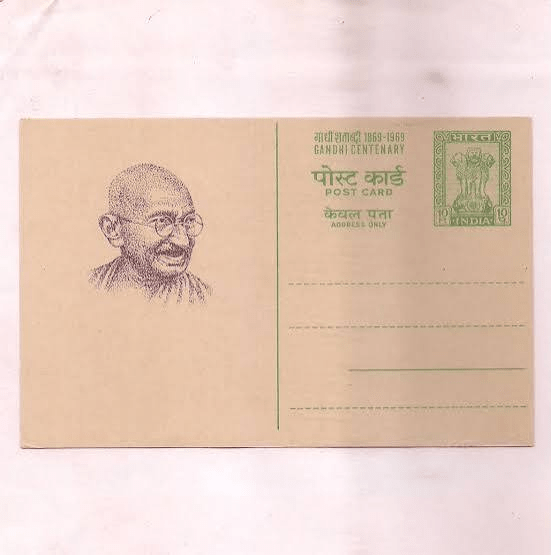
Postcards carried all kinds of news—from good to bad. News of a forthcoming marriage, of an exam passed or failed, of a job appointment, an impending visit from a relative, a birth in the family, as well as of a death. Post cards were cheap, convenient, easily available and transported in their thousands across the length and breadth of the country. For most people of a certain generation this was the primary means of communication. And for many, this was a very “Indian” product.
However, the postcard had already made its debut in Europe. Following earlier experiments in Austria-Hungary and Britain, the first postcard in the world was issued in Austria on 1 October 1869. This was yellow in colour; it was 12.2 cm long and 8.5 cm wide. One side was left blank for writing the message and the other side had space for writing the address. In Britain, postcards without images were issued by Post Office, and were printed with a stamp as part of the design, which was included in the price of purchase.
In British-ruled India the postcard was officially introduced by the Post Office of India on 1 July 1897. The postcard was light brown in colour, with East India Postcard printed on it. The coat of arms of Great Britain was printed in the centre and in the upper right corner was the crowned face of Queen Victoria, printed in red brown. It was 14 cm in length and 9 cm in width.
The card was priced at one fourth of an anna or 3 paise. It was the cheapest form of post and proved a huge success. It is believed that postcards worth about ₹7.5 lakh were sold in the first three quarters of the inaugural year itself. The convenience of this form of communication led the government to also introduce postcards meant specifically for government use in April 1880. Ten years later reply postcards were introduced. In all cases the specs were uniform: The postage was prepaid in full; the weight of the card was not to exceed 5 grams; the cards shall have a legend Post Card written in Hindi or English or printed on the address side. Thus postcards, while uniform in form, took on multiple roles and uses which continued even after India became independent and do so till this day.
While today there are ‘privacy issues’ related to the sharing of data, the postcard, by its very form, was open and public. It was open to be read by anyone from the clerk in the post office, to the postman who carried it in his bag, to the actual recipient. At the receiving end, sometimes in a remote village, it was often read out loud by the postman himself, or by a literate member of the community; or the contents were shared under a tree where the elders gathered. Whether it bore good news or sad news, the emotions that it conveyed were equally shared by the community.
The size of the postcard (which has remained unchanged since it was introduced) and the space available for writing presented a silent challenge to every writer. Squish the handwriting or condense the message? This was no place for waxing eloquent or beating around the bush! Keep it short and neat!
Postcards soon became the cheapest and most accessible form of communication, revolutionizing mass correspondence. Though introduced in India by the British, postcards played a key role in the sharing of information during the movement to gain freedom from the British rule. No one utilized this means of communication better than Mahatma Gandhi.
A prodigious writer of letters, Gandhiji actively used postcards for the majority of his vast correspondence. As a highly practical and budget-conscious communicator who constantly traveled, he found that postcards were the most efficient method to share updates with friends and relatives without wasting time or money. With his unerring logic he explained that postcards were cost-effective, as they cost much less than standard envelopes. Indeed, they did not require an envelope at all, nor the hassle of buying, keeping, and pasting stamps. They were more durable than ordinary writing paper. And their news was transparent, anyone could read the message, and Gandhiji had nothing to hide! And, as a person who could not abide waste in any form, Gandhiji appreciated that the limited space forced the writer to express themselves concisely and clearly.
While Gandhiji wrote perhaps thousands of postcards to people from all walks of life, people from all parts of India and the world also reached out to him through postcards. Throughout the freedom struggle, Gandhiji was constantly on the move, but people who wrote to him were not worried about his address. They simply wrote postcards with his name, and sometimes added “Wherever he may be”. And these postcards did reach him, wherever he was! We can still see some of these original postcards in archives and exhibitions.
Independent India’s first requirement was to collect reliable demographic statistics. A census was considered to be central to this. But the government faced two immediate challenges: how to persuade people to participate in the census, and how to maintain communication between enumerators and census officials across a vast, poor and largely rural country. By then the postal department was the largest unified communications network available to the Indian state. In the run up to the first census in 1951, government used a bilingual pictorial postmark stamped on postcards and letters travelling across the country to educate the public and mobilize participation. The postmark showed a family of three framed by the words “Census of India” in Hindi and English. Subsequently postcards and postmarks were used for different mass pubic campaigns.
When they were first launched, only plain government postcards were permitted, printed and sold by the Indian Post Office. In 1898 the Post office formally permitted privately printed postcards, provided that adhered to size, layout and message restrictions. This opened up a large picture postcards industry in India. Publishers began printing scenic views, cultural monuments, and daily life in India, which became popular.
Almost a century later, India Post introduced Competition Postcards, following the immense popularity of Doordarshan’s show Surabhi where viewers were invited to send in answers to the quiz questions of the week. Initially viewers used the standard 15 paise postcard to send in responses. The response was so overwhelming that the postal department issued a different category of blue-coloured postcards priced at Rs 2/- each to send in responses. These Competition Postcards were subsequently used for many competitions inviting mass public responses.
The Competition Postcards are not currently available, but there are three types of postcards available in post offices. Normal postcards (50 paise), Reply postcards: A double card format which has an attached pre-paid flap that the recipient can detach and send a reply message (Rs 1). Meghdoot postcards wherein the address side features pre-printed colourful advertisements allowing the post office to generate revenue while subsidizing the cost (25 paise). So much to be communicated in so little, literally and cost-wise.
While there is still a generation for which postcards evoke a lot of nostalgia, sadly there is a generation for whom communication has a whole new meaning.
–Mamata


Mamta babhi you helped me time travel back to my childhood when collecting foreign scenery in postcards was a hobby and receiving postcards was pure joy 👏❤️👌
LikeLiked by 1 person