
In the days before cold storage and “imported” made all kinds of fruits and vegetables available in all seasons, there was a strong seasonal association with these. There were distinct summer fruits, reigned over by King Mango, and bitter karela that matched well with the pungent jamuns in the rainy season. There were the winter favourites ushered in by carrots and peas, and fruits like custard apple and guava.
Growing up in Delhi in those days, for us October was always associated with the Apple season. It was around Dussera time that the Golden Delicious variety of apples made their way from Himachal Pradesh to the markets of the plains. The smooth green crunchy apples had a distinct personality from the red apples from Kashmir. Today these are not easily seen, and not many would even bother to know the difference. An apple is an apple, after all.
The history of apples in Himachal Pradesh is linked with a person whose life and work was a curious journey that took many turns. This was a man who was born in the United States as Samuel Evans Stokes, and died as Satyananda, in the service of the poor in India.
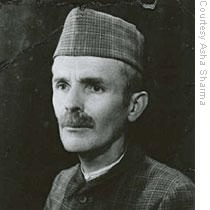
Samuel Stokes was the son of a wealthy American businessman. It was expected that he would continue the family business, but even from his early youth, it was not profit but service that motivated him. This quest led him to join the Christian Quakers religious movement which led him to India as missionary at the age of 22 years. His father initially indulged what he believed was his son’s youthful quest, and even financed his trip.
Stokes arrived in India in 1904. He began work in a leprosy home in Solan district of Himachal Pradesh. His parents were afraid that he would get leprosy and never return home. Samuel survived, but did not return home.
As he started work with leprosy patients, Samuel realised that he would always be seen as a ‘white outsider’. While he could not change his skin colour, began to dress like the local people and learnt the Pahari dialect so that he could directly communicate. Gradually he integrated with the local community and culture.
In 1912, he fell in love with Benjamin Agnes, a daughter of a first-generation Rajput Christian. Together, they bought a large plot of land in the foothills of the Himalayas and settled there. Harmony Hall became the centre of his new passion–horticulture. However, the poverty of the local people and the need to support them was always on his mind. As Samuel decided to turn to farming and embarked on several experiments in cultivating pear, plum and apples, he began to feel that large-scale fruit growing in the area could help to boost the local economy.
In 1914, Samuel went to America carrying soil samples from his land, and returned with saplings of apples of various varieties that he believed would be suited to the climate and terrain of Himachal. After experimenting with these for a year or two, he found that the Red Delicious variety worked best. Then his mother sent him saplings of the Golden Delicious variety which he added to the mix. While apples were not unknown on the Indian subcontinent, they were mainly grown in Kashmir. The few varieties that grew in Himachal were wild, small, and sour. Once Samuel’s apples were doing well, he started distributing saplings to encourage local farmers to start apple cultivation. They were initially reluctant to replace food crops with fruit which took seven years to yield fruit, but Samuel supported them in the sale and export of the produce as they made the transition. Stokes also built a school for children who worked for him in his orchards in lieu of the fee.
By 1928 apples from Harmony Hall had taken over the Himachal valleys. Samuel also set up a training school for future horticulturists on his estate. Himachal Pradesh officially became the Apple State of India.
Stokes had always fought for the rights of the local labourers in Himachal, and fought against injustice. In the meanwhile, Stokes’ close friendship with CF Andrews led him to Gandhi. The Jallianwala Bagh incident which brutally exposed British violence against people led him to join the freedom movement. He attended the Nagpur session of the Indian National Congress in 1920, and was the only non-Indian signatory to the declaration urging Indians to shun government service. He travelled with Gandhi around the United Provinces to spread the message of swadeshi and soon took to wearing khadi kurtas and churidars, topped with a Gandhi cap. His articles in support of non-cooperation and against British rule led to his arrest for sedition in December 1921. In prison, he protested against the preferential treatment accorded him as a European – he considered himself a British Indian and a Congressman.
Stokes officially gave up politics in 1924 but continued to correspond with Gandhiji. He described himself as more of a philosopher than a politician. He devoted himself to working for the land and the people of Himachal. His own life journey then took a spiritual turn. In a simple conversion ceremony, he embraced Hinduism in 1932, and took the name Satyananda Stokes. His desire to serve remained the guiding principle of his work and life till the very end. He died on 14 May 1946 at the age of 64, and is buried in Kotghar, Shimla.
This season, as we savour the Delicious Apples from Himachal Pradesh, it is a good time to remember Samuel Stokes who can be aptly described as the Johnny Appleseed of the Himalayas.
–Mamata


