
There are few relationships as universal as that between a mother and her child. Yet the ways in which we imagine, represent and revere motherhood vary enormously across cultures and centuries. This is the idea at the heart of One Mother, Many Mother Tongues, an exhibition at the National Gallery of Modern Art (NGMA), Bengaluru, curated by Naman P. Ahuja and Andrea Anastasio. Bringing together works from India and Italy, the exhibition spans more than two millennia, inviting us to look beyond familiar images of the mother as nurturer and caregiver. Here, motherhood encompasses protection, fertility, sacrifice, regeneration and even ferocious power. The striking juxtaposition of an Italian Renaissance painting with ancient Indian sculptures makes this more than an exhibition about mothers: it is a conversation between civilisations about what the maternal represents.
The star attraction was billed as Botticelli’s Madonna and Child, but honestly, there were so many works more jaw dropping.
The Italian Attraction
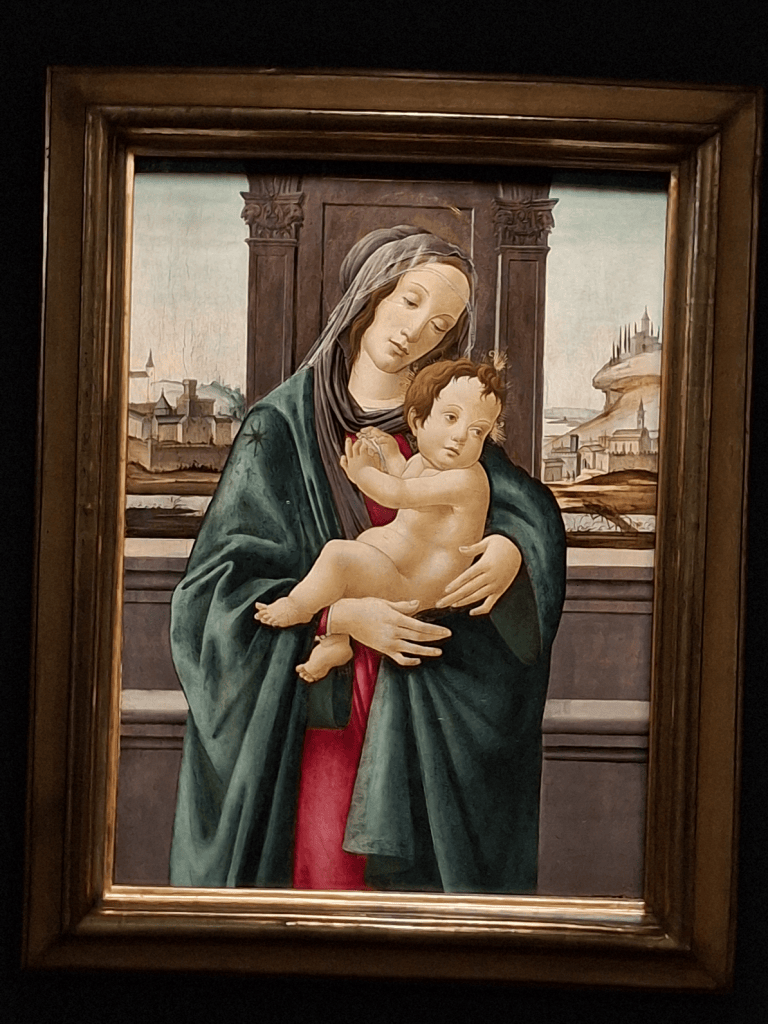
Not to diss the Madonna and Child, painted around 1490 by Sandro Botticelli, one of the great masters of the Italian Renaissance. Seeing a work by Botticelli in Bengaluru is an occasion in itself. The painting depicts the Virgin Mary with the infant Jesus, a subject that Botticelli returned to repeatedly during his career. As per historians, this is not simply a tender portrait of a mother and baby. Look closely, and the relationship seems weighed with foreknowledge. Mary’s red robe evokes her earthly presence, while her blue veil suggests the celestial. Her expression is melancholy, and her hands appear to be opening rather than clasping the child to herself. The infant, meanwhile, seems to gaze beyond the immediate moment, towards a future that his mother may already understand.
In Christian tradition, the infant Jesus is destined for sacrifice, and the painting can be read as a meditation on a mother’s love shadowed by the loss she must eventually endure. It is an image of motherhood in which love does not mean possession: the mother must ultimately release the child to a purpose larger than herself.
The Harappan Mother and Child
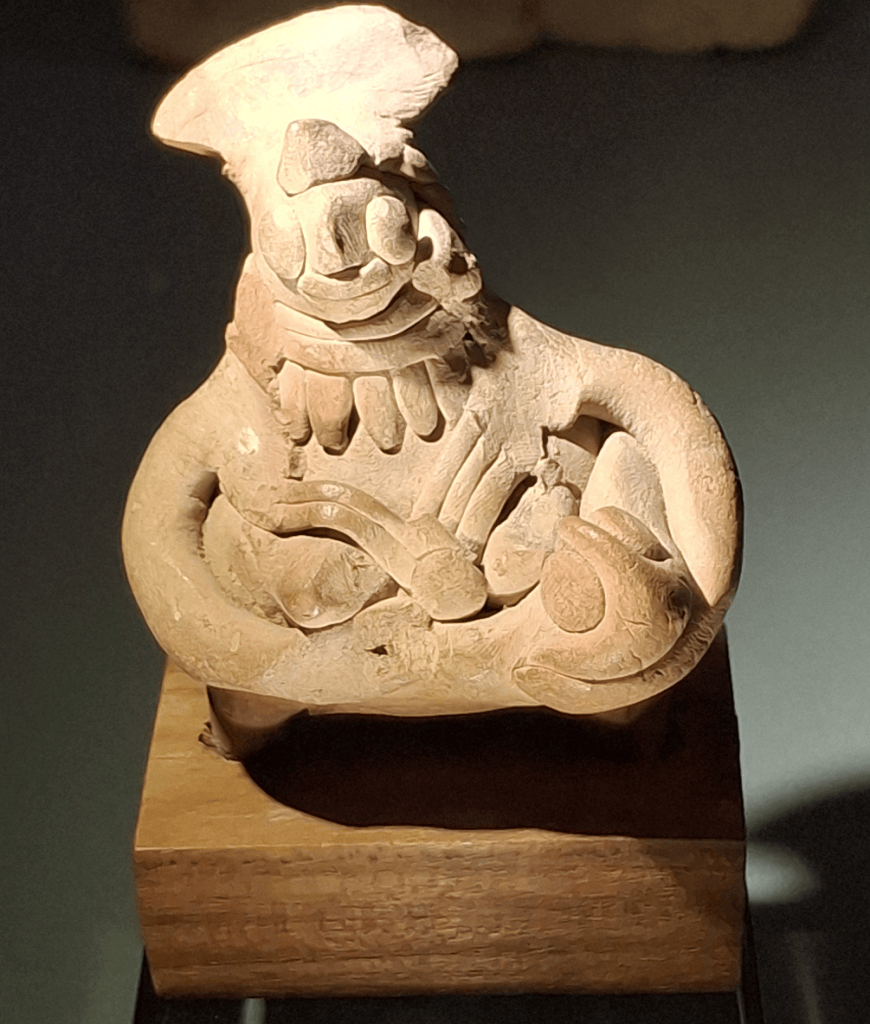
But the most goose-bumpy moment was a small terracotta Mother and Child figurine from the Indus Valley civilisation, dating back to around 2500 BCE, loaned by the National Museum, New Delhi. It is modest in scale and material. Yet its emotional appeal is immediate. The mother cradles her baby. The simple act of holding a child is enough.
We cannot know precisely what the maker intended, whether the figurine had a domestic, ritual or other purpose, or whether it represented a particular deity. But the image does invite us to reflect on the enduring human experience of motherhood. Across the vast gulf of time, a small piece of baked clay brings us face to face with a familiar gesture: the holding of a baby close.
Baby in a Basket
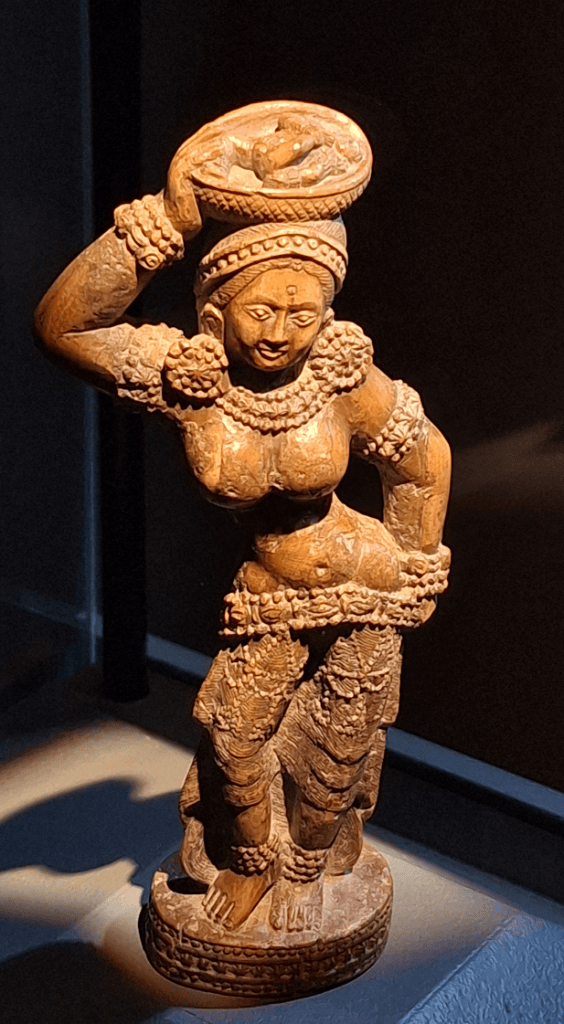
Perhaps the most charmingly matter-of-fact image of motherhood in the exhibition is the small (less than 6 inches high) ivory/bone figure from the Shunga–Kushan period, around the 1st–2nd century CE. A mother carries a basket on her head, with her baby girl (yes, you can make out the sex of the baby on such a tiny figure!) safely tucked inside it. If the detailing of her clothes and jewels is intricate, what I found more intriguing was, why was she carrying the baby in a basket on her head? Where was she going? Again, we have no clue about the situation or the artist’s intentions.
The Yogini: Motherhood Beyond the Human
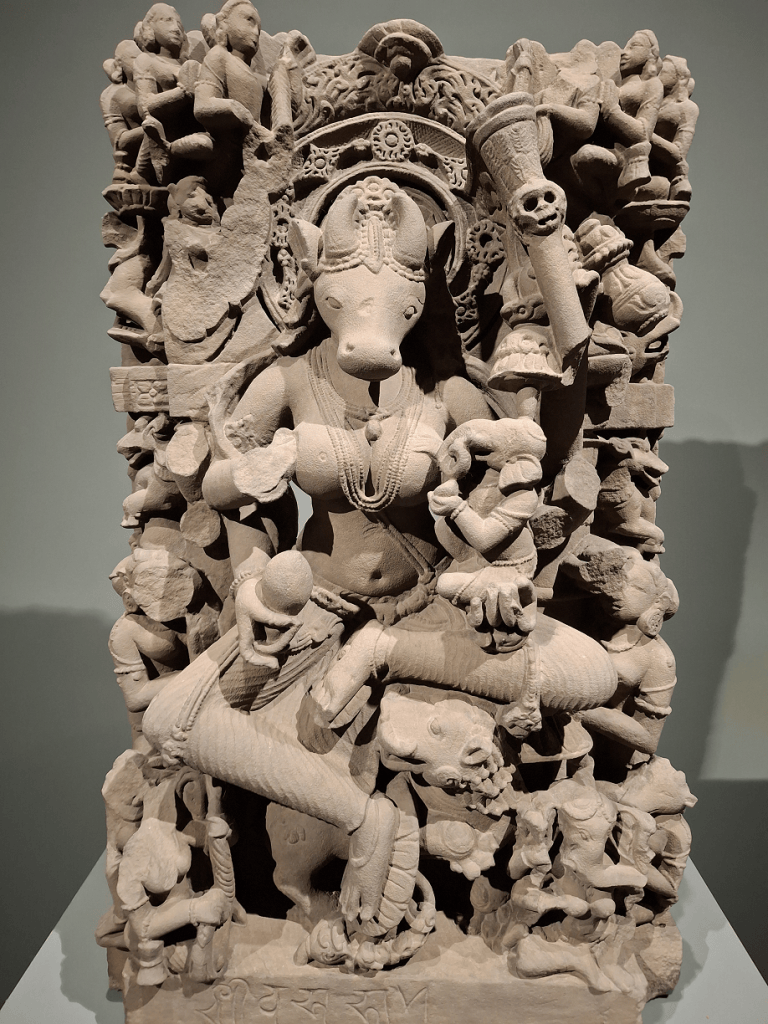
The exhibition becomes particularly intriguing when it moves beyond the conventional mother-and-child image to the world of Indian goddess traditions. The Yogini tradition, associated with powerful female divinities and Tantric practices, does not always fit neatly into familiar categories of motherhood. One of the works highlighted in the exhibition is Vrishabhayogini, a reminder that these figures are not merely idealised representations of feminine beauty or domestic care. The Yoginis belong to a complex religious and artistic world in which female power can be mysterious, unsettling and difficult to contain within a single definition. Their forms and attributes invite us to think about the sacred feminine as something more expansive than the familiar image of a mother holding a baby.
Beyond the Familiar Mother
The exhibition’s other highlights include ancient Etruscan representations of Mater Matuta, a goddess associated with the protection of children, fertility, dawn and renewal, offer a compelling parallel with Indian mother-goddess traditions. The Buddhist goddess Hariti has an especially remarkable story: once depicted in Buddhist narratives as a demoness who abducted and ate children, she was transformed into a protector of children after the Buddha confronted her with the loss of one of her own. Also striking are the Indian Matrikas, or mother goddesses, and the fierce Chamunda, whose fearsome appearance stands at the opposite end of the spectrum from Botticelli’s sorrowful Madonna. A sculpture of Skandamata, the mother of Skanda, adds another dimension to the many ways maternal divinity has been imagined.
One Mother, Many Mother Tongues succeeds in showing us that motherhood is not one fixed image. It is a multitude of stories, beliefs and artistic expressions, each shaped by its own culture.
The juxtapositioning of mothers across geographies and time helps us to see how the mother-and-child motif travelled through different societies and acquired different meanings. Civilisations may differ in their beliefs and artistic conventions; the human bond between parent and child is enduring.
All in all, a wonderful experience!
–Meena


