
Karni Bharni: When a Jain Manuscript Turned Karma into Pictures

What does karma look like?

It is a difficult question. We can explain karma, discuss it, preach about it and philosophise about it. But how do you actually show it?

Some Jain manuscript makers found an ingenious answer. They turned it into a sequence of pictures: this is what someone did and this is what happened as a consequence. The manuscripts came to be known as Karni Bharni, a phrase meaning “as you do, so you receive”. The Gyan Museum describes them as ‘an illustrated Jain didactic tradition in which actions and their consequences are laid out as a sequence of scenes’. The pictures were important precisely because the argument could be followed even by someone who could not read the accompanying text.

I saw a display of such a book when I visited the Museum of Arts and Photography last week. It is a particularly intriguing subject to encounter around Paryushan, when Jains turn their attention towards self-discipline, reflection, religious study, repentance and forgiveness. At the heart of the festival is the uncomfortable but useful exercise of looking at one’s own actions and their consequences.

Karni Bharni does much the same thing—but instead of asking us to imagine the consequences, it paints them.

These are not quite “picture books” in the modern children’s-book sense. They belong to the long and sophisticated manuscript tradition of Jain communities, particularly in western India. Jain bhandars, or manuscript repositories, preserved texts with remarkable continuity. Their importance goes well beyond religion to contributing to understanding the history of Indian painting, as these are some of the earliest surviving Indian paintings on paper.

And there is something wonderfully practical about the way Karni Bharni works. A page can show an action; another scene shows its result. The sequence does the teaching. The figures are deliberately schematic and punishments quite graphic! Their job is to be recognised and understood.
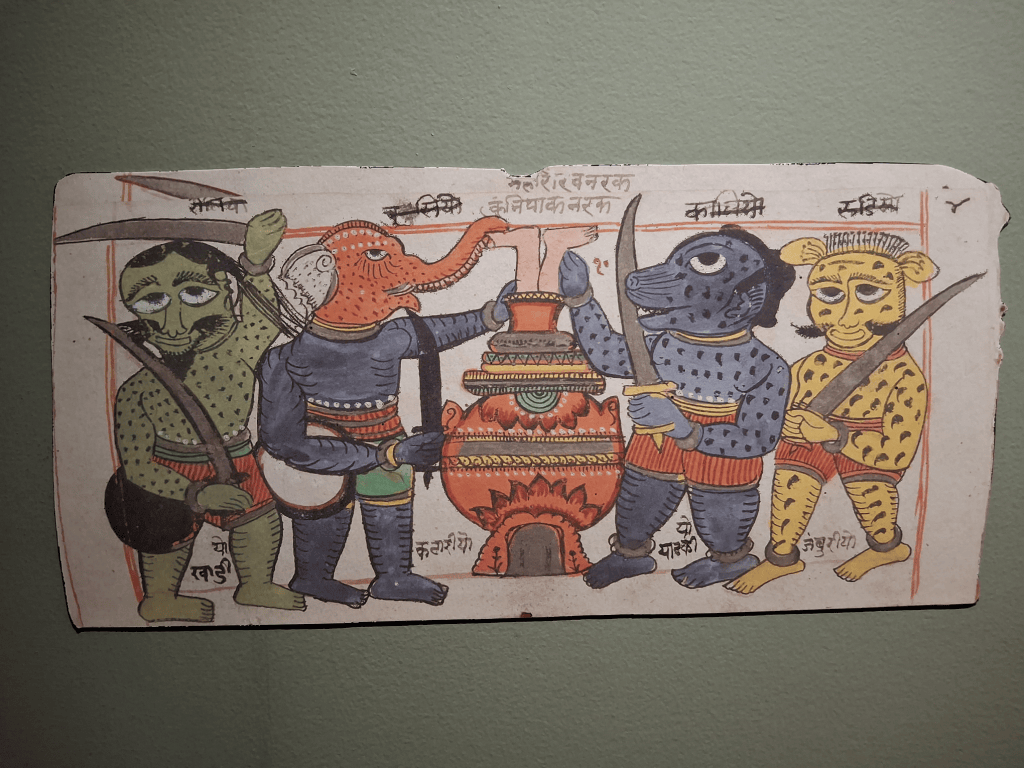
That makes the manuscripts surprisingly contemporary. We live surrounded by infographics, diagrams, animations and explainer videos because we have discovered that complicated ideas can sometimes be grasped more easily when they are visual. The Jain manuscript maker had much the same insight. Instead of writing several pages explaining the workings of karma, why not show the viewer?

Jain cosmology offered an elaborate universe of different realms, including the human world, celestial worlds and hellish realms. Karni Bharni manuscripts could bring this moral universe alive through images of actions, rewards and punishments. A page might therefore be visually dramatic as well as philosophically serious. Heaven and hell were not distant abstractions; they became places that could be imagined through colour, figures and repeated visual motifs.

The striking thing is that these manuscripts were not produced in isolation. Jain merchants and other patrons supported manuscript production, while scribes and artists developed traditions of copying, illustrating and preserving texts. The result was a remarkable interaction between religion, commerce, scholarship and art. The same Jain communities whose members were active in the world of trade were also among the important custodians of India’s manuscript heritage.

It was particularly appropriate that I saw the manuscript during Paryushan. The festival is not simply about fasting. It is a period of pausing long enough to examine how one has lived. Pratikraman involves reflecting upon transgressions and seeking to repair them; Michchhami Dukkadam, traditionally offered at the end of Paryushan, expresses the wish for forgiveness for harm caused knowingly or unknowingly.

The fundamental question these manuscripts answer is universal. Every parent has told a child that actions have consequences. Every schoolteacher has explained cause and effect. Every society has some version of the idea that what we do eventually comes back to us.

But the Jain manuscript tradition did something more ambitious. It made cause and effect visible.

So, during Paryushan, when the emphasis is on reflection, restraint and forgiveness, there is something rather fitting about looking at these old little books.

They remind us that karma was not always something to be explained in a philosophical lecture. Sometimes it was drawn in ink and colour, one scene after another.

If you would like to see some of this remarkable Jain manuscript tradition for yourself, the Gyan Museum in Jaipur offers a wonderful window into India’s rich heritage of art, manuscripts and material culture. Its collection brings together objects that tell stories not just about religion and art, but about the ways in which knowledge, craftsmanship and cultural traditions have been preserved across generations.

And readers, from us to you: Michchhami Dukkadam!

–Meena

Pic taken at MAP of page from late 19th/early 20th century Kharni Bharni book from Gujarat..
WAR AND PEACE: BERTRAND RUSSELL

The media has been bringing to our homes never-ending images of different parts of the world which are in the throes of war. The world is on the brink of what could well be the third world war. At some level people are becoming dangerously inured to the horrors through the never-ending barrage of images and reports that have almost become a part of daily sights and sounds. This in itself is frightening; are we accepting that violence (and its consequences) are an inescapable part of life? And while the world is led by egoistic power-hungry leaders, there is a rapidly declining number of people who feel helpless, even hopeless at the situation as it spirals towards a possibly irrevocable conclusion. Amidst the clamour of belligerent war cries, are some who lament that there are, today, so few voices of reason to remind the world of the precipitous path that we seem to be treading.

What does war achieve? And why do we need to seek peace?

Questions that have been asked since millennia. And answered in different ways in different periods of history. Perhaps one of the most pertinent answers came over a century ago, at a time when the sparks of what became the First World War were just beginning to fan the fire that would rage for the next four years. This was an essay titled The Ethics of War, written by Bertrand Russell in 1915. This was first published in the International Journal of Ethics 25, in January 1915.   

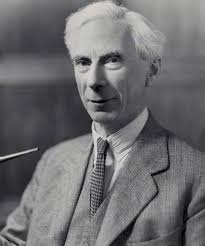
Bertrand Russell is considered as one of the greatest philosophers of the twentieth century. He was actively engaged in numerous social and political issues controversies of his time. A mathematician, educator, social critic, pacifist and political activist, Russell authored over 70 books and thousands of essays and letters addressing a wide range of subjects. He was awarded the Nobel Prize for Literature in 1950 in “recognition of his varied and significant writings in which he champions humanitarian ideals and freedom of thought. Bertrand Russell died in 1970 at the age of 97. Till the end of his life he supported free thought in religion and morals, he opposed war, nationalism and political persecution.

Bertrand Russell’s thoughts on all of the above are beautifully articulated in the essay The Ethics of War. Here are some excerpts:

The question whether war is ever justified, and if so under what circumstances, is one which has been forcing itself upon the attention of all thoughtful men. On this question I find myself in the somewhat painful position of holding that no single one of the combatants is justified in the present war, while not taking the extreme Tolstoyan view that war is under all circumstances a crime. Opinions on such a subject as war are the outcome of feeling rather than of thought: given a man’s emotional temperament, his convictions, both on war in general and on any particular war which may occur during his lifetime, can be predicted with tolerable certainty. The arguments used will be mere reinforcements to convictions otherwise reached. The fundamental facts in this as in all ethical questions are feelings; all that thought can do is to clarify and systematize the expressions of those feelings, and it is such clarifying and systematizing of my own feelings that I wish to attempt in the present article. 

At the beginning of a war each nation, under the influence of what is called patriotism, believes that its own victory is both certain and of great importance to mankind. By concentrating attention upon the supposed advantages of victory of our own side, we become more or less blind to the evils inseparable from war and equally certain whichever side may ultimately prove victorious. Yet so long as these are not fully realized, it is impossible to judge justly whether a war is or is not likely to be beneficial to the human race. Although the theme is trite, it is necessary therefore to briefly remind ourselves what the evils of war really are.

To begin with the most obvious evil: large numbers of young men, the most courageous and the most physically fit in their respective nations, are killed, bringing great sorrow to their friends, loss to the community and gain only to themselves. Many others are maimed for life, some go mad, and others become nervous wrecks. Of those who survive many will be brutalized and morally degraded by the fierce business of killing, which however much it may be a soldier’s duty, must shock and often destroy more humane instincts.

The evils which war produces outside the area of military operations are perhaps even more serious, for though less intense they are far more widespread. …The extent and consequences of the economic injury inflicted by war are much greater than is usually realized. …Thus war, and the fear of war, has a double-effect in retarding social progress: it diminishes the resources available for improving the condition of the wage-earning classes, and it distracts men’s minds from the need and possibility of general improvement by persuading them that the way to better themselves is to injure their comrades in some other country.

Of all the evils of war the greatest, in my opinion, is the purely spiritual evil: the hatred, the injustice, the repudiation of truth, the artificial conflict, where if once the blindness of atavistic instincts and sinister influence of anti-social interests, such as those of armaments with their subservient press, could be overcome, it would seem that there is a real consonance of interest and essential identity of human nature, and every reason to replace hatred by love.

It has been over a century since this impassioned plea by Bertrand Russell. Much has changed since then, but much remains the same. Let us remind ourselves of the futility of mindless violence. Let us Give Peace a Chance.

–Mamata