
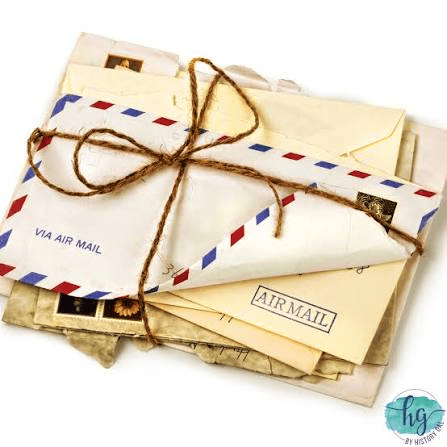
I recently read a book that resonated with me. The Correspondent by Virginia Evans is a novel narrated entirely through letters. The protagonist Sybil is a mother and a grandmother, divorced, retired from a distinguished career in law. Every morning at half-past ten, Sybil Van Antwerp sits down to write letters. Letters to family, letters to friends, even letters to authors whose books she has read, to share her own thoughts on these. Sybil uses her letters to make sense of the world. And by the end of the novel, it is her letters that unfold the story of her own life.
As a person who has been a letter writer most of my life. And who persisted with writing on real paper with real ink, although by part-necessity, succumbed to emails, much after the rest of the world around, this book was the reiteration of the enduring value of ‘real’ letters.
Coincidentally, just a few days later, I read that in an already-packed Calendar of “Days” there is a day which celebrates the disappearing art of putting pen to paper. World Letter Writing Day is marked on 1 September every year, as a reminder of the appreciation of handwritten correspondence. How ironic, and so sad that people need reminding of this. And yet, there is a new generation that has probably never sat down with a clean sheet of paper, a pen of their choice, and enough time to open their minds and hearts to a loved one. In this day of instant sharing of bullets of information, written in abbreviated code, and shot off with the tip of a finger, what are we losing?
Sybil, in one of her letters to a sceptic who wonders why she still writes each letter by hand explains: You also asked after the meaning of my practice of letter writing, calling it quaint and impractical. Imagine all that you have said to one another, all the commentary you have exchanged with friends over drinks, over the phone with colleagues and distant relatives, all the prattle sent quickly, mindlessly over the email, messages typed into your cellular phone, and really, the sum of this interpersonal communication is the substance of your life, relationships being, as we know by now in our old ages, the meat of our lives, but all of that is gone. Vanished!
This mode of communication has been replaced by what another member of the letter-writers club describes as “relinquishing the post the envelope, a pen, a slower cerebral whirring, the use of our whole hands and not just the tips of our fingers.”
And yet, even more ironically, although electronic forms of communication have now largely taken over from the handwritten letter, perhaps even Gen Z secretly yearns to receive the kind of letters that their parents and grandparents talk about with nostalgia. A survey discovered that while 64% of people would not sit down and hand write a single letter over the course of a year, 69% said that receiving something handwritten through the post would mean more to them than a text, tweet or Facebook message.
The first ever personal handwritten letter was thought to have been sent by the Persian Queen Atossa in around 500 BC, according to the ancient Greek historian Hellanicus. The popularity of letters as a way of sending messages grew as more people became literate. While the exact contents or physical copy of this letter have not survived, letters as a form of communication have withstood the passage of times. Great authors have not just penned works of literature, they have revealed so many personal facets through hundreds of letters that remain timeless windows into another time, and other ways of seeing the world. Thankfully these letters are preserved today in archives, and several published.
What will remain of the ephemeral messages that today whiz across the virtual skies, and disappear like shooting stars? Where will there be the magical experience of joining someone, perhaps hundreds of years later, to peek into their relationships, their thoughts, and, reading between the lines, imagining the additional unpenned words? How will we be able to trace the contours of their lives, discover the greys on the fringes of the more obvious black and white? How will we experience the serendipitous excitement when we discover the words that suddenly connect their experience with ours, and the uncanny sense of bonding with the author?
For this, we need letters. And we need to be able to access these letters. But first, these letters need to be written.
Simon Garfield shares this angst in his book To the Letter: A Celebration of the Lost Art of Letter Writing.
Letters have the power to grant us a larger life. They reveal motivation and deepen understanding. They are evidential. They change lives, and they rewire history. The world once used to run upon their transmission — the lubricant of human interaction and the freefall of ideas, the silent conduit of the worthy and the incidental, the time we were coming for dinner, the account of our marvelous day, the weightiest joys and sorrows of love. It must have seemed impossible that their worth would ever be taken for granted or swept aside. A world without letters would surely be a world without oxygen.
Sybil, in her ruminations reiterates this sentiment:
And yet if one has committed oneself to the page…Imagine, the letters one has sent out into the world, the letters received back in turn, are like the pieces of a magnificent puzzle, or, a better metaphor, if dated, links of along chain, and even if those links are never put back together, which they will certainly never be, even if they remain for the rest of time dispersed across the earth like the fragile blown seeds of a dying dandelion, isn’t there something wonderful in that, to think the story of one’s life is preserved in some way, that this very letter may one day mean something, even if it is a very small thing, to someone?
–Mamata


