I Am a Tree

Meena’s recent musings on “her’ guava tree took me back to my early days as an environmental educator. One of our first assignments was to develop a series of worksheets for children which would help to spark curiosity, interest, and appreciation of the natural world. This meant that we ourselves needed to experience what we expected the children to experience. We decided to start small, with a single tree, rather than a forest. The exercise began with our own observations of a single tree.

Over days, as we began to explore the numerous dimensions of a single tree, we got caught up in a fascinating journey of observing, exploring, and discovering. Putting together our notes, and engaging in refreshing discussions, the worksheets and activities for guided observation began to evolve. Preliminary try-outs of these with teachers and students added new dimensions that enriched our own understanding.

One of the unplanned spin-offs from this experience was a poem that I wrote; an attempt to capture the wonderful web of life that a single tree nurtures.

Decades later, the poem about the guava tree evoked many memories, and led me back to these words, penned long ago.

I Am a Tree

I am a tree

so straight and free

all branches and twigs and trunk am i

but i stand alone

bare to the bone

i am a tree

so tall and free

who will come and be with me?

WE are the roots

from us will sprout the shoots

we dig deep and wide

spread out on every side

under the earth we hide

food and water we gather it all

to help the tree stand strong and tall.

WE are the leaves

we dance in the breeze

so many are we, different ones for every tree

some long, some short, some large some small

some yellow, some red, some grow some fall

we cover the branches and twigs like a screen

making a beautiful dress of green

to help the tree to breathe and dine

there’s lots to be done

but for that we need the sun.

WE are the insects

we live on the tree

we crawl, we creep, we hop, we fly

in cracks and hollows, some damp, some dry

we take our fill of fruit and flower

leaf and bark we lay our eggs and spin our webs

if you look hard you’ll see our mark.

WE are the birds of different feathers

we flock to the tree in all kinds of weather

we stitch, or weave, or build our homes

from twigs, on branches, in trunks with holes

we coo, we caw, we chirp, we chatter

we rest, we roost, we flutter, we patter.

WE are the children

we love the tree

in village, in city, town, and country

it gives us shade and fruit for free

it plays with us when we make believe

that we are a squirrel, a hawk, tarzan

up we go on it, one…two…three

look at the world like a monkey.  

A tree i am

so happy and free

so many friends are part of me

they make me a world of colour and sound

we help each other

from sky to ground.

I was a tree

once proud and free

i lived, i grew, i got i gave

some rain i brought, some soil i saved

i was a world for living things.

i am now a stump, just left to dry

cut up for wood. oh, how i cry

a table, a chair, a window, a door, a pencil, a paper, something more

a bonfire has been lit of me.

I that was tree

once tall and free  

While poets continue to wax eloquent about trees, no human can ever create a tree. That is exclusively Nature’s miracle and gift.

Joyce Kilmer reminded us of this in 1913.

   I think that I shall never see

  A poem lovely as a tree.

  Poems are made by fools like me,

  But only God can make a tree.

–Mamata

An Ode to Letters

I recently read a book that resonated with me. The Correspondent by Virginia Evans is a novel narrated entirely through letters. The protagonist Sybil is a mother and a grandmother, divorced, retired from a distinguished career in law. Every morning at half-past ten, Sybil Van Antwerp sits down to write letters. Letters to family, letters to friends, even letters to authors whose books she has read, to share her own thoughts on these.  Sybil uses her letters to make sense of the world. And by the end of the novel, it is her letters that unfold the story of her own life.

As a person who has been a letter writer most of my life. And who persisted with writing on real paper with real ink, although by part-necessity, succumbed to emails, much after the rest of the world around, this book was the reiteration of the enduring value of ‘real’ letters.

Coincidentally, just a few days later, I read that in an already-packed Calendar of “Days” there is a day which celebrates the disappearing art of putting pen to paper. World Letter Writing Day is marked on 1 September every year, as a reminder of the appreciation of handwritten correspondence. How ironic, and so sad that people need reminding of this. And yet, there is a new generation that has probably never sat down with a clean sheet of paper, a pen of their choice, and enough time to open their minds and hearts to a loved one. In this day of instant sharing of bullets of information, written in abbreviated code, and shot off with the tip of a finger, what are we losing?

Sybil, in one of her letters to a sceptic who wonders why she still writes each letter by hand explains: You also asked after the meaning of my practice of letter writing, calling it quaint and impractical. Imagine all that you have said to one another, all the commentary you have exchanged with friends over drinks, over the phone with colleagues and distant relatives, all the prattle sent quickly, mindlessly over the email, messages typed into your cellular phone, and really, the sum of this interpersonal communication is the substance of your life, relationships being, as we know by now in our old ages, the meat of our lives, but all of that is gone.  Vanished!

This mode of communication has been replaced by what another member of the letter-writers club describes as “relinquishing the post the envelope, a pen, a slower cerebral whirring, the use of our whole hands and not just the tips of our fingers.”

And yet, even more ironically, although electronic forms of communication have now largely taken over from the handwritten letter, perhaps even Gen Z secretly yearns to receive the kind of letters that their parents and grandparents talk about with nostalgia. A survey discovered that while 64% of people would not sit down and hand write a single letter over the course of a year, 69% said that receiving something handwritten through the post would mean more to them than a text, tweet or Facebook message.

The first ever personal handwritten letter was thought to have been sent by the Persian Queen Atossa in around 500 BC, according to the ancient Greek historian Hellanicus. The popularity of letters as a way of sending messages grew as more people became literate. While the exact contents or physical copy of this letter have not survived, letters as a form of communication have withstood the passage of times. Great authors have not just penned works of literature, they have revealed so many personal facets through hundreds of letters that remain timeless windows into another time, and other ways of seeing the world. Thankfully these letters are preserved today in archives, and several published.

What will remain of the ephemeral messages that today whiz across the virtual skies, and disappear like shooting stars? Where will there be the magical experience of joining someone, perhaps hundreds of years later, to peek into their relationships, their thoughts, and, reading between the lines, imagining the additional unpenned words? How will we be able to trace the contours of their lives, discover the greys on the fringes of the more obvious black and white? How will we experience the serendipitous excitement when we discover the words that suddenly connect their experience with ours, and the uncanny sense of bonding with the author?

For this, we need letters. And we need to be able to access these letters. But first, these letters need to be written.

Simon Garfield shares this angst in his book To the Letter: A Celebration of the Lost Art of Letter Writing.

Letters have the power to grant us a larger life. They reveal motivation and deepen understanding. They are evidential. They change lives, and they rewire history. The world once used to run upon their transmission — the lubricant of human interaction and the freefall of ideas, the silent conduit of the worthy and the incidental, the time we were coming for dinner, the account of our marvelous day, the weightiest joys and sorrows of love. It must have seemed impossible that their worth would ever be taken for granted or swept aside. A world without letters would surely be a world without oxygen.

Sybil, in her ruminations reiterates this sentiment:

And yet if one has committed oneself to the page…Imagine, the letters one has sent out into the world, the letters received back in turn, are like the pieces of a magnificent puzzle, or, a better metaphor, if dated, links of along chain, and even if those links are never put back together, which they will certainly never be, even if they remain for the rest of time dispersed across the earth like the fragile blown seeds of a dying dandelion, isn’t there something wonderful in that, to think the story of one’s life is preserved in some way, that this very letter may one day mean something, even if it is a very small thing, to someone?

–Mamata

Wimbledon Shines On

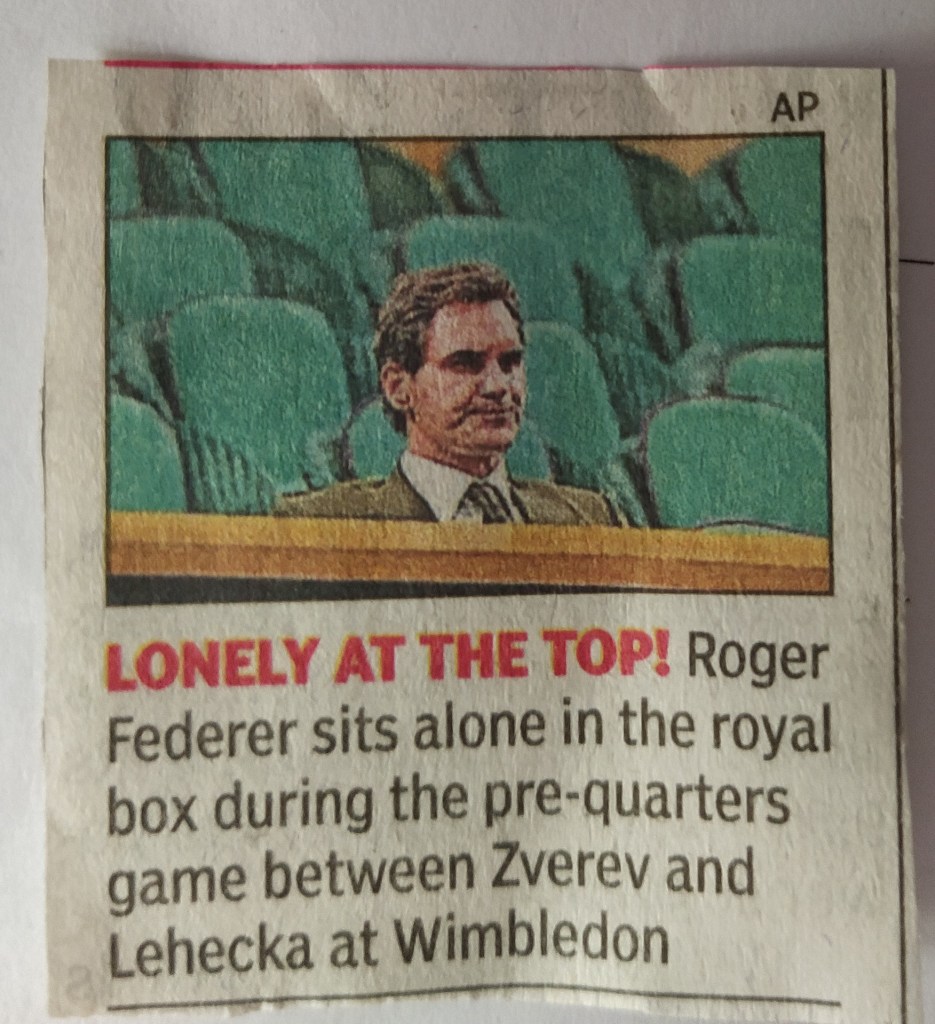
A photograph in the newspaper showed Roger Federer tennis’ GOAT sitting alone in the VIP Pavilion at Wimbledon. It made me wonder why? Wimbledon is one of the oldest and most revered of Tennis traditions, and to be a spectator at this venue which is teeming not only with the GOATs and future Greats of Tennis, but equally the crème de la crème of society from British monarchy to Hollywood icons, is a special privilege. Is it that this year the FIFA World Cup has eclipsed all other sporting events?

Be that as it may, Wimbledon remains the grand old lady of professional tennis. It’s interesting history dates back to 1877. The first tournament was hosted by the All England Lawn Tennis and Croquet Club. It had originally been called the All England Croquet Club when it opened in 1869. But as the new game of lawn tennis was growing in popularity the club decided to provide tennis courts for their visitors. And also changed its name to include Lawn Tennis.

Tennis itself had its origins in a 13th century French handball game called je de paume or ‘game of the palm’ which developed into an indoor racket-and-ball game called real or ‘royal’ tennis.  In about 1873, an Englishman adapted indoor tennis to be played on grass, naming the game ‘sphairistike’, after an ancient Greek game. Sphairistike quickly became popular among the idle upper classes, who were itching for a new sport to play.

The game was promoted by the All England Lawn Tennis and Croquet Club which laid down the rules of the game that codified and shaped the game. Since then the All India Club has been the ‘supreme court of appeal on the question of rules’.  

The club held its first lawn tennis tournament on 9 July 1877 at Wimbledon, then an outer suburb of London. The tournament continued for the next several days, including some non-playing days. The only event was the Gentlemen’s Singles tournament, where the winner would take home a 25-guinea prize. 200 spectators showed up. By the mid-1880s thousands were flocking the stands. By 1905 the championships were attracting competitors from overseas. Tennis was coming of age.

Twenty-two amateurs registered to compete in the first championship, but only 21 showed up on July 9 for its first day. Interestingly only ‘amateurs’ were allowed to compete in the championships, and that clause remained for the next 90 years. ‘Amateur’ was then a synonym of ‘gentleman’. For the elite running the country clubs, sport wasn’t sport until it was played in one’s leisure time on private estates. The term professional carried the stigma of the ‘manual labourer’.

In the 1950s, many tennis stars turned professional while Wimbledon struggled to remain an amateur tournament. It is only in 1968 that Wimbledon first allowed professionals—players who in some manner were paid for their tennis ability—to compete at the championships, ushering in the “open era.”

Women began playing at Wimbledon in 1884, seven years after the men. But it was only in 2007 that Wimbledon introduced equal prize money for women.

The annual championships continued uninterrupted except for the years during World War II. In preparation for Germany’s infamous Blitz bombing attacks on London, the grounds of the 150-year-old British tennis club were transformed into a Civil Defence camp. The grounds even became home to a small farmyard stocked with rabbits, pigs and hens. On 11 October 1940 Wimbledon’s historic Centre Court even took a direct hit from a 500-pound German bomb. The grounds were not fully repaired until 1949. And from then on, the annual tournaments were uninterrupted.

As with all things English, Wimbledon has its special traditions. The accepted outfit of choice for Wimbledon players in the nineteenth century was plain white long-sleeved shirts and trousers for men, and full-length corseted white dresses and hats for women. It was not until the 1920s and 1930s that the players, and particularly the female players, began to experiment with their clothing. Shorter skirts, shorts and sleeveless tops were all introduced, some more daringly than others, to provide ease of movement and a sense of individual personality. Today we have players like Naomi Osaka making her entrance to the court in outfits that attract as much (if not more) attention as her dramatic tennis.

The men have long been promoters of commerce. As far back as the nineteen thirties, the French grand slam winner Rene Lacoste promoted his own label by wearing crocodile emblazoned shirts on court. Today designer wear and multi-million dollar sponsorships which announce themselves with emblazoned logos, make players look like animated ads. Even the ball boys and girls have left behind the traditional Wimbledon colours of green and purple, and have sported navy and cream uniforms created by the American fashion designer Ralph Lauren since 2006. The tradition of having strawberries and cream has remained unchanged.

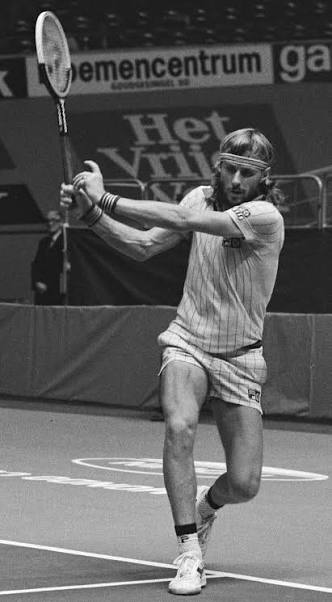
Bjorn Borg 1975

I cannot resist adding my own Wimbledon story. As a young student in England in 1975, one of the items on the ‘bucket list’ of things to do before I leave England was to catch a match at Wimbledon. So early one morning, a couple of friends and I set off by train from Brighton to the Wimbledon station. Having walked to the venue we joined the serpentine queues for the daily tickets. Our carefully saved few pounds would not let us anywhere near the luxury of season tickets, or seats for any of the later matches on the Centre Court, as the players advanced from quarter finals to crowning glory. Nevertheless, we could afford standing room for the day’s matches. We saved a few shillings to partake of the traditional strawberries and cream, as we flaunted our wide-brimmed straw hats. But we did get to see the rising star, and everyone’s current heart throb Bjorn Borg play. He lost that year’s Wimbledon title to Arthur Ashe, but the next month went on the win the French Open title.

Today 149 years after the first tournament was initiated on 9 July, the Wimbledon championships remain the only major tennis event still played on grass. The name and the game continue to make headlines as new comets emerge, skyrocket to fame and, when their time comes, give way to a new crop of stars. The glory of Wimbledon continues to glitter and gleam like old gold.

–Mamata

A Just War: St. Augustine of Hippo

Pope Leo XIV’s recent visit to Algeria had a special personal significance for His Holiness. The current Pope is the first Augustinian Pope; he is a member of the Order of St. Augustine. The Pope visited the archaeological site of ancient Hippo, (modern day Annaba) where once stood the Basilica of Peace church where St Augustine was Bishop was 34 years. He described it as “a profoundly emotional and spiritual moment”.

Who was St Augustine, and why is he significant even today, even though he lived 16 centuries ago? 

St. Augustine of Hippo was a theologian, writer, preacher, rhetorician, and bishop. Before he became a saint, Augustine’s life saw many different phases. He was born in 354 AD in Thagaste, presently called Souk Ahras in modern-day Algeria, which was then a part of the Roman Empire. He was African, and not white, as later depicted. His mother Monica was a devout Christian, and his father, a tax collector who converted to Christianity only on his deathbed.

Augustine was bright student, and he had great rhetorical skills; he travelled to Carthage to study rhetoric. But in his teenage years he was irreligious and led a wild life, in spite of his mother’s prayers and counselling. In his twenties Augustine was restless and in his quest to discover ‘the truth’ he experimented with the cult of Manichaeism, a concoction of Christian, Buddhist, astrological and pagan elements. He then became influenced by Neo-Platonism, which drew from Plato. Augustine was still lost and wandering, much to his mother’s despair.

His wandering led him to Milan, where an encounter with the bishop of Milan, Ambrose, changed his life path. The bishop, who was considered one of the greatest orators in the Roman world influenced Augustine, at the age of 33, to convert to Christianity in AD 347. Augustine was ordained a priest in 391 and he became Bishop of Hippo (today’s Annaba, Algeria) in 395.

After his conversion, Augustine used his skills as a thinker and writer in service to the church. He moved back to North Africa and eventually became bishop of a town named Hippo. He continued not only to speak eloquently, but was also a prolific writer. His personal journey, the story of his spiritual quest, formation and conversion, is documented in The Confessions. Written in 401, this work is a model for modern autobiography as it depicts the formation of a mind and character.

St. Augustine also wrote several other noteworthy books. Perhaps the most relevant today, are his thoughts and writings on war and peace. He was one of the first people to articulate a philosophical statement of war and justice. Augustine drew upon Christian teachings as well as Greek and Roman philosophy to propose a set of principles that defined a ‘just’ versus an ‘unjust’ war. He laid the groundwork for what became known as the Just War Doctrine.

St. Augustine lived in volatile times. In a period when there was a race to expand Empires, St. Augustine questioned the value of such expansion, comparing it to a human body, arguing that a moderate stature with good health is preferable to an oversized, unhealthy body (and by extension, empire).

He viewed war with deep sorrow and profound skepticism regarding its ultimate value. Acknowledging that war is inevitable in some situations, he laid down certain criteria under which war is a permissible recourse. 

Just Cause: to confront “a real and certain danger” to protect innocent life.

Competent Authority: declared by those with responsibility for public order.

Comparative Justice: Are the values at stake critical enough to override the presumption against war?

Right Intention: War can only be conducted to satisfy the just cause.

Last Resort: All peaceful alternatives have already been exhausted.

Probability of Success: The outcome cannot be disproportionate or futile.

Proportionality: inflicted damage must be proportionate to the good expected.

St. Augustine also drew upon earlier Roman conventions about war. For example, that it must be declared by proper authorities and not by angry mobs. The Empire also had a policy — not always followed — of allowing conquered people to keep their own customs, religions, and local laws.

Which wars are not just? These would be wars marked by selfish intent. Wars to seize territory, wealth, or power are not just. Wars fought for personal glory or out of vindictiveness are not just.

While he agreed that a ‘just war’ could be fought to restore peace or punish injustice, he viewed it as a ‘necessary evil’ rather than a good. He maintained a fundamental belief in the futility of war for achieving lasting, meaningful human happiness.

As early as the fifth century St. Augustine was considering the moral consequences of war. For Augustine, any conflict that does not have the final establishment of a stable, just peace as its sole purpose, is useless and immoral.

Writing in 418 A.D., he wrote: “Peace should be the object of your desire; war should be waged only as a necessity…in order that peace may be obtained. Therefore, even in waging a war, cherish the spirit of a peacemaker, that, by conquering those whom you attack, you may lead them back to the advantages of peace…As violence is used toward him who rebels and resists, so mercy is due to the vanquished or captive.”  

In his book City of God, he noted that even a ‘just war’ is characterized by cruelties and miseries. He viewed the brutality of war with profound lament and often expressed a “deep hatred of war” and contempt for those who glorified military victories. The Just War doctrine emphasizes that a set of rules for military combat must be followed. This means treating non-combatants such as women, children, elderly, wounded, and prisoners of war humanely.

The Just War theory has become an integral part of Western philosophy. Even today it is reflected in international humanitarian law.

St. Augustine regarded the power-seeking know-it-alls of the day as ‘dangerous fools armed with the pretense of knowledge’. In our current turbulent period of history, we are witness to how international and humanitarian law is being flouted with arrogance and impunity by exactly the same kind of people.

It is a time to remember another valuable insight from St Augustine–The idea that you were bigger or better, or more self-righteous, or somehow immune from the rules that govern others — the absence of humility, in other words, gave you license to do unto others what you would never allow them to do unto you.

Just War?  Or A Just War?

–Mamata

When Letters Took Flight: The First Air Mail

As a member of the generation before email and ‘texting,’ and one who has always been an avid letter writer, there are many memories of trips to the local Post Office to buy stamps and personally drop the letter in the friendly red post box. The process was more complicated when mailing a letter to someone who was not in India. This meant taking a decision on whether the post should be sent by surface mail or air mail. Air mail was more expensive, albeit faster. There were two options for the air mail—the standard pre-stamped aerogramme, and the challenge to squeeze in as much text as possible in the available space, and an envelope which could accommodate more sheets and hence more matter. But then there was the issue of weight. The envelope would be weighed and the postage decided depending on the weight! Hence an earlier exercise involved acquiring the lightest, thinnest writing paper. (There was an ‘onion skin’ paper as I recall which was in itself more expensive!) Ah, the sweet travails of written communication then!

One always associated the entire concept of ‘air mail’ as having its origin in the West. Many decades later, I discovered that the very first air mail delivery happened in India!

The story goes back over a century ago. India was still under British rule but Indian festivals and fairs went on. One of the biggest of these was the Kumbh Mela held at Allahabad. It was to coincide with the Kumbh Mela of 1910-1911 that the then Lieutenant Governor of the United Provinces Sir John Prescott Hewett organized a national exhibition in Allahabad. It was a huge show housed in buildings with elaborate architecture. The twelve sections included exhibits for engineering as well as agricultural sciences, textiles, forestry, and display of handicrafts from around the world. There were cultural programmes featuring prominent singers and dancers of the day. The exhibition ran from December 1910 to February 1911.

As part of the many attractions, Captain Walter George Windham, one of the influential pioneers of aviation was invited to bring some flying machines from England to Allahabad and organize demonstration flights. These would be the first planes to fly in India. Captain Windham brought two aircraft to Allahabad and organized aerial demonstrations by the two pilots that accompanied the aircraft. One of these was a 23- year-old French pilot Henri Pequet.

When Captain Windham was in Allahabad, the Rev. Holland, warden of a hostel for Indian students in Allahabad asked him if he could help raise some funds for repair of the hostel and construction of a new one. Windham had the idea that sending post by air would attract a lot of attention, and hopefully raise funds. He obtained permission from the India Post Office. To send through this, at the time novel means, people were asked to send mail to Rev. Holland, addressed and stamped, at the regular rate, but requested to donate a nominal sum of 6 annas for every letter or card which would be sent on the flight, as a donation for the new buildings. This mail would be part of the airborne postal service. A special postmark was authorised for this batch; it was designed by Captain Windham and the die for this was cast at the postal workshop in Allahabad. It was four cm in diameter and magenta in colour. All postal arrangements were handled by the Exhibition Camp Post Office.

On 18 February 1911, a Humber-Sommers bi-plane, piloted by Henri Pequet was loaded with 6,500 postal articles with the special postmark. The flight took off from the Allahabad polo field, witnessed by thousands of spectators. It landed near Naini railway station where there were no crowds, but a lone postal official who took the mail bags. From there, the post would continue to its destinations by the regular route, and with the regular charges.  The distance covered was approximately 11 km and the flight time was 13 minutes! Having delivered the first officially sanctioned airborne postal consignment in the world, Peqeut got back into the plane and returned to Allahabad. 

The use of a plane for delivering letters received world-wide attention once the letters with the special post mark reached England. 

Before this, some transport of post by ‘air’ was not entirely unknown. During the 1800s balloons and gliders carried some mail. The first sustained powered flight by the Wright brothers on 17 December 1903 did not carry any mail, but in the decade that followed, pioneering pilots would carry ‘unofficial’ mail on their short flights. This did not have official postal authorization. The Allahabad to Naini flight carried the first ‘official’ air mail. Following this, the world’s first scheduled airmail post service took place in the UK between the London suburb of Hendon and the Postmaster General’s office in Berkshire on 9 September 1911, as part of celebrations for King George V’s coronation.  

Subsequently, while the rest of the world saw rapid developments in postal air services, there was not so much happening in India. The first regular air service between India and UK was opened in 1929. Soon after that the first domestic route was opened between Karachi and Delhi. The Indian State Air Service as it was designated, ran for just two years during which it completed 197 scheduled flights, and carried 6,300 kg of mails. After its closure, the Delhi Flying Club was given permission to operate an exclusive mail service between Delhi and Karachi. Its one light aircraft carried over 7000 kg of mail during its operational period of 18 months. The big leap came in October 1932 when JRD Tata flew a Puss Moth airplane from Karachi to Bombay. The inaugural flight of India’s first air service was to become Tata Sons Ltd, and later grow into Air India, carried a load of mail. Karachi was chosen as the starting point because Imperial Airways terminated there with the mail from England, and the mail route chosen by Tatas was Karachi-Bombay-Madras (via Ahmedabad and Bellary). At the beginning the airplanes used were so small that the service was restricted to mail, but a single passenger was occasionally allowed to sit on top of the mail bags — usually with his heels higher than his head! Meanwhile the mail load had increased from about 10,500 kg in 1933 to about 30,000 kg in 1935. Larger aircraft were introduced only in 1936. While the government refused to subsidize the service, it could be sustained by a ten-year mail contact with the Government for transport of mails.

After Independence there was need for delivery of mail that was faster than through road and rail services. Daytime flights could carry only passengers. In 1949, Night Air Mail was introduced in which mail from Delhi, Calcutta, Bombay and Madras was collected at designated points in each city, delivered straight to the airport and flown to Nagpur, where it was sorted and flown back to the respective cities the same night, and delivered the next day. In the sixties there were as many as ten flights carrying mail to Nagpur in a single night. The service was discontinued in 1973. Subsequently the Indian Postal Service introduced many services including Speed Post. Today couriers and electronic exchange of information have overshadowed the work of the postal service. The postman, once eagerly awaited, and letters, eagerly opened and read and reread, have almost faded from memory. But it is important not to forget the pioneering efforts that brought us here. 

–Mamata

A Spoonful of Good Luck: Dahi-Cheeni

It has been the tradition in my family that is most closely associated with my mother. And one that we continue to follow. Giving a spoon of curd and sugar just before any one leaves for an exam, an interview, an important meeting, and embarking on any travel, short or long. My mother never failed to do this, even when she herself could not do so easily, but by reminding us to take it ourselves before we said au revoir.

We sisters always believed that this was something exclusive to our mother and our family, never once wondering where tradition originated, and where and when it began in our family. Then this week I read an article on this very practice, and realized that another family also considered this as a personal family tradition! And that, perhaps there were many others who followed this tradition. A more focussed exploration uncovered that the tradition of dahi-cheeni (curd and sugar) as it is called is not only an ancient one, but is also Pan-Indian! In North India it is a spoon of curd with a sprinkling of sugar, as also in Gujarat. In Bengal it is doi-shinni a mix of curd, sugar and sometimes a bit of banana or jiggery. In Tamil Nadu it takes the form of thayir sadam, the ubiquitous curd rice. I am sure that every state has its own version with some variations on the theme.

This combination features in Valmiki’s Ramayana in the book on Ayodhya Kand, when Sage Bharadwaja offers a sumptuous banquet to Bharata and his army. Among the list of rich foods offered as part of the feast, there is a mention of fresh curds mixed with sugar and spices. Thus it finds its niche While this offering seems too simple as compared to the rest of the meal, it held a great significance, and had its niche in the menu.

Indeed, this simple combination is a trusted part of the ancient holistic health system of Ayurveda where curd (dahi) and sugar (sakara) were considered sattvik, pure life-supporting foods that bring clarity and calm. Charaka Samhita, one of the oldest books on Ayurveda, written over 2000 years ago, mentions curd mixed with jaggery as being refreshing, and helping in alleviating Vata qualities. Ayurveda deals with three doshas: Vata. Pittta and Kapha, which are believed to be responsible for a person’s physiological, mental and emotional health, and categories different foods as having a ‘heating’  or ‘cooling’ effect. With reference to dahi-cheeni it is believed that the curd’s potentially cold nature combined with jaggery’s warmth leads to better digestion and vitality making it a wholesome food. Also while curd can be heavy, adding sugar or jaggery helps to balance it, making it easier to digest. Jaggery provides quick energy while curd offers hydration. Thus the mixture is cooling yet energizing.

If Ayurveda offers a ‘balanced’ perspective to dahi-cheeni, astrology has its own theories wherein consumption of dahi-cheeni before important events is believed to have celestial significance. Vedic astrology believes that the moon is associated with mind and emotions. Consuming dairy products like curd is thought to appease the moon, bringing clarity and emotional balance. Here too, the combination of cool (yogurt) and warm (sugar) is believed to create a balance of energies, aligning with the cosmic balance. Some astrological beliefs suggest that the act of eating dahi-cheeni can help ward off negative planetary influences ensuring a smooth start to important tasks.

A simple tradition supported by ancient schools of thought!

Fast forward to the present. A new age currently obsessed with healthy eating and superfoods. One would have imagined that the humble dahi-cheeni would find no place on the menu (what with its lactose content and wicked white sugar too!!) Surprise Surprise! It finds endorsement again, with a new vocabulary.

What does the combination offer?

Probiotics in curd which promote gut health, alleviate digestive issues, and boost the immune system.

Calcium in curd essential for strong bones and teeth.

Protein content which is crucial for muscle health and overall body function.

Hydration through the high water content in curd, which is crucial for long journeys or along day.

Blood sugar regulation through the protein in the curd which can slow down absorption of the sugar added to the curd, potentially preventing spike in blood sugar.

Yes, all these are much-touted as benefits of curd which has been part of our diet since times immemorial, but reincarnated today as the Superman of Probiotics! And the question arises, will just a spoonful of curd and sugar be enough to wrought such miracles?

Some have sought to explain the dahi-cheeni tradition with a simpler explanation.

Everyone has butterflies in their stomach before an important event. Today this is explained by the ‘gut-brain axis’ wherein there is a close connection between the brain and digestive systems. The butterflies are manifestation of stomach discomfort that is triggered by stress. The probiotic nature of curd can help settle the nervous distress to some extent. The protein in the curd combined with carbohydrates from sugar provide a quick energy boost and enhance alertness, which are needed at the start of a journey, or a day which could be potentially draining (think exam or interview!). Curd also has a cooling effect on the body which can help calm nerves and reduce stress. It is a soothing food that the brain associates with safety and comfort. Thus it can help one to be a bit less ‘hot and bothered’ at the onset of an important event. It is a soothing food that the brain associates with safety and comfort.

These sound more plausible. However, all the ancient texts and contemporary theories seem to miss out on the key ingredient that make dahi-cheeni so special. It is a gesture of love and care; a form of confidence and protection bestowed by loving ones on their loved ones. It is the taste that lingers in the mouth as one steps into a taxi, or into an examination hall, or an interview. It is the flavour that says ‘we are with you, we always wish the best for you, we believe in you’. How much more can be heaped into a single spoonful?  

–Mamata     

Looking Out, Looking Within

We ushered out the last year with a resolve to be more giving. To give not only of our material wealth, but equally of ourselves, in whatever form and scale is best suited for each one of us. We resolved to strive towards a deeper purpose, defined by connection. As the New Year dawns, let us consider what this purpose and connection could really be. And for this let us look back at words of wisdom from the past.

Bertrand Russell reminds of our mortality but also that life is not lived by the length of years but by the depth of living.

Make your interests gradually wider and more impersonal, until bit by bit the walls of the ego recede, and your life becomes increasingly merged in the universal life. An individual human existence should be like a river — small at first, narrowly contained within its banks, and rushing passionately past rocks and over waterfalls. Gradually the river grows wider, the banks recede, the waters flow more quietly, and in the end, without any visible break, they become merged in the sea, and painlessly lose their individual being.

Today we live in an age of uncertainty on every front, and are constantly bracing for an imagined catastrophe. Two millennia before this ‘age of anxiety’, Roman Stoic philosopher Seneca counselled about ‘groundless fears’ about the future that keep us from living fully in the present.

What I advise you to do is, not to be unhappy before the crisis comes; since it may be that the dangers before which you paled as if they were threatening you, will never come upon you; they certainly have not yet come.

Accordingly, some things torment us more than they ought; some torment us before they ought; and some torment us when they ought not to torment us at all. We are in the habit of exaggerating, or imagining, or anticipating, sorrow.

And thus we wallow in our imagined sorrows, and impending gloom and doom scenarios. We become increasingly obsessive about ourselves and our interests, and our perceived threatened security. But Soren Kierkegaard, the existentialist philosopher reminded us a century and a half ago:

The unhappy person is one who has his ideal, the content of his life, the fullness of his consciousness, the essence of his being, in some manner outside of himself. The unhappy man is always absent from himself, never present to himself. But one can be absent, obviously, either in the past or in the future. This adequately circumscribes the entire territory of the unhappy consciousness. The unhappy one is absent… It is only the person who is present to himself that is happy.

So what is the formula for happiness? Something as simple as kindness, as Leo Tolstoy reminds us:

Nothing can make our life, or the lives of other people, more beautiful than perpetual kindness.

The kinder and the more thoughtful a person is, the more kindness he can find in other people.

Kindness enriches our life; with kindness mysterious things become clear, difficult things become easy, and dull things become cheerful.

You should respond with kindness toward evil done to you, and you will destroy in an evil person that pleasure which he derives from evil.

Kindness is for your soul as health is for your body: you do not notice it when you have it.

Kindness is a beautiful act of communication. Speech is another. In these times of instant, truncated communication, often expressed through insta images and emojis, are we in danger of reducing human communication to mere exchange of information? In our frenetic texting, are we forgetting that the heart and soul of a message is a relationship between the sender and the receiver? This comes alive through the power of the spoken word. 

Ursula K. Le Guin reminds us:

Speech connects us so immediately and vitally because it is a physical, bodily process, to begin with. Not a mental or spiritual one, wherever it may end… The voice creates a sphere around it, which includes all its hearers: an intimate sphere or area, limited in both space and time.

Sound is dynamic. Speech is dynamic — it is action. To act is to take power, to have power, to be powerful. Mutual communication between speakers and listeners is a powerful act. The power of each speaker is amplified, augmented, by the entrainment of the listeners. The strength of a community is amplified, augmented by its mutual entrainment in speech.

This is why utterance is magic. Words do have power. Names have power. Words are events, they do things, change things. They transform both speaker and hearer; they feed energy back and forth and amplify it. They feed understanding or emotion back and forth and amplify it.

This year, let us remind ourselves to converse with, and among each other, and not at each other.

And as we continue to seek the elusive “happiness” in the year ahead, may the wisdom of Bertrand Russell once more be our template:

Shift focus from self-absorption to cultivating interests beyond oneself; avoid excessive self-analysis; develop a healthy balance of effort and acceptance; engage in meaningful work; foster deep meaningful relationships; develop a sense of humour, and find contentment in spontaneous participation in life’s stream rather than battle the currents and eddies.  

May this year allow us all this and more, enriching our lives in more ways than one.

Happy New Year 2026!

–Mamata and Meena

Stupid Toy Day? Makes No Sense!

Every year on December 16, the internet celebrates something most households have tripped over, stepped on in the dark, or quietly wished would disappear: the “stupid toy.” Officially, it’s called Stupid Toy Day—a day devoted to toys that serve no obvious purpose, promise no educational outcomes, and stubbornly resist all attempts at being “enriching.” They do not teach coding. They do not build emotional intelligence. They simply… exist.

A “stupid” toy, as the internet defines it, is not broken or unsafe. It’s just inexplicable. It does one odd thing. It refuses to justify itself. It looks faintly ridiculous. Pet Rocks. Rubber chickens. Slime. Talking dolls that say things no one programmed on purpose. Lights that flash for no reason at all.

And honestly? That’s exactly why I think there is no such thing as a stupid toy. Because anything that gives joy to a child and it wants to spend time playing with, is a good toy! Whether store-bought, found at home or contrived from the most mundane things, whatever floats a child’s boat, is a toy. Entire generations have grown up playing with objects that contributed nothing measurable—and yet somehow contributed enormously to childhood.

The thing about calling a toy stupid is that the word never really belongs to the object. It belongs to the adult standing next to it and judging it.

When parents complain about “stupid toys,” they rarely mean toys that fail the child. They mean toys that fail them. Too loud. Too sticky. Too impossible to clean. Too bright. Too many pieces. Too much glitter. Too much slime. Too much mess. Too much noise. Too much… joy, possibly, expressed in a form that requires major clean-ups. Seems to me, most “stupid” toys are simply inconvenient toys. Toys which seem pointless to an adult.

AN ARVIND GUPTA TOY

But to my mind, there is one category of toys that are stupid. A toy becomes exponentially more “stupid” the minute it costs a small fortune. A plush animal that costs as much as a phone. A doll with a wardrobe bigger than yours. A remote-controlled something that breaks in three days. High price and low value—what could be stupider?

Brian Sutton-Smith’s work on toys and play is powerful. In Toys as Culture, he argues that toys don’t live in one neat category like “fun” or “education.” They exist in overlapping worlds—family, technology, education, and marketplace. Toys can be consolation, security and companionship. They can be tools, machines, friends, achievements. They are not just objects; they are emotional support.

A glitter jar might look like a mess waiting to happen.
To a child, it might be the universe in a bottle.

A noisy toy might feel like an assault on adult nerves.
To a child, it might be power.

A useless toy might be, in truth, a deeply useful one—the kind that absorbs loneliness, invents stories, and makes space for imagination.

We forget that children do not play with toys to improve themselves. They play to live inside themselves.

And children by themselves never measure toys by price or return on investment. But sadly, there is no refuting that peer pressure and media pressure have enormous influence on a child perceiving a toy as highly desirable. And that is a worry.

Stupid Toy Day, at its best, quietly reminds us that joy doesn’t require justification. It doesn’t need a developmental framework or a learning outcome chart. Play is not a performance. It is a state of being.

Basically, Stupid Toy Day is STUPID!

Honour the toy that made no sense but means everything. And remember: not everything precious needs to be practical. And in this holiday season, as we go about buying things left and right, remember, a child will be as happy playing with the cardboard carton as the toy which was packed in it. Remember Calvin, Hobbes and their time machine? And Arvind Gupta’s Toys from Trash? Money does NOT equal toy-joy.

–Meena

Sandow in our Lives

The end of the year is a time of going back in time and re-living memories.

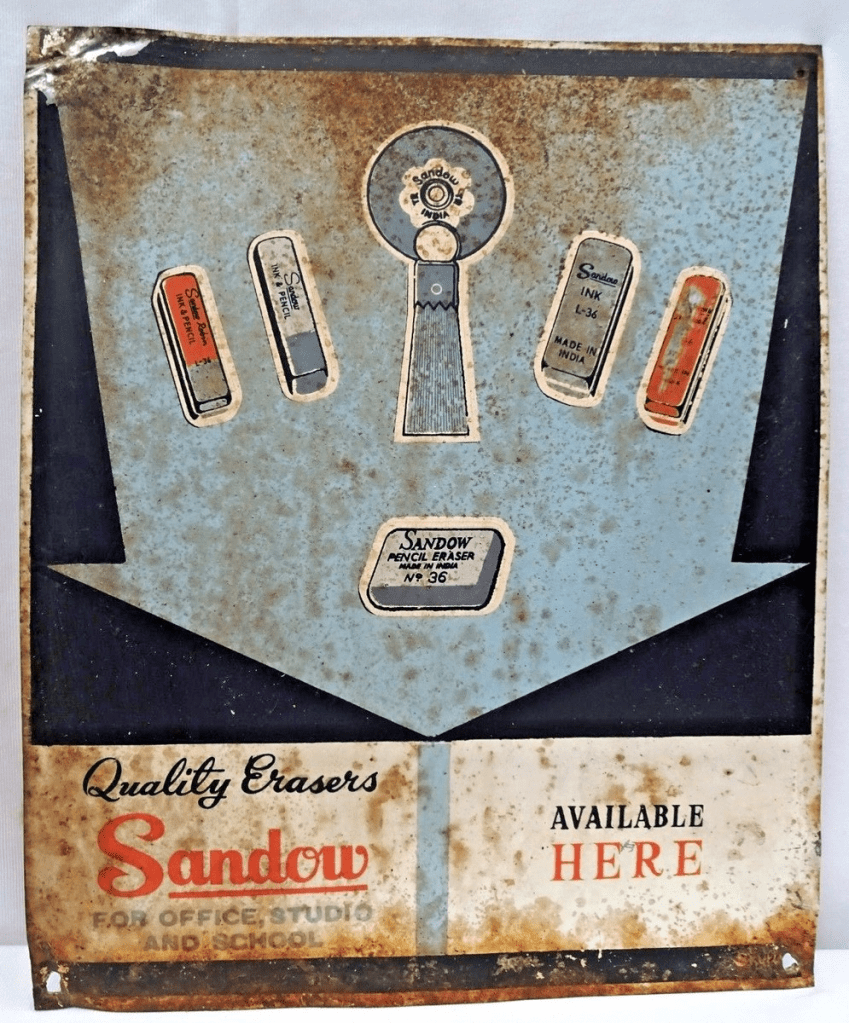
And one of the enduring memories for those of us who grew up in the  1950s, 60s and 70s, is the word Sandow. It was a part of everyday lives—an integral part of the pencil box, a dirty grey rubber that erased pencil marks.

For us in India, “rubber” was the term for eraser, a usage inherited from British English and reinforced through colonial schooling. A child did not “borrow an eraser”; they asked for a rubber. And the most trusted rubber of all in our times was the Sandow.

These erasers were made of natural vulcanised rubber, not vinyl or plastic as most modern erasers are. They were firmer, slightly gritty, and erased by abrasion — scraping graphite off paper rather than gently lifting it. They left dark crumbs behind and wore down slowly. A new Sandow rubber meant clean pages. A worn one told the story of errors made and lessons learnt.

Where did Sandow rubbers come from?

The earliest Sandow erasers were almost certainly manufactured in Britain and exported to India during the late nineteenth and early twentieth centuries through British stationery suppliers. During the colonial period, Indian schools depended heavily on imported notebooks, inks, slates and erasers.

Stupid Toy Day (December 16) is a celebration of the wonderfully useless things from childhood—rubber chickens, yo-yos, slinkies, and strange plastic objects that made no sense but brought endless joy. From ridiculous toys to unsettling antique dolls that now star in creepy museum contests, this post reflects on how toys—whether silly or sinister—stay with us long after childhood ends. A nostalgic look at why useless never really meant unimportant.

After Independence, Indian factories began manufacturing erasers using similar formulations and — crucially — the same name. By the 1950s, most Sandow erasers sold in India were produced locally. However, the word “Sandow” was never firmly trademarked in India, allowing multiple manufacturers to use it freely. Over time, it became not a brand but a category. “Sandow rubber” simply meant “the regular school rubber.”

Sandows were not the only erasers available. There were white, scented rubbers, with a gel-like coloured top. But alas, most of us never possessed one, given they were about four or five times more expensive!

And a Strongman called Sandow

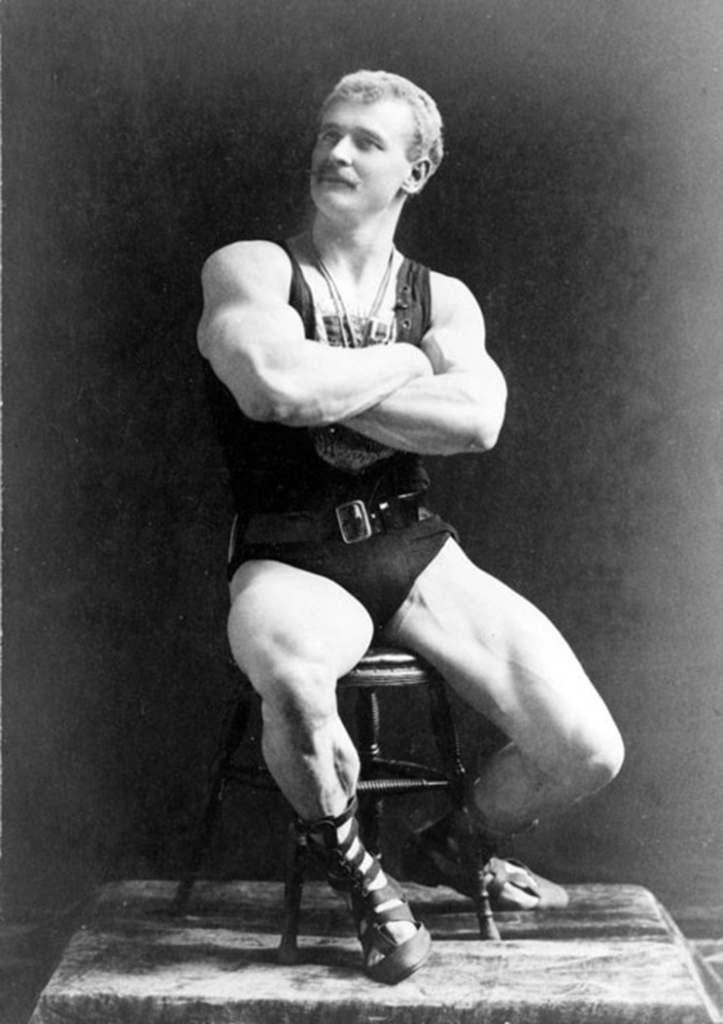
Another Sandow (though of older vintage) was part of our childhoods too. He lived on barbershop calendars and tattered posters: a muscular European strongman frozen in permanent flex.

Eugen Sandow (1867–1925) was a Prussian-born showman, athlete and entrepreneur who became the world’s first international bodybuilding celebrity. He toured Europe, Britain and America performing feats of strength before royal families and packed audiences.

Sandow was much ahead of his time, and would have done great in the current days, surely becoming a hero of Insta reels, posing as he did to deliberately display his muscularity. He was also a businessman. He published training manuals, endorsed health products, sold exercise equipment, and promoted physical culture as moral discipline. King George V even appointed him “Professor of Scientific and Physical Culture” in Britain — a title that further elevated his image as a respectable authority on fitness.

In India, encounters were through his images — black-and-white posters, calendar art, tins, and labels that travelled through imperial trade routes. But nevertheless, his name was well known, whether with urban kids or rural youth.

Were the rubber and the strongman officially connected?

There is no evidence that Sandow ever licensed his name to an eraser manufacturer. No contract, no advertisement, no endorsement exists in any reliable archive.

However, the naming may have had a connection. The two existed at around the same time, and the name ‘Sandow’ symbolised durability, strength and European modernity. Calling an eraser “Sandow” suggested that it would last, work hard and not fail easily. In an era with loose branding laws, borrowing famous names for product credibility was common.

Today…

Now, erasers come in neon colours and cartoon shapes. Eugen Sandow is remembered only by historians and fitness professionals. But for those who grew up in that older India, the word still carries a double image: fingers dusted with graphite, and a chest forever flexed on fading paper.

Sandow was never just an eraser.
And Sandow was never only a man.

Both were a part of our simple, innocent youth!

–Meena

Photocredit: Wikipedia for Mr. Sandow

ebay for the Vintage Tin advertising the eraser

A Fool of Fruits

This morning my sisters suddenly remembered our mother’s (who had a great sweet tooth) fondness for Mango Fool. This brought back so many memories of the many sweet dishes that we used to have at home, which included lots of sugary syrupy Indian sweetmeats, as well as the more subtle English ones such as custard and pies. Our combined memories recall that Mango Fool was some form of thick milk shake. Turns out that the real Mango Fool is a more sophisticated desert that includes mangoes, and whipped cream. And, of course, so many years later, the memory nudged me to dig deeper into investigating the curious name of this dessert.

As it turns out ‘Fools’ of the fruity variety have ancient origins and a rich history. Fruit fool is a classic English dessert. Traditionally, fools were made by folding a stewed fruit (originally gooseberries) into a creamy, sweet custard. The documented origins of the desert can be traced back to the 17th century, although it is believed that some form of this existed as far back as the 15th century.

The earliest known recipe is from the time of the Merry Monarch, King Charles II in a book called The Compleat Cook published in 1665, written by an anonymous author ‘Mr WM’. The recipe was for what he called Gooseberry Foole. The recipe included cooked, mashed, and strained gooseberries, which are beaten with sugar, butter, and eggs to form a pudding-like consistency.

Take your gooseberries and put them in a silver or earthen pot, and set it in a skillet of boiling water, and when they are coddled enough, strain them; when they are scalding hot beat them well with a good piece of butter, rose-water and sugar, and put in the yolk of two or three egg, you may put rose-water into them, and so stir it altogether and serve it to the table when it is cold.  Anonymous.  London.  1658.

The recipe endured through the ages, and was almost no change in the one included 250 years later in the Victorian era cookbook The Art Of Cookery Made Easy and Refined.

But why the name Foole? The most popular theory to explain this is that the term comes from the old French term ‘fouler’ which meant to mash or crush. And this is what the recipe demands—that the cooked fruit be crushed or pressed before being folded into the custard mixture. In those days most fruits were cooked, because people thought that raw fruits were dangerous for health.

Another theory points out to the fact that it was an unpretentious dessert which ended a meal, just as a trifle did. Fool was another term for a syllabub or trifle (something of little value). As an etymological dictionary explained Fool is ‘a reallocation of a word for something light-headed or frivolous as a light dessert’. Perhaps these desserts were literally lighter than the stodgy traditional English desserts like Sticky Toffee Pudding, Steamed Syrup Sponge, Jam Roly-Poly, and Suet Pudding.  

Whatever the theory, gooseberry remained a favoured fruit for this dessert, and the Gooseberry Fool was a popular dessert for many years. So popular that Edward Lear even incorporated it into a limerick in his A Book of Nonsense published in 1846.

There was an Old Person of Leeds,
Whose head was infested with beads;
She sat on a stool,
And ate gooseberry fool,
Which agreed with that person of Leeds.

Over time, other seasonal fruits such as strawberries, raspberries, apples, apricots, and cherries, also began to be incorporated in the recipe. Also, the custard was replaced by whipped cream which made it lighter. The combination of fresh fruit and frothy cream, served chilled, makes for a refreshing summer treat.

The ‘Fool’ part was also incorporated in the names of other desserts.

Norfolk Fool as an early type of bread and butter pudding dating back to the 17th century. It included creamy custard, dates and spices.

Westminster Fool was a sweet custard with a flavouring of rose, mace and nutmeg, poured over a penny loaf cut into six slices, soaked in sherry. (Maybe the inspiration for our own Shahi Tukra, or inspired by it!)

Boodles Fool was named after Boodle’s Club, a private exclusive gentlemen’s club founded in 1762. Ironically, in the very class-conscious British society, the club was named after its head waiter Edward Boodle! His namesake dessert featured a citrus (orange and lemon) mixture whipped with cream, poured over sponge cake, served chilled, decorated with orange slices.  

Whatever the ingredients and recipe, Fruit Fools provided for a delicious finale to a meal. Today these continue to be popular as cool summer desserts. Where my mother picked up the concept and term is a mystery lost in time, and so is the actual form of her version, but the name Mango Fool is closely associated with our childhood memories of sweltering hot Delhi summers.

–Mamata