The Irresistible World of Japanese Stationery

Japanese stationery–it’s not just about paper and pens. It’s an entire universe of meticulously designed (and over-engineered, some people say)products that blend functionality with a sense of artistry. From perfectly engineered mechanical pencils to pastel-hued notebooks that feel like an experience rather than just stationery, Japan’s stationery game is on another level.

Japan’s obsession with stationery is more than just a passing trend or quirky fascination. There’s a deep cultural history and a respect for craftsmanship that informs the country’s relationship with its stationery products. It’s not about pens, paper, or notebooks—it’s about reverence for beauty, functionality, and attention to detail.

At the core of this lies the cultural reverence for precision and perfection. The concept of kirei—a Japanese word that means “clean,” “beautiful,” or “elegant”—is key to understanding the stationery obsession. In everyday life, the Japanese strive for beauty and simplicity, and this aesthetic extends deeply into the design of their stationery. Minimalism is at the heart of many stationery designs: neutral colors, sleek lines, and a focus on function over excess.When it comes to everyday tools like stationery, the emphasis is on creating items that are not only practical but also exquisitely refined.

There’s a conscious focus on making something beautiful out of the mundane or utilitarian, a concept that transcends into stationery. Pens aren’t just about writing—they’re carefully crafted to deliver the perfect writing experience. Paper isn’t just a surface for notes; it’s a tactile experience that enhances the act of writing itself. Craftsmanship plays an enormous role. Many high-end stationery items, like Uni-ball pens or Midori notebooks, are created by artisans who bring decades of expertise to their craft. Stationery is an extension of this artistry.

The Zen of Stationery: Mindfulness and Ritual

Japanese students are encouraged to use their stationery in an almost sacred way. Their school notebooks are often neatly organized with an emphasis on clean, legible handwriting. Calligraphy—known as shodo—is still a highly respected art form in Japan, and the skills learned in this practice often extend into daily life.

The slow, deliberate process of choosing a pen, selecting the right paper, and finding the perfect notebook to match your mood is an act of mindfulness. It’s about being present in the moment and honouring the process of creation.

The Japanese Stationery Expo and Awards: A Celebration of Craftsmanship and Innovation

This devotion to elevating the everyday reaches its peak each year at two marquee events which take place in June every year in Tokyo: the Japan Stationery Expo and the Japanese Stationery Store Awards. Together, they showcase the best of design, functionality, and sheer creativity.

The Japan Stationery Expo is where stationery enthusiasts, designers, and brands converge to showcase the best of what the industry has to offer. (More on this expo and another interesting one next week).

If the Japan Stationery Expo is where products are showcased, the Stationery Awards are where the best of the best are recognized. They honour the incredible craftsmanship and innovation in Japanese stationery, celebrating both traditional designs and newer, boundary-pushing concepts. It’s the Oscars of the stationery world, but without the drama and red-carpet couture. Products are judged based on various criteria, including design, function, innovation, and overall quality, with awards in several categories, from Best Stationery Product to Best New Brand, and even a category for environmental sustainability.

The 2025 Awards went to:

  • Grand Prize: Pilot Kirei-na Highlighter — engineered with a guiding plate that keeps lines neat and smudge-free.
  • Design Award: Luddite THE POST Sustainable Leather Bendy Pen Case — chic, durable, and eco-friendly,
  • Functionality Award: Uni Jetstream Single Ballpoint Pen (Lite Touch Ink) — celebrated for its smooth flow and comfort, turning everyday scribbles into a silky experience.
  • Idea Award: King Jim Hitotoki Kori Jirushi Ice Stamp — a playful yet practical reinvention of a classic tool.

35 other winners were recognized, from elegant fountain pens to ingenious pen cases, and even a “tea-time notebook”.

Some of the Most Innovative Award Winners in Recent Years

1. Pilot FriXion (2006) – Erasable Ink Pen: This was one of the first pens to use thermosensitive ink, which could be erased with friction.

2. Midori MD Paper (2011) – Premium Paper Notebooks : Known for its exceptionally smooth texture, these revolutionized notebook writing with its soft, cream-colored, bleed-resistant paper

3. Lihit Lab Teffa Bag-in-Bag (2017): A unique product that allows people to organize their small stationery, gadgets, and accessories inside a larger bag. It has pockets of various sizes to fit pens, notebooks, chargers, and other essentials.

4. Kokuyo Campus Sticky Notes (2019): This product took the classic sticky note and reimagined it with a special adhesive that works even on rougher papers.

5. Karuizawa Stationery – Plantable Paper (2020): A sustainable stationery innovation that uses plantable paper embedded with seeds. Once you’ve used the paper, you can plant it and grow flowers, herbs, or even vegetables from it.

I will be content if I can read my own handwriting after a few hours. No loftier ambitions!

–Meena

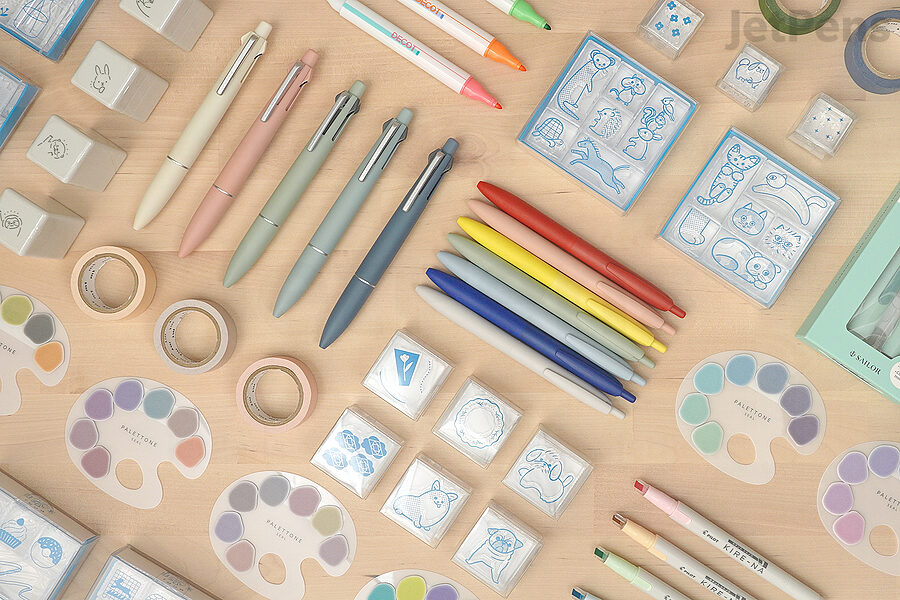
Pic: .jetpens.com/

Freedom of Imagination Makes a Book

A few years ago an exhibition at a Research Centre at the University of Chicago was titled But is it a Book? The exhibition broke down the classic elements of ‘bookness’ like format, shape and binding.

The walk-through exhibition had a number of objects that through history were considered as ‘books’, ranging from a clay tablet made in the 3rd century BCE to a modern audiobook. But are either of these books? It was up to the visitor to decide. The exhibition posed a series of questions: “Does a book need to have pages? Does a book need text?” It was up to the visitors to decide. And each decision led the decider down a different path.

If some adults find the journey of exploring and discovering what makes a book, and furthermore, what makes a good book interesting, this exploration is even more adventurous when we enter the realm of children’s books. It is generally accepted that good children’s books are a blend of engaging storytelling, relatable characters, age-appropriate language, vibrant illustrations, cultural diversity, emotional depth, interactive elements, and timelessness. Each of these elements is deep and has numerous facets. And there is no magic formula; even if all these elements are present, it does not guarantee that the outcome is a ‘great’ children’s book.

Perhaps one element that is not explicitly listed, and which may be the key, is the ability of the author to think like a child; to recall how the world seemed as a child—the sense of mystery and discovery, the sense of wonder and anticipation, the sense of being insignificant and powerless in a world of adults…And to translate these complexities into a story that feels true to its young readers, wherein the spark of their imagination is ignited, to explore their imagination, and develop their creativity.

These are the guiding tenets of the International Board on Books for Young People (IBBY), an organization which represents an international network of people from all over the world who are committed to bringing books and children together. The mission of the IBBY includes the promotion of international understanding through children’s books, giving children everywhere the opportunity to have access to books with high literary and artistic standards, and encouraging the publication and distribution of quality children’s books, especially in developing countries.

The IBBY also promotes the celebration of International Children’s Book Day. This is celebrated every year on 2 April, to mark the birthday of Hans Christian Andersen, whose fairy tales have been an integral part of the childhood of many generations.

International Children’s Book Day (ICBD) emphasizes the significance of high-quality literature for children and the creativity it fosters. It highlights the love of reading that unites children worldwide. In high-quality children’s books, the reader’s imagination is kindled and developed. These books help children to explore their imagination, to develop their creativity and to see the world in a new way.

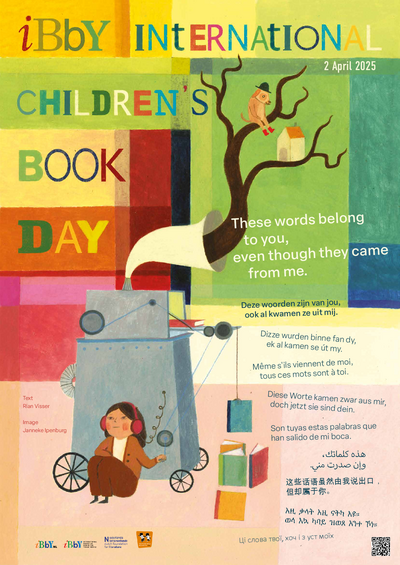
Each year a different National Section of IBBY has the opportunity to be the international sponsor of ICBD. It decides upon a theme and invites a prominent author from the host country to write a message to the children of the world and a well-known illustrator to design a poster. The host country for this year’s ICBD is the Netherlands. The theme for 2025 is The Freedom of Imagination. This derives from the belief that good books invite readers to interpret the words for themselves, making the story their own.

The poster for the theme is designed by two Dutch creators of children’s books, and the message of the theme is highlighted with the last sentence of the poem The Language of Pictures: Make pictures for my poem, and please feel free: these words belong to you even though they came from me.

Reading about this brought back memories of a wonderful project that I was involved in, many years ago, and which was sparked by the same message.

As environmental educators at the Centre for Environment Education, my team and I had diverse opportunities to develop creative teaching-learning resources for teachers and children. Perhaps the most exciting of these was a project to develop children’s books on four different themes: Pollution, Forests, Waste, and Conservation of Natural Resources. The form, format and presentation was left for us to decide. This presented an exciting blank canvas, as well as the challenge to be creative while still retaining the educational objectives for each theme. The outcome was the decision to develop books in four very different formats: a magazine format for Pollution; a collection of folk tales from the region for Forests; a quirky mystery story for Waste. But when it came to Natural Resources we were stumped! What was a manageable way of covering the wide range and scope of the theme?

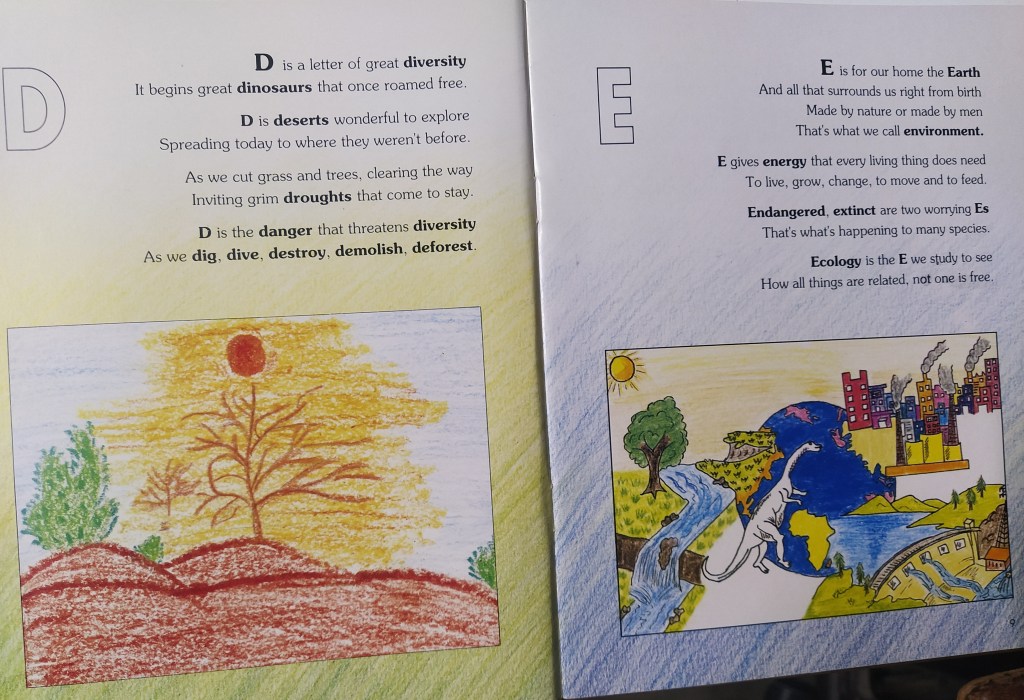
Much brainstorming later this took the form of verses through which we could take “poetic liberties” by bringing together different natural resources. To make it more fun, we decided to do this alphabetically. Hence the title ABC…Naturally. And so the R page could have a verse with the words: rivers, rainbows, reptiles, roots, rainforests, resources, recycle, reuse and reduce.    

With such a motley assortment of words in place, there arose the next challenge. How would an artist illustrate these verses? As adults we are so conditioned to ‘labels’ and fixing of labels in ‘appropriate places’; this would need a huge leap of imagination. But Eureka! Children could make these leaps effortlessly. And so, we walked into a school and handed it over to more creative minds! We simply gave different children the verses, and gave them the Freedom of Imagination to interpret the words through their pictures, as they saw fit. The result was an incredibly rich and many-layered tapestry where disparate elements seamlessly fell into place. ABC…Naturally became a shared work, with every child feeling a sense of ownership and pride at being a ‘creator’. It was a true reflection of the freedom of imagination! It was also a validation of the belief that good books invite readers to interpret the words for themselves, making the story their own.

As someone who was deeply engaged in every part of this process, I am excited that the IBBY is celebrating International Children’s Book Day this year by providing a similar opportunity to

children across the world. IBBY Netherlands has launched an International Illustration Competition to encourage children worldwide to use and express their imagination and creativity by creating works of art inspired by the theme The Freedom of Imagination and the associated motto: “Make pictures for my poem, and please feel free: these words belong to you, even though they came from me.”

Details are available on https://www.ibby.org/fileadmin/user_upload/icbd/icbd_2025/ICBD_2025_international_illustration_competition_-_regulations.pdf

https://www.ibby.org/awards-activities/activities/international-childrens-book-day/icbd-2025-sponsored-by-the-netherlands#:~:text=The%20theme%20of%20the%202025,’

–Mamata

Of Blasted Bunions and Cussed Cuboids

I was not born with beautiful feet. And they grew to a pretty unfeminine 6.5 size. I could have still lived with that. But then in my 30s, my right foot also started blooming a bunion. For those who do not suffer with this affliction, it is a word you may not even have heard. But for those of us who suffer, it an everyday reality. When will it start aching? Has it started growing again? Will I find a decent pair of footwear which accommodates the wretched bunion? Has anyone come out with yet another horrific torture-instrument that promises to solve the problem? And does it work? These are the questions we ask ourselves each day.

What is a bunion? Hallux valgus as it is called in medical terms, is ‘a bony bump that forms on the joint at the base of the big toe. It occurs when some of the bones in the front part of the foot move out of place, causing the tip of the big toe to get pulled toward the smaller toes and forcing the joint at the base of the big toe to stick out.’

Actually, bunions are not that uncommon. Experts estimate that about a third of the population of the US is thus afflicted. And why do they happen? Well, it is not a single reason. A combination of factors —family history, abnormal bone structure, increased motion and shoe choice — can cause them. When something puts extra pressure on the big toe joint over a long period– usually years–that can push the joint out of its natural alignment and toward the other toes, leading to bunions.  Some of the causative factors are beyond our control, but some things which we can take care of include the type of shoes we wear (narrow, pointed shoes are a no-no); the way we walk (what is called foot mechanics—though not easy, it may be possible to modify our gait so it more balanced); and how long we stand (avoid standing for extended periods of time).

And in yet another blow against the female gender, women are more prone to this! 30 per cent women versus 13 per cent men report this condition. And it is ageist too—people over 40 are more prone to it.

And can bunions be treated? Well, footwear change is recommended (but where do I go, I only wear open toe flats?); bunion pads and taping (of not too much use, believe you me); orthotics–shoe inserts that support your feet (these can help); icing and physical therapy (definitely help). If the pain and swelling are intense, painkillers or steroids are prescribed (fortunately I am not there yet). Surgery is the last resort in very severe cases, but not often resorted to for various reasons.

There are also a number of ‘correctors’ available which physically separate the toes and try to change the alignment of the big toe. These look like medieval torture instruments and have been of dubious utility to me.

Well, if there is any solace to be taken from the fact that very glamorous people have bunions, we can list several such. From Oprah Winfrey and Victoria Beckham, to Kate Middleton and Meghan Markle, from Uma Thurman to Naomi Campbell, the list is pretty long. And considering that they and their feet have to be in the glare of public and media view, we can count ourselves lucky that we can be more casual about our footwear and feet.

I had reconciled myself that I would face pain from time to time, and that I would never be able to wear dainty shoes. But then along came the cuboid! What is this very geometric sounding thing? Cuboid syndrome is a condition caused by an injury to the joint and ligaments surrounding the cuboid bone. The cuboid bone is one of the seven tarsal bones in the foot. It causes pain on the lateral side of the foot — the side of the little toe. A person often feels pain around the middle of the foot, or at the base of the fourth and fifth toes. So while the bunion hurts on the inner side of my foot, the cuboid hurts on the outside of the same foot.

And not to talk of my plantar fasciitis. The plantar fascia is a band of tissue, called fascia, that connects your heel bone to the base of your toes. It supports the arch of the foot and absorbs shock when walking. Plantar fasciitis typically causes a stabbing pain in the bottom of your foot near the heel. 

So all in all, I am definitely not Happy Feet!

I wonder why shoe-makers are not taking note of this huge market. If 30 per cent of the population suffers from bunions, surely many of them are yearning for comfortable footwear which is also half way decent looking. There is a pretty big market opportunity waiting!

Incidentally, Bunion is a cartoon strip by George Martin that was syndicated in newspapers throughout Britain and abroad (Canada, Sweden, etc.) in the 1960s and 1970s. Good to know someone found ‘Bunion’ funny!

–Meena

In solidarity with all sufferers of foot-pain, especially my bunion-sister Mamata!


The Flowers of War

The media has been full of the 50th anniversary of the Carnation Revolution over the last week. It happened in Portugal. And apparently, Portugal wasn’t even a respectable democracy 50 years ago! Since a coup in May 1926, Portugal was under an authoritarian regime. In 1932, Antonio Salazar took over as Prime Minister, and remained at the helm of affairs till 1968 and continued to hold the reins of power tightly, with little say for the people in anything. He alo would not give up Portugal’s large overseas territories including Goa, Daman, Dadra and Nagar Haveli. In India of course, the Indian armed forces invaded, and supported by the local freedom fighters, took over in 1961. Portugal continued fighting long-drawn colonial wars in other parts of the world. Within Portugal also, it was an authoritarian rule. Finally, in 1974, the people of Portugal lost patience. On 25th April, there was a largely peaceful coup led by members of the Armed Forces Movement and backed by civilians from all walks of life. It began to be called the Carnation Revolution because there were almost no shots fired. It being the carnation season, the markets were full of carnations, and people started giving them to each other and also placed them in the muzzles of the soldiers’ guns, as well as in their button holes.  It was a happy ending!

Flowers
Bouquet of Flowers in a Vase Georgius Jacobus Johannes .Getty Open Access

Many subsequent peaceful revolutions have been named after flowers, including: The Tunisian revolution of 2010-11 is called the Jasmine Revolution in honour of the country’s national flower In the Rose Revolution in Georgia in 2003, Opposition leader Mikhail Saakashvili carried a rose into parliament when he demanded the resignation of President Eduard Shevardnadze, while protesters in the streets gave long-stemmed roses to soldiers called out to stop them. The President resigned. The 2005 Tulip Revolution in Kyrgyzstan forced President Askar Akayev to flee the country. 

But the association of wars with flowers goes further back than that. The famous War of Roses was a long-drawn series of inter-generational wars for the British throne. Fought over 30 years starting 1455, the war was between the House of Lancaster and the House of York, descendants of two sons of Edward III who reigned from 1330-1377. Amidst  claims and counter-claims to the throne almost as complicated as between the Pandavas and Kauravas, the war raged till Henry Tudor (later Henry VII) who represented the claim of the House of Lancaster, won the Battle of Bosworth, and sealed the claim by marrying Elizabeth of York, the daughter of the Yorkist King, thus uniting the two houses. The War of Roses is so called for the symbols of the two sides—the white rose of York and the red rose of Lancaster. After the marriage of Henry and Elizabeth, the symbol was combined in a way that overlaid the white and red roses.

But the oldest of flower-wars has to be war over the parijata tree fought between Krishna and Indira. The origin of the story goes back to the Harivamsam (1st or 2nd century BCE). In this tale, Narada gives Krishna a single enchanting blossom of the parijata flower from the special tree in Indra’s garden. Krishna is with his senior-wife Rukmini at the time, and gives it to her. When the junior-wife Satyabhama hears of this, she is angry beyond belief and is only pacified when Krishna promises to fetch her the tree itself from the heavenly garden. However, Indra refuses to part with the tree, and Krishna has to fight a mighty battle—which of course he wins. And the parijata is brought to earth and planted here. (See ‘Heaven’s Flower’ https://wordpress.com/post/millennialmatriarchs.com/164)

So flowers can cause wars. And they can stop wars.

It’s a choice we have to make today!

–Meena

Valentine’s-Galantine’s

Media are frantically trying to sell us everything from roses to chocolates to romantic dinner. ‘Tis the season—the Valentine season. The origins of Valentine’s Day as a day to celebrate romantic love go back a long time.  But the commercialization is a phenomenon of the last century.

Fortunately, at least in India, the sellers have not fully caught on that it is actually Valentine’s Week celebrated from 7 February to 14 February, with the seven days including  Rose Day, Propose Day, Chocolate Day, Teddy Day, Promise Day, Hug Day, Kiss Day, and finally, Valentine’s Day.

The origins of Valentine’s Day may lay in the Roman festival of Lupercalia which used to fall around the same time–essentially a spring festival which included fertility rites. A 5th century pope banned the celebration of Lupercalia, but it came back with renewed vigour in the 14th century and has been celebrated since then.

There have been many St. Valentines down history, and it is not quite clear after whom the festival is named. From a priest who was martyred about 270 CE by the emperor Claudius? According to legend, this priest who was incarcerated by the Romans, was friendly with his jailer’s young daughter, whose blindness he is said to have cured, and subsequently wrote her a letter which he signed off with “from your Valentine”. Or was it St. Valentine of Terni? Or a St. Valentine who defied the emperor’s orders and secretly married couples to spare the husbands from war?

At any rate, the festival is now celebrated world-wide on the 14th of Feb as a day of love.

But another day which is of fairly recent origin, and celebrated on 13th Feb is Galantine’s Day. It is like Valentine’s Day, but for girl-pals! It celebrates the bonds between best friends, sisters, moms, grandmoms….

The origins of this one are quite clear—it all started with the comedy show ‘Parks and Recreation’. Leslie Knope, played by Amy Poehler used the term in the second season of the show in 2010. She kind of makes up this day and says ‘What is Galentine’s Day? Oh, it’s only the best day of the year. Every February 13th, my lady friends and I leave our husbands and our boyfriends at home, and we just come and kick it… ladies celebrating ladies.”

Guys of course don’t need to feel left out. After all, the term ‘bromance’ is much better known than Galentine’s Day. It was coined sometime in the 1990s, by Dave Carnie, the editor of the skateboard magazines Big Brother, in reference to the close bond that develops between skaters who spend a lot of time together.

Bromance is a portmanteau word, made up of bro (or brother) and romance  A bromance is officially defined as ‘a very close and non-sexual relationship between two or more men’. It is distinguished from normal friendship by a particularly high level of emotional intimacy.

Here is to Galentine’s Day! May we celebrate it in the true spirit of friendship and bonding, and not let it go the commercial way of Valentine’s Day.

With a shout out to all my girl-pals!

–Meena

PS: www.millennialmatriarchs is a Galentine initiative!

Fun and Games

Play is something the young of many species indulge in. Play is of course a part of the life of young humans, but we also see puppies, kittens, the young of many mammals and even some birds play.

The study of play is however, a serious matter, as can be seen from this definition: ’ play is repeated, seemingly non-functional behavior differing from more adaptive versions structurally, contextually, or developmentally, and initiated when the animal is in a relaxed, un-stimulating, or low stress setting’ (Burghardt, 2014).

If that sounds a bit complex, here is a breakdown of the behaviours associated with play, i.e. play should

‘*be incompletely functional in the context in which it appears;

*be spontaneous, pleasurable, rewarding, or voluntary;

*be different from other more serious behaviors in form (for example, be exaggerated) or timing (for example, occur early in life, before the more serious version is needed);

* be repeated, but not in abnormal and unvarying stereotypic form (for example, rocking or pacing); and

* be initiated in the absence of severe stress.’

Till a few decades ago, it used to be believed that only the young of warm-blooded animals and birds played. But research is showing that many other creatures play too, including the young of some fish, frogs, lizards, turtles and even Komodo dragons. Coming from a human perspective, we may not recognize this as play. But going by the definition and framework above, many of the activities of the young of these species fall in the category.

Play is of critical importance in the development of all species who indulge in it. In the case of human children, it helps in the development of cognitive, physical, social, and emotional well-being. It helps children learn about themselves and the world, and through play they learn many life-skills like confidence, resilience, cooperation, team spirit, coping with challenging situations etc.

Play itself can be of different types: Physical Play, which helps in physical development and skills like coordination; Social Play which helps children develop the skills of how to interact with others, taking turns, cooperation, etc.; Constructive Play, wherein children create things—arts and crafts including drawing, painting, building things, etc.; Fantasy Play, that is using the imagination to create situations and enacting parts; and Games with Rules, which helps the child develop cognitively and learn how to follow instructions and rules.

If the topic of the conversation is play, can toys be far behind? Toys too date back to ancient times– archaeologists excavating the ancient city of Kültepe Kaniş-Karum in Turkey discovered a 4,000 year old ceramic rattle, which is believed to be the oldest children’s toy yet uncovered.

Toys
Photocredit: Harini M.

Today toys and games are a highly sophisticated market with several categories including puzzles, dolls, soft toys, fidget toys, modelling clay and related products, movable vehicles, construction toys, constructed toys, board games etc. 

It is also a huge market–in 2022, this market generated total revenue of US$122.90 billion. India is a tiny part of this—with the Indian toys market size reaching $ 1.5 billion last year, with barely $ 1.14 per capita spend on toys. Which means most of our children don’t have access to toys, or have too few toys—which is definitely disadvantages their development. Not that I am saying that store-bought toys are the only way to go. We know that children show enormous ingenuity in making anything into a toy–kitchen vessels, sticks and stones, boxes and cartons. And creative parents and teachers can make toys at no or low-cost. (For ideas, you can visit https://arvindguptatoys.com/, the website of Padma Shri awardee Shri Arvind Gupta, who has spent his life developing and advocating for the use of no- and low-cost toys with educational value). But having said that, I do believe that every child has the right to a new, shiny toy once in a while. So not only must we manufacture more toys, but low-cost, innovative ones which don’t compormise on safety.

Equally important are innovative ideas like toy libraries so each child does not have to buy every toy and less-advantaged children can get access too; toy hospitals so toys can be mended and their life extended;  and NGOs which collect, refurbish and re-distribute toys. Another complex challenge is how to keep toys from reaching solid waste dumps—how to recycle them safely and cost-effectively?

So toys may be fun and games, but it’s definitely not all child’s ply!

–Meena

PS: The image is from a storybook Harini and I created using toys as charecters. ‘My Sunday with Daadu and Deedu’ available on Amazon. The Telugu version by Manchi Pustakam is available on their site.


Celebrating Vishwakarma, Master-Craftsman

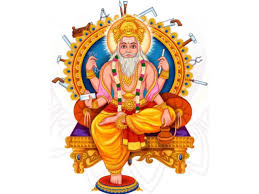
Vishwakarma Jayanthi is marked every year on Kanya Sankaranthi, which falls this year on September 17th. As per legend, Vishwakarma was a master architect and craftsman. The son of Brahma, he is supposed to have been the engineer for the creation of the world. He is also said to have built Lanka, Hastinapur and Dwarka.

Vishwakarma plays a pivotal role in the two great epics, Mahabharat and Ramayana. In the Mahabharat, the Pandavas retained him to plan and build their new capital of Indraprastha, which evoked the wonder and envy of all the other kings. One of the triggers for the Mahabharat war however was this amazing architecture. The pools of water looked like floors, and floors looked like water-bodies. Duryodhana mistaking a pool for a floor, slipped ignominiously and fell, evoking the mirth of the onlookers. He took particular exception to Draupadi’s laughing and commenting at his plight, and this was almost the last straw contributing to the breakdown of relations between the Pandavas and the Kauravas.

Vishwakarma’s work also features as a turning point in the other epic Ramayana. He is said to have built Pushpaka Vimana the flying chariot. It was built originally for Brahma, who at some stage gifted it to Kubera, the God of Wealth. But Ravana, Kubera’s half brother, stole the flying chariot, and used it for the infamous abduction of Sita. The Vimana however was also part of happy times, ferrying Ram and Sita back to India after the victory over Ravana. Ram later returned the vehicle to Kubera.

Vishwakarma has his equivalents in Greek and Roman mythology. The god Hephaestus was blacksmith to the Gods of Olympus, and made all their weapons of the gods in Olympus. He used to be worshipped in the manufacturing and industrial centres of Greece. Vulcan was the Roman God of fire and forge as well as fire and volcanoes. He was the patron of artisans and smiths, and there were several shrines dedicated to him. Vishwakarma like his peers also designed weapons, including Krisha’s Sudharshan Chakra and Indra’s Vajra.

We in India continue to remember and commemorate Vishwakarma. Vishwakarma Jayanthi is a special day for engineers, architects, mechanics, craftsmen, welders etc., and it is marked with pujas in factories and industrial estates. The prayers are for increased mastery and success in their field, as well as for safety.

As an ancient culture, excellence in engineering and the crafts were so revered that not only was there a God for this, but his achievements were enumerated and remembered. We still remember him and worship him. But ironically, we don’t seem to value the excellence he stands for. Our towns and cities are unplanned chaos—surely not Indraprastha or Hastinpur were.

In India, barely one in five persons at the workplace is skilled. We stand at 129 out of 162 countries ranked. As someone who has been involved in skill training, I am aware of some of the challenges in this sector. Critical among these are that skills except those related to IT and computers are not aspirational. To get a young person excited about being a master-electrician, master-plumber, master-anything that needs working with hands is next to impossible. In our culture, manual skills are not valued and respected—plumbers and masons feature way down in the social hierarchy. Nor are they paid in accordance to the value they bring. And sadly, career pathways don’t lead them very far.  

Nor is the skill-training we provide of very high quality, such as will lead them to excellence in their vocations. Most skill training is outdated and out of sync with what industry needs. Our ITI and other skilling institutions are bureaucratic set-ups, far behind where they should be. The faculty has no real experience on the shop floor. Nor do most students ever go into a factory or workplace during their education.

For a country which marks Vishwakarma Jayanthi with widespread events, we don’t seem to really value skills or our skilled craftspeople. Until that changes, there does not seem much point in observing yet another day.

–Meena

Homes for Hippos

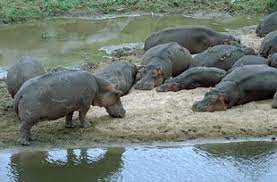
Hippos hit the news every now and then. And in the past weeks, they have been a topic of some discussion in India, thanks to a request from the Colombian Government for us to provide a home to some of the ‘cocaine hippos’ that have become feral there. Actually, it is quite unfair to call them ‘cocaine hippos’—it is not like they snort cocaine. Their ‘fault’ is that they (or their parents/grand-parents) were owned by the infamous cocaine smuggler Pablo Escobar.

Pablo Escobar was a Colombian druglord, who was called the ‘King of Cocaine’, due to his monopoly of the cocaine trade into the US. He was the founder of the Medellin Cartel, and the wealthiest criminal ever, with his wealth being estimated at $ 30 billion in 1993, when he was killed at the age of 44, by the Colombian National Police.

Every aspect of Escobar’s life was larger-than-life. Like the emperors of old, he set up a menagerie at Hacienda Napoles, his huge ranch east of Medellin, and kept giraffes, elephants, ostriches, and other exotic species there. Four hippos—three males and one female–were part of this menagerie.

When he was killed, authorities did not quite know what to do with these animals, and just left them in the estate—where not unexpectedly, they multiplied. In about 25 years, there were close to a 100 individuals (the number may stand at over 150 today). A single hippo can eat over 35 kg of grass and other green plant material in a day, posing a threat to local biodiversity. Being large and heavy animals, they stomp the ground and compact it as they move over the same area day after day. They defecate in the water, and end up polluting rivers and water bodies.

Hippos
Pic: Encyclopedia Britannica

Efforts to curb the population explosion have not met with success. About 15 years ago, the local government tried culling the animals, but this led to protests across Colombia and was thankfully stopped. A sterilization programme is in place, but the hippos breed faster than local experts can find, catch and castrate them (We can’t even manage it with stray dogs, what to talk of hippos!).

Hence the plan to ship the hippos to various countries which are ready to receive them. Mexico has agreed to take 10 of them. Colombia has approached India to house 60 of the animals at the ‘Greens Zoological Rescue and Rehabilitation Kingdom (GZRRC)’, being created by Reliance Industries in Jamnagar, Gujarat. The plan has not met with enthusiasm by any wildlife expert. Housing them in zoos is an expensive proposition.  Hippos are native to Sub-Saharan Africa, not India, and definitely cannot be released into the wild. (However, based on a small fragmented tooth unearthed in Madhya Pradesh, researchers claim that India was home to hippopotami nearly 5.9 million to 9,000 years ago. The hypothesis is that they entered Eurasia from Africa, and then diversified in South Asia before going extinct. But even if they ever were native here, they haven’t been for many millennia.)

There is no doubt Colombia has a problem. Apart from destroying vegetation and biodiversity, hippos are also a threat to humans. They are known to be very aggressive, and can chase people on land, as well as capsize boats in the water. They sometimes raid fields and come into conflict with humans.

And it is also true that a safe home must be found for the hippos—they are only living their life as they were meant to. How can they help it if someone uprooted them from their home and brought them to a new continent?

But bringing them to India definitely does not sound like a good idea. The recent import of cheetahs should serve as a cautionary tale. We need to protect our biodiversity and trying to introduce non-native (at least in human memory) species is not going to help either our diversity or the introduced species.

–Meena

A ‘Strictly Personal’ Common Experience

Recently I was reading ‘Strictly Personal’ an account of the lives of Dr. Manmohan Singh and Mrs. Gurcharan Singh, by their daughter Daman Singh.

The-then Mr. Manmohan Singh went to Oxford in the early ‘60s. He was joined in a few months by his wife and daughter. He was there for about 2 years. He was there to do his Ph.D

My father went to London in the early ‘60s, He was joined in a few months by his wife and children. He was there for about 2 years. He was deputed there by the Defence Research and Development Organization to train at the Royal Marsden Hospital, towards helping in the operationalization of the Institute of Nuclear Medicine and Allied Sciences (INMAS), which was to be involved in nuclear medicine research, and response to nuclear accidents and explosions.

What amazed me was the commonality between the experience that the book talks about, and the stories which are a part of my family history.

First and foremost, the travails of living on a very limited budget. It was literally hand-to-mouth! My mother recalls that at times, there were not enough pennies to put into the home-heater, and we all spent the day huddled in our woollies. The free milk that my brother and I were eligible for as children was a major saviour. It was not that the pay and allowances were so bad (they were not generous, but adequate). It was that they simply did not come for the first 3 months, till the bureaucratic wheels started moving. And even after, the money came in by fits and starts. One incident which was etched deep into my parents’ memories was a visit to Veerasway, UK’s oldest Indian restaurant. Yearning for other-than-home Indian food, they, with the two of us in tow, ventured in one day. Only to beat a hasty retreat on learning that the cover charge was £ 1 per head!

The book quotes Mrs, Singh as saying ‘We were quite hard up. I don’t know how many pounds a week we got. We had to survive within that. It was not a great, handsome scholarship.’

To the question ‘did you wear Western clothes?’ Mrs. Singh responds ‘No, no, no, never.’ But at least she may have worn salwar kameez. My poor mother stuck to saries through the freezing windy days, walking through hail and snow to the shops or to drop or pick up my brother from the school bus. I fully attribute her getting arthritis by the age of 35 to this exposure to the terrible cold and wet.

Food may have been a bigger problem for my strictly vegetarian family. My mother, on one of her initial trips to the super market, brought home margarine, which an English friend had suggested as a cheaper substitute for butter. It was only after her return home that she read the packaging and realized it was made from pork fat. The trauma stayed with her for life!

The Singhs lived in Oxford. Apart from one trip to London and one to Stratford-upon-Avon, they saw nothing of England. Maybe to that extent we were luckier. Living in London, we at least got to see the sights there—the few family pics taken with my father’s precious camera bought there show us at Trafalgar Square, outside the Buckingham Palace, the Tower, Westminster Abbey etc. The penguin show and the Chimpanzees’ Tea Party (discontinued in the ‘70s) were the highlights of the zoo visit.

The SInghs did not have a TV, and went to a neighbour’s to watch. We did have a television and the show that my parents talked about, which still sticks in my memory is ‘Saturday Night at the London Palladium’, a long-running variety show.

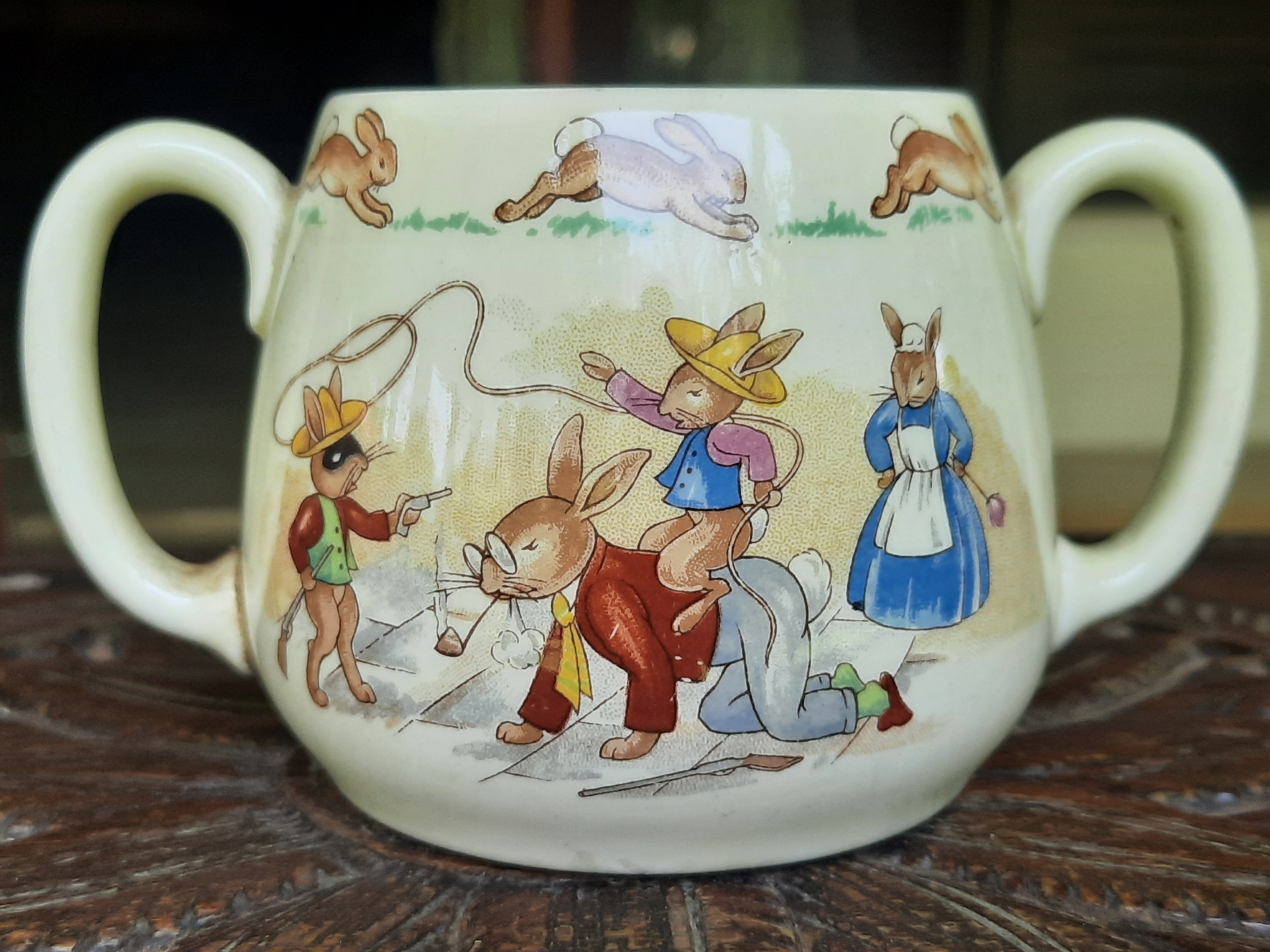
Peter Rabbit Milk Mug
My Peter Rabbit Milk Mug: A Precious Relic

Equally, the things they chose to buy and bring back. Both Mrs. Singh and my mother brought back Baby Belling ovens—a part of British history. The Belling company was established in 1912 and manufactured electric heaters. The first complete domestic electric cooker was made in 1919 and the first Baby Belling oven was manufactured in 1929. The company still exists but is not the gold standard for ovens that it obviously was in mid twentieth century. The other significant item to accompany the Singhs back were three saucepans. In my parents’ case, it was a mixie—a Braun Liquidizer, if I recall. This was my mother’s most precious possession. In fact, when a mischievous visiting child was on the verge of pushing it over, she caught the machine, and her hand was badly slashed, requiring stiches! Mrs. Singh’s oven served her for 3 decades, as did my mother’s mixie!

I think this would be the story of all professionals who went to the UK in those days. But interesting to see that a PM’s family and mine were in the same straits! (We were in other similar ‘straits’, more about which next week.)

In today’s world, all this sounds so strange! Life is so international today, our exposure is great, that nothing really comes as a surprise even when we go to the farthest part of the world. Purchasing power is not a problem, except maybe when there are threats of taxing international credit card payments. Not only are we more international in our eating, Indian food of every variety is available everywhere.

But how did they handle it back then—landing in a country familiar only through books, with few support systems or networks, with little money, inadequate warm clothes, unfamiliar food. They were certainly adventurous, maybe much more than we are today!

–Meena

Sri Lanka by Tuktuk, with a Baby

My friend Sudha, her husband Gladson, and 2+ year old Evan, recently had a wonderful and off-beat holiday in Sri Lanka. In Sudha’s words….

Beauteous in grace and love,

Laden with grain and luscious fruit,

And fragrant flowers of radiant hue,

Giver of life and all good things.’

The words from the Sri Lankan national anthem resonated with me, as the train chugged along from Colombo to Hikkaduwa. We had chosen to travel in the A/C coach that was mostly filled with tourists, eagerly looking out the windows as the train chugged along the railway line that runs along the south coast. We passed charming railway stations, such as the one in Bentota, designed by the erstwhile Geoffrey Bawa- heralded as the father of the tropical modernist movement. From time to time, Evan, my two year old son Evan would shriek in excitement at passing trains: ‘Mama looook, Thomas the train’. 

Amidst the beauty of the coastal line, my mind meandered to what was to come. Was renting out a tuktuk – known commonly as three-wheeler in Sri Lanka – a good idea? My husband and I for years have been in the practice of renting out a motorcycle, no matter where in the world we were. But with a toddler in tow, a motorcycle was out of question. The more sensible and economical option was to rent a tuktuk and drive it oneself, which tourists in Sri Lanka are permitted to do.

Having enquired with many rental agencies online, we found a reasonably rated one in Hikkaduwa. The rental was going to cost us USD 10 per day which was a few dollars less than most agencies. We had to pay a deposit and an insurance amount before we took the vehicle for the stipulated period of 10 days.

We arrived in Hikkaduwa, which is one of the more expensive destinations along the south coast. The person-in-charge promised to hand over the tuktuk by 9 a.m. the next morning. 9 a.m. came and went, and he assured to meet us by afternoon. Hours later, we took custody of a blue tuktuk, that had in-built speakers. The exterior was customized with fun stickers and graffiti of the fictional pirate, Jack Sparrow. Having taken a short spin in it, my husband G and I started our journey to Tangalle as planned. Evan approved of the bright blue ‘toooktooook’, and couldn’t contain his excitement at the sight of his father riding it. 

We stopped for a late lunch ‘Dilshan Beachhouse & Cafe’ in Unnawatuna, a quaint beach town 40 minutes away. The scrumptious lunch was cooked by a young couple who have turned their little ancestral property into a beach side café. The husband, Dil, was a hardworking man who had dreamt of starting a cafe of his own ever since he worked in a restaurant washing dishes as a 20 year old. He mastered the art of cooking by simply observing the chef cooking elaborate seafood meals for hungry tourists.

Having eaten a satisfyingly good meal, we boarded the tuktuk and mentally prepared ourselves for the second half of the journey. G however found it impossible to start the tuktuk. Dil came over and lent a helping hand, but to no avail. Noticing the overcast skies, Dil called a few of his friends to help us. They pored over the engine and found nothing noticeably wrong. They then called over a mechanic friend, who found that the gear selector – which allows the vehicle to be put into different gears on a manual transmission – was broken. By this time, it had started to rain heavily. Gauging this was no ordinary situation, Dil’s wife proceeded to give Evan a tall glass of milk. She at first refused to charge us for it, but knowing how expensive milk is in Sri Lanka, we insisted on paying. When we offered to buy tea for the friends who continued examining the engine in the rain, they just refused and carried on with their work. 

Upon the mechanic’s suggestion that it would take an entire day to fix and cost around 10,000SLR (2360 INR), G called the vehicle’s owner. The latter insisted that it was our fault, despite the mechanic taking over the conversation and assuring him that it was a matter of gradual deterioration over weeks and days. The owner finally relented and agreed to bear the entire cost of repairs. But Dil and his friends were sceptical, saying he might go back on his word. G and I contemplated the pros and cons and decided to go ahead and fix the gear selector. My toddler and I proceeded to walk to a nearby guesthouse, run by an elderly woman, fondly called ‘Mama’, where we decided to book a room given the situation. Mama welcomed us and cooked Evan hot rice. In the meantime, G, Dil and the mechanic continued working on liaising with mechanics from nearby towns to get the replacement part. Having finalized the details, Dil dropped G off at the guesthouse way past bedtime. Dil would not agree to take any money for the all the time and effort he had put in to help us, and none of our protestations worked. 

The following morning, we visited Dallawella beach, renowned for the numerous sea turtles found on the shoreline. Our little one had the time of his life, watching the turtles swim and eat algae. ‘Mamaaa, Dadaaa OhMyGod, Looook’ he cried out excitedly, every few minutes.

By evening the tuktuk was in running condition, and true to Dil’s warning, the owner insisted we cover the cost. For years, we have been fully aware of the downside of renting a vehicle in any country as tourists, having heard tales of woe from fellow travellers. We considered ourselves lucky since we never experienced it – until NOW. But it was close to impossible for short term travellers to insist on being repaid since (a) You do not know who the owner of the vehicle rental maybe locally; (b) They have your passport in custody until you handover the vehicle; (c) With a toddler in tow, it probably isn’t prudent to get into fights. We decided to pay for it ourselves and carried on to Tangalle, 76 kms away.

20 minutes before reaching our hotel, the tuktuk abruptly stopped on the side of the highway. Thankfully a group of youngsters came forward to help G push the tuktuk to the side of the highway. Turns out that the mechanic who had assured G that there was enough fuel to reach Tangalle was wrong – rookie mistake. The youngsters immediately called a friend of theirs to take G to the nearby petrol bunk to fetch fuel in a bottle. I initiated a conversation with some of the young boys, and found that they too ran a café nearby. Intrigued, I jotted down the details and told G about it when he returned. We promised we would return to their beachside café the next day and left for the hotel.

The Tuktuk Gods however had one last surprise for us that day. Two cops on a motorcycle flagged us down and came over to tell G that our brake light wasn’t working and we needed to get it fixed. We thanked them for letting us know and promised to fix it. Turned out it was a matter of electrical earthing and didn’t cost us anything.

The following day, as promised we headed to the café run by the youngsters. The Top Surf was a charming café, with great food on an isolated stretch of beach accessible only to guests of an elite hotel. PERFECT! We spent the day snorkelling and unwinding.

The rest of our tuktuk journey was thankfully seamless. We spent idyllic days in beach towns such as Mirissa and Welligama, ate good seafood, snorkelled and spotted turtles. Our little one was smiling throughout the journey and woke up each morning saying, “Let’s GOOO, Mama,  Dada’. The beach road along the south coast of Sri Lanka is magnificent! Winding toll-free roads along the coastline, wild peacocks flying by, and people who are always willing to lend a helping hand. Overall, the journey was peaceful and accomplished what we were looking for – blissful days by the beach. 

Dil’s Cafe:  https://www.booking.com/Share-EoKmaG 

–Sudha