The Bee’s Knees and Other Curious Creatures of Language

Language is a strange and wonderful thing.

Every day, we use expressions that roll effortlessly off the tongue without pausing to think about what they actually mean. We wish people the “best of luck,” promise to “keep an eye on things,” and complain when life becomes “a rat race.” Most of the time, these phrases do their job so well that we never stop to examine them.

But every now and then, an expression invites a second look.

Take the phrase “the bee’s knees.”

If someone describes a new restaurant, a favourite book, or a clever invention as the bee’s knees, they mean it is excellent—something special, perhaps even the best. Yet the moment one stops to think about it, a question arises.

Why a bee?

And why its knees?

Bees are many things. They are hardworking pollinators, builders of intricate hives, and producers of honey. But their knees do not seem especially famous. No one admires a bee and immediately thinks, “What magnificent knees!”

Yet for more than a century, English speakers have happily used the phrase without demanding an explanation.

The story begins in the United States during the roaring 1920s. It was an age that loved novelty. Jazz filled dance halls, fashions changed rapidly, and language became a playground for creativity. People delighted in inventing colourful slang. Something impressive might be called “the cat’s pajamas,” “the eel’s ankle,” “the monkey’s eyebrows,” or “the bee’s knees.”

These expressions were not meant to be logical. In fact, their appeal often came from their absurdity. The more unlikely the combination, the more amusing it sounded.

Most of these phrases disappeared as fashions changed. Yet a few survived. The bee’s knees buzzed on while many of its companions faded into obscurity.

Perhaps it endured because bees themselves occupy a special place in the human imagination.

Across cultures, bees have long been symbols of industry, cooperation, and diligence. Ancient Egyptians kept bees. Greek philosophers admired their organisation. Medieval monasteries prized beeswax for candles. Farmers depended on pollination long before anyone fully understood the science behind it.

Today, we know that bees are among the most important creatures on the planet. Their daily work helps pollinate crops, wildflowers, fruit trees, and countless other plants. A world without bees would be a poorer and less colourful place.

And in an amusing twist, bees do have something noteworthy on their legs. Worker bees collect pollen in specialised structures on their hind legs known as pollen baskets. If you have ever seen a bee carrying bright yellow clumps of pollen, you have witnessed one of nature’s most efficient collection systems at work.

So while the phrase was probably invented as nonsense, modern biology has accidentally given it a touch of credibility.

The bee’s knees are, in their own way, quite remarkable.

The phrase also reminds us of something larger: language is filled with animals.

Consider how often creatures appear in everyday speech.

When we hear information directly from the original source, we get it “straight from the horse’s mouth.” The expression likely comes from horse traders, who could estimate a horse’s age by examining its teeth.

When someone raises a false alarm repeatedly, we say they “cry wolf.” The phrase traces its roots to one of Aesop’s famous fables, in which a shepherd boy repeatedly tricks villagers into believing a wolf is attacking his flock. When a wolf finally appears, no one believes him.

If a person sends us on a pointless errand, we call it “a wild goose chase.” The expression was popularised by Shakespeare, who used it in Romeo and Juliet. Today, it describes any pursuit that is unlikely to succeed.

Then there is the curious warning not to “look a gift horse in the mouth.” Once again, horses are involved. Since age and health could be judged from a horse’s teeth, examining the mouth of a horse that had been freely given was considered ungrateful.

Some animal expressions are easier to understand.

Someone who is “busy as a bee” needs little explanation. A person with “eagle eyes” sees details others miss. A “social butterfly” moves easily from one conversation to another.

Others are delightfully baffling.

Why do we have “ants in our pants” when we are restless? Why are secretive people said to be “as sly as a fox”? Why do difficult situations become a “dog’s breakfast” in some parts of the English-speaking world?

The answer often lies in history. These phrases are linguistic fossils, preserving traces of old occupations, folk tales, observations of nature, and forgotten jokes. Long after the original context disappears, the expression remains.

In this way, language resembles an attic filled with heirlooms. We continue to use objects whose stories have been partly forgotten. Their meanings survive even when their origins grow hazy.

That may be why expressions such as “the bee’s knees” continue to charm us. They remind us that language is not merely a tool for communication. It is also a record of human imagination.

Generations of speakers have played with words, invented absurd images, borrowed ideas from animals, and passed them on. Most vanished. A few endured.

And among those survivors is a tiny insect whose unlikely knees have become a symbol of excellence.

Not bad for a creature that was probably never consulted on the matter.

The next time someone describes a book, a meal, a holiday, or a grandchild as “the bee’s knees,” spare a thought for the strange journey of that phrase. It has travelled through jazz-age slang, survived changing fashions, outlived dozens of rival expressions, and settled comfortably into modern English.

That, one might say, is the bee’s knees of linguistic success.

–Meena

Jane Goodall: Teaching the World to Care

Jane Goodall’s story begins, as many extraordinary stories do, with an ordinary girl and an unlikely dream. As a child in England, she carried a toy chimpanzee named Jubilee everywhere. No one could have guessed that this early fascination would lead her to the forests of Gombe, where she would change not just how we look at chimpanzees, but also how we think about our relationship with nature.

When Jane set off to Africa in 1960, she had no formal scientific training. What she did have was patience, an open mind, and an eye for detail. Those qualities led to her ground-breaking observations: chimpanzees using tools, showing complex emotions, and displaying social bonds once thought to be uniquely human. These revelations turned the world of primatology upside down, but more importantly, they shifted how the public perceived animals. No longer were chimpanzees just “creatures” in the wild; they were kin.

Jane Goodall was truly path-breaking as a woman scientist at a time when the field of primatology, and indeed most of science, was dominated by men. In the early 1960s, she ventured into the forests of Gombe, Tanzania at a time few women undertook intensive fieldwork. For countless young women, she became a role model who showed that passion and persistence could break barriers, and that it was possible to be both rigorous and compassionate in research. By sharing her journey widely, she inspired generations of women to believe that they, too, could pursue careers in science, venture into the field, and shape the questions that redefine our understanding of the natural world.

Jane’s greatest contribution may not lie in her scientific discoveries alone. It lay in how she chose to use them. From the 1980s onwards, she began to move away from research and into advocacy and education. She saw forests vanishing, wildlife populations declining, and young people growing increasingly alienated from nature. She knew that science alone could not stem the tide of environmental degradation. What was needed was education—education that could inspire empathy, action, and hope.

This vision gave birth to Roots & Shoots, her global program for young people. Starting in 1991 with just a handful of students in Tanzania, it has now spread to more than 60 countries, empowering thousands of young people to become change-makers in their communities. The premise is simple: every individual matters, every individual has a role to play, and every individual can make a difference. Roots & Shoots projects range from planting trees and cleaning up neighbourhoods, to wildlife conservation and social justice initiatives. Jane wanted children to see themselves not as passive inheritors of a troubled world, but as active participants in shaping a sustainable future.

Her approach to environmental education is distinctive in three ways. First, it is grounded in hope. At a time when climate anxiety is widespread, Jane insists that hope is not naïve optimism, but a call to action. “Without hope,” she says, “we fall into apathy. With hope, we find the courage to act.” Second, she emphasised connection—to animals, to the land, and to each other. In her talks across the globe, she reminded audiences that the health of humans, animals, and ecosystems is intertwined. And third, she led by example. Even in her late 80s, Jane travelled around the world, tirelessly addressing schools, communities, and governments, showing that passion has no retirement age.

What makes Jane Goodall so compelling as an educator is that she does not lecture; she told stories. She talked about the moment when a chimpanzee she named David Greybeard accepted her presence, breaking the barrier between human and animal. She recalled village children in Tanzania planting trees that now tower above their schools. Through these narratives, she drew her listeners into a shared emotional space where science and spirit met.

For us, as parents, teachers, and citizens, there is much to learn from her style. Environmental education, she shows us, is not about overwhelming children with statistics on melting ice caps. It is about nurturing wonder, building empathy, and giving them the tools to act. It is about ensuring that the animals the children see today do not become just relics of lost species tomorrow.

Jane Goodall often said that every day we make an impact on the planet, and we can choose what kind of impact that will be. That simple truth is perhaps her most enduring lesson. She taught generations not only how to care about the environment, but also how to carry that care into action.

In a world crowded with crises, Jane stands as a reminder that education is not about filling minds, but about lighting fires. And hers is a fire that continues to spread, quietly but persistently, across classrooms, living rooms, and communities worldwide.

When I worked at Centre for Environment Education, I was lucky enough to meet her to introduce the institution and its work to her. She had very little time, but focussed intently on the conversation. It was indeed a memorable moment!

Thank you Jane Godall for all you have done and all the people you have inspired. RIP.

–Meena

PIC: My ex-collegue Ramjee is lucky to have got this signed pic of her’s when he met her.

Libraries Take Wing

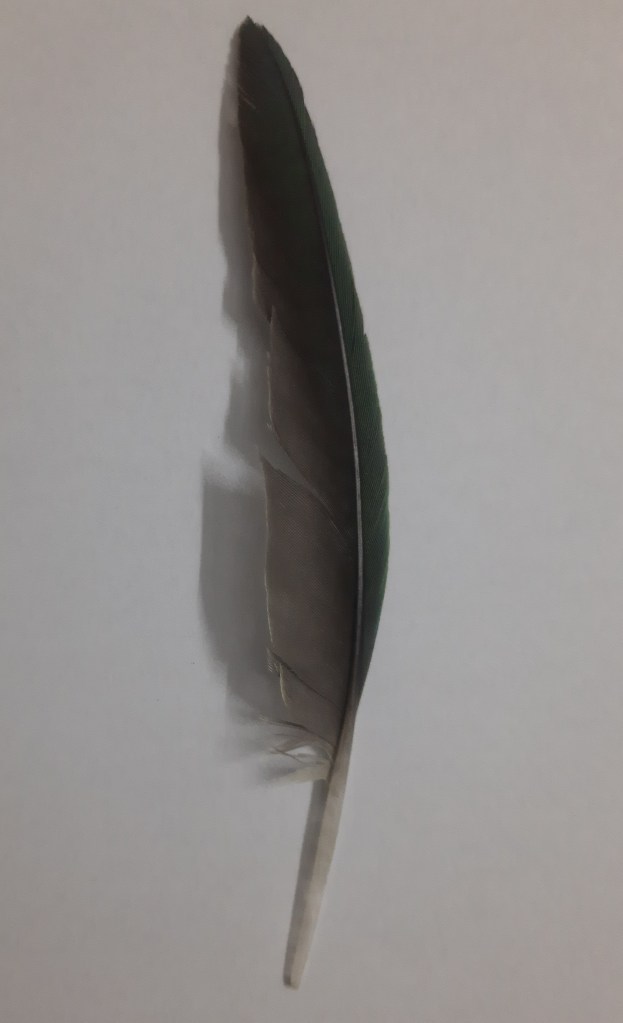
How often we randomly pick up a feather as we walk along. And wonder which bird it could belong to.

A feather library is where we can turn to for help in such a situation. These are digital or physical collections of bird feathers, used for research and education. They are an invaluable resource for understanding bird species, identifying feathers, and gathering data on bird health and natural history. These libraries are important tools for the study and conservation of bird species, offering insights into bird morphology and helping in the identification of feathers found in the wild.

There are not too many across the world. Some of the established ones include:

1. The Feather Atlas created by the U.S. Fish and Wildlife Service is a comprehensive image database of North American birds and covers about 438 species. It can be browsed by bird order, family, or species. It has an open identification tool in which one can fill in details about feather patterns, colors, size, and position, which can help you identify the bird your feather belongs to.

2.Featherbase (Germany) has been created by a working group of German feather-scientists and other collectors worldwide who have come together and contributed their personal collections. It holds close to 8000 specimens from over 1,000 bird species, with a focus on European and African birds. The collection includes high-resolution images and detailed anatomical information, and has supporeted studies in forensics, conservation, and biodiversity monitoring. It is rigorously classified and offers options of various languages so that birders from across the world can use it.

3. Found Feathers (iNaturalist Project) is a citizen science initiative where users contribute observations of feathers they find. The project encourages the collection of feather length and placement data, enhancing the database’s utility for researchers and birders. There are over 2,00,000 observations from across the world.

Special among these is India’s Feather Library. This pioneering initiative is the first of its kind in India and the world, dedicated to documenting, identifying, and studying the flight feathers of Indian birds. It is the passion project of architect Esha Munshi, a dedicated bird watcher who has seen over 1500 bird species across the world, and veterinarian Sherwin Everett who works in a bird hospital in Ahmedabad. They have created the library with the aim of having all feather-related data under one roof, fostering collaboration and advancing the collective understanding of Indian birds. In the short span of time since inception on Nov 15, 2021, 135 species have been documented.

The process is rigorous. They collect feather specimens from dead birds at rescue centres to establish a primary database of bird species. They then make detailed notes on the flight feathers, taking into account the number of Primaries, Secondaries, Tertials (Wing Feathers), and Rectrices (Tail Feathers), along with basic details such as overall length, bill length and width, leg lengths, etc. Then they stretch out one wing and fan the tail in both dorsal and ventral views to document the exact number of feathers, unique characteristics, colour, pattern, and size etc. The physical collection is housed at the National Centre for Biological Sciences (NCBS) in Bangalore.

The database is open to all and provides easy access.

Kudos to the dedication and passion of people like Esha and Sherwin who through their efforts help support avian research, conservation efforts, and educational outreach. And make a better world.

Happy Environment Day!

–Meena

Prickly Love

May 10 is celebrated as Cactus Day in the US. It is “a day dedicated to recognizing and appreciating the unique and fascinating world of cacti. This day also serves as a reminder of the many cactus species facing extinction and the need for their conservation, especially in their natural habitats.” Cacti are flowering plants that produce seeds. They are able to bloom every year, but they will produce an abundance of flowers in response to heavy rains. The family Cactaceae comprises many species of flowering plants with succulent (water-storing) stems.

It is entirely appropriate that it is a day marked in the US. Because 1749 out of the known 1750 species of cacti are native to the Americas! In other words, cacti were not originally found in any other part of the world.

I have to admit, this kind of blew my mind. All of us, from the time we are children, when asked to draw deserts or make an exhibit around the theme, have always generously populated our deserts with our own versions of cacti.

But cacti occur naturally only in the Americas–from Patagonia in South America, through the US, to parts of Canada. Anywhere else we see them, they have been taken by humans.

There are however equivalents in other parts of the world. There are the Euphorbs, tamarisks, saltbrushes etc. in Africa, and succulent and spinifex grasses in Australia. In India we have khejri, thoor, acacias etc. all of which grow in our deserts. But these are not cacti. All them have various adaptations to dry conditions like small or no leaves, spines, thick stems and deep roots. But they differ from cacti in that they do not have areoles. The presence of a structure called the areole is what sets cacti apart from all other plants. Areoles are round or elongated, often raised or depressed area on a cactus which is equivalent to a bud and from which spines, flowers, stems, or roots grow.

Cacti were introduced to Europe by, no surprises, Christopher Columbus. In 1493, on his second voyage to the Americas, he brought back a specimen of the prickly pear—the first time a cactus was seen in Europe. It caught the fancy of botanists, horticulturists and the public, and led to widespread cultivation of these plants.

They came to India with the Europeans, most likely sometime in the 16th or 17th century. In recent times, there has been much interest in these plants. They are much prized for their dramatic looks and are a feature in every balcony garden and indoor succulent-tray.  At a commercial level, the dragon fruit, cultivated widely across the country and now found in roadside fruit stands everywhere, is a cactus. Known  as pitaya or pitahaya, it is native to southern Mexico, Central America, and parts of South America. It is a climbing cactus species. The fruit is low in calories, rich in antioxidants and is said to have many other wonderful properties. But frankly, I am yet to get used to the bland taste!

For a few years now, our Central Arid Zone Research Institute (CAZRI), and ICARDA, an international organization, have been experimenting with cultivation of cacti, with a view to using it as fodder. Cacti as a fodder crop is seen as having the potential to help in the widespread shortage of green fodder, particularly during the summer months in many parts of the country. While still in experimental stages, it is thought to have some possibility.

India also has large and scientifically significant cacti collections. The National Cactus and Succulent Botanical Garden and Research Centre is located in the city Panchkula, the satellite town of Chandigarh. It is spread over seven acres and houses over 2500 species of cacti and succulents. The Regional Plant Resource Centre at Bhubenehswar has Asia’s largest collection of cacti. This Centre has created 200 new varieties and hybrids of cacti by breeding, growth manipulation, etc.

We said at the start that all except one cactus species was native to the Americas. The one exception is Thipsalis baccifera also know as the mistletoe cactus, which occurs naturally not only in the Americas, but also Africa, Madagascar, and close home in Sri Lanka. Scientists are still figuring out the how and why of this exception.

So look at cacti with new eyes. Love them, but don’t hug them!

-Meena

Contested Hedges

Contested borders are in the news every day. You can’t miss the claims and counter-claims between neighbouring countires—in our case, mainly China.

But it seems that disputes between neighbours on humble garden hedges are as serious. In the UK, disputes between neighbours on this issue have even resulted in deaths, with one Mr. Wilson of Lincolnshire, dying from gunshot wounds sustained during an argument over hedges, and a Mr. Reid dying of a heart attack after a heated dispute with his neighbour on the same subject. While not so drastic, many people have been levied stiff fines on the charge of trespass for cutting their neighbours’ encroaching hedges. In all, there were 1,00,000 hedge disputes in the UK prior in 2003.

Why do these disputes arise? A major reason is that the hedge blocks too much light to a neighbour’s house or garden; or that the hedge blocks a view. Or a neighbor’s overgrown hedge may encroach on your property. Also, branches or roots may cross into your property from a neighbor’s property or a public road.

This serious situation led to the passing of laws to manage the situation. In 2003, UK passed laws to manage disputes related to hedges. The UK Law essentially is about ‘high hedges’ defined as those over 2 meters in height. Transgressions of hedge-related law come under the definition of Anti-Social Behavior, since 2003!

The situation is understandable, given the extent of hedges in the UK. Laser scanning has shown that the UK has 390,000 km of hedges and hedgerows (1-6 metres tall) on field boundaries– enough to go round the world almost 10 times.

A step back. What is a hedge? A hedge is a line of shrubs (and occasionally trees), planted closely (3 feet or closer) which form a barrier or mark the boundary of an area, such as between neighbouring properties. Hedgerows on the other hand are hedges used to separate a road from adjoining fields, or one field from another, and which may incorporate larger trees. Apart from demarcating boundaries, hedges and hedgerows may serve as windbreaks to improve conditions for crops, as. A hedge is also called a “live fence”.

Under the UK Law, these disputes don’t go to court. Neighbours are encouraged to reach negotiated settlements. If this does not work, a written complaint may be given to the local Council, which will look into both sides of the argument and give a decision. Either the Council will reject the complaint, or they will give an order to cut the hedge to the mandated height. The cutting has to be done keeping in mind The Wildlife and Countryside Act 1981 which makes it an offence to destroy any bird’s nest that is either in use or being built!

Few other countries have such elaborate laws on the subject. However, some local authorities in the US do regulate the height or placement of hedges. For example, a resident of Palo Alto was arrested for allowing her xylosma hedge to grow too tall.

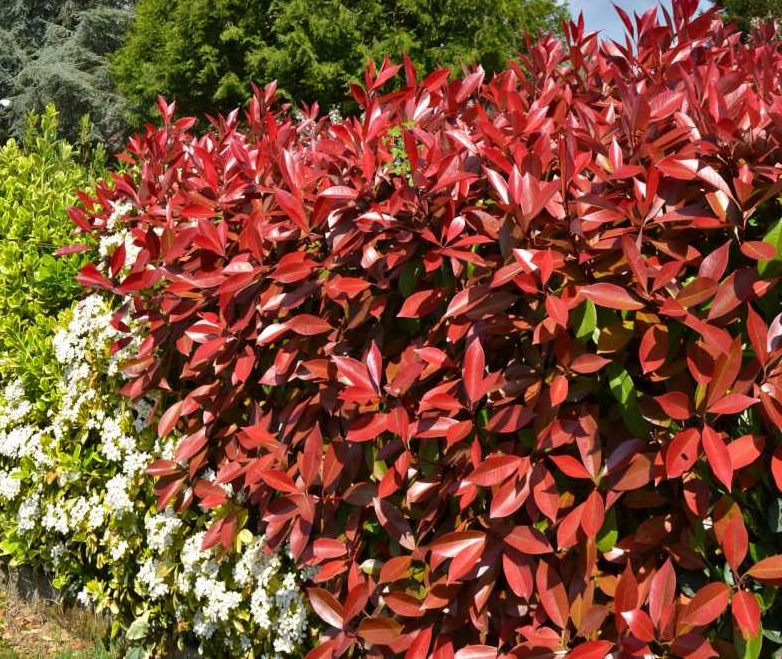
So go ahead. Do grow your Photinia, Duranta, Golden Cypress, Nerium, Hibiscus, Copper Leaf, Ixora, Tecoma, Vilayati Mehendi or whatever else takes your fancy. But make sure they don’t inconvenience your neighbours and get your behaviour labelled as anti-social—at least under the UK laws!

If everyone could plant hedges and learn to maintain them with discipline, maybe we will also learn to manage other boundary disputes without resorting to violence.  It could make for a world where boundary disputes become a thing of the past!

–Meena

A Quarry Blooms: Butchart Gardens

Victoria, the capital of British Columbia, Canada, is a place renowned for its tranquil beauty. And the crown jewel of Victoria is the Butchart Garden. Visited by about 1 million people every year, this 55-acre garden houses about 900 varieties of flowers  tended by 50 gardeners.

Two things are especially interesting about the Butchart.

The first, it is cultivated on the site of an abandoned quarry. Way back in the 19th century, the Butcharts were into cement production–Robert Butchart had started manufacturing Portland cement in 1888 in Ontario, Canada. As his business grew, he and his wife Jennie Butchart decided to move to the west coast of Canada because it had rich deposits of limestone—a critical input for cement production. They started quarrying limestone there, in the Saanich Penisula on Vicotria Island. Jennie trained as a chemist and worked in the company laboratory.

The couple also decided to build a house there, and in 1904, established their home near the quarry.

Jennie was always interested in gardening. In 1907 Isaburo Kishida, a Japenese garden designer from Yokohama, Japan, came to Victoria to build a tea garden at the Esquimalt Gorge Park. Following this, Japanese-style gardens became the rage in the area. Several prominent citizens, including Jennie Butchart, commissioned Kishida to build Japanese gardens in their estates.

This was the start of Jennie’s horticultural journey. In 1909, the limestone quarry was exhausted. Jennie was devastated to see the degradation and destruction left behind. She set about turning it into what came to be known as the Sunken Garden.  She transported tonnes of topsoil by horse-carts and is said to have personally tucked ivy into any hole or crevice in the rock and the grim quarry walls, suspended in a boson’s chair. It was a long process to get the ravaged quarry to bloom, but the garden was ready in 1921. So rather than a wound on the face of the earth which the abandoned quarry might have been, thanks to the relentless efforts of one woman, the site houses a world-famous garden.

After this highly successful reclamation project, Jennie’s ambitions grew and in 1926, she converted their tennis courts into an Italian garden. In 1929, the kitchen garden gave way to a rose garden. 

The reclamation is one part of the story.

The other interesting aspect of the Butchart Gardens are that they family-owned but perfectly accessible to the public.

The gardens came up on land owned by Robert and Jennie. And since then, have passed from generation to generation. The couple gifted the gardens to their grandson Ian Ross on his 21st birthday. He took the mission passionately forward, transforming the garden into an internationally-recognized landmark. Over the course of five decades, Ross not only enhanced the horticultural aspects, but added several performance features, like outdoor symphony concerts, a variety stage show, and in 1987 introduced a Magic of Christmas display.

When Ross died in 1997, his son Christopher took over, expanding the gardens and staff. The weekly fireworks, for which the Gardens are famous even today, were started by him.

After Christopher’s passing in 2000, Christopher’s sister Robin-Lee has been managing the legacy. Barnabas Butchart Clarke, the only child of Robin-Lee and David Clarke, and great-great-grandson of the founders, is next in line.

While the Butchart Gardens continue to be family-owned, they have been a designated a National Historic Site of Canada since 2004.

That the legacy has stood the test of time for almost 130 years is testimony to the fact that Jennie was a woman out of the ordinary. She cared more for her gardens and flowers than fashion, and was usually to be found dressed in overalls and a straw hat. She wanted people to see and enjoy the gardens, and even though there were thousands of visitors even in her lifetime, she was against charging.

The Butchart Gardens have always been at the forefront of taking up environmental causes. Even currently, their site features a campaign against improper disposal of biosolids (nutrient-rich, organic material that are produced as a result of wastewater treatment). They also support NGOs in their area through in-kind donations.

A legacy beyond flowers indeed!

–Meena

Nature Deficit Disorder

Among the many new medical disorders that have entered into our consciousness and everyday vocabulary in the last decade or so, a new one was added in 2005— Nature Deficit Disorder. The term was coined by Richard Louv as a way to describe the psychological, physical and cognitive costs of human alienation from nature, particularly for children in their vulnerable developing years.

As we live in our concrete jungles, increasingly cut off from the sight, sound and feel of Nature, these senses are steadily diminishing. Increasingly medical research is now proving that our sedentary lifestyles or “epidemic of inactivity” is the cause of a host of appropriately-called ‘lifestyle diseases.”

Richard Louv in his book Last Child in the Woods: Saving Our Children From Nature-Deficit Disorder expressed his apprehension at the growing phenomenon of alienation from Nature, and built a case for consciously building closer links between young children and Nature, through opportunities to go outside, be in Nature, and learn from Nature.

Times have changed—and not for the better. Almost fifteen years after Louv articulated his concern, the “wave from the West” has reached our homes in India, as it has most parts of the world. Children don’t seem to get as much opportunity to play outdoors and explore and discover independently anymore; meeting friends is usually organised and supervised in “play dates” rather than children spontaneously getting together and simply “mucking and mooching around!” Yes, there are genuine issues—safe spaces, security and time; but this over-protectiveness can actually be detrimental to children’s health, if they don’t get enough outdoor time and experiences. Difficult though it is, while we as parents, leave no stone unturned to give our children the best opportunities that money can buy for their all-round development, are we giving them enough exposure to the outdoors? For children and their development Nature is not “optional”, it is as essential as a healthy diet for growing up.

I do believe that the same formula applies equally to adults. Nature and the outdoors are vital for our physical and emotional development and well-being; it is only here that can we encounter all four non-negotiable sources for self-development: freedom, immediacy, resistance and relatedness (connection). In fact, it is for us to take the lead.

An even more alarming trend has been towards the gradual deficit of Nature, even in our language. Since 2007 the Oxford Children’s Dictionary has been dropping words related to nature to replace them with words that they felt better represented the present day and age. Acorn, Buttercup, Conker gave way to Attachment, Blog, and Cut-and-Paste. In 2015, some of the world’s most prominent authors composed an open letter of protest and alarm at this impoverishment of children’s vocabulary by replacement with words “associated with the increasingly interior, solitary childhoods of today,” and its consequent diminishment of children’s belonging to and with the natural world. A frightening manifestation of Nature Deficit Disorder. The authors expressed their distress that such culling of words would “deny children a store of words that is marvellous for its own sake, but also a vital means of connection and understanding.”

As one of the authors said, “If you can’t name things, how can you love them?”

–Mamata

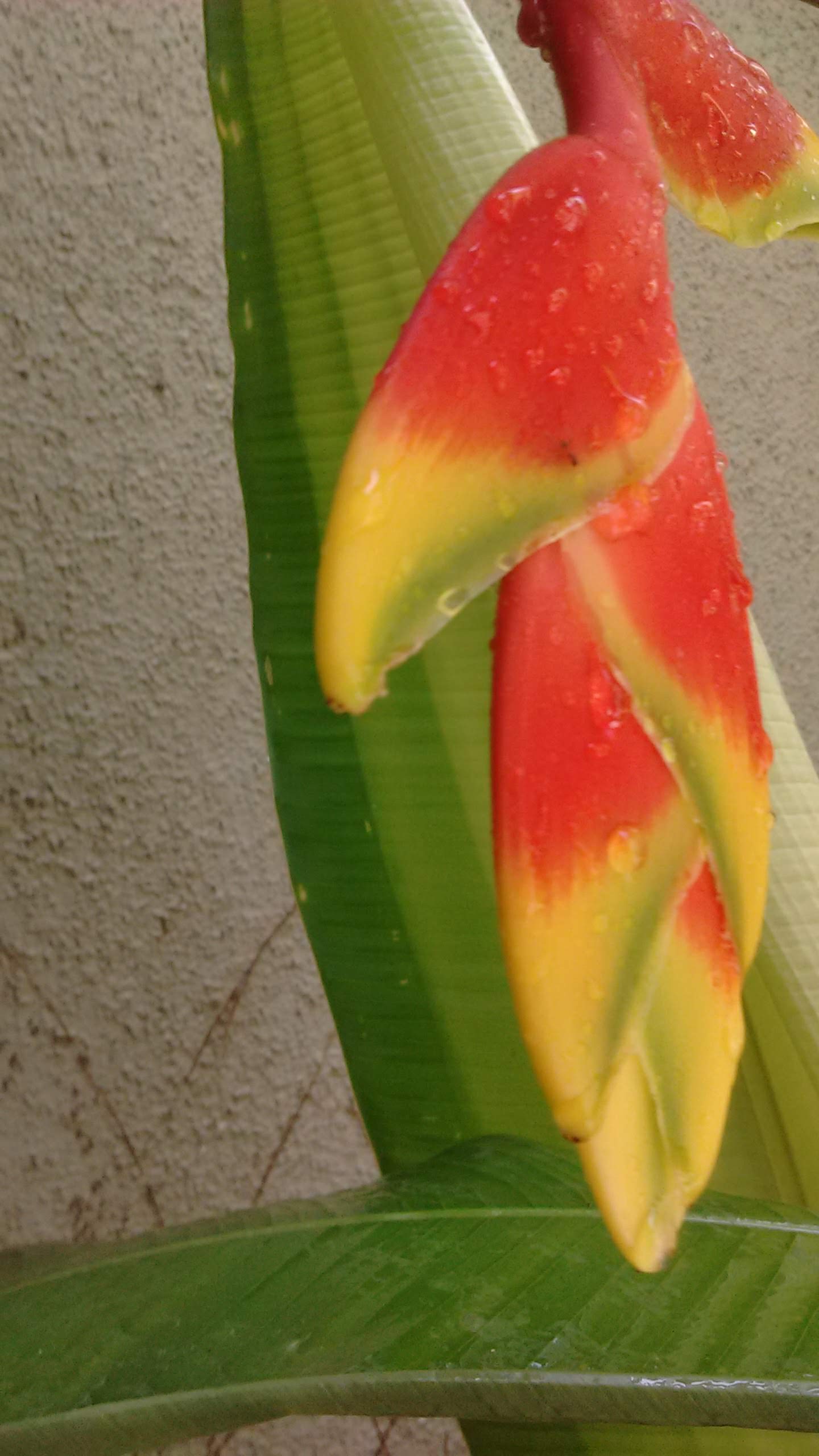
crabs claw close 2.jpg
A flower by any other name…Crab’s Claw