Veerappan: Re-visiting the Story of the Forest Brigand

In the ‘80s, ’90s and early into this century, Verappan was a name we often saw in newspaper headlines. As in:

India’s Most Wanted.

Outlaw of Jungle.

In the Lair of India’s Asthmatic Bandit King.

Veerappan Strikes Again.

Veerappan Kidnaps Rajkumar, Three Others.

A Ruthless and Daring Bandit.

And then, in October 2004, the headlines:

Veerppan walked into well-laid trap.

Veerappan shot dead.

Death of a Demon.

A ruthless killer, a sandalwood smuggler, a poacher who was responsible for the killing of elephants  in the four-figures; a kidnapper; a murderer; a hero to his gang and some poor communities; a man wanted and actively hunted by the security forces of two states and the BSF sent by the Centre, Veerappan was an elusive figure. A figure who fed news headlines, who kept security forces on their toes, and who with his dramatic moustache and daredevilry, excited the imaginations of many.

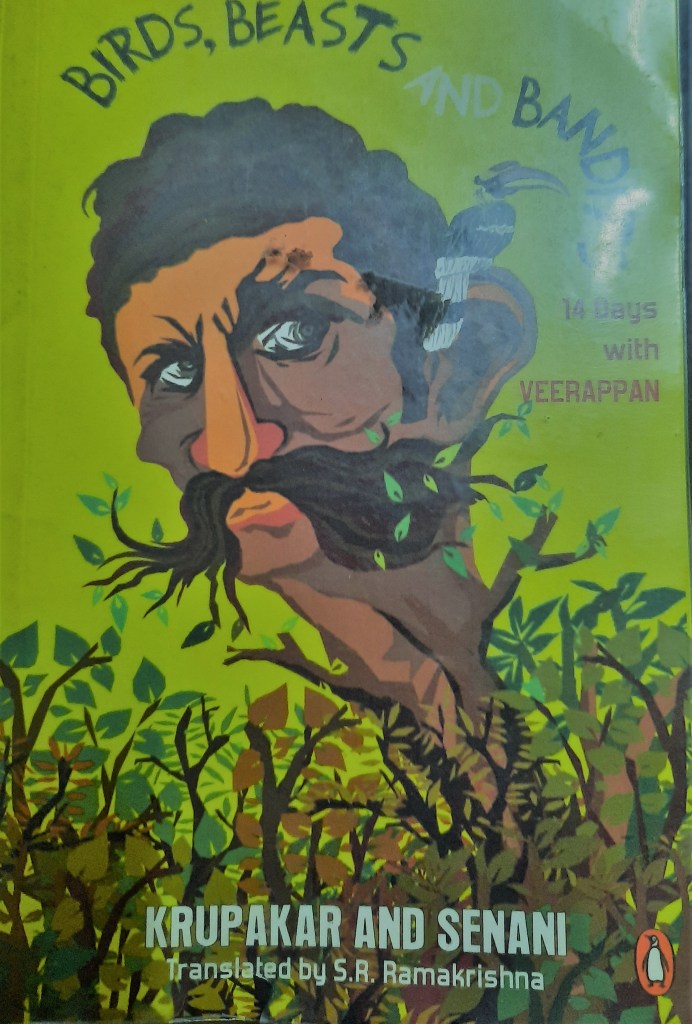
Why, 17 years after his death, have I suddenly been reminded about Veerappan? Well, I happened to stumble upon this book called BIRDS, BEASTS AND BANDITS: 14 DAYS WITH VEERAPPAN.

It is the true story of two wildlife-film maker-conservationists who were kidnapped by Veerappan and his gang under the mistaken impression that they were government officials who could be useful as bargaining chips for some of their demands. The gang captures a Bengali scientist visiting the forests as a tourist, as well as three forest guards as well, to add heft to their bargaining power. The seven hostages are marched across the forest for 14 days before they are released. The book is the account of these 14 days by the two main hostages, Krupakar and Senani.

They wrote their account for a Kannada weekly magazine ‘Sudha’ in 1998, a year after they were captured and released, and subsequently, as a book in Kannada. About 10 years after that, the book was translated and brought out in English by Penguin.

It is a light-hearted book, though it talks of an ordeal which must have taken a lot of guts to endure. And though light-hearted, it is not trivial. It touches upon many serious issues, from the injustice that Veerappan and others in his gang have faced, which may have driven them to become what they did. But it does not justify their actions. It mentions the unfair portrayal of his misdeeds in the press and by officialdom, in terms of chalking up a lot of crimes,  elephant-poachings and murders to his account, than he could have possibly committed.

Most importantly, it brings us glimpses of Veerappan as a person. His incredible abilities as well as his incredible instability; his naiveté and ignorance of the world, as well as his understanding of the jungles and the tribulations of the poor; his humour as well as his tantrums; his readiness to use the gun, as well as his gentleness in some situations.

As much as bringing Veerappan to us, the book brings us Krupakar and Senani. How they take the whole ordeal as pretty much routine—all in a day’s work, so to speak. Their equanimity, their fearlessness, their presence of mind, their strategic and thoughtful approach to communicating with their captors to move them towards the decision to release them—all these shine through. They don’t mention any of this explicitly, but as one reads, one is completely awed by this. The equanimity and stoicism of Dr. Maithi, an agricultural scientist from West Bengal who is another captive is unbelievable too! He spends his time meditating, indifferent to his situation, and in fact trying to teach the others meditation! And the incredible integrity of all the three, whether in their intentions that a peaceful resolution be brokered between Veerappan and the official machinery, or in their sympathy and empathy with the gang members, is touching.

There can be no sympathy with ruthless killers like these, but the book does portray their human side—their motivations, hopes and dreams.

The prize goes however to the following incident that Veerappan narrates to his prisoners, with whom the gang builds up a warm and emotional relationship. Veerappan tells them of how he had once kidnapped a government official and asked for a ransom of Rs. 3 crore for his release. A government emissary appears on bike, carrying a bag. Veerappan asks him to throw the money on the road to ensure that the bag does not have a bomb or something. He sees that the money is much less than promised (Rs. 3 lakh in fact). When angrily questioned, the emissary, a second-division clerk, is pretty fearless and says that this is what he was given. Disgusted, Veerappan tells him to go. But the man keeps standing there.  The story continues in Veerappan’s words as follows:

‘I was taken aback. People run the moment they see Verappan. But here I was telling this man to get lost, and he was still standing around.

‘What else?’ I asked loudly.

‘He bent forward, scratching his head with his left hand, and said ‘Nothing for me, sir?’

‘I gave him ten thousand, to rid myself of his wretched presence’.

Definitely a book for a weekend read!

–Meena

Changi Quilt

What on earth is that? A fancy quilt bought at some duty-free store at Changi Airport?

No! Changi is an old area of Singapore, and its name is derived from either a tree or creeper which was common there. Changi has two major landmarks– the Airport, which is among the world’s best; and the Changi Prison. The Quilts are associated with the latter.

On Feb 15 1942, Singapore fell to the Japanese and the Allied troops surrendered. Civilians including over 400 women and children were marched to the Changi Prison and interned there. These were women and children who had either not been able to get berths on ships to leave the island before the surrender, or who had consciously chosen not to leave. While the majority of the women were English, there were also women from Australia, New Zealand, the Netherlands, Canada, and the United States. The group included doctors, nurses, secretaries, teachers, as well as home-makers.

The Changi Prison building was designed to hold about 600 inmates, but with this influx, was accommodating about 2,400. The women and children occupied one wing of the building, while the men were put in the other. There was no communication between the two wings, and separated families had no way of knowing if members had survived, how they were, etc.

While some schooling did happen, some of the women were concerned that the children lacked a structure to their lives, and normal activities that would have been a part of their daily schedules outside prison. Elizabeth Ennis, an Army Nurse, along with a young Dutch girl, Trude van Roode, decided to do something about it. They made a group of about 30 girls between the ages of 8 and 13, and started a Girl Guides unit. The activity gave a focus and provided the girls with a purpose and discipline. The girls obviously thought the world of Elizabeth Ennis. On learning of her birthday, they decided to undertake a group-project of making a quilt for her. Each girl contributed to the making of a beautiful quilt, scrounging out fabric, thread and needles—precious commodities—to make hexagonal patches. Each child also embroidered her own name on to it. They put all the patches together and presented the quilt to Elizabeth.

This inspired a Canadian internee, Mrs Ethel Mulvany, a Red Cross representative in Singapore and chosen to be the camp Red Cross representative for the Changi women, with the idea of getting the women to make quilts for the Red Cross. The idea behind this move was ostensibly to alleviate boredom and to boost morale, and to give blankets to the wounded in hospitals. But it was also a means of passing information to men in other camps that the women and children were alive. 

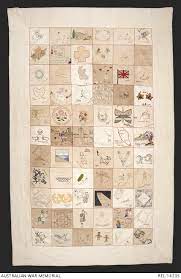
Three quilts were made—one each for the British Red Cross, Australian Red Cross and the Japanese Red Cross. Each quilt had 66 squares.

Changi Quilt
Changi Quilt

Every woman who volunteered to make a square for the quilt was given a piece of plain white cotton– from various sources including flour bags and bed sheets–and was asked to put “something of herself” into the square, and also embroider her name on it. The squares varied in many ways—from the skill levels of the embroiderers, to the designs. While flowers were of course a common theme, there were animals, national symbols, and cartoon characters like Snow White and Pinocchio. Some were very poignant–Trudie von Roode’s square, for instance, shows a waiter and a table laid with lots of food and elegant cutlery, alongside the words ‘It was only a dream’. There were also messages, some which were very personal and understood only by the families concerned. For instance, one woman portrayed a baby rabbit wearing a blue ribbon—probably to inform the husband that a baby boy had been born. There was a level of censorship here too—for instance, the word ‘prison’ had to be unpicked before the quilts could go out.

]

The quilts survived the War. The Australian quilt was given to the Australian Red Cross and is on permanent loan to Australia’s War Memorial. The Japanese quilt too is with this War Memorial. The British Quilt is at the British Red Cross UK office.

And thus did some personal histories get recorded and preserved.

–Meena

Low-tech Barriers to Tourism

Some months ago, I wrote a piece called High-tech Barriers to Heritage, describing how we had to have smartphones to buy tickets to get into a monument.

But my trip last week to Mysuru as a tourist reminded me that there were low-tech barriers aplenty too in our country.

To begin with, both in the Mysuru Palace (about half of which is closed to visitors due to renovation), and in the Jaganmohan Palace Art Gallery, it is necessary for visitors to take off footwear.  The reason is that in the Palace, there are sacred shaligrams which are worshipped. But the shaligrams are behind thick silver doors, and anyway not in the view of, or within shoe-shod feet of visitors. In the Jaganmohan Palace, the reason is that there is a large Ganesha idol as part of the exhibits. It would not be too difficult to move the beautiful idol to a secluded room so that visitors interested in seeing it could take off their shoes just outside that room. Both of these are largish museums and are spread over various floors. Tourists are on the road all day. It is neither comfortable, nor hygienic to go around with dirty feet. If footwear must not enter, then can cloth covers for feet be provided, which can be collected back at the exit, washed, sanitized and re-used? Or any other solution? Raghu who hates walking barefoot, and is also seriously diabetic and hence paranoid about getting his feet hurt, sat out both the visits while the rest of us went in. Sad, because he would have enjoyed seeing the exhibits, including the large collection of Ravi Varmas at the Jaganmohan Palace.

The visit to Brindavan Gardens was traumatic in a different way. We went in fairly late and were eager to catch a glimpse of the gardens before dark. We saw an electric buggy just as we entered, but the decrepit vehicle had just gathered its full load and took off for its round. We looked around for an Information Desk to check when the next buggy trip was scheduled. But there wasn’t a desk or kiosk. Nor even a schedule of buggy departures. We asked around in the shops which cluster and mess up the entrance, but no two answers coincided. We decided to have a coffee and wait for the next ride. We ordered the coffees, but didn’t get them because the electricity went off in between. We looked for loos, but as there was no Information Desk or signage, it took us quite some wandering around before we found them. At the end of 45 minutes, there was no sign of a buggy, it was quite dark, and we decided to leave.

The next day was a Tuesday. We wanted to visit the Rail Museum. But when we reached there, it was closed. So we decided to visit the Zoo, which is counted among the best in the country. But Tuesday was off for this site too!

Not that the Mysuru trip was a total disaster. The city itself is beautiful, green and stately, and driving around was a pleasure. We (some of us) did see the Palace and the Museum. We savoured the crispest dosas, the fluffiest idlies, the most flavourful of sambhars, the tangiest of chutneys—all in clean, modest, reasonably priced places.

And the highlight of the trip: the illuminations at the Palace in the evening. Lit up by 99,000 bulbs, it was a scene out of a fairytale or a dream. Apparently the Palace is lit up on Sundays and public holidays. We might have missed if we had not been told about by our Palace tour guide, for there were no signboards informing us that this was one of the evenings when the lighting was on.

It is not news that India is home to rich treasures. Indians now have the means, the time and desire to travel and see them. Can we not make life just a little easier for our tourists? Can we not treat them with respect and dignity? Can we not make the travel experience easy, pleasant, memorable, and an opportunity for learning?

To begin with, can we take a few simple steps?

  • Have information desks not only at the sites, but also prominent places in tourist cities, with helpful people who really want tourists to see and enjoy the sights?
  • Have basic informational and directional signs, as well as imaginatively conceived informational signage?
  • Not force people to trail through miles of corridor barefoot, inviting germs. If we are particular about keeping out shoes, can we come out with dignified alternatives?
  • Have some system of universally-accepted holidays for public places? After my experience, I did a bit of Google research and this is what I found:
FACILITYOFF-DAY
Delhi ZooFriday
Hyderabad ZooMonday
Mysuru ZooTuesday
Chennai ZooTuesday
National Museum, DelhiMonday
Dr. Bhau Daji Lad Museum, MumbaiWednesday
Kelkar Museum, PuneNo off-day
National Gallery of Modern Art, DelhiMonday
Visveswaraya Science Museum, BangaloreNo off-day
Science City, KolkattaNo off-day
National Science Centre, DelhiSaturday and Sunday

               Surely there is a case for rationalization!

Let’s celebrate Amazing India! But powers-that-be, could you just make it a little more convenient for the public?

–Meena

Valuing Toilets

As the World Toilet Day site says: ‘Life without a toilet is dirty, dangerous and undignified. Public health depends on toilets. Toilets also drive improvements in gender equality, education, economics and the environment. There will be no sustainable future without toilets.’

3.6 billion people across the world still lack access to safe sanitation.

World Toilet Day is observed on 19 Nov every year as a way to remind ourselves of this situation. This year, the theme as declared by the UN is Valuing Toilets. World Toilet Day is an occasion to remind ourselves of a goal the world is committed to, viz, Sustainable Development Goal  6, which is about Clean Water and Sanitation. Specifically under this Goal, the sub-goals related to sanitation are:

6.1 By 2030, achieve universal and equitable access to safe and affordable drinking water for all

6.2 By 2030, achieve access to adequate and equitable sanitation and hygiene for all and end open defecation, paying special attention to the needs of women and girls and those in vulnerable situations

6.A By 2030, expand international cooperation and capacity-building support to developing countries in water- and sanitation-related activities and programmes, including water harvesting, desalination, water efficiency, wastewater treatment, recycling and reuse technologies

6.B Support and strengthen the participation of local communities in improving water and sanitation management

India has made some progress, but there is still a long way to go. Creating infrastructure is the easier part. Bringing about behaviour change to get people to use toilets; to ensure water supply; to ensure maintenance and functionality—these are the bigger challenges that we still have to tackle.

This is where innovations are needed. And are happening. A very interesting publication ‘ 10 Innovative Approaches To Improve The Urban Wa-S-H Sector In India’ brought out by the  USAID and the National Institute of Urban Affairs documents some of these. Here are some of the most interesting:

Creation Of A Urine Bank and Collection by A Special Vehicle and Its Utilization as Fertilizer: Society for Community Organization and People’s Education (SCOPE), a Trichy based NGO, has tried this experiment in Musiri, Tamilnadu. Basically, they separated urine and faeces at the household/institution level through the use of ECOSAN toilets. About 400 litres of urine, which is good fertilizer, were collected with the help of a special van, suitably treated, diluted and put into use in agriculture. The application increased yields and was found to be cost-effective.

Waterless Urinals to Conserve Fresh Water, Save Energy and Reduce Maintenance Costs: This IIT-Delhi incubated innovation is for urinals in public spaces. It avoids the use of water for flushing. This is a considerable amount of water saved, for each flush uses from 4 to as much as 15 litres of water. The odour control mechanism like the sealant liquid, membrane trap and biological blocks are used to substitute for flushing.

I have personally had some experience of this innovation, having installed it in one of the public toilets we built and maintained in Hyderabad, and it worked pretty well.

Vandal Proof, Easy to Maintain and Durable Toilets: Anyone, like me, who has experience of managing public toilets, knows that vandalism, breakage, and irresponsible usage of the facilities are an inevitable and unpleasant part of a difficult job. This is one reason why the recurring costs of running such toilets is high. GARV toilets, an innovation tried in Faridabad, use stainless steel for the superstructure of the toilet pan and wash basin, rather than the less durable china clay or porcelain. This not only increases the life of various utilities in, but also reduces maintenance cost and water needed for cleaning. This innovation was apparently born out of the desire of a manufacturer who wanted to use the steel lying around in his factory. If you think through it, it is the approach used by the Indian Railways for maybe over a century now, and if it can work in our trains, it can work anywhere!


The publication is over five years old, and the innovations discussed go back even a decade. Some, like waterless urinals, have found wide application. Hopefully, the others have been also diffused far and wide, picked up and improved further.

The need to scale up and innovate in the sanitation sector is urgent. There is no better way to put it than to sum it up than in Gandhiji’s words: ‘A lavatory must be as clean as a drawing-room ‘.

–Meena

A Shout-out for the Environment: NEAC

India has always been a little ahead of the curve in its thinking about environmental issues. Four decades ago, it recognized that raising public awareness and educating key target groups as well the future generations on environmental issues, were key to a sustainable future. It designated a Centre of Excellence in this area way back in 1985–viz the Centre for Environment Education.

In 1986, the Ministry of Environment and Forests (as it was then) launched another unique initiative called the National Environmental Awareness Campaign (NEAC). The unique feature of this was that it called upon various types of organizations to plan their own Environmental Awareness programmes for their own local communities or other target groups, and implement them with the support of small grants from the Ministry.

Every year, NEAC started on Nov. 19th. Nov 19 to Dec 18 was marked as Environment Month in the old days in India—Nov 19 being Mrs. Indira Gandhi’s birthday, and she certainly had a big role in setting the environmental agenda for the country, and was a voice for developing countries on these issues at global forums.

NEAC was unique that it was conceived as a pan-national programme, at a time when there were not very many such. Even in the first year of its launch, it already touched almost every state and union territory. And it was unique in its proactive involvement of a variety of agencies as implementers. NGOs, educational institutions, professional associations, scientific bodies, community-based organizations—all were welcome to put in proposals, which were scrutinized and passed. There was a degree of trust which is not often seen.

And there were few constraints on media and methods for outreach—from street plays, to seminars to drawing competitions to films to essay-writing to teacher training to door-to-door campaigns to wall-painting to bringing out booklets and posters to….. The NEAC probably saw a flowering of outreach methods which was unique. And it reached every nook and corner of the country—from women in remote forest villages, to students in the Andamans; from famers in Assam to small industries in Gujarat.

NEAC
NEAC Campaign. CUTS.

The numbers were mind-boggling. From the involvement of 120 NGOs in the first year, it went to 9784 implementing agencies in 2006-2007. A total of 13,336 campaigns are reported to have been conducted in 2014-15. And each of these reached hundreds of people.

And the administrative backbone also evolved with the growing numbers. To begin with, there was one central Committee set up by the Ministry to scrutinize and pass the proposals. Slowly, the concept of Regional Resource Agencies (RRA) took root—reputed NGOs or academic institutions which were well networked in specific areas were given the responsibility to set up their own expert-committees and pass the proposals. Within 10 years of the programme starting, there were 27 such RRAs, making for very decentralized operations.

The amount of money involved was not high. Each implementing NGO got about Rs. 30,000 to implement the programme. But the energy, creativity and outreach it gave rise to were truly remarkable.

The NEAC has been more or less been given up in the last few years. Environment Minister Anil Madhav Dave in a written reply to Parliament said that the NEAC could not be conducted during 2015-16 and 2016-17 due to lack of funds.

Nov 19 is almost here. It does not seem that there is much action on this front this year either.

There were a lot of problems with NEAC, with the key ones being: Were the funds being utilized properly? Did the kind of awareness programmes being done make a difference?

Many evaluations of NEAC were done, the latest one being in around 2017. But the report of the evaluation is not exactly locatable. So has NEAC been dropped due to lack of funds? Because it was not making a difference? Because something else has taken its place? It is not clear.

The one thing that is clear is that with environmental crises looming, the need for environmental awareness and education have never been greater. OK, if the NEAC was not effective, let’s revamp it. Surely the evaluation report should tell us how to do it. But let’s not forget that building public opinion is critical to saving the world!

–Meena


COP Out?

The acronym COP has been hitting us in the face for the last few weeks. We know that there is a meeting happening at Glasgow, and that Climate Change is being discussed. And that the decisions made or not made will affect the future of the Planet and of humankind.

COP 26

But what is COP? COP stands for Conference of Parties, i.e., all the nations which have signed the United Nations Framework Convention on Climate Change (UNFCC). This is the foundational treaty on climate change, and came into being at the landmark Rio Convention in 1992. A ‘Framework Convention’ is one wherein parties acknowledge that there is a problem, and commit, more or less in principle, to work together to solve it. However, there are no specific obligations laid out in these. The UNFCC is ‘subject to ratification, acceptance, approval or accession by States and by regional economic integration organizations’. 

Over time, as more information, knowledge and science come in, and consensus grows, a Framework is fleshed out, and specific Protocols and Agreements with clear obligations come in. From UNFCC for instance, we have the Kyoto Protocol and the Paris Agreement, laying down specific obligations on the parties. Each of these has to be signed and ratified separately—and this is where the crux of it is. Easy enough to sign statements of intent, but countries baulk at signing on to specific commitments.

The UNFCC opened up for ratification at the Rio Conference on 4th June 1992. It came into force on 21st March 1994, after the 50th instrument of ratification, acceptance, approval or accession had been deposited. India was one of the early movers, signing the Convention on June 10, 1992, and ratified it in Nov 1993.

As of now, there are there are 197 Parties (196 States and 1 regional economic integration organization). And these are the ‘parties’ referred to in COP. The COP is the highest decision-making body of the Convention and all States that are Parties to the Convention are represented here.

The COP meets every year, unless the parties agree otherwise. The first meeting was held at Bonn in 1995, the year after the Convention came into force. The COP presidency rotates among the five UN regions. COP 8 was held in New Delhi in 2002.

Apart from the Parties, COPs are attended by Observer States. Beyond this, there are two more categories of participants. The Press and Media are one category of participants. The last category is of observer organizations. These ‘observer organizations’ include the United Nations System and its Specialized Agencies; intergovernmental organizations; and non-governmental organizations (NGOs).

The number of people registered for COP 26 at Glasgow was close to 40,000, approximately double the numbers from COP 25 held in 2019. But there have been allegations that many delegates and participants from developing countries could not make it because COVID-related travel restrictions for their countries were lifted too late, thereby restricting the voices of the Global South.

This is not the only angle from which COP 26 has been criticized. More than half way through the event, many are concerned with the progress made. Greta Thunberg feels that it has been a “two-week long celebration of business as usual and blah, blah, blah”.

What can we do but hope? And take actions at the personal level, while the powers talk and discuss and negotiate.

Till another COP next year, at a yet-to-be announced venue.

–Meena

Cantonments: Serene Oases

I recently came across a fascinating 2017 publication titled ‘Cantonments: A Transition from Heritage to Modernity’. This coffee table book has been brought out by the Director General of Defence Estates, which has ‘the task of Cantonment Administration and Land Management of all the defence land in the country’.

The word cantonment is derived from the French word canton, which means corner or district. Originally, it referred to temporary arrangements made for armies to stay during campaigns or for the winter. However, with colonization, the colonial powers had to set up more permanent military stations, and in India and other parts of South Asia, such permanent military stations came to be referred to as cantonments. In the US too, a cantonment is essentially ‘a permanent residential section (ie., barracks) of a fort or other military installation’. In India, the very first cantonment was set up by the British at Barrackpore about 250 years ago (though Danapur in Bihar also makes a claim to be the first!), and they grew in numbers in the 18th century.

Coffee table book on Indian Cantonments
A Coffee table book on Indian Cantonments

There are 62 cantonments in India, classified into four categories, depending on their size and population. The total cantonment land in the country totals to over 2 lakh acres. Cantonments are mixed-use areas, with both military and civil populations, unlike Military Stations which are exclusively inhabited by the Armed Forces. Cantonments are governed by the Cantonments Act, 2006, and the ultimate decision-making body is the Cantonment Board, which has equal representation of elected and nominated/ex-officio members.

Coming back to the book I started the piece with, it is a fascinating display of visuals from cantonments, and a great showcase of the diversity that cantonments are home to.

I learnt a lot of things I was not aware of. For instance, that the site of the Kumbh Mela, the Sangam, is within the Fort Cantonment of Allahabad. During the Kumbhs, the state government takes over the management of the area. Or that the Agra Fort, to which all of us troop, to get a glimpse of the Taj as Shah Jehan did a few centuries ago, is within a cantonment. Or that the Allahabad Cantonment houses an Ashokan pillar with edicts. This pillar is unique in that apart from Ashoka’s inscriptions, it contains later inscriptions attributed to the Gupta emperor, Samudragupta of the 4th century (an early case of state-sponsored graffiti?). Forts at Ahmednagar, Belgaum, Cannanore etc., are also part of cantonments.

Dr. Ambedkar, the father of our Constitution, was born in Mhow Cantonment—his father Ramji Maloji Sakpal held the rank of Subedar in the British army. Mhow is in fact today officially called Dr. Ambedkar Nagar. The Cantonment houses the Dr. B.R. Ambedkar Smarak, a marble structure which has an exhibition on the life of the leader.

Gurudev Rabindranath Tagore spent considerable time at the Almora Cantonment Board and is said to have written a number of books, including parts of the Gitanjali, during his sojourn here. The building where he stayed is now called Tagore House.

Cantonments house excellent buildings—the Flag Staff House built in 1828 on the banks of the Hooghly is now the Barrackpore home of the Governor of Bengal. The Rashtrapathi Nilayam at Secunderabad is part of a cantonment.

Expectedly, many war memorials are also housed in various cantonments, including the Madras War Cemetery, the Kirkee War Cemetery, Delhi War Cemetery, etc.

These areas also have a number of old and revered places of worship, from churches to temples to masjids.

And of course these are biodiversity havens—especially the ones up in the hill reaches of Shillong, Ranikhet, Landsdowne etc. Migratory birds visit the Danapur Cantonment, and thousands of open-billed white storks breed here.

We have all seen/passed through/visited/lived in cantonments, and have to admit they feel like serene, clean, green, well-ordered oases.  But cantonments are not without their controversies. Not only are they criticized as Raj-era relics perpetuating colonial mindsets, but also, there have been several tussles between civilians and the Forces establishment—whether public access to roads that run through these areas, or the issues of civilians who live within them—they cannot for instance, access home loans or government housing schemes.

The Comptroller and Auditor General of India (CAG) has been rather scathing with regard to the management of lands under Defence Control. The Army itself at some stage has wondered if it can afford the money spent on the upkeep of these areas. In a major development, at the start of 2021, the PMO has asked for views on the abolition of all cantonments.

So it seems there is some kind of a push at the top levels to do away with them. But one wonders—is that throwing out the baby with the bathwater? Would it not be better to re-conceive them to give a fair say to all stakeholders, and make the management more inclusive and responsive? And learn lessons from them on how to run our urban settlements well?

–Meena

Gandhi’s Women Warriors: M.S. Subbalakshmi

‘Warrior’ is a word far from the image of M.S., the doyen of Carnatic music, and the personification of spirituality, goodness and gentleness to people across the country and the world. The one who voiced the message of world peace at the UN on the occasion of its 50th anniversary through Kanchi Shankaracharya Shri Chandrasekarendra Saraswathi’s composition, which starts with ‘Maithreem Bhajatha Akila Hrith Jeththreem’—meaning,Serve with Friendship and Humility which will conquer the Hearts of Everyone; and ends with ‘Shreyo Bhooyaath Sakala Janaanaam’—meaning,  May All People of this World be Happy and Prosperous.

But she was indeed a warrior active in the Freedom Movement.  Along with her husband Sadasivam who participated in the first Satyagraha launched by Gandhiji in 1920, she was passionately committed to India’s Independence. She attended several Congress Sessions in the thirties and forties and sang at many of them. Her husband Sadasivam also used to sing at the start of local political meetings–usually songs by the fiery Tamil poet Bharatiyar–to enthuse the crowds and fill them with patriotic fervour. But after he got married to MS, he never sang publically!

MS Amma and Sadasivam were close to Gandhiji, Rajagopalachari, and many other freedom fighters, and were iconic in the South as symbols of the freedom movement.

Gandhiji recognized her ability to raise money for the freedom struggle through her music. She gave several concerts to do this. In 1944, she gave a series of five concerts to raise resources for the Kasturba Memorial Fund. Gandhiji wrote her a letter to thank her for this, signing it in Tamil.

Gandhi MS.Subbalakshmi
Gandhiji’s Letter to MS Subbalakshmi. Google Arts and Culture

In 1947, a few months prior to Independence, M.S Amma received a message from Gandhiji to record one of his favourite bhajans ‘Hari tum haro..’ and send it to him. In keeping with her characteristic humility, Amma did not feel she could do justice to the bhajan as she was unfamiliar with it, and suggested to Gandhiji that someone else should sing it. Gandhiji replied that he would rather have her recite it, than have anyone else sing it! So she did the recording and sent it on immediately. Not long afterwards, Gandhiji passed away. After the announcement of this news on All India Radio, they played her rendition of the bhajan. It is said that M.S. fainted at this point.

She was the first musician to be awarded the Bharat Ratna, and was the first Indian musician to get the Ramon Magsaysay award.

Her generosity and charity saw her support to many other causes through her lifetime.  The Tamil Isai movement—the movement to promote Tamil songs in Carnatic music–was one she was passionate about, and raised a lot of money for.  Her manifold awards included huge cash prizes, most of which she donated. She is said to have given over 200 concerts for charity, and raised over a crore of rupees  (in the sixties and seventies!). The royalties from her recording of Venkatesa Subrabhatam, which rings out every morning in every South India town and village, were written over to the Veda Patasala of the Tirupati Temple. Royalties from many other recordings were given to several other charities. In fact, so deep was her charitable instinct that it depleted her personal wealth considerably, necessitating considerable modification of her lifestyle.

But in the spirit of any of Gandhiji’s warriors, it was others before self for M.S. Amma!

–Meena

RIP Dr. SM Nair: Father of Natural History Museums

There are the pioneers, and he was among them. Museology is not a widely-known or popular field of study even today. Way back in the 1950s, it was even less so. This is the time at which a young boy from Kerala, after finishing his B.Sc in Trivandrum, travelled all the way to Baroda to pursue his M.Sc in the subject, at the M.S. University. He went on to do research on the Bio-deterioration of Museum Materials, and was awarded the first Doctorate in Museology from M.S. University for this work.

Dr. Nair started his career as an academic, first teaching at his alma mater in Baroda, and then moving on to Department of Museum Studies, BITS Pilani.

Mrs. Indira Gandhi, then-PM, and a leader who took great interest in the environment, had been very impressed by the Natural History Museums she saw during her visits to Europe. She wanted to create similar ones in India. She conceived of a plan for one in New Delhi and one in Bhopal. She put together an eminent team of museum professionals and scientists to take this idea forward. One thing led to another, and Dr. SM Nair, only 37 years old at that time, was chosen as the Project Director for this initiative in 1974.

Dr. Nair and Mrs. Gandhi at NMNH

Four hectic years followed, when the conceptualization, planning and execution was done by a dedicated core team including Shri D.P.Singh, S.K. Saraswat, B. Venugopal and several others. Dr. Nair visited the best Natural History Museums around the world. He got several artists and model-makers trained at the best centres in the world. And the National Museum of Natural History opened its doors to the public on June 5, 1978 (Environment Day). Subsequently, Regional Museums of Natural History came up in Mysore, Bhopal and Bhubaneswar  under Dr. Nair’s guidance.

The stuffed rhino that greeted one on the ground floor of the FICCI building where NMNH was housed, will surely be in the memories of many a Delhi school child. The rhino had died a natural death at the Delhi Zoo, and was stuffed and kept here.

The effort in NMNH was always to make the experience interactive for children. For those times, when most museums were static displays, this focus was unusual. The Museum also had a major thrust on outreach and extension. It had an active teacher training and orientation programme, which reached out to thousands of educators in its time.

Dr. Nair had a personal connect with every exhibit and activity at NMNH, and continued to take an interest in it even after his retirement in the late ‘90s. What he must have gone through on 26th April 2016, when the news of a fire breaking out in the museum and destroying the entire collection, can only be imagined.

Dr. Nair continued to be active in his mission of Environmental Education long after his retirement, working at WWF-India and Centre for Environment Education.

Not just at a national level, he was extremely respected internationally, serving as Chairman of Natural History Museum Committee of ICOM (international Council of Museums) and as

a Member of the Joint Museum Committee of the lndo-US Subcommission on Education and Culture.

Among his books are ‘Endangered Animals of India and their Conservation’, brought out by the National Book Trust, and  ‘Bio-deterioration of Museum Materials’ by Agam Kala Prakashan.

We knew Dr. Nair since the mid-eighties, as one of the fathers of the Environmental Education movement an India.

He mentored us first as a member of the Governing Council of CEE, and then as a senior colleague. Even today, old-timers in CEE-VIKSAT recall his contribution to these institutions with great respect—when it was a struggling NGO, he spotted the potential of the team and gave them a project to develop labels and take-away materials for the NMNH exhibits. This not only paid salaries for a couple of months, but gave them their first project from a national-level, government institution. This project was a critical stepping-stone.

We have also known him as the father of a colleague, Meena, who was inspired by him to follow in his footsteps in a career in Environmental Education.

NMNH and other natural history museums excited the imagination and curiosity of generations of children. NMNH may no longer exist, but Dr. Nair’s legacy lives on.

Dr. Nair passed away last week. May his soul rest in peace.

Dr. SM Nair (1937-2021).

–Meena

All Dolled Up: Golu Festival

When we were young, Navaratri was one of the most exciting festivals. Several reasons: first, it was the only festival which stretched for so many days; then, for the girls, it involved getting dressed up every evening and visiting neighbours, friends and relatives; it meant different interesting prasads every day; and importantly, there was an ‘official’ ban on studying on the day of Saraswathi Puja, when all books, musical instruments etc., had to be kept at the altar.

The highlight of Navaratri for South Indians is Golu, the display of dolls.  The first step involves the putting up of the ‘golu padi’ or steps on which the dolls would be arranged. Some houses had modest 3-step set-ups, while others had up to nine steps (always in odd numbers). Households brought their their engineering skills to full play—sometimes steps were made of trunks ingeniously stacked to form a stair case, and covered with a cloth. Some constructed temporary arrangements from year to year. Others had permanent dismantalable steps which were stored away in some attic and assembled every year.

Popular leaders in Golu. Dusshera Dolls Exhibition

Then the dolls would be unpacked. Wooden ones, clay ones, porcelain ones, you name it. Those whose dresses were worn-out would need new clothes. Others needed a lick of paint or minor repairs. There was a particular order to arranging these dolls, with gods on the top steps, saints and famous people below them, and regular ordinary everyday people and scenes below these. There used to be sets—e.g., village scenes, scenes from the Ramayana, occupations, musicians, etc. Every year, each family also bought a few new dolls.

Golu dolls
Kumbhakaran being woken up. Dusshera Dolls Exhibition.

Below the steps on the floor, would be garden scenes, or most coveted, a ‘thopakulam’ (pond). Again, family ingenuity would come into play here. What container would hold the water (usually a large shallow tub); how it would be concealed (that involved importing a lot of sand or mud into the house!); what would float in it—ducks and other birds, flowers (real or plastic), etc; and the scene around the pond, including benches, trees, people strolling around, and when there was a particularly enthusiastic family, twinkling street lights.

Hi-tech was very much part of the display. Not just the lighting, but setting up elaborate working train sets or car racing-tracks instead of a traditional pond, and running the trains was a favourite.

And then, every day, elaborate rangolies had to be made, as well as prasad including the mandatory sundal (legumes like chana, lobia etc. cooked with coconut etc.).

For the little girls, it was about pulling out all the pattu-pavadais (silk longskirts), reviewing which would be worn on which day, which had grown short and needed to be let out, begging mothers and aunts to buy them blingy ornaments, and deciding whose house to visit when. We also had to prepare songs—every Aunty would ask every visitor to sing, and after the mandatory coy no’s, we would all sing the songs we had prepared. It must have been torturous to the listeners because most of us couldn’t hold a tune to save our lives. But everyone would applaud most politely, and then we would be given our vatala-paaku, fruit and packets of sundal wrapped in newspaper, and depart to the next house. The highlight of course was to savour the sundals—all of them used to taste delicious, partly because there was a limited quantity in the packages we were given.  We would discuss the relative merits of the doll display for days, and neighbourhood reputations were made or unmade based on the displays and sundals.

Such were the excitements of our simple lives. And so are memories made and traditions continued.

–Meena

Both pictures were taken at the Exhibition of Dusshera Dolls, Karnataka Chitrakala Parishath, Bangalore.