Gandhi’s Women Warriors: M.S. Subbalakshmi

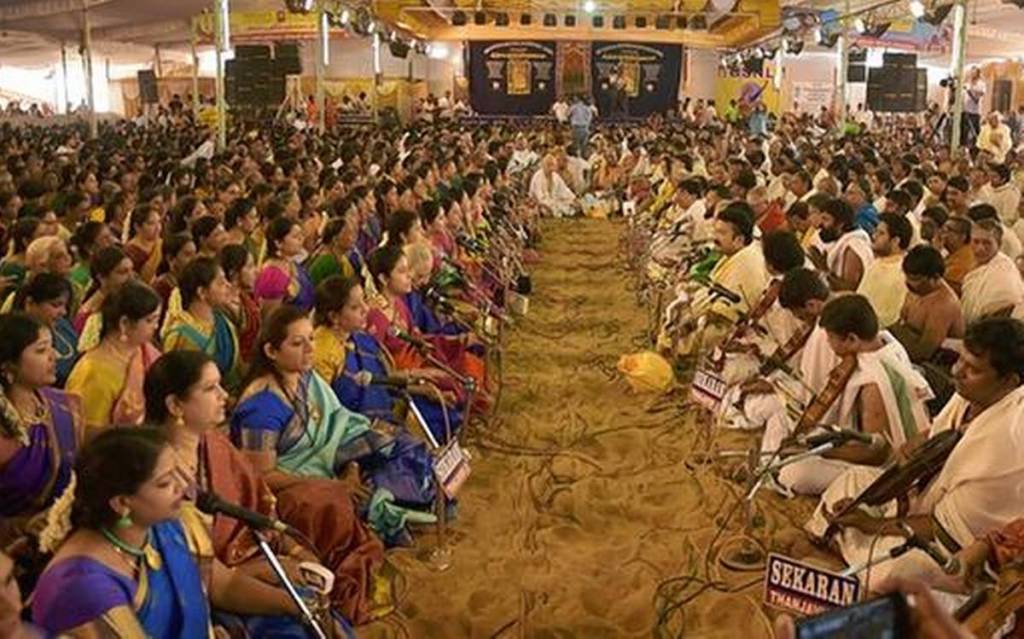
‘Warrior’ is a word far from the image of M.S., the doyen of Carnatic music, and the personification of spirituality, goodness and gentleness to people across the country and the world. The one who voiced the message of world peace at the UN on the occasion of its 50th anniversary through Kanchi Shankaracharya Shri Chandrasekarendra Saraswathi’s composition, which starts with ‘Maithreem Bhajatha Akila Hrith Jeththreem’—meaning,Serve with Friendship and Humility which will conquer the Hearts of Everyone; and ends with ‘Shreyo Bhooyaath Sakala Janaanaam’—meaning,  May All People of this World be Happy and Prosperous.

But she was indeed a warrior active in the Freedom Movement.  Along with her husband Sadasivam who participated in the first Satyagraha launched by Gandhiji in 1920, she was passionately committed to India’s Independence. She attended several Congress Sessions in the thirties and forties and sang at many of them. Her husband Sadasivam also used to sing at the start of local political meetings–usually songs by the fiery Tamil poet Bharatiyar–to enthuse the crowds and fill them with patriotic fervour. But after he got married to MS, he never sang publically!

MS Amma and Sadasivam were close to Gandhiji, Rajagopalachari, and many other freedom fighters, and were iconic in the South as symbols of the freedom movement.

Gandhiji recognized her ability to raise money for the freedom struggle through her music. She gave several concerts to do this. In 1944, she gave a series of five concerts to raise resources for the Kasturba Memorial Fund. Gandhiji wrote her a letter to thank her for this, signing it in Tamil.

Gandhi MS.Subbalakshmi
Gandhiji’s Letter to MS Subbalakshmi. Google Arts and Culture

In 1947, a few months prior to Independence, M.S Amma received a message from Gandhiji to record one of his favourite bhajans ‘Hari tum haro..’ and send it to him. In keeping with her characteristic humility, Amma did not feel she could do justice to the bhajan as she was unfamiliar with it, and suggested to Gandhiji that someone else should sing it. Gandhiji replied that he would rather have her recite it, than have anyone else sing it! So she did the recording and sent it on immediately. Not long afterwards, Gandhiji passed away. After the announcement of this news on All India Radio, they played her rendition of the bhajan. It is said that M.S. fainted at this point.

She was the first musician to be awarded the Bharat Ratna, and was the first Indian musician to get the Ramon Magsaysay award.

Her generosity and charity saw her support to many other causes through her lifetime.  The Tamil Isai movement—the movement to promote Tamil songs in Carnatic music–was one she was passionate about, and raised a lot of money for.  Her manifold awards included huge cash prizes, most of which she donated. She is said to have given over 200 concerts for charity, and raised over a crore of rupees  (in the sixties and seventies!). The royalties from her recording of Venkatesa Subrabhatam, which rings out every morning in every South India town and village, were written over to the Veda Patasala of the Tirupati Temple. Royalties from many other recordings were given to several other charities. In fact, so deep was her charitable instinct that it depleted her personal wealth considerably, necessitating considerable modification of her lifestyle.

But in the spirit of any of Gandhiji’s warriors, it was others before self for M.S. Amma!

–Meena

RIP Dr. SM Nair: Father of Natural History Museums

There are the pioneers, and he was among them. Museology is not a widely-known or popular field of study even today. Way back in the 1950s, it was even less so. This is the time at which a young boy from Kerala, after finishing his B.Sc in Trivandrum, travelled all the way to Baroda to pursue his M.Sc in the subject, at the M.S. University. He went on to do research on the Bio-deterioration of Museum Materials, and was awarded the first Doctorate in Museology from M.S. University for this work.

Dr. Nair started his career as an academic, first teaching at his alma mater in Baroda, and then moving on to Department of Museum Studies, BITS Pilani.

Mrs. Indira Gandhi, then-PM, and a leader who took great interest in the environment, had been very impressed by the Natural History Museums she saw during her visits to Europe. She wanted to create similar ones in India. She conceived of a plan for one in New Delhi and one in Bhopal. She put together an eminent team of museum professionals and scientists to take this idea forward. One thing led to another, and Dr. SM Nair, only 37 years old at that time, was chosen as the Project Director for this initiative in 1974.

Dr. Nair and Mrs. Gandhi at NMNH

Four hectic years followed, when the conceptualization, planning and execution was done by a dedicated core team including Shri D.P.Singh, S.K. Saraswat, B. Venugopal and several others. Dr. Nair visited the best Natural History Museums around the world. He got several artists and model-makers trained at the best centres in the world. And the National Museum of Natural History opened its doors to the public on June 5, 1978 (Environment Day). Subsequently, Regional Museums of Natural History came up in Mysore, Bhopal and Bhubaneswar  under Dr. Nair’s guidance.

The stuffed rhino that greeted one on the ground floor of the FICCI building where NMNH was housed, will surely be in the memories of many a Delhi school child. The rhino had died a natural death at the Delhi Zoo, and was stuffed and kept here.

The effort in NMNH was always to make the experience interactive for children. For those times, when most museums were static displays, this focus was unusual. The Museum also had a major thrust on outreach and extension. It had an active teacher training and orientation programme, which reached out to thousands of educators in its time.

Dr. Nair had a personal connect with every exhibit and activity at NMNH, and continued to take an interest in it even after his retirement in the late ‘90s. What he must have gone through on 26th April 2016, when the news of a fire breaking out in the museum and destroying the entire collection, can only be imagined.

Dr. Nair continued to be active in his mission of Environmental Education long after his retirement, working at WWF-India and Centre for Environment Education.

Not just at a national level, he was extremely respected internationally, serving as Chairman of Natural History Museum Committee of ICOM (international Council of Museums) and as

a Member of the Joint Museum Committee of the lndo-US Subcommission on Education and Culture.

Among his books are ‘Endangered Animals of India and their Conservation’, brought out by the National Book Trust, and  ‘Bio-deterioration of Museum Materials’ by Agam Kala Prakashan.

We knew Dr. Nair since the mid-eighties, as one of the fathers of the Environmental Education movement an India.

He mentored us first as a member of the Governing Council of CEE, and then as a senior colleague. Even today, old-timers in CEE-VIKSAT recall his contribution to these institutions with great respect—when it was a struggling NGO, he spotted the potential of the team and gave them a project to develop labels and take-away materials for the NMNH exhibits. This not only paid salaries for a couple of months, but gave them their first project from a national-level, government institution. This project was a critical stepping-stone.

We have also known him as the father of a colleague, Meena, who was inspired by him to follow in his footsteps in a career in Environmental Education.

NMNH and other natural history museums excited the imagination and curiosity of generations of children. NMNH may no longer exist, but Dr. Nair’s legacy lives on.

Dr. Nair passed away last week. May his soul rest in peace.

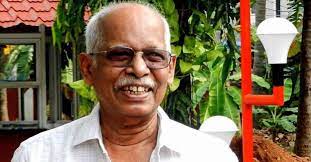
Dr. SM Nair (1937-2021).

–Meena

All Dolled Up: Golu Festival

When we were young, Navaratri was one of the most exciting festivals. Several reasons: first, it was the only festival which stretched for so many days; then, for the girls, it involved getting dressed up every evening and visiting neighbours, friends and relatives; it meant different interesting prasads every day; and importantly, there was an ‘official’ ban on studying on the day of Saraswathi Puja, when all books, musical instruments etc., had to be kept at the altar.

The highlight of Navaratri for South Indians is Golu, the display of dolls.  The first step involves the putting up of the ‘golu padi’ or steps on which the dolls would be arranged. Some houses had modest 3-step set-ups, while others had up to nine steps (always in odd numbers). Households brought their their engineering skills to full play—sometimes steps were made of trunks ingeniously stacked to form a stair case, and covered with a cloth. Some constructed temporary arrangements from year to year. Others had permanent dismantalable steps which were stored away in some attic and assembled every year.

Popular leaders in Golu. Dusshera Dolls Exhibition

Then the dolls would be unpacked. Wooden ones, clay ones, porcelain ones, you name it. Those whose dresses were worn-out would need new clothes. Others needed a lick of paint or minor repairs. There was a particular order to arranging these dolls, with gods on the top steps, saints and famous people below them, and regular ordinary everyday people and scenes below these. There used to be sets—e.g., village scenes, scenes from the Ramayana, occupations, musicians, etc. Every year, each family also bought a few new dolls.

Golu dolls
Kumbhakaran being woken up. Dusshera Dolls Exhibition.

Below the steps on the floor, would be garden scenes, or most coveted, a ‘thopakulam’ (pond). Again, family ingenuity would come into play here. What container would hold the water (usually a large shallow tub); how it would be concealed (that involved importing a lot of sand or mud into the house!); what would float in it—ducks and other birds, flowers (real or plastic), etc; and the scene around the pond, including benches, trees, people strolling around, and when there was a particularly enthusiastic family, twinkling street lights.

Hi-tech was very much part of the display. Not just the lighting, but setting up elaborate working train sets or car racing-tracks instead of a traditional pond, and running the trains was a favourite.

And then, every day, elaborate rangolies had to be made, as well as prasad including the mandatory sundal (legumes like chana, lobia etc. cooked with coconut etc.).

For the little girls, it was about pulling out all the pattu-pavadais (silk longskirts), reviewing which would be worn on which day, which had grown short and needed to be let out, begging mothers and aunts to buy them blingy ornaments, and deciding whose house to visit when. We also had to prepare songs—every Aunty would ask every visitor to sing, and after the mandatory coy no’s, we would all sing the songs we had prepared. It must have been torturous to the listeners because most of us couldn’t hold a tune to save our lives. But everyone would applaud most politely, and then we would be given our vatala-paaku, fruit and packets of sundal wrapped in newspaper, and depart to the next house. The highlight of course was to savour the sundals—all of them used to taste delicious, partly because there was a limited quantity in the packages we were given.  We would discuss the relative merits of the doll display for days, and neighbourhood reputations were made or unmade based on the displays and sundals.

Such were the excitements of our simple lives. And so are memories made and traditions continued.

–Meena

Both pictures were taken at the Exhibition of Dusshera Dolls, Karnataka Chitrakala Parishath, Bangalore.

A Thousand Flowers Bloom on my Table: Millefiori


When I was young, visits to my father’s office were looked-forward to treats. And one of the things that fascinated me were the beautiful, colourful glass paperweights that lay on the table, doing what they were supposed to do, i.e., keeping papers from flying in the wind created by the fan.

With bright colours and intricate designs, each one was different from the other. And of course, I always wondered how the fantastic shapes got into the glass dome.

It was only recently that poking around in a drawer, I re-discovered one of these. And I decided to read up on them.

Appropriately, the technique is called ‘millefiori’, Italian for ‘thousand flowers’ and is a kind of glass mosaic. The technique was probably invented in ancient Egypt and can be traced back to Ancient Roman Times. Samples have been found dating back to the 5th century. But the process got lost somewhere and was revived only in the 19th century by Murano glass artists. Vincenzo Moretti is credited with this, and is said to have put in years of painstaking trial and error to perfect the art. The term ‘millefiori’ itself first found its place in the Oxford dictionary in 1849. It was around this time that it became a rage in Europe, and factories came up in Italy, France and England, making paperweights, beads and marbles. France was at the center of the blossoming creativity. The Great Exhibition of London in 1851 and the Paris Expo of 1878 gave a fillip to the popularity of this craft. However, the trend petered out in a few decades but some artists still carry forward the tradition, creating works to suit modern sensibilities.

Millefiori paperweight

The first step in the technique is to create Millefiori canes by layering molten glass of different colours into a pattern in a cylindrical shape. Then the cylinder is pulled by two glassmakers walking away from each other, pulling it to create a long rod. When the rod is sliced, the pattern is seen. Each such slice is called a murine. Many murines are arranged in a pattern and cased in glass, resulting in the beautiful products, ranging from paperweights, vases, rings, pendants, decorative plates, ashtrays and even playing marbles. It is a craft requiring not just an aesthetic sense but also great skills of working with glass, and precision. While flowers are the most common patterns, there are paperweights with geometrical shapes, insects, etc. too.

Today, these weights are collectors’ items, auctioned by the likes of Christie’s.

Alas, the one I have dug out is chipped at the bottom, so unlikely to make me my fortune. But it sure gives me joy every day when I look at it on my table. As precious!

—Meena

Motto: A Call to Action

A motto is a sentence, phrase, or word inscribed on something as appropriate to or indicative of its character or use’. It is a ‘short expression of a guiding principle’. A motto is official, like a logo or a statement, and an entity can have only one motto at a time (though they can and do change this over time).

Any entity can have a motto: a person, a country, a corporate, an educational institution, a non-profit.

Satyameva jayate
Satyameva jayate

India’s motto is Satayameva Jayata: Truth alone shall triumph. Some organs of the government have their own mottos too: The motto of our Supreme Court is: Yato Dharmastato Jayah. (Where there is righteousness (dharma), there is victory). The Indian Army: The safety,  honour and welfare of your country; Indian Air Force: Nabha sparsham Deeptam (Touch the sky with glory ); Indian Navy: Shaṁ No Varunah(May the Lord of Water be auspicious unto us).

Some interesting mottos of other countries are:

Truth prevails: Somewhat similar to India’s, this is the motto of the Czech Republic.

Janani Janmabhumishcha Swargadapi Gariyasi: Like India, Nepal’s motto is in Sanskrit, and means ‘Mother and motherland are greater than heaven’.

Rain: This is the motto of Botswana, and only one-word motto for a country. It pithily communicates the importance of rain for an agricultural county.

Liberté, égalité, fraternité: The motto of the French Revolution became the motto of two countries—France and Haiti.

In God we trust: This was taken as the motto of USA in 1956. Till then, the motto was ‘E pluribus unum’, meaning ‘Out of many, one’.

Some countries like the UK, China, Denmark, Bangladesh etc. have no official motto.

Business houses of course have mottoes too. Some are philosophical and conceptual, other very practical.

Tatas: Leadership with Trust.

Wipro: Applying thought

TCS: Experience certainty.

Reliance Industries: Growth is Life.

Non-profits convey their mission through the mottos:

Pratham: Every child in school and learning well.

Indian Red Cross Society: I Serve

Blind People’s Association: Touching People, Changing Lives

Adyar Cancer Institute: With Humanity and In Wisdom

Our educational institutions have profound mottoes too:

UGC: Gyan Vigyan Vimuktaye, meaning ‘knowledge liberates.’

IIM-A: Vidya Vinaygodhvikasah, meaning ‘development through the distribution or application of knowledge’.

IIT-B: Gyanam Marmam dhyatam, meaning ‘knowledge is the supreme goal.’

Delhi University: Nishta Drithiha Satyam: Dedication, steadfastness and truth.

Anna University: Progress through knowledge.

BITS Pilani: Gyanam Paramam Balam: Knowledge is the supreme power.

TISS: Re-imaging Futures.

There is not a motto of a country, an organization or institution which is not uplifting, elevating, noble. But sadly, I doubt if members of the entity even know or recall what their motto is. Maybe each organization needs to consciously set aside time on a regular basis to reflect, discuss and internalize how their motto should and can guide their day-to-day operations.  A motto can be an inspiration, a guide to action, something that conveys a mission, something that unites. It is a powerful way of bringing people together and inspiring them. But if they are left on paper, they are simply unreal statements of aspirational intent, rather than guiding principles.

–Meena

Poet with the Piercing Gaze: Subramania Bharathi

The image of Che Guevera, his hair flowing to the shoulders, eyes looking off-camera and a beret on his head, is the international image of revolution, of the oppressed fighting against the powerful, of idealism, of nobility.

No less iconic for Tamilians is the image of Subramania Bharathi, turban on the head with the end wound around his throat, a mustache, and eyes that seem to pierce into the soul. It stands for all of the above, and in addition, for sublime poetry and an idealistic vision for India.

Poet Subramania Bharathi
Mahakavi Bharathi

We mark a century of Mahakavi Subramania Bharathi’s passing this month. He died at the age of 39, tragically trampled to death by the elephant at the Parthasarathy Temple, Triplicane, Chennai. He used to feed the elephant regularly, and they were friends. But on that particular day, something went drastically wrong. His death, as his life, was completely out of the ordinary.

But he is very much alive today, a living tradition. The versatility of Bharathi’s composition is one reason—his songs of national pride, his songs of revolution and social change, of romance, of bhakti—there is something for every occasion.

There is no schoolchild in Tamilnadu who does not know his poems and writings. Not a musician—classical or light-classical or filmi or pop–who does not have a repertoire of Bharathi songs. Not a film-maker who has not used a song or at least a verse from one of his compositions at one time or the other. Not a Tamilian who has not been touched, moved, affected by his poems.

He was something of a child prodigy, being conferred the title of ‘Bharathi’—one who was blessed by the Goddess Saraswathi—at the age of 12, by the Raja of Ettayapuram, for his poetic genius.

He knew 14 languages, but chose to write in Tamil. He was a teacher, a journalist, a poet, a writer, a freedom fighter. He was deeply spiritual, delving deep into Hinduism. It is said that he adopted his trademark turban in admiration of the Sikhs.

The British Empire feared his pen so much that there was an arrest warrant out for him. He spent almost 10 years in exile in Pondicherry (a French territory), so escape imprisonment.

He was an ardent proponent of the emancipation of women, and advocated that they take their place shoulder to shoulder in the freedom struggle and in the development of the nation. In fact, traditional Madras of over a century ago was shocked and agog when he insisted on walking in public, holding hands with his wife!

Poetry in translation seldom works anywhere as well as the original. But even with that, a poet’s words speak louder than anyone else can, of his thoughts, ideas and ideals. So here is an excerpt from one of his most stirring songs:

‘With the name of Bharat Desh on our lips

Let us shake off our fears and poverty

And overcome our sorrows and enemies.

We shall stroll on the snow-clad silver heights of the Himalayas

Our ships shall sail across the high seas

We shall set up schools—scared temples for us.

We shall span the sea to reach Sri Lanka

And raise the level of the Sethu and pave a road on it

We shall water Central India with the bounteous rivers of Bengal.

We shall have such devices that sitting at Kanchi

We will listen to the discourses of scholars in Varanasi.

We shall make tools and weapons

We shall produce paper

We shall open factories and schools

We shall never be lazy or weary

We shall ever be generous

We shall always speak the truth.

Both scriptures and sciences we shall learn

The heavens and oceans we will explore

The mysteries of the moon we shall unravel

The art of street-sweeping too, we shall learn.’

Be inspired, be elevated. Listen to renditions of Bharathi even if you don’t understand the words. And do look out for translations of his work. This translation is from a 1984 publication brought out by NCERT, which also has a well put-together summary of his life. Proving once again that NCERT has done some wonderful work!

https://archive.org/stream/in.ernet.dli.2015.231768/2015.231768.Poems-Subramania_djvu.txt)

–Meena

Blender-Composting for the Lazy Gardener

Compost as we all know, is decomposed organic matter. Rich in nutrients, it is also known as ‘black gold’ for the vigour and fortification it brings to soil. Compost is the end-result of the natural degradation of biomaterials like garden waste and kitchen waste. Everything in nature will degrade in the natural course. But left to itself, it may take years or even decades. Composting is a way to nudge the process along. Win-win, because it reduces the amount of green and brown waste entering the garbage management system, and because the end-product enriches soil.

During composting, microorganisms—bacteria, fungi etc.–decompose the bio-materials. Among these, bacteria play a large part—they secrete a variety of enzymes which chemically break down organic materials. Worms, bugs, nematodes, and other critters in the soil contribute by physically breaking down those materials, which makes it easier for the bacteria, fungi and others to do their work.

The resultant compost provides the soil nitrogen, phosphorus and potassium, along with a host of micronutrients and trace minerals.

Fundamentally, there are two types of composting processes which can go to work. The first is aerobic composting, in which the kind of bacteria at work use air to help speed up the breakdown of materials. The other is anaerobic composting, where the bacteria do not need oxygen to carry out the process.

There are several types of composting methods which can be used, basically classified as:

* Hot Composting: This quickly turns organic material into usable compost, but requires a lot of time and effort. Hot composting involves keeping the temperature at the center of the compost pile elevated, ideally to somewhere between 43-60o Celsius. The pile needs to be kept turned once a week or so to move colder material from the outside of the pile to the inside where it is heated and so breaks down into rich humus more quickly

* Cold Composting: Cold composting essentially means creating a compost pile and leaving nature to do its job. It requires less input from the gardener, but does mean that useable compost can take up to a year to be ready.

* Vermicomposting: Here worms are added to hasten the process of composting.

Popular domestic composting methods include open air composting, bin composting, tumbler composting and vermi-composting.

On and off, I have tried my hand at composting my kitchen waste. But being both lazy and inept, it was a mess each time!

Then I came across a method called trench-composting, which basically involves digging up the area around your plants in a shallow ditch, spreading the cut-up kitchen waste in the ditch, and covering it back with soil. I liked this method. Kind of no-fuss, no-muss; possible even for the ten-thumbed like me; and can be done on a daily basis. But then I ran into a problem. This was possible in the kitchen patch or even in the flower-beds. But what about the lawn? I could obviously not dig trenches there.

Then an idea struck. Why not blend up the kitchen waste and just pour it on the lawn? I reasoned that it would return nutrients to the soil, and would also results in a huge reduction of the kitchen waste going out into the waste management system. I started doing this.

And also decided to check if this idea had struck anyone else. Well, yes. Looks it has! The internet has accounts of what is called Blender-Composting. Several gardeners use it, though I could find no scientific papers on it. As some of the participants in the debates point out, this is not composting at all, since one is only physically crushing the pieces. But since that is the starting point of the composting process, I suppose it will help the bacteria and other micro-organisms do their work faster. Gardening experts say that addition of reasonable amount of bio-waste in this form can only have positive effects on the soil, even though it is not clear how much. However, they do caution against adding too much of this, as the early stages of the composting process could deplete nitrogen from the soil.

I can vouch that there is no smell and the goop, properly diluted and spread, attracts no flies or other insects. But depending on what goes into it, the goop can sometimes be yucky-looking, in fact referred to by some as ‘dragon-vomit’. I can vouch for this also—the day the goop is papaya-based, I definitely have to hide it in the soil in the hedges and bushes!

I am sold—it is either trench composting or blender composting for me!

–Meena

Telling Stories on Cloth: Patachitra

Patachitra, from ‘patta’ meaning cloth, and ‘chitra’ meaning picture, is an art form of East India, which tells stories on cloth. Believed to have originated in the 12th century in Odisha, Patachitra traditionally depicts stories of Krishna. So what better way to mark Janmashtami than to talk of Patachitra!

The art probably originated around the Puri Jagannath temple, serving both ritual uses and as souvenirs for devotees visiting the temple.  The pieces depict Lord Jagannath and the other deities of the Puri temple—Subhadra and Bhalabhadra, and temple activities. These are called Badhia paintings. Other themes include the exploits of Krishna as a child (Krishna Leela); Dashavatara (the ten incarnations of Krishna); and scenes from the Geeta Govinda. Some Patachitras are centred on Ganesha, usually depicting him with five heads (Panchamukhi). There are also Ramayana-themed ones, as well as those which are based on Lord Shiva and the stories about him. The art-form is also well-developed in West Bengal with several schools of Patachitra. Here, the Goddess Durga is a very popular theme, along with other mythological tales and folktales.

The Patachitra is not just a painting to be put up and worshipped or admired (or both!). Especially in Bengal, it is often a prop used by itinerant story-tellers called patuas. Some of these paintings are made up of several panels which are kept rolled up. The story teller unfolds the cloth to progress the story, accompanied by songs and verses which narrate the events depicted—the original moving pictures! Such paintings and story-telling are not confined to religious or mythological tales, but extends to contemporary news, juicy scandals, and even messaging for social change!

The paintings are made on strips of cotton cloth prepared by coating the clothing with a mixture of chalk and a special gum made from tamarind seeds. The coating is rubbed using two different kinds of stones to smoothen it. After this, it is dried before the artist starts work. The process results in a leathery surface.

There are specific rules that all Patachitra paintings follow. For instance, paintings are enclosed in borders decorated with flowers and other motifs. Krishna is always painted in blue, while light pink, purple or brown are used to paint Gopis. There are usually no landscapes, distant views or perspectives. Only natural colours—vegetable dyes or mineral colours–are used in Patachitra. The luminescent white comes from ground conch shells.

The master-craftsmen are so skilled that they do not draw outlines of the figures and motifs with pencil or charcoal. They directly paint it on the cloth using fine brushes. After this, the colours are filled in. A single panel may take 5-10 days, while a more elaborate work may take months.

Contemporary artists are now adapting the style to make new products, from saris to bags to decorative items, which can be commercially viable At the forefront of keeping the art form alive is the heritage village of  Raghurajpur in Odisha. About 160 families here practice this art, and even the younger generation, many professionally qualified, follow the tradition and continue to paint.

May their tribe increase!

–Meena

Beauty and the Bees

If last week was about boring bees, this week it is about beautiful bees—bees in art, bees and art.

Bees have been depicted in art through the ages, the oldest known been a Spanish cave painting dating back 15,000 years. These insects also have great symbolic value—variously standing for peaceful coexistence, teamwork, industriousness. In some cultures, they are symbols for fertility and healing. In Hindu mythology, Kamadev’s sugarcane bow is strung with a row of bees, thus symbolizing the sting of love.

One of the most popular works depicting bees has to be the Fontana delle Api, or Fountain of Bees in Rome. In a city replete with fountains, this one stands out for its elegance and creativity. Built in 1644, it prominently features bees because it was commissioned by Pope Urban VIII, who belonged to the Barberini family, whose symbol was the bee. The 3-bee symbol of the family was also immortalized with St. Peter’s Basilica in the Vatican, in the Baldacchino sculpture.

Fountain of Bees
Fountain of Bees, Rome

Napoleon did his part for bees—they were one of his imperial symbols. His red coronation robes were embroidered with gold bees. It was not just the beauty of bees which captured Napoleon’s imagination. He consciously used this symbol as a rejection of the fleur-de-lis, which was the symbol of the previous regime of the Bourbons. His use of bees started a rage, and they were used as decorative symbols on everything, from porcelain to textiles.

Coming to contemporary arts, in something called bee sculpture, artist Tomas Libertiny collaborates with bees and bee keepers, to re-create famous sculptures in beeswax. He makes 3-D replicas of the originals—from the Nefertiti bust to Micaheangelo’s sculptures—and creates a wire frame of the same shape. He gives these frames to beekeepers, who encourage bees to build their hives on these. In a matter of months (or years if it is a large and complex structure), the bees build in the desired shape. Not a simple process though—Libertiny compares it to doing bonsai, with the constant need for adjusting, trimming and building the growth in the desired shape. The result is a beautiful and very durable piece of art made of beeswax.

The Hive is a huge immersive exhibit at the Kew Gardens. It is a huge structure made of metal. It reflects the activity of a real bee hive in the Kew. An accelerometer (a device which detects vibrations) is placed in the real hive. It picks up the vibrations of the bees and transmits them to the metal hive in real time. There are 1000 LED lights in the structure, which light up in tandem with these vibrations. There are also recorded sounds from hives to add an audio dimension. It is the closet a human can safely get to being in a beehive!

Then there are artists for bees. The Good of the Hive initiative of artist Mathew Willey has made it a mission to depict 50,000 bees in murals and installations across the world, towards raising awareness of the role of bees in our lives, and the threats they face. The number 50,000 is chosen because that that is the number of bees which can sustain a healthy colony. Louis Masai Michel is another artist with a similar mission.

On the one hand there are humans celebrating bees in art. On the other, there are bees exhibiting a developed sense of art recognition! There is a fascinating experiment concerning bees and art conducted by scientists in Australia. Bees were shown 8 paintings, four by the French artist Claude Monet, and four by Australian Indigenous artist Noŋgirrŋa Marawili. The scientists placed a small blue dot at the centre of each painting. The ones on the painting by Monet had a bitter quinine drop in it. The ones by Marawili had a drop of sugar solution. After letting the bees interact with these paintings for some time, the scientists replaced the paintings with two new paintings which the bees had not seen, one by Monet and one by Marawili. The bees made a beeline for the painting by Marawili! In other words, they were able to distinguish the styles of the two artists, and knew which painting would yield the sugar!

Long live bees!

–Meena

Portrait of a Potato

I am an unabashed and unapologetic potato-worshipper. I was therefore thrilled to learn about a competition called the Potato Photographer of the Year. The inaugural edition of the competition was held in 2020, and the results of the 2021 competition were just announced. And I could see the love and appreciation for the vegetable in the superbly imaginative prize-winning entries. Poems for the eyes!

The Potato Photographer of the Year competition has an eminent panel of judges including photography-great Martin Parr. The prizes will not make your fortune, and come to about £2000 worth of stuff, including a lens kit, camera case, backpack, coveted (by photographers) subscriptions, and a photography workshop. But the good part, apart from celebrating the potato, is that all entry fees (£5 per single entry) are donated to the Trussell Trust, a food bank charity that aims to end food poverty in the UK.

Potato Photo Competition
One of the winners of the Potato Photo Competition 2021!

Prosaically, the potato (Solanum tuberosum) is a tuber. It is an annual plant of the nightshade family. It is native to the Peruvian-Bolivian Andes and is one of the world’s main food crops. It is a great source of Vit C, protein, thiamin, and niacin.

Potatoes were domesticated and cultivated in South America by the Incas as early as 1,800 years ago. Spaniards who invaded South America transported them and introduced them into Europe during the second half of the 16th century. By the end of the 17th century the plant was a major crop in Ireland, and by the end of the 18th century it was being grown in significant quantities in continental Europe, particularly Germany, and in the west of England. The Irish economy became dependent on the potato, and the disastrous failures of the Irish crops in the mid-19th century because of late blight, and the resulting Irish Potato Famine had huge impacts in terms of human life, the economy and demographics.

The potato reached India in the late 16th-early 17th centuries, most likely aboard Portuguese and Dutch ships. Today, India ranks as the world’s third largest potato producing nation—with about 4.9 crore tonnes grown here in 2017. Potato is not only a staple, but a cash crop that provides significant income for farmers, through domestic sales and exports.

Though the potato reached India through the Portuguese and Dutch, it initially remained confined to the Malabar cost. It was the British who were responsible for its spread. The East India Company wanted to replace local vegetables which they thought were of low quality, with superior vegetables, viz, potato—basically because they wanted to have a reliable source for this food which had become part of their staple. So they aggressively evangelized and promoted it in every which way, including giving out the seeds and plants to farmers for free. Apart from a source to supply their own tables, the British also pushed the potato as a panacea for several ills in India. The 1838 records of the Agricultural and Horticultural Society of India states that through growing European-introduced crops such as the potato, “happiness till now unknown in India, will be diffused abroad.” Similarly, the East India Company records that growing potatoes would help “alleviate the Miseries” in India caused by frequent failures of rice crops. So the potato is indeed part of our troubled colonial past.

But to imagine a present without potatoes, I do not want to do!

While the Potato Photographer of the Year celebrates visual depictions of the tuber, the vegetable does not seem to have found much favour from wordsmiths. Poems eulogizing the potato are few and far between. One that I liked was Potatoes by Lucy Adkins.

But names of Indian potatoes are pretty poetic! Kufri Jawahar, Kufri Chandramukhi, Kufri Sutlej, Kufri Bahar, Kufri Anand, Kufri Ashoka, Kufri Pukhraj, Kufri Sindhuri, Kufri Jyoti, Kufri Megha, Kufri Lauvkar and Kufri Swarna are a few. (Kufri, I think must come from the place in Himachal which is a major potato growing area, and the location of Research Station of the Central Potato Research Institute).

Long live the potato, and may we find ways for all our senses to celebrate it!

–Meena