
It was the pied piper’s tune that we woke up to, and one that drew the family together at 9 pm every night to catch up on the news of the country and the world. It was the signature tune of All India Radio that gave structure to the day, and a sense of common purpose. The radio was the meeting point for all generations, and the source of connection to national and international events. And indeed, it was All India Radio that defined this coming together, and the tune that summoned the gathering.
The origins of AIR as it was popularly called, go back before India became independent. Radio broadcasting services started in India during the British rule in 1922-23 under the initiative of the Bombay Presidency Radio Club. In 1927, the Indian Broadcasting Company (IBC) was set up as a private entity and was granted permission to operate two radio stations. On 23 July 1927 the IBC made the first ever radio broadcast in the country from the Bombay Station. This event marked the start of organized radio
IBC dissolved its operations on 1 March 1930; thereafter the Imperial Government took over the broadcasting operations. The Indian State Broadcasting Service (ISBS) was started on 1 April 1930 on an experimental basis for two years, and then permanently from May 1932. Eventually on 8 June 1936, it became what came to be known as All India Radio. It was also in 1936 that the first daily news bulletin was introduced.
After Independence, AIR’s offerings began to expand beyond news and important announcements to a wide range of programmes—music, drama, live commentaries, and more. It was the primary source of news as well as entertainment.
AIR adopted the name Akashvani in 1956. The name meaning Voice from the Sky was derived from the title of Rabindranath Tagore’s poem written in 1938 for the inauguration of Calcutta All India radio’s shortwave transmission service. AIR and Akashvani were used interchangeably until 3 May 2023 when Akashvani became the exclusive name.
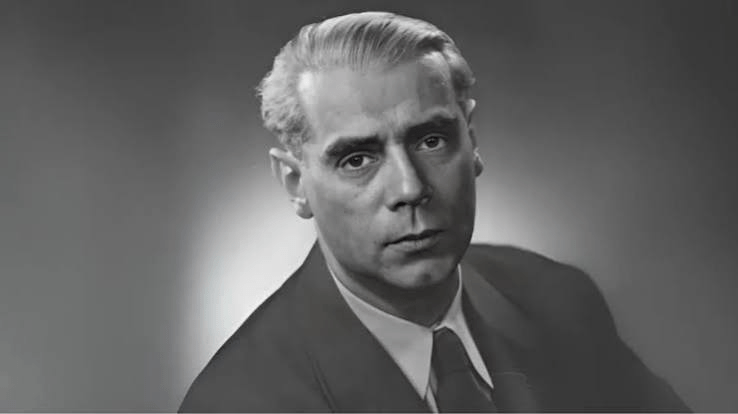
What was synonymous with Akashvani was its signature tune. The lilting violin notes played to the background of a tanpura, drawing upon the classical raga Shivranjani, are closely associated with timeless Indian heritage. It comes as a surprise therefore to discover that the tune was composed by a Czech Jew fleeing the Nazis in Europe, who took refuge in India. This was Walter Kaufmann, a multifaceted musician.
Walter Kaufmann was born in 1907 to Jewish parents, in Karlovy Vary, today a city in the Czech Republic. Music was always his passion, which he also pursued formally. He graduated with a degree in music from Berlin, and moved on to do a PhD in musicology from the German University in Prague. By this time, the anti-Semitic wave was building up in Europe. Walter was beginning to feel the sprinkling from the wave. He himself refused to accept his degree when he discovered that one of his teachers was a leader of the Nazi youth group. As the clouds of war and discrimination against Jews grew darker, the young musician fled Europe and landed up in Mumbai in 1934, carrying a violin case and a battered suitcase filled with sheet music. As he revealed later, there was no specific logic that drew him here, only the fact that it was the only place for which he could easily get a visa! Thus he arrived thinking that Mumbai would be a transition point for moving on, and that his stay would be brief. Walter ended up staying in India for fourteen years!
Having landed here Walter now had to find means of supporting himself. He was a trained musician but from the European school. He knew next to nothing about Indian music sounds that he initially found “alien and incomprehensible”. But he was also open enough to appreciate that this music was created by people with “heart and intellect” and had a rich heritage and history. He was willing to learn more about it. Using his earlier academic training in musicology, he began to study the tradition of Indian music; he attended concerts by the great singers of the day, and even travelled to record folk musicians. He published scholarly notes on Indian ragas. He began to incorporate elements of the Indian tradition into his compositions, not as ornamental add-ons, but skillfully and seamlessly fused. Through this process, over his time in India, Walter himself transformed from a European musician into a cross-cultural composer.
In the meanwhile, he used his existing skills and experience to found the Bombay Chamber Music Society which started giving weekly performances of Western symphonies. As Walter learned how to present Western classical traditions to Indians, the Society’s performances began to attract more and larger audiences. He also tutored students in violin, among whom was the young Zubin Mehta who would go on to become an internationally renowned Western classical music conductor.
In 1936 Walter joined AIR, initially as supervisor of the Western Music Department, and then became Director of Music. He worked at AIR for the next ten years. It is in the early years of his time at AIR he was tasked with creating a signature tune for AIR that was emerging as a powerful cultural institution across India. Walter composed the signature tune that became the identity of the radio station. The tune drew upon the raga Shivranjani. Barely a minute long, began with the notes of the tanpura followed by the lyrical sound of the violin. The violin for the piece was played by Mehli Mehta, the father of Zubin Mehta, and himself a noted concert violinist.
This was a time when the film industry was shifting from silent movies. Mumbai was the hub of the fledgling industry. Walter’s mastery over blending western music with Indian forms was useful in getting a foothold in the film music field. He composed the background score for several films. For a decade, Walter Kaufmann continued to blend his academic training in western music with his deep study of the music of his adopted country.
Just before India gained independence, Walter moved on, in 1946. He went first to London where he worked for the BBC; then to Canada where he conducted the Winnipeg Symphony Orchestra; and finally, in 1975, to the United States, where he joined the School of Music at Indiana University Bloomington as a professor of ethnomusicology. He taught till 1977, and died there in 1984. His connection to India endured, and his rich collection of field recordings, photographs and handwritten scores from his time in India are preserved at Indiana University’s Cook Music Library.
Walter Kaufmann was an ethnomusicologist long before the discipline was formally established. Not many in India know of his many contributions, academic as well as creative to the field of music. And fewer still may know that the tune that is so strongly the sound and symbol of All India Radio stemmed from the creative juices of Walter Kaufmann.
23 July is celebrated as National Broadcasting Day in India to mark the beginning of radio broadcasting in the country. A good day to remember the pied piper who played the tune that is an integral part of the nation’s cultural and social landscape.
–Mamata


