A Tuneful AIR: Courtesy Walter Kaufmann

It was the pied piper’s tune that we woke up to, and one that drew the family together at 9 pm every night to catch up on the news of the country and the world. It was the signature tune of All India Radio that gave structure to the day, and a sense of common purpose. The radio was the meeting point for all generations, and the source of connection to national and international events. And indeed, it was All India Radio that defined this coming together, and the tune that summoned the gathering.
The origins of AIR as it was popularly called, go back before India became independent. Radio broadcasting services started in India during the British rule in 1922-23 under the initiative of the Bombay Presidency Radio Club.  In 1927, the Indian Broadcasting Company (IBC) was set up as a private entity and was granted permission to operate two radio stations. On 23 July 1927 the IBC made the first ever radio broadcast in the country from the Bombay Station. This event marked the start of organized radio

IBC dissolved its operations on 1 March 1930; thereafter the Imperial Government took over the broadcasting operations. The Indian State Broadcasting Service (ISBS) was started on 1 April 1930 on an experimental basis for two years, and then permanently from May 1932. Eventually on 8 June 1936, it became what came to be known as All India Radio. It was also in 1936 that the first daily news bulletin was introduced.

After Independence, AIR’s offerings began to expand beyond news and important announcements to a wide range of programmes—music, drama, live commentaries, and more. It was the primary source of news as well as entertainment.

AIR adopted the name Akashvani in 1956. The name meaning Voice from the Sky was derived from the title of Rabindranath Tagore’s poem written in 1938 for the inauguration of Calcutta All India radio’s shortwave transmission service. AIR and Akashvani were used interchangeably until 3 May 2023 when Akashvani became the exclusive name.

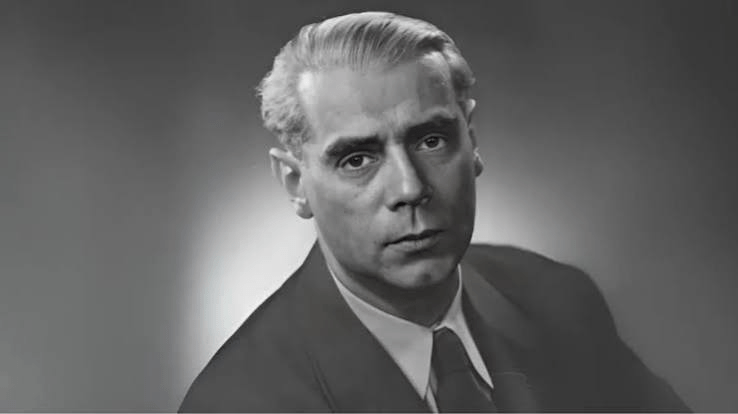
What was synonymous with Akashvani was its signature tune. The lilting violin notes played to the background of a tanpura, drawing upon the classical raga Shivranjani, are closely associated with timeless Indian heritage. It comes as a surprise therefore to discover that the tune was composed by a Czech Jew fleeing the Nazis in Europe, who took refuge in India. This was Walter Kaufmann, a multifaceted musician.

Walter Kaufmann was born in 1907 to Jewish parents, in Karlovy Vary, today a city in the Czech Republic. Music was always his passion, which he also pursued formally. He graduated with a degree in music from Berlin, and moved on to do a PhD in musicology from the German University in Prague. By this time, the anti-Semitic wave was building up in Europe. Walter was beginning to feel the sprinkling from the wave. He himself refused to accept his degree when he discovered that one of his teachers was a leader of the Nazi youth group. As the clouds of war and discrimination against Jews grew darker, the young musician fled Europe and landed up in Mumbai in 1934, carrying a violin case and a battered suitcase filled with sheet music. As he revealed later, there was no specific logic that drew him here, only the fact that it was the only place for which he could easily get a visa! Thus he arrived thinking that Mumbai would be a transition point for moving on, and that his stay would be brief. Walter ended up staying in India for fourteen years!

Having landed here Walter now had to find means of supporting himself. He was a trained musician but from the European school. He knew next to nothing about Indian music sounds that he initially found “alien and incomprehensible”. But he was also open enough to appreciate that this music was created by people with “heart and intellect” and had a rich heritage and history. He was willing to learn more about it. Using his earlier academic training in musicology, he began to study the tradition of Indian music; he attended concerts by the great singers of the day, and even travelled to record folk musicians. He published scholarly notes on Indian ragas. He began to incorporate elements of the Indian tradition into his compositions, not as ornamental add-ons, but skillfully and seamlessly fused. Through this process, over his time in India, Walter himself transformed from a European musician into a cross-cultural composer.   

In the meanwhile, he used his existing skills and experience to found the Bombay Chamber Music Society which started giving weekly performances of Western symphonies. As Walter learned how to present Western classical traditions to Indians, the Society’s performances began to attract more and larger audiences. He also tutored students in violin, among whom was the young Zubin Mehta who would go on to become an internationally renowned Western classical music conductor.

In 1936 Walter joined AIR, initially as supervisor of the Western Music Department, and then became Director of Music. He worked at AIR for the next ten years. It is in the early years of his time at AIR he was tasked with creating a signature tune for AIR that was emerging as a powerful cultural institution across India. Walter composed the signature tune that became the identity of the radio station. The tune drew upon the raga Shivranjani. Barely a minute long, began with the notes of the tanpura followed by the lyrical sound of the violin. The violin for the piece was played by Mehli Mehta, the father of Zubin Mehta, and himself a noted concert violinist.   

This was a time when the film industry was shifting from silent movies. Mumbai was the hub of the fledgling industry. Walter’s mastery over blending western music with Indian forms was useful in getting a foothold in the film music field. He composed the background score for several films. For a decade, Walter Kaufmann continued to blend his academic training in western music with his deep study of the music of his adopted country.

Just before India gained independence, Walter moved on, in 1946. He went first to London where he worked for the BBC; then to Canada where he conducted the Winnipeg Symphony Orchestra; and finally, in 1975, to the United States, where he joined the School of Music at Indiana University Bloomington as a professor of ethnomusicology. He taught till 1977, and died there in 1984. His connection to India endured, and his rich collection of field recordings, photographs and handwritten scores from his time in India are preserved at Indiana University’s Cook Music Library.

Walter Kaufmann was an ethnomusicologist long before the discipline was formally established. Not many in India know of his many contributions, academic as well as creative to the field of music. And fewer still may know that the tune that is so strongly the sound and symbol of All India Radio stemmed from the creative juices of Walter Kaufmann.

23 July is celebrated as National Broadcasting Day in India to mark the beginning of radio broadcasting in the country. A good day to remember the pied piper who played the tune that is an integral part of the nation’s cultural and social landscape.      

–Mamata
“This is All India Radio”

“This is All India Radio, and here is the news read by Melville de Mello.” Nine p.m. and the family is gathered around the radio, as the deep baritone voice begins to read the news of the day–news from home and abroad; the only news that the nation absorbed and digested before retiring for the night. The radio was the meeting point for all generations, and the source of connection to national and international events. And indeed, it was All India Radio that defined this coming together.

Radio broadcasting services started in India during the British rule in 1922-23 under the initiative of the Bombay Presidency Radio Club.  In 1927, the Indian Broadcasting Company (IBC) was set up as a private entity and was granted permission to operate two radio stations. On 23 July 1927 the IBC made the first ever radio broadcast in the country from the Bombay Station.This event marked the start of organised radio broadcasting in India. The Calcutta Radio Club came into existence five months later. IBC dissolved its operations on 1 March 1930; thereafter the Imperial Government took over the broadcasting operations. The Indian State Broadcasting Service (ISBS) was started on 1 April 1930 on an experimental basis for two years, and then permanently from May 1932. Eventually on 8 June 1936, it became what came to be known as All India Radio. It was also in 1936 that the first daily news bulletin was introduced.

All India Radio’s signature tune was synonymous with the name AIR. It was composed in 1936 by Walter Kaufmann, a Czech Jew who was one of the many Jewish refugees fleeing Nazi persecution in Europe who sought refuge in India. Kaufmann became the director of music at AIR. Kuaffman was a serious western music scholar and performer, but the tune he composed for AIR was based on the Indian raga Shivranjani. It remained the identity of AIR, and was the ‘pied piper’ tune that drew the millions of listeners to the radio as the broadcasts began.

During World War II radio was being used for Nazi propaganda and there was a strong need to counter it. Hence, the practice of broadcasting all news bulletins from one central newsroom started. Around 27 bulletins were being broadcasted every day during the war years. In a time when the press was supressed, and news censored, radio broadcasts from underground radio stations played a significant role. The radio was used by nationalists to share news about the real situation on the ground, spread the message of Swadeshi, and rally the people in the non-violent struggle against British rule. These radio broadcasts had an immense impact in rousing Indians and to step up the demands of Indian freedom in the pre-independence era.  One such story on https://millennialmatriarchs.com/2021/10/07/gandhis-women-warriors-usha-mehta/

When India attained Independence on 15 August 1947, there were six radio stations: Delhi, Calcutta, Madras, Bombay, Tiruchirapalli, and Lucknow. In 1956 AIR formally adopted the name Akashvani. The word Akashvani which means ‘voice from the sky’ was derived from the title of Rabindranath Tagore’s poem written in 1938 for the inauguration of Calcutta All India radio’s shortwave transmission service. AIR and Akashvani were used interchangeably until 3 May 2023 when Akashvani became the exclusive name.

After Independence, AIR’s offerings began to expand beyond news and important announcements to a wide range of programmes—music, drama, live commentaries, and more. It was the primary source of news as well as entertainment. Radio continued to be the favourite companion of old and young, initially as the focal point of a household. With the advent of transistors, it became a trusty companion which accompanied wherever one went. It was the provider of songs, weather bulletins and live cricket scores. AIR’s simple listener-friendly format, its ABC of Authenticity, Brevity and Clarity became its USP. The news readers became household names, and the ultimate examples of proper diction and high quality commentary—from the Republic Day parade to cricket matches. The anchors of music programmes (today’s RJs) were popular idols with big fan clubs. Radio became a quintessential way of life for Indians.

This role is beautifully summed by Santosh Desai who grew up in the golden age of AIR: ‘All India Radio had many moods and played different kinds of roles in our lives. It was the official voice of state, the keeper of cultural standards, the chronicler of the times, the certifier of reality, the breathless commentator of the current, the receptacle of small desires of its viewers and an entertainer allowing escape into an imagined world.’

88 years after its first broadcast, AIR remains steadfast, with a widely expanded canvas. It is one of the largest broadcasting organisations in the world in terms of the number of languages of broadcast and the spectrum of socio-economic and cultural diversity it serves. AIR’s home service comprises of 591 broadcasting centres located across the country, covering nearly 90% of the country’s area and 98% of the total population. Terrestrially, AIR originates programming in 23 languages and 179 dialects.

Today as we once more salute the national flag to mark 77 years as an independent nation, it is a good time to remember that it was on AIR that the nation heard Jawaharlal Nehru’s emotional Tryst With Destiny speech, live at midnight of 14th August 1947. And when, for the first time when Nehru hoisted the Indian flag from the ramparts of the Red Fort in Delhi, it was the minute-to-minute narration that the proud nation followed on AIR.

Happy Independence Day!

–Mamata

Akashvani: Voice From the Sky

There are many significant dates associated with radio in India. July 23 is one of them. Broadcasting in India started in June 1923, when the Bombay Presidency Radio Club of India transmitted the first-ever broadcast.  But July 23 1927 is significant because it is the day on which the private Indian Broadcasting Company was authorized to operate two radio stations and started its Mumbai transmission. However, the company went into liquidation in three years and the government took over the facilities and the Indian State Broadcasting Service started operations on an experimental basis  in April 1930 (strangely under the Department of Industries and Labour). In June 1936, this became All India Radio. In the meantime, in September 1935, Akashvani Mysore, a private broadcasting station had been set up. (This is significant as the term ‘Akashvani’—literally meaning ‘Voice from the Sky’–was first used by Mr. MV Gopalaswamy who set up this station. All India Radio, India’s public radio broadcaster, adopted Akashvani as its on-air name in 1956.).

AIRToday, All India Radio is the largest radio network in the world, and one of the largest broadcasters i in terms of the number of languages broadcast (23 languages and 179 dialects!), and the range of audiences it serves. This is done through 420 stations located across the country, reaching nearly 92% of the country’s area and 99.19% of the population. AIR also operates close to 25 FM stations.

Though there is some amount of educational programming in India, the real power of radio to support formal education has probably never been fully tapped. In a country like Australia, for instance, radio has been used for direct teaching, whereby radio schools were used to connect children in secluded farmsteads in the outback together with a teacher sited many hundred miles away.

In the last few days, we have seen some data related to media access that is worrying. Reports based on latest National Sample Survey (NSS) data show that children in only 4% rural and 23% of urban households have access to computers. A survey in Karnataka has revealed that over 5.5 lakh school children in North Karnataka did not have access to TV.

In these COVID times—that is the foreseeable future—education has to depend heavily on such media. Yes, we must use the latest technology and leapfrog (as discussed in the previous blog). But it would be foolish indeed to ignore the good old medium of radio, which reaches 99+% of the population! It is time that AIR and educational authorities went into mission mode to ensure relevant, interesting educational radio programming, to support school children who will otherwise miss out on any educatoinal inputs. Education is not about exams, but about engaging the growing mind of the child, giving it food for thought, helping the imagination. We cannot leave lakhs of children without any educational inputs for months, maybe a whole year.

Radio surely has a part to play in this, especially in these times. May it truly be Bahujana Sukhaya Bahujana Hitaya( “For the happiness of many, for the welfare of many”),as the AIR motto goes!.

–Meena