I marvel when I see the pomelo tree in my yard. It is no higher than 6 feet, and doesn’t have very strong branches. More a bush than a tree, almost. But the number of fruits it bears at a time, and the size of those fruits! I spanned one of the fruits on my tree and the circumference was upwards of 18 inches! And a tree may have up to 20 fruits at any given time. I really wonder how the tree takes the weight!
Pomelo or Citrus maxima or Citrus grandis is the largest citrus fruit, and all other citrus fruits have apparently been hybridized from this. The pomelo tree shares ancestry with the grapefruit.
The origin of the name ‘pomelo’ is uncertain. My mother used to call it Bablimass, insisting that this was the Tamil name. Probably a corruption of pampa limāsu, which means “big citrus”
Coincidentally, there is a GI link to the pomelo. The Devanahalli pomelo is a variety of pomelo (Citrus maxima) grown in the region around Devanahalli taluk, Bangalore Rural District, India and locally known as chakkota.
The Devanahalli pomelo is protected under the Geographical Indications of Goods (Registration & Protection) Act (GI Act) 1999 of the Government of India, under the title “Devanahalli Pomello”.
The Devanahalli pomelo has a unique, sweet taste, unlike other local varieties which have a bitter taste. Five decades ago, this plant was crossbred with local varieties, and it was nearing extinction. A few old Devanahalli pomelo plants were identified in the area and then propagated widely, thanks to which the variety has been preserved.
A story goes that Mahatma Gandhi tasted this fruit when he visited Nandi Hills near Devanahalli. He liked its taste and suggested that the authorities conserve this variety.
I wish the pomelo in my yard was a Devanahalli pomelo. But due to the special soil conditions at Devanahalli and its GI status, mine is not and cannot be!
So though I am not more than 20 kms away, sadly mine is a Rajanakunte pomelo, not a Devanahalli one!
I only ever tasted a fruit from my tree once, and did not particularly like the taste. Oh, if only I had a Devnahalli Pomelo tree!
Last week, I happened to go to Goa (regretfully, not a holiday!). The airport, as many airports across the country, is full of shops.
Apart from the usual brand shops and the special Goa memorabilia shops, I came across a fascinating outlet here. It was a ‘GIs of India’ shop!
Oh, I have jumped the gun! GI could stand for any number of things. I am referring to Geographical Indication, which is “an indication which identifies goods such as agricultural goods, natural goods or manufactured goods as originating, or manufactured in the territory of a country, or a region or locality in that territory, where a given quality, reputation or other characteristic of such goods is essentially attributable to its geographical origin and in case where such goods are manufactured goods one of the activities of either the production or of processing or preparation of the goods concerned takes place in such territory, region or locality, as the case may be.”. GI is a type of intellectual property right, which certifies a product as having originated in a specific geographic location—for instance, that the Mysore silk you just bought is indeed produced in Mysore; or the Jaipur Blue Pottery is indeed from Jaipur.
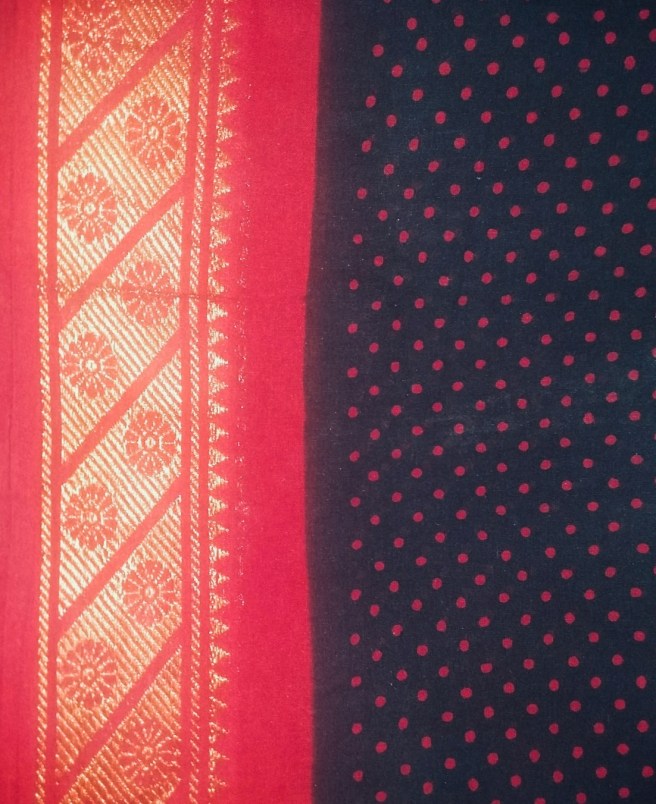
Madurai Sungudi is GI registered
India enacted the Geographical Indications of Goods (Registration and Protection) Act in 1999. The first GI product to be registered was Darjeeling Tea. Now there are 330 GI registered products—a fascinating range, from the usual suspects to the completely unexpected—from Kanpur Saddlery, to Beed Custard Apple; from Coimbatore Wet Grinder, to Varanasi Glass Beads!
The shop at the Goa Airport was very new, just being set up. But the staff were extremely enthusiastic and eager not just to sell their products, but also share information on the concept of GI shops. They said that a large chain of these was coming up across the country.
Indeed an exciting way to create a market for these amazing products, and preserve the diversity, both natural and cultural.
I’ll be on the lookout for these GI shops, for sure!
One of the most important parts of my day at work was the walk home at the end of the day. It was not a very long walk (under 15 minutes) and certainly not a route that offered great beauty of nature or landscape. For me, the walk was more than the act of getting from the physical space of work to that of home. It was an important ritual that helped in the transition from the mental space of ‘work’ to ‘home’. Through my three decades of work there were different transitions that took place. As a young mother, it was the bridge between leaving behind of the role of busy professional and bracing for an evening with the mental and physical energy required in parenting young children. As the children grew older, and one’s parents older still, it was the period of putting behind the challenges of the job to tackle the challenges of coping with geriatric health and care-taking issues. When both children and parents no longer needed the sort of support I could give, it was simply the luxury of going over the day—hours which had passed, and the few hours ahead. Walking thus was form of therapy for me.
I like walking. And I enjoy walking on busy streets. I like observing people and activities, and my walk home offered much. There were the familiar regulars—walkers like myself, and others that I would cross or pass on the way. Strangers at one level, but a familiar and comforting daily cast of characters—I used to imagine who they were, what they did, and what awaited them that evening. As someone aptly put it, “Simply by being outside on the street, people are inadvertently revealing their life histories in their bodies, in their steps, in the hunch of their shoulders, or set of their jaw.”
Walking thus, even as one is observing people there is an odd sense that you are invisible yourself! I was occasionally reminded of the fact that others may be “doing unto you what you do unto them” when someone I did not recognise would tell me “we don’t see you walking these days” or “I know where I have seen you—you walk everyday on that road.”
There were the little ‘milestones’ on the route–the small Hanuman temple at the corner, and the Momo mobile stall, and the busy tailor with his sewing machine right on the footpath; the pavement dwellers lounging on the battered tattered sofa that they had salvaged; the ‘party plot’, where in the wedding season one could see last night’s decorations being taken down in the morning while going to work, and new ones being put up in the evening for that night’s wedding.
There were the trees along the route, especially the huge mango tree—and always the eagerness to spot the first blossoms on it. The big open ground which hosted a variety of water birds when it filled with the monsoon water, and which hosted a variety of handloom and handicraft melas in the winter. There were the cows that crossed the road along with you, and the dangerously straying puppies in puppy season.
Of course there were no real footpaths or pavements! It was an exercise in agility and alertness—sidestepping the cowpats and litter; circumventing the potholes and muddy patches; dodging the scooters and cars that veered dangerously close, and finding the perfect moment to cross the road amid the chaos of the traffic. Whatever the challenges, the walk was always an adventure!
As one of my favourite authors Ruskin Bond puts it so well—“The adventure is not in arriving, it’s the on-the-way experience. It is not the expected; it’s the surprise. You are not choosing what you shall see in the world, but are giving the world an even chance to see you.”
Jodhpur is an old city, going back to 1459. The magnificent Mehrangarh Fort, the slightly anachronistic Umaid Bhawan Palace, bazaars, the camels that still stride the streets, the food…an experience for all the senses.
One danger with going back to re-visit old haunts is that the present almost never lives up to past memories.
But as far as Jodhpur is concerned, I will not complain on this count! We’ve been going back every few years, and it just gets more interesting!
This year, the highlight of our trip was the Mehrangarh Fort. We go there every visit, but this year new areas seem to have been opened up. Shaded gardens, cobbled paths, open spaces from which to view the city–many of which I do not recall from dozens of visits. And the whole, immaculately maintained.
And the zipline running from the Fort! This has been in operation for about a year now, it seems. It has six segments, some offering dramatic views of the blue city; others of the ramparts of the fort; and yet others of the Padamsar lake. And most important, it looks safe and well-maintained, and the people running it come across as professional and competent.
I must not forget however the highlight of our trip. We went to catch a movie at the mall with our friends. And there, waiting with us was a lovely Rajput couple, with their little 6 month old son. He was bundled up in a green velvet teddy-bear like costume. After the usual cooing around the smiling baby, we asked what his name was. It was Rudra Pratap Singh! Wow! What a name for a gurgling little fellow dressed in green velvet! Will it put pressure on him? Or will he just grow into it? Who knows?
Scientists in Israel say they will find the definitive cure to cancer within the year. Who would not like to believe this? Who is there today who has not lost someone to cancer– a family member, a friend, a colleague?
Even as these reports hit the news, there were others saying this was all bunkum.
Well, I do not know enough about the matter. Reason tells me that it is unlikely that a panacea is so close. But my heart would like to believe it.
I have lost my brother to cancer. And the MMs lost a dear, dear friend in her thirties to the Dreaded C. These losses have left indelible imprints, and maybe changed us as people.
But equally have the incredible stories of survivors: young nieces who survived and have made a full lives for themselves; a sister in law so gutsy, I even forget what she has gone through; friends like Anita (who did two guest pieces for the blog last year), who have overcome; an amazing and brave lady I knew in Italy, who not just survived cancer, but started an NGO (called Attive Come Prima) which has helped generations of breast cancer survivors to cope.
It is in this context that Feb 4, World Cancer Day is important. World Cancer Day is an initiative of the Union for International Cancer Control to bring focus on the disease and come together to fight it. The day is marked by events across many parts of the world.
It’s a day to take a pause and see what we can do. Know young people who may be vulnerable to taking up smoking? As a parent, teacher, mentor, friend, do what you can to stop them. Know a family battling the C? Be there for them—physically, emotionally, every which way. Know about a good organization working on the issue? Donate generously.
‘9.6 million people die from cancer every year – this number is predicted to almost double by 2030. At least one third of common cancers are preventable. Cancer is the second-leading cause of death worldwide. 70% of cancer deaths occur in low-to-middle income countries.’ Union for International Cancer Control.
While I soak in the sunshine on a pleasantly cool Ahmedabad winter day I read that the big Arctic chill has hit North America and Europe. It’s cold, cold, cold! News reports show how the blanket of snow has brought life to a standstill, and people are being interviewed to share how they are coping.
I remember a poem that wonders how the Snow itself must feel.
SNOW PILE
Snow on top
must feel chilly
the cold moonlight piercing it.
Snow on the bottom
must feel burdened
by the hundreds who tread on it.
Snow in the middle
must feel lonely
with neither earth nor sky to look at.
The poem was written in the 1920s by a young Japanese poet Misuzu Kaneko. “Teru” as she was called, was born in 1903 in a family of booksellers in a small fishing village in western Japan. The book-loving child was encouraged to study by her mother and grandmother, and she stayed in school until she was 18, a rare achievement for Japanese girls at the time. She began writing poetry at age 20, and signed her work “Misuzu”, in an allusion to classical Japanese literature meaning “where the bamboo is reaped.”
In her poetry, Misuzu would share her sense of curiosity and wonder–What does snow feel in a drift? Where does day end and night begin? Why don’t adults ask the questions children do? “To Misuzu, everything was alive and had its own feelings—plants, rocks, even telephone poles! She felt the loneliness of whale calves orphaned after a hunt. She felt the night-time chill of cicadas who had shed their old shells. And she felt the tearful sadness of a flower wet with dew.”
Sadly her personal life was tragic and she committed suicide when she was only 27 years old. Kaneko and her work were forgotten for the next 50 years. The only known copy of her poems had been destroyed during the bombing of Tokyo in WWII. The bookstore where she once worked was long gone. No one seemed to know if she had any surviving family. It is only in the 1980s that another Japanese poet Setsuo Yazaki, recovered her poetry manuscripts and these were published.
Today, almost a 100 years later, Kaneko’s poems remain as fresh and moving with their innocent sense of wonder.
I wonder why
the rain that falls from black clouds
shines like silver.
I wonder why
the silkworm that eats green mulberry leaves
is so white.
I wonder why
the moonflower that no one tends
blooms on its own.
I wonder why
everyone I ask
about these things
laughs and says, “That’s just how it is.”
If only we could all retain that magical sense of wonder rather than simply accepting “That’s just how it is.”
2019 has been declared as The International Year of Indigenous Languages (IYIL2019) by UNESCO. The official launch of IYIL was held on 28 January 2019. The aim of IYIL is to “draw attention to the critical loss of indigenous languages and the urgent need to preserve, revitalize and promote indigenous languages around the world”.
Of the 6000-7000 languages in the world today, about 97% of the world’s population speaks only 4 % of these languages, while only 3% of the world speak 96% of all remaining languages. A great majority of those languages are spoken mainly by indigenous peoples.
India is one of four countries, along with Nigeria, Indonesia and Papua New Guinea, with the largest number of living languages. A mammoth project to conduct a comprehensive survey of Indian languages was launched in 2010. Initiated by Prof. G.N. Devy, founder of the Bhasha Research and Publication Centre in Vadodara, and undertaken by a large team of scholars, the project called the People’s Linguistic Survey Of India (PLSI) set out to document and preserve 780 languages which are being spoken in India today. These are being published in the multi-volume People’s Linguistic Survey of India, towards providing an overview of the extant and dying languages of India, as evolved till 2011, and as perceived by their speakers. The volumes chronicle the evolution of these languages in all their socio-political and linguistic dimensions, and encapsulate the worldview of their speakers. PLSI proposes to complete its task of publishing 92 volumes by 2020.
In the last couple of years, I have had the enriching opportunity to learn about some of the indigenous people of the north east of India and a glimpse of not just the incredibly rich traditions of textiles in the region, but equally the close ties between language of the people and the language of their textiles. Not only does every tribe have their own dialect, but each dialect has wonderfully nuanced words to describe every textile that they weave, and even every motif that is woven on these.
Names of textiles of the tribes have references to the history and geography of the tribe, as well as names that literally relate to colour, size, on which part of the body they are worn, as well as referring to age and status of the wearer. There are specific shawls for elder men or women, for those who have special social status (as in the Naga the Feast of Merit shawl), for a new bride to wear to her marital home, and for covering the deceased.
As Ganesh Devy puts it “in every manner without any exception, the language we learn or use is the absolute condition of our narrative of the world and the way we see the world.”
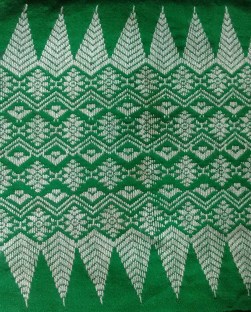
Of the numerous examples of this, is that of a textile of the Bodo Kachari tr
Aronai with Hawjagor pattern
ibe of Assam.The multi-use decorative textile called Aronai is characterised by a zig-zag motif called Hawjagor (hill pattern) in the Bodo dialect. This pattern is inspired by the hills which form an important part of the history as well as the geography of the Bodo people who settled by the foothills, on the north bank of the Brahmaputra in Assam.
It is in the names of motifs that women weave onto the textiles that the symbiosis between life, nature and culture is most evident. The names not just reflect how nature inspires form, but also reveal a keen eye for subtle detail and the richness of language to reflect this.
A common triangular motif on wrap skirts of the women of a small Naga tribe is called impeak bam. The word Impeak translates to ‘stretching out/extending/ spreading out’ and bam means ‘wings’; and the motif symbolises a flying Hornbill. While a similar but smaller triangular motif is named to mean the wings of the bird called a Swift.
Some of the motifs of the Liangmai Naga tribe in Manipur are named literally to represent elements such as fish bone (kakhara thua), cow’s teeth (kabuihu), and ripples in a lake (kazai kapai). There is even a woven line stitch line called matiang kang meaning ‘group of ants.’ These are only the tip of the iceberg of detail, as it were.
One of the traditional shawls of a small Naga tribe of the Manipur Naga Hills has a motif called inchitatpi that translates to ‘head of a long worm’ found in the woods. Another has a pattern representing cucumber seed called angi thei ru. Getting into even more minute detail, another tribe has a popular motif called aphinamik which literally means the ‘eye of a dove’.
There are patterns representing frog’s feet called sangkang nou ban and grasshoppers’ egg called changkow gum, and even a stitch called kabi n’dui where kabi translates to ‘good’ and ndui translates to ‘egg’, relating to the arrangement of eggs on a paddy plant!
What evocative words and how beautifully they capture richness of life lived in synergy with one’s environment. These are only a tiny sprinkling of the vocabulary of a tiny segment of indigenous people and languages.
Sadly with ‘modernisation’ comes homogenisation. A lot of the local weaving traditions are being replaced with mass-produced machine-made garments, and with it are lost not just the textiles and motifs but also the language that represented these.
According to UNESCO, approximately 600 languages have disappeared in the last century, and they continue to disappear at a rate of one language every two weeks. Up to 90 perccent of the world’s languages are likely to disappear before the end of this century if current trends are allowed to continue.
And Ganesh Devy expresses the Domino Effect that this has—“When a language dies, its speakers decide to migrate. First, they migrate to another language and then they physically start migrating to another region. The second thing that happens is that their traditional livelihood patterns go down. They may have some special skills and that disappears. Thirdly, a unique way of looking at the world disappears.”
Spoiler alert: We are discussing only pain balms, not wimpy stuff like lip balms!
I am an unrepentant balm sniffer. I cannot fall asleep unless I sniff some balm and apply some to my temples. The hint of a headache, and I reach for a balm. A niggling in the throat calls for a generous rub and copious sniffing. The go-to balm in my family, as in many, many others, is of course the tried and tested Amrutanjan.
My friends know a balm is the way to my heart. So I actually have friends gift me bottles and tins, from Kerala, from the Himalayas, from travels to Southeast Asia. It is a balm story which defines ‘hostess with the mostest’ for me. A friend in Delhi with whom I sometimes stay over provides toothbrushes for frequent guests—they stay in colour-coded caps in the guest bathroom. But she really set the standard when she stocked a jar of my favourite balm in the guestroom, so that I could feel that much more at home!
I think the word unguent was made for balms. I have never heard it used in any other context: ‘a soft greasy or viscous substance used as ointment or for lubrication’.
But what intrigues me a little is that the definition of balm is: ‘A fragrant cream or liquid used to heal or soothe the skin; Something that has a soothing or restorative effect.’
None of my balms soothe! They sting. In fact, the test of a balm is that your eyes should water when you put a spot of it on your temples.
As far as I can make out, balms come in two types—the brown unguents, and the off-white ones. There are good ones in both categories. But as far as Tiger Balm is concerned, the brown one beats the white one hollow.
We balm buffs are sensitive to packaging too. You have the glass bottles (the best). Then the plastic jars (OK). The metal flat disc-like boxes (good too). And now the roll-on type (I know that a liquid too can be a balm, but I am not so convinced).
Why a random rant on balms? No idea, except that the weather is not very balmy (Meaning: ‘characterized by pleasantly warm weather’– obviously not from the same root), thanks to which people all around are sneezing and coughing, which makes me want to stock on my balms!
I was introduced to Ruskin Bond over 30 years ago by Uncle Ken and Rusty. These were the characters in the first books that I translated. I so enjoyed the madcap adventures of the eccentric Uncle Ken and the restless school boy Rusty, not just for the stories but for the simple style of writing and the lovely use of language. As a translator it was a challenge to try to retain the spirit and the form in another language.
Following this introduction I continued to follow Ruskin Bond on his wanderings and meanderings through his essays and columns. Here was someone who was not only sensitive to, and entranced by every minute detail of nature, but one who could share this evocatively through words.
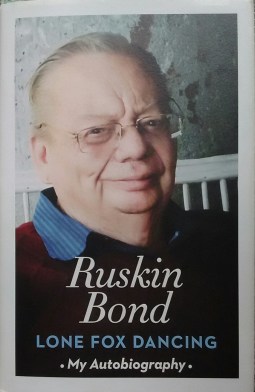
When Ruskin Bond’s autobiography was published just over a year ago, I was curious and eager to fill in the blanks and to know more about Ruskin the person. I recently read the book called Lone Fox Dancing: My Autobiography. In it saw how many parts of his own life have been woven in his writings. Ruskin’s story is simply told and flows gently through eight decades, capturing flavours of the life of the angrez and the Anglo-Indians from the colonial times, through the Second World War, India’s partition and the birth and development of the new republic.
Ruskin writes about family and friends, travels and travails, painting word pictures that make one feel as if one is leafing through a real photo album. As he wrote “That’s what life is really like—episodic, full of highs and lows and some fairly dull troughs in between. Life is not a novel, it does not have the organisation of a novel. People are not characters in a play; they refuse to conform to the exigencies of a plot or a set of scenes. Some people become an integral part of our lives; others are ships that pass in the night. Short stories, in fact.”
For me there were “Eureka” moments when one recognized the people who became memorable characters in many of his stories. I marveled at the memory that could conjure up images from sixty-seventy years ago, but I also learnt the value of keeping a journal, something that Ruskin has done since his school days.
Above all, what the book reiterated was the celebration of solitude. Ruskin Bond is not a recluse nor one who shuns human contact. As a boy he writes that he was lonely, “loneliness that was not of my seeking. The solitude I sought. And found.” This solitude he found in nature, nature is the companion that has sustained and energized him over eighty years, and with it, the magic of the words to share the joy with others.


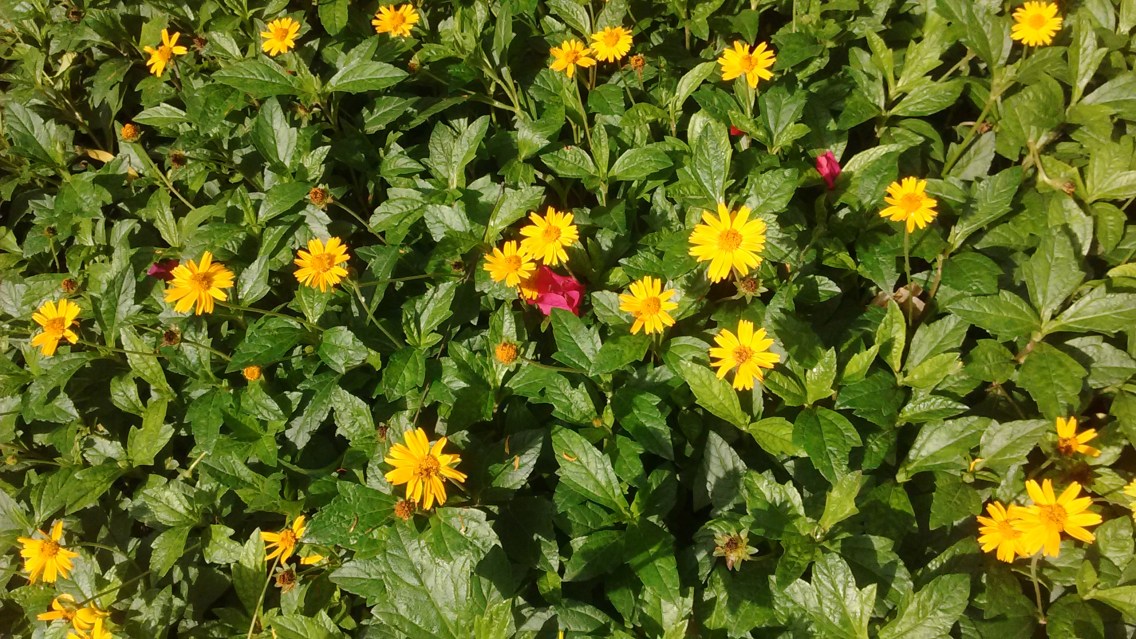
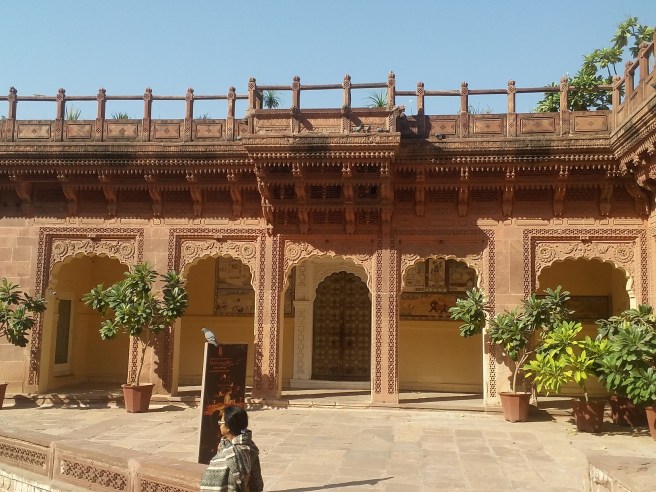 This year, the highlight of our trip was the Mehrangarh Fort. We go there every visit, but this year new areas seem to have been opened up. Shaded gardens, cobbled paths, open spaces from which to view the city–many of which I do not recall from dozens of visits.
 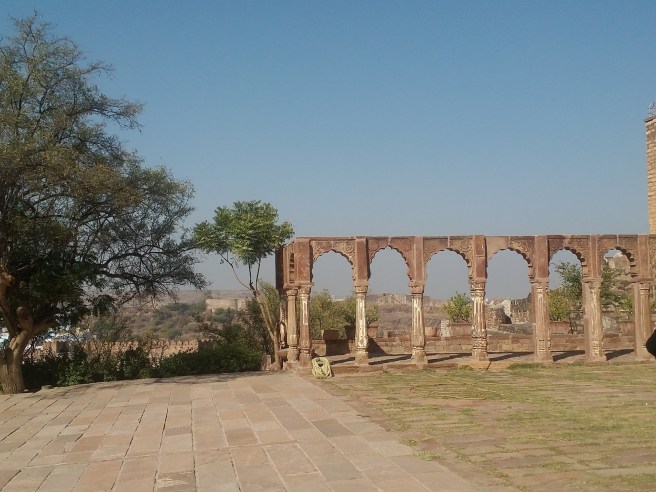 And the whole, immaculately maintained.
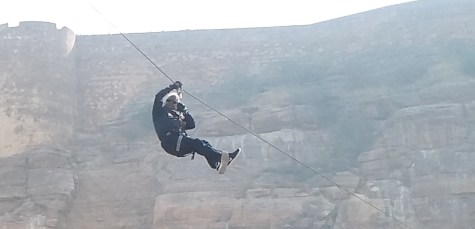 And the zipline running from the Fort! This has been in operation for about a year now, it seems. It has six segments, some offering dramatic views of the blue city; others of the ramparts of the fort; and yet others of the Padamsar lake. And most important, it looks safe and well-maintained, and the people running it come across as professional and competent.
 Scientists in Israel say they will find the definitive cure to cancer within the year. Who would not like to believe this? Who is there today who has not lost someone to cancer– a family member, a friend, a colleague?