
December 22, the birthday of the mathematical genius Shri Srinivasa Ramanujam, has been observed as National Mathematics Day in India since 2012, the start of the celebration of his 125th birth anniversary. The Day has, since then, been marked in schools and colleges by special events like maths quizzes, competitions etc. Hopefully, the enthusiasm will be carried over to the digital medium this year.
Those of us who fear math will also recall they feared their math teachers. In fact, the fear of math stems in most of us because we just did not understand what was happening in the class. And math teachers seldom felt the need to do anything differently to help students understand the abstract concepts better.
It is in this light that Mathematics Educators like Shri AR Rao stand out. He dedicated his life to math education and inspired generations.
Born in the small village of Jakka Samudram of Salem district, Tamilnadu, he had his initial schooling at Tanjore—not far from Kumbakonam, where Ramanujam and studied lived when he was young. He studied chemistry, not mathematics at graduate level, and then took a post graduate degree from Chennai. But his karmabhumi was Gujarat. He joined Bahauddin College, Junagadh in 1933, as a Professor of Mathematics and spent 27 years there. After that he taught in various other colleges in the state.
After ‘retirement’ in 1974, he started his second innings. He became a mathematician at VASCSC (Vikram Sarabhai Community Science Centre), a pioneering science education facility in the county. The teacher of formal mathematics became the flag-bearer of non-formal mathematics as a means to popularize mathematics. His mission was to make mathematics enjoyable for students and everyone else.

His innovative mind came up with dozens of puzzles, games, models and teaching aids towards this.
He set up India’s first Mathematics Laboratory at VASCSC. He traveled, attended workshops and seminars, and spoke all over the country to popularize these ideas.
I had the great good fortune of having interacted with Shri AR Rao to some extent. When I was helping at VASCSC, his 90th birthday came up. It was decided to throw a surprise party at the Centre. Just to ensure that he did come in that day, a message was sent to him that the Trustees wanted to meet him.
I still remember the joy and the excitement of the many students and bhakts who came for the party. And at last the guest of honour, Shri AR Rao, walked in. He was truly surprised and thrilled. He almost broke down when it was his turn to speak. He said that he had come in very nervously, thinking that the Trustees had wanted to meet him to ask him to retire now that he was 90! Such was his love and passion for spreading the word on mathematics education that he wanted to come in to work at this age. And indeed he did, till the age of 100. He passed away on 4th April, 2011.
If today the teaching of mathematics in India has become more comprehensible to the average student, if students appreciate and enjoy the beauty of mathematics, and if teachers have begun to employ innovative methods to teach the subject, Prof. AR Rao had a lot to do with it.
It would be appropriate to end with a quote from him:
“Although everyone concedes that without mathematics, modern science and technology can hardly make any progress, it is common knowledge that the students everywhere consider mathematics as a very difficult subject. Of the many reasons that can be found for this, perhaps, the most important are, some defective methods of teaching, over emphasis on exams and indiscriminate cramming of materials from the text books and the so-called guides. So what is really needed is inculcation of a power of understanding and a capacity of creative thinking.” AR Rao.
Blessed indeed to have met such people!
–Meena
Much of the material has been drawn from http://www.vascsc.org/images/pdfs/Glorious-Innings-of-Prof.A-R-Rao.pdf.


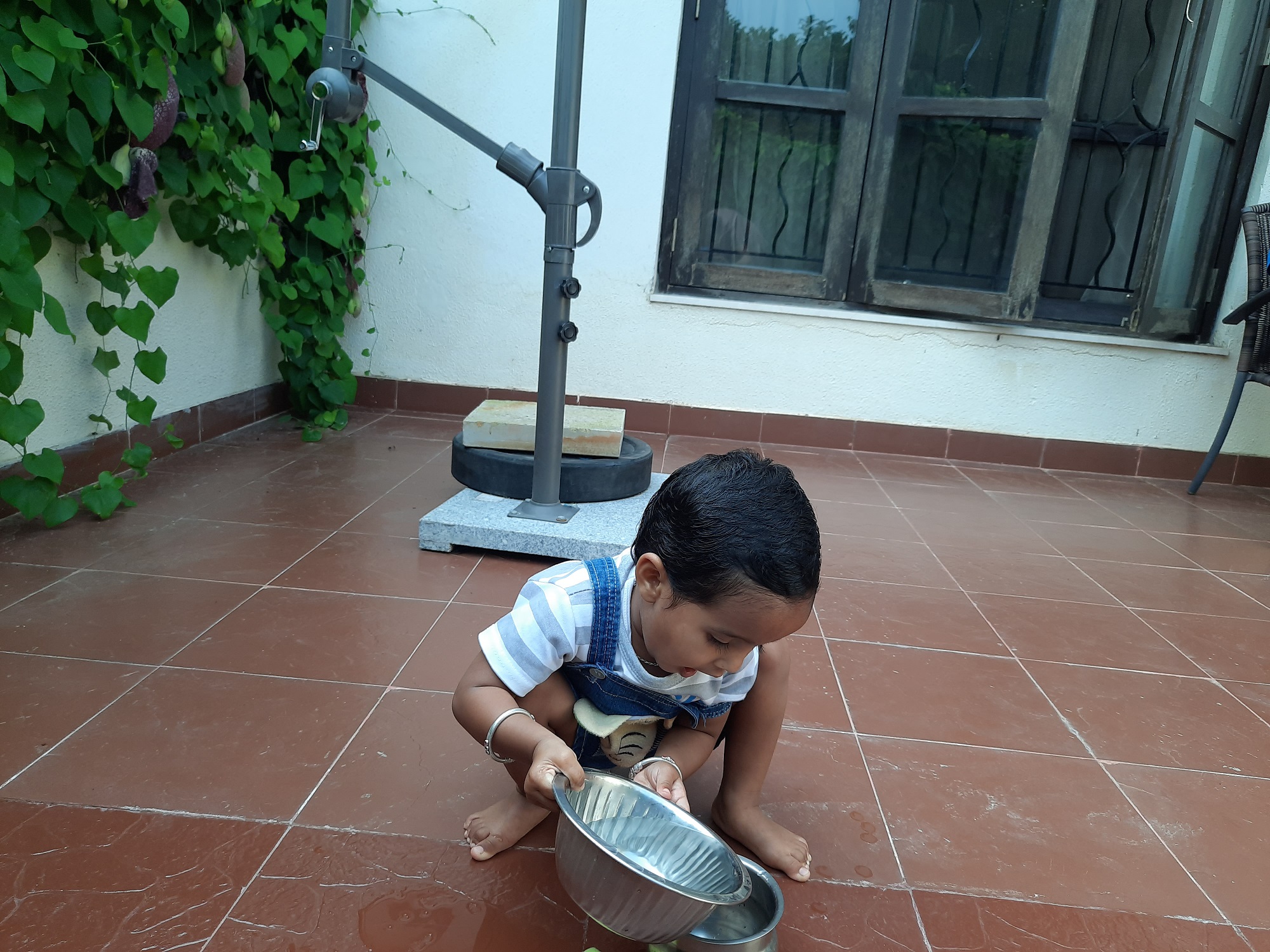 The school showed amazing results. Soon the children exhibited great interest in working with puzzles, learning to prepare meals and clean their environment, were calm, orderly, self-regulating, and engaging in hands-on learning experiences—essentially teaching themselves.
 But I think this puts a greater and different responsibility on the Ministry of Women and Child Development—viz, the responsibility of educational inputs in the home environment for children below the age of 3. Ages 0-3 is when a baby’s brain grows to 80% of its adult size and is twice as active as adults. Research in developed countries has shown that at age 2, toddlers from low-income families are already 6 months behind in their language processing skills. Without greater investment in the first 3 years, many children will miss the opportunity to reach their full potential. And inputs and influences at this age come mainly from the home environment.
 Today, All India Radio is the largest radio network in the world, and one of the largest broadcasters i in terms of the number of languages broadcast (23 languages and 179 dialects!), and the range of audiences it serves. This is done through 420 stations located across the country, reaching nearly 92% of the country’s area and 99.19% of the population. AIR also operates close to 25 FM stations.
