Lollipop Day

July 20th last week was marked as Lollipop Day—where else but in the US!
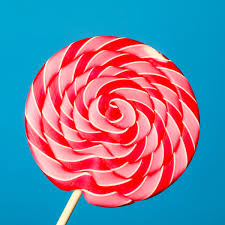
Well, and why not? Lollipops have been ubiquitous since for as long as any of us can remember. Toddlers and young children are happiest when their tongues are red or yellow or any of the other colours of the rainbow, and the sugar of the lollipop is coursing through their blood. So what if this is every mother’s nightmare!

The human predilection to lick and suck at sweet things goes back to pre-history. At that time of course, it was much more ‘natural’—people would poke sticks into honeycombs and suck the sticks—probably the earliest form of lollipops.

In China, Egypt and in the Arab world, fruits and nuts were glazed with honey and sticks inserted into them, to make for more convenient sweet-treats.

But the sweet as we know it today, has its origins in the late 16th and early 17th century. This was the time when sugar started becoming abundant in Britain (on the back of inhuman and slave labour in the colonies). The English started making boiled hard sweets, and inserting sticks into them. And there they were—the first official lollipops. The name itself probably originated in North-England, where tongue is called ‘lolly’ and pop means ‘slap’ — so ‘lollypop’ meant ‘tongue slap.’ 

The McAviney Candy Company started marketing lollipops in 1908, but it was the Bradley Smith Company which really took it to scale. Manufacturing got automated, when the Racine Confectioners Machinery Company built a machine which could attach hard candy to a stick at the rate of 2400 sweet per hour.

Today, there are over 100 varieties of lollipops available today in all shapes and sizes.

And of course something like lollipops are sure to have many a bizarre record associated with them. So here are a few:

The largest lollipop ever made weighed 3176.5 kg and was created by See’s Candies (USA) for Lollipop Day 2012. It was chocolate-flavoured and was 4 feet 8.75 inches long, 3 feet 6 inches wide, and 5 feet 11 inches in height. The lollipop stick which was 11 feet 10 inches tall was not counted towards the record.

A lollipop-licking event was organized in 2008, in Valladolid, Spain. Here a world record of the most people (12,831)  licking lollipops was made.

27 people lined up 11,602 lollipops in a line stretching half-a-kilometre in length to create a Guinness record. This was in South Africa.

But the weirdest has to be the record set by two boys bouncing a balloon back and forth 56 times without letting it touch the ground, using lollipops held in their mouth!

Today, there are lollipop flavours that suit the adult palate as well– lollipops in beer and wine flavours, as well as tea and coffee-flavoured lollipops.

And lollipops don’t need to be sweet. The Indian version—imli-based lollipops are, in my reckoning, the best! Today they are marketed commercially, but back in the day, my grandmother used to pound together tamarind, jaggery, chilli powder, salt, ghee and hing, put the shiny ball at the end of a stick and hand the treat around to us kids. Of course these were extremely restricted and made once a month or so, after much begging and pleading.

But we did also enjoy the store-bought sweets occasionally. Lollipops in those days were generally flat and in one colour. A particular favourite of ours used to be a longish one which had a hole towards one end so that it doubled as a whistle as well.

Today lollipops are often round, and come in a variety of other shapes as well. There is a wide range of sizes, and they are often in a riot of colours. Some are so large that even the most-eager 4-year olds cannot finish them at one go—leaving the mothers with the challenge of a sticky, drooly mess.

Popular as this sweet may be, one also has to be aware that it not only can lead to cavities, and other tooth and gum-related issues, but the sugar-high can sometimes be too much. So it should definitely be a rare treat.

–Meena

Maryam the Mathematician

I often write about women in different time periods, who have struggled, against all odds, to break glass ceilings in numerous fields. Their stories continue to inspire and move us even today. This is a contemporary story of a young woman who scaled new heights in mathematics, in a short life.

Maryam Mirzakhani was born in Tehran, Iran, on 12 May 1977. Her father was an electrical engineer, and she grew up with three siblings. Her parents were always supportive of their children, and encouraged them to work towards something that would be meaningful and satisfying to them, rather than for what society would consider success and achievement. The nineteen-eighties were difficult years for growing up in Iran which was in the middle of the Iran-Iraq war. But Maryam was secure in the love of her family. She loved to read and wanted to become a writer. She would make up stories about a girl who achieved great things, like travelling the world. Science was not her first love; it was her older brother who gradually wakened the spark when he used to tell her what he had learned in school.

The war ended when Maryam finished elementary school, and she joined Farzanegan Middle School in Tehran where she met Roya Beheshti who became a close friend. The two shared an interest in reading and used to spend a lot of time going to bookstores and buying books. Their school which was administered by Iran’s National Organization for Development of Exceptional Talents, aimed to educate the brightest pupils, and the Principal and teachers of the school were keen that their students should get the same opportunities as would students in a boys’ school. 

Maryam did not do well in Mathematics in her first year at Farzanegan middle school. Her teacher told her that she was not particularly talented in that subject and Maryam lost interest and confidence in maths. However, in her second year she had a different mathematics teacher who encouraged her. This led Maryam, and Roya, to become excited and engaged with Mathematics.

When the two friends progressed to high school, they found a copy of six Mathematical Olympiad problems and Maryam managed to solve three of them. Encouraged by this, the girls asked their school principal if she could arrange for them to have mathematical problem-solving classes, as boy’s schools had for talented students. The principal was supportive, and classes were arranged for the girls. Later Maryam recalled that this positive mind set was a great influence in her life.

Both Maryam Mirzakhani and her friend Roya Beheshti made the Iranian Mathematical Olympiad team in 1994—the first girls to do so. The international competition was held that year in Hong Kong and Mirzakhani was awarded a gold medal, while Roya bagged the silver. The next year, Mirzakhani, still in high school, was a member of the Iranian Mathematical Olympiad team, and was once again awarded a gold medal in 1995.

In 1995 Maryam joined the Sharif University of Technology in Tehran to study mathematics. She enjoyed the problem-solving sessions and informal reading groups, and also the support and friendship of many professors and students who inspired her, and shared her growing excitement with mathematics. She published several papers while still an undergraduate. After obtaining her degree from Sharif University in 1999, Mirzakhani left for the United States to join graduate school at Harvard University. She earned a Ph.D. from Harvard University in 2004 for her 130-page thesis Simple Geodesics on Hyperbolic Surfaces and Volume of the Moduli Space of Curves. 

In 2004 she was offered a junior fellowship at Harvard, but turned down the offer. In the same year she was awarded a Clay Research Fellowship and was appointed as an Assistant Professor of Mathematics at Princeton University. This was a great opportunity for her. As she recalled: The Clay Fellowship gave me the freedom to think about harder problems, travel freely, and talk to other mathematicians. I am a slow thinker, and have to spend a lot of time before I can clean up my ideas and make progress. So I really appreciate that I didn’t have to write up my work in a rush.

The fellowship gave her the time to produce some brilliant papers. After completion of her Research Fellowship in 2008, Maryam moved to Stanford University where she was appointed as Professor of Mathematics in 2009. She was 31 years old. Maryam married a computer scientist Jan Vondrak whom she met while at Princeton, who also joined the faculty at Stanford in 2016. Their daughter Anahita was born in 2011. Maryam would spend hours at home with large sheets of paper sketching out ideas, diagrams and formulae; her young daughter would say “Mummy is painting again!”

When once asked what was the most rewarding part of her work Maryam said: Of course, the most rewarding part is the “Aha” moment, the excitement of discovery and enjoyment of understanding something new, the feeling of being on top of a hill, and having a clear view. But most of the time, doing mathematics for me is like being on a long hike with no trail and no end in sight! I find discussing mathematics with colleagues of different backgrounds one of the most productive ways of making progress.

Maryam’s work soon led to her receiving recognition and awards. The most significant was the Fields Medal that Maryam was awarded in 2014.

The Fields Medal, established in 1936, is often described as the Nobel Prize of mathematics. But unlike the Nobel Prizes, the Fields Medals for Mathematics are given only to people aged 40 or younger, not just to honour their accomplishments but also to predict future mathematical triumphs.

Maryam was the first woman, and the first Iranian to win this prize. It was presented to her at the International Congress of Mathematics, held in Seoul, South Korea on 13 August 2014. The award recognized Mirzakhani’s “outstanding contributions to the fields of geometry and dynamical systems, particularly in understanding the symmetry of curved surfaces, such as spheres, the surfaces of doughnuts and of hyperbolic objects”. 

Even before she got this award, Mirzakhani had been diagnosed with breast cancer. She continued her work, producing not only results of great significance but developing tools that would be used by other researchers in the field. The cancer spread to her liver and bones and she passed away in July 2017. Her death robbed mathematics of one of its brightest stars who, at the age of 40, was at the peak of her creativity.

The little girl who loved to read and to imagine, reached unimagined peaks in a subject that did not initially excite her. As she once said about the pursuit of mathematics: I don’t think that everyone should become a mathematician, but I do believe that many students don’t give mathematics a real chance. I did poorly in math for a couple of years in middle school; I was just not interested in thinking about it. I can see that without being excited mathematics can look pointless and cold. The beauty of mathematics only shows itself to more patient followers.

Described as one of the greatest mathematicians of her generation, several mathematics prizes have been named after her, including the Maryam Mirzakhani New Frontiers Prize to be awarded to outstanding young female researchers in the field of mathematics each year.

In 2020 Maryam Mirzakhani was named by UN Women as one of seven female scientists (dead or alive) who have shaped the world. 12 May, her birth anniversary, is now celebrated as International Women in Mathematics Day.

–Mamata

A Parade to be Proud Of

26 January always evokes many memories of waking up at the crack of dawn in the chill of the Delhi winter, bundling up in our warmest clothes, packing sandwiches and hot coffee, and setting out to see the republic day parade. This was one of the highlights of the year during the time my family lived in Delhi.

The parade itself was a magnificent spectacle with the many components that made it so special. The perfectly synchronized marching of the many contingents of the armed forces, the display of the new developments in different fields from technology to trade, and the exuberance of the participating school children and cultural troupes; the vibrant “floats” as we called them, and finally the breathtaking ‘fly past’. Every part of the long march of the passing groups made us swell with pride that we were also a part of this ‘unity in diversity’ that is India.

It is only this year that I stopped to wonder about what went behind this parade.

The Indian Constituent Assembly adopted the Constitution of the newly independent India on November 26, 1949. This came into effect one year later, on January 26, 1950. Hence this day marks Republic Day. On 26 January 1950, the newly-sworn in President of India rode through the roads of Delhi to reach what was then called Irwin Amphitheatre (now the Dhyan Chand National Stadium) to take the salute of the first ever national parade where 3000 officers of the armed forces and more than 100 aircraft participated.  The parade was led by then Brigadier Moti Sagar of the Gorkha Regiment. From 1950 to 1954, the celebrations took place in different parts of Delhi including the Red Fort and Ramleela Maidan. The format of the current parade was adopted in 1955, and Rajpath (then called Kingsway, and now Kartavya Path) was chosen as the permanent venue.

Since the first parade when the Indonesian President Dr. Sukarno was the chief guest, it has been a tradition to invite the head of state of a country to be the chief guest for the event every year.

Every step of the parade is meticulously planned and coordinated so that there is perfect accuracy in the movement without the slightest hitch or delay. While the participants in the parade seem to move in perfect precision and coordination, this is the end result of months of rigorous training.

All the participants from the different participating groups across the country are notified in July of the preceding year. The practice begins right then at the respective centres and goes on till August. The participating groups reach Delhi in December where the intensive training commences which culminates in the ‘dress rehearsal’ a few days before the big day. While the practice march covers a distance of 12 km, the actual march on 26 January covers a distance of 9 km. On 26 January the participants reach there designated places on Rajpath at 3 a.m. for the ultimate Great March. By then they would each have put in over 600 hours of training!

All army personnel that take part in the parade go through four levels of investigation. All of the defence vehicles and equipment are housed in a dedicated camp near India Gate.

After the regimented procession of foot marchers the parade takes on a smoother and slower pace as the tableaux roll (at 5 km an hour) along the wide avenue of Rajpath. As children it was these ‘floats’ as we called them that provided animated lessons in the geography, history and culture of our country. At the time all we looked for was the sign that indicated what state the tableau represented, and then sat back and took in the diverse “scenes” as it were from that state, complete with live people doing activities on the moving tableaux.

It is only recently that I discovered that behind the creative presentations lies a long and bureaucratic process. The process is spearheaded by the Ministry of Defence. States are invited to submit proposals for a tableau that represents some historical event, culture, heritage, development programmes, and environment of that state. The tableaux proposals received from various states, Union territories, central ministries, and central departments are evaluated in a series of meetings by a panel of experts comprising of eminent persons from various disciplines such as art, culture, painting, sculpture, music, architecture, choreography, etc. The expert committee examines the proposals on the basis of theme, concept, design and its visual impact before making its recommendations

The selection process of the tableaux passes through various stages of development and evaluation. It begins with an initial appreciation of sketch/design and the themes of the demonstration. It culminates, after many interactions between the expert committee and the states/UTs/departments/ministries, with a three-dimensional model of the tableau. For the selected tableaux, the Ministry of Defence provides, free of charge, one tractor and one trailer upon which the tableau can be fabricated. There are also a series of other guidelines regarding the use of logos, animation, electronic displays, music and much more that need to be adhered to. And finally, the tableaux that ‘float by’ to mark the tail end of the awe-inspiring parade!

In recent years there have been a lot of controversies and contention with respect to the selection/rejection of tableau proposals from different states. Sad indeed, for an occasion that started as a celebration of the diversity that made our republic so unique and rich.

I certainly prefer to hold on to my youthful memories of the spectacular spectacle that made me proud to be a citizen of this republic. I celebrate the warp and weft of diversity that weaves the rich tapestry of this vast and varied country.

–Mamata

Aquarium Inventor: Jeanne Villepreux-Power

A few weeks ago Meena wrote about modern-day aquariums. Quite by chance I recently discovered that the first inventor of the aquarium was a woman! Her name was Jeanne Villepreux-Power and she was much more than just an inventor. She was a leading 19th-century leading French naturalist and marine biologist. With just a basic education, and very little knowledge of more than simple reading and writing, Jeanne Villepreux not only taught herself much more, but did ground-breaking work in marine biology.

Jeanne was born in 1794 in a village in France in a family of shoemakers. Her mother died when she was eleven years old, and the young Jeanne dreamt of becoming a dressmaker. To follow this dream, when she was eighteen, she set out on foot for Paris, a journey of over 300 km. After many hardships enroute, she finally made it to Paris and spent the next few years as a dressmaker’s assistant, making hundreds of dresses for the rich and famous. It was at one of the weddings for which she had made the dresses that she met a successful English merchant James Power. The two married in 1818, and the couple lived in Sicily for the next several years. It was here that Jeanne became fascinated with the island and its natural environment. Jeanne had never had any science education but she immersed herself in reading everything she could about the natural history, geology and ecosystem of the island. She also closely observed and noted the flora and fauna, she collected specimens of minerals, fossils, butterflies and shells. Gradually her interest focussed on marine life and she began walking along the shoreline and wading into the ocean in her long cumbersome skirts to closely study fish and shelled marine creatures.

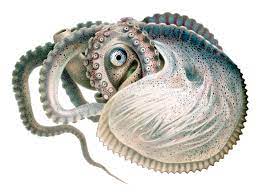
The creature that began to dominate her interest was a small octopus Argonauta argo which was also known as Argonaut or paper nautilus because of the thin, intricately corrugated shell of its females. These octopuses spend their lives drifting near the surface of tropical and subtropical seas, whereas most other octopus live on the sea floor. The females of the argonauts make a fragile, translucent shell to carry incubating eggs. The shell also acts as a ballast tank which aids their movement in the water.

The argonaut had fascinated naturalists since Aristotle with the mystery of its spiral shell—did the octopus ‘borrow’ a discarded shell as the hermit crab did, or did it make its own shell? Why was the shape of the shell so different from that of its dweller, and why did only the female have a shell?

Jeanne set out to unravel these mysteries. As she wrote in her research memoirs: Having for several years devoted to the natural sciences the hours that remained to me free from my domestic affairs, while I was classifying some marine objects for my study, the octopus of the Argonauta transfixed my attention above the rest, because naturalists have been of such various opinions about this mollusk.

But observing these shy creatures was a daunting task. While they appeared on the surface they quickly plunged deep into the sea as soon as they sensed anything close by. Jeanne spent hours, and years, quietly and patiently waiting and watching, and sketching (she taught herself). She realised that the mystery of how and why the shell was made could not be solved through preserved specimens. She had to regularly observe the living creatures. Towards this end Jeanne designed a system of huge cages complete with observation windows through which she could study the argonauts undisturbed. She anchored these off the coast of Sicily. Every day she would row out to the cages, and spend hours observing the creatures from a platform above the cages. This was wet, uncomfortable, and back breaking work. She needed to have some way of continuing her observations in a different way. 

Jeanne the marine scientist applied her mind to engineering now. She made a series of large glass tanks in her home, and populated these with living argonauts. Now she could conduct observations and experiments of all types in a lab-like situation which still provided the marine organisms with a near-natural environment. And so in 1832, the first recognisable glass aquarium had been designed! Jeanne also developed two other aquarium designs: a glass apparatus placed within a cage for use in shallow water and a cage-like aquarium capable of lowering its contents to various depths.

After a series of ground-breaking experiments with these captive marine creatures which she began in 1833, and five years of hours of patience and persistence, Jeanne was able to observe how the argonaut makes its own spiral home, and also is capable of repairing it in case of damage. In doing so she not only solved a long-debated mystery of whether these creatures made their own shells, but also revealed the innate “intelligence” of the octopus in a period when science was yet to recognise the consciousness of non-human animals.  

Jeanne wrote papers to support her research, but as a woman she was unable to present these at scientific conferences or societies, so these were read by male scientists on her behalf. In 1839 Sir Richard Owen, an eminent scientist of his time, presented her findings before the London Zoological Society. Jeanne’s work attracted attention and began to be published in many languages.

In 1839 Villepreux-Power published a book describing her observations of the Argonaut and other animals. In 1842 she published a comprehensive guide to the island of Sicily. The following year Jeanne and her husband relocated from Sicily to London. During the move, the ship carrying most of her scientific documents and collections sank, and these were lost forever. After her move to England Jeanne no longer did scientific research, but she continued with her writing. It was only towards the end of her life that Jeanne Villepreux-Power was accepted into scientific societies in England and Europe. She died on January 26, 1871. Sadly, Jeanne was forgotten for more than a century after her death. It was only around 1997, that her work was rediscovered. In the same year, Jeanne’s name was given to a major crater on Venus discovered by the Magellan probe. 

–Mamata

Christ in Sculpture

There are many awe-inspiring statues of Christ across the world, and Christmas week would surely be an appropriate time to talk about some of them.

Jesus is portrayed in sculpture in specific ways: the first and most common way is Christ on the cross, or the crucifix. Another popular form is Christ on the judgement seat, presiding over the Last Judgement. This is a common depiction in churches built in the Middle Ages. Sculptures of Mary with baby Jesus in her arms are found across the world. Arguably the most famous sculpture of Jesus is the Pieta of Michelangelo—Pieta being the depiction of the dead Jesus in the arms of his mother. Pietas are also often seen in various churches.

There are many modern Christ statues which are put up not in churches, but on top of mountains or in outdoor spaces, which are huge and have become iconic of their locations. The most famous of these is of course the statue of Christ the Redeemer in Rio de Janeiro, Brazil. Done in the Art Deco style, it took nine years to complete. The French-Polish sculptor Paul Landowski made it with the help of several renowned engineers out of reinforced concrete and sandstone. It stands 30 metres in height, on an 8-metre pedestal, excluding its 8-metre. The arms stretch out 28 metres wide.

 But there are many other interesting ones as well. For instance, the Heart of Jesus in Harghita, Romania, is a metal structure which looks like something out of science fiction. Made of stainless steel, it was completed in 2011, and stands at about 23 meters. Visitors can go up a series of metal staircases to stand inside the head of the statue and look out at the amazing landscape from that height.

In terms of location, a unique Christ statue is Christ of the Abyss in Portofino, Italy. This is an underwater statue off the Italian Riviera, and is submerged over 15 metres deep. It was created in 1954, and was commissioned to commemorate Dario Gonzatti , the first diver to ever use scuba diving gear.  One has to dive or snorkel to see this statue of course!

Two famous Christ statues were created to give the message of peace. The first is the statue of Christ the King, put up in Portugal. It was built in the 1950s to give thanks for Portugal being saved from the destruction of World War II. The other is the statue called Christ the Redeemer of the Andes, which straddles the border between Chile and Argentina. It was built in 1904 to mark the resolution of a border dispute between the two nations—a dispute which almost resulted in war. 

Equally interesting is a statue I saw at the St. Joseph’s Church in Mandya, on my recent drive from Bangalore to Mysore. Not of Christ but of his father, St. Joseph. This is the depiction of Joseph in sleep on his side, called the Reclining Joseph. The symbolism is that God appeared to Joseph when he was asleep, to tell him to accept and protect Mary, who was carrying the Son of God, which of course Joseph did.

Apparently fairly common in many parts of the world, this depiction is said to be a favourite of Jorge Mario Bergoglio, the current Pope Francis, who is supposed to write down prayers and wishes and leave them under the statue of the Reclining Joseph, so that he may sleep over the problems and solve them!

So here is wishing everyone a Merry Christmas, with some divine interventions to solve the problems of the world today!

–-Meena

A Pied Piper for New York

Rats!
They fought the dogs, and killed the cats,

And bit the babies in the cradles,
And ate the cheeses out of the vats,
And licked the soup from the cook’s own ladles,
Split open the kegs of salted sprats,
Made nests inside men’s Sunday hats,
And even spoiled the women’s chats,
By drowning their speaking
With shrieking and squeaking
In fifty different sharps and flats.

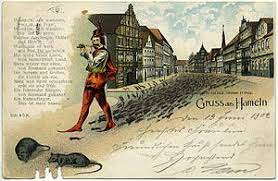
This verse from a poem written in 1842 by Robert Browning describes the plight of a town called Hamelin. The tale of the rats and what happened to them has been told through the ages in what is a classic children’s story called the Pied Piper of Hamelin. 

The story continues in another version by the famous Brothers Grimm.

Once upon a time, in the year 1284 a mysterious man appeared in Hamelin. He was wearing a coat of many-coloured bright cloth, for which reason he was called the Pied Piper. He claimed to be a rat catcher, and he promised that for a certain sum of money he would rid the city of all mice and rats. The citizens struck a deal, promising him a certain price. The rat catcher then took a small fife from his pocket and began to blow on it. Rats and mice immediately came from every house and gathered around him. When he thought that he had them all he led them to the River Weser where he pulled up his clothes and walked into the water. The animals all followed him, fell in, and drowned.

The tale which originated as medieval folklore, which is believed to be based in fact, (there is really a town called Hamelin in Germany) has been retold in many forms through the ages. And it continues to a somewhat grim ending–when the townspeople are unwilling to pay the piper for his services, he lures their children away by the same means.

Fast forward to 2022. Once again here is a city, no less than New York itself, which is looking for the services of a real life Pied Piper who will entice away the millions of rats that are crawling through the city’s streets and subways.

New York is infested with rats. It is estimated that there is one rat for every four New Yorkers!

Interestingly these rats also arrived in New York just as the thousands of immigrants did over the centuries. New York City rats are of the Norway Rat, or “brown” rat, variety that first arrived in North America sometime around 1776 on boats from Europe with the Germans who arrived in America. They quickly spread across the country. The large rats (7-9 inch body with a 7-9 inch tail) and weighing about 500 grams, have superhuman abilities to squeeze through small openings, falling from great heights without injury, and chewing through pipes and cinder blocks. They are also notoriously difficult to capture and eliminate.

As a result rat infestation is a serious and widespread issue in the New York metro area. Rats have become not only a huge menace but also a health and environmental threat. They devour food supplies and contaminate what they don’t eat with faeces and urine. They carry pathogens that spread a range of harmful viruses and bacteria that cause serious illness. Their gnawing and burrowing can cause damage that can be a problem for residents, property owners, businesses and entire neighbourhoods.

Rats seek out places to live that provide them with everything they need to survive: food, water, shelter, and safe ways for them to get around. Areas around restaurants provided these easily for the rats. But during the Covid lockdown of public eating places, and more work, and eat, from home meant that the garbage accumulation shifted to residential areas, and the rats were quick to follow. The rat issue has exacerbated in residential areas since the Covid lockdown was lifted.

The residents are almost held to ransom by the rat brigands. New York’s Sanitation Department reported a roughly 71% increase in rat complaints since October 2020. There is even a Rat Information Portal on the city government’s website which offers information and tips to battle the menace such as: -Clean up. Garbage and clutter give rats a place to hide. -Rats eat your garbage, so store all garbage in hard plastic rat-resistant containers with tight fitting lids. Provide enough trash containers for all of the occupants of your property. Any exposed garbage will attract rats. -Keep landscaped areas around your property free of tall weeds and trim shrubs that are close to the ground. -Check for cracks or holes in the foundation of your building, sidewalk and under doors and repair them by filling and sealing them.

There is a new epidemic in New York that calls for emergency measures.

Hence the recent post by the New York Mayor Eric Adams inviting candidates for a position of a “citywide director of rodent mitigation,” or “a rat czar.”  “If you have the drive, determination, and killer instinct needed to fight New York City’s relentless rat population — then your dream job awaits.”

The qualifications for the post? “The ideal candidate is highly motivated and somewhat bloodthirsty, determined to look at all solutions from various angles, including improving operational efficiency, data collection, technology innovation, trash management, and wholesale slaughter.”

The role’s more serious qualifications include an ability to “self-manage and conduct rigorous research and outreach,” a “desire to be entrepreneurial with an interest in social impact” and either experience in local government or a background in a “relevant” field.

The city government is also putting in place more stringent measures with respect to garbage disposal. As of April 1 2023, New Yorkers will be fined for putting put their trash on the curb before 8 p.m.; currently the rule allows them to put out the trash at 4 p.m. (The rats will have to wait four extra hours before their sidewalk buffets are open!)

In the meanwhile, it would be most interesting to get a sneak peek into the CVs of the applicants for Rat Czar, and to know who will be the new age Pied Piper of New York!

–Mamata

India’s First Law towards Women Empowerment: Sarda Act, 1929

September marks a momentous month in the saga of women empowerment in India. It was in Sept 1927 that the Hindu Child Marriage Bill was proposed in the Legislative Assembly of the Govt. of India. And it was on 28 Sept 1929 that it became an Act.

What was the Sarda Act and why was it so important? The marriage of girls as young as a few days or a few weeks old was rampant at the time when the law was being discussed (sadly one cannot say it has totally disappeared. Pre-1857, the British had tried to legislate on social practices. But after this period, they went slow on pushing any social reform in the fear of being accused of intrusion into traditions. Sadly, even the Age of Consent Bill 1927 making marriages of girls under the age of 12 illegal. was opposed by nationalist leaders like Bal Gangadhar Tilak and Madan Mohan Malaviya who saw it as British interference in Indian customs.

It was Har Bilas Sarda who took it upon himself to do something about this. Sarda was a scholar.  the administrator of Agra and Ajmer, and later Senior Judge of the Jodhpur Chief Court. He was first elected to the Central Legislative Assembly in 1924, and then for two more terms subsequently.

He was deeply moved by the plight of child-widows in India. Introducing the Bill to the Assembly, he made a passionate plea to bring in legislation in this regard.  Though a staunch Hindu traditionalist, he was ready to take a stand on calling for reform in this matter, stating: ‘No country in the world, except this unhappy land, presents the sorry spectacle of having in its population child widows, who according to the customs of the country, cannot remarry. Enforced widowhood is a feature peculiar to Hindu society; and when we consider that some of the victims of this pernicious—I had almost said inhuman—custom were babies eight to ten months old when they were married, Honourable members will realize how urgent and imperative is the call for legislation in the matter.’

But it was not just an emotional appeal though. He quoted facts and figures meticulously culled out from the census of 1921. To make it easier for the reader, here is a summary of the ghastly numbers he presents:

CHILD WIDOWS IN INDIA, CENSUS 1921

Age of childNumber of widows
Less than 1 year612
1-2 years498
2-3 years1280
3-4 years2863
4-5 years6758
Total Number of Widows below the Age of 512016

Sarda further goes on to state that the number of widows below the age of 10 was 97,596, and below the age of 15 was 3,31,793. Not a small problem!

He quotes Manu and Dhanwantri to support his plea to increase the marriage age of girls, saying Manu had said that girls should marry 3 years after puberty, which would take the minimum age of marriage to 15.

The Bill was referred to a select committee named as the Age of Consent Committee headed by Sir Moropant Joshi with several distinguished members. The Bill saw concerted advocacy by women for the first time in India, with the All India Women’s Conference, the Women’s Indian Association, the National Council for Women in India, groups of Muslim women, all presenting their pleas to the Committee to raise the age for marriage and consent, sometimes going against orthodox opposition. The Joshi Committee presented its report, and it was passed into law on 28 Sept 1929, as the Child Marriage Restraint Act (also known as the Sarda Act). It fixed the marriageable age for girls at 14 and for boys at 18, and was applicable throughout British India, for all communities.

Alas, like many other laws passed without either education or strict enforcement, the Sarda Act was not really successful in curbing the practice. Census figures in the next decade showed a steady increase in child marriages. The lack of success was attributed by Nehru and other scholars to the British reluctance to enforce the law as it would cost them the support of orthodox and communal elements.

After Independence in 1949, the age of marriage was further raised to 15 for girls; in 1978, it was raised to 18 for girls and 21 for boys.

But for all that, Census 2011 still shows that 3.7% girls were married before the age of 18. Which goes to show that while having laws in place is vital, there have to be concerted efforts to educate and enforce.

And at the same time to celebrate the battles women have won in the empowerment journey.

It is the moment to recall and celebrate the contribution of Har Bilas Sarda who with his persistence, propelled the first step in this journey.

–Meena

Pic: New Indian Express

Giving Thanks

Someone I loved once gave me
a box full of darkness.

It took me years to understand
that this, too, was a gift
.

Mary Oliver Contemporary American poet

As we look back into the tunnel of darkness that we are cautiously tiptoeing out of, one step at a time, the overwhelming emotion that many of us are experiencing, is that of thankfulness. We are grateful to be fortunate enough to have come out of a very dark and difficult period to face a new day.

The last year-and-a-half has led most of us to re-evaluate our life and our priorities. It has humbled us to be grateful for what we have, rather than always aspiring for what  we do not have. It has opened our senses and sensibilities to the smaller joys of living, and simply, just to count our blessings.

Well before the unprecedented pandemic taught us how to look for, and appreciate, the small rays of light in dark skies, wise people had recognised the power of gratitude. In 1965, during a Thanksgiving gathering at the International East-West Center in Hawaii, Sri Chinmoy, a spiritual leader and meditation teacher, had suggested that a day be designatedwhen the entire world came together for the message of thanks. After the meeting in Hawaii, many attendees began marking Gratitude Day in their own countries on the autumnal equinox in September. In the following years, Gratitude Day became bigger and bigger, and in 1977 the United Nations Meditation Group requested a formal resolution to give recognition for World Gratitude Day to be celebrated every year on 21 September.

The ideal of World Gratitude Day is to give people the opportunity to offer personal gratitude, but also to remember that gratitude is an essential emotion that should be universally shared.

While we usually think of giving thanks to people for all the happy things, we also need to think of situations and experiences that may have seemed difficult or painful, but that have taught us something, and made us wiser and stronger. This is a gift that makes us realise that no one person is an island, and that we are all interconnected in one way or another. Gratefulness shapes how we relate to each other, and to our circumstances. It stems out of generosity, compassion, and respect…towards those things that nurture peace.

Feeling and expressing gratitude imbues both the giver and the receiver with a sense of peace. When the emotion transcends the personal to embrace the universal, it could be the first step towards a peaceful global order. Perhaps this is what prompted the United Nations to also designate 21 September as the International Day of Peace–a day devoted to strengthening the ideals of peace. In a time when so many parts of the world continue to be ravaged by so much violence, in all its explicit and implicit forms, the theme for the United Nations International Day of Peace this year is “Recovering better for an equitable and sustainable world”. This reminds us to be grateful for what we may be fortunate to have, as individuals and as communities and nations, and to join hands for a world that is more equitable, inclusive, sustainable and healthy.

Human memory is short. Even as we rapidly try to regain the “old normal” and the climb back onto our treadmills and into the rat races, this is a good week to remind ourselves to give thanks for the new day, and all that it may bring. 

As the Sufi poet Rumi beautifully puts it:

This being human is a guest house.
Every morning a new arrival.

A joy, a depression, a meanness,
some momentary awareness comes
as an unexpected visitor.

Welcome and entertain them all!
Even if they’re a crowd of sorrows,
who violently sweep your house
empty of its furniture,
still, treat each guest honorably.
He may be clearing you out
for some new delight.

The dark thought, the shame, the malice,
meet them at the door laughing,
and invite them in.

Be grateful for whoever comes,
because each has been sent
as a guide from beyond.

–Mamata

Fire Cat

Source: en.wikipedia.org

I first got acquainted with the Red Panda not in the lush forests of North East India but in the hot and arid environs of Gujarat. In fact, I shared office space with it in Sundarvan, the small-animal park in Ahmedabad, as I embarked on a new journey as an environmental educator. How it reached all the way across the country to live a solitary life surrounded by humans is a story that I cannot clearly recollect. But the memory of starting the day by seeing the quiet furry creature with its bright curious eyes is as clear as if it was just yesterday.

For most of us, the word Panda immediately conjures up the image of the teddy bear-like black and white animal that bears little resemblance to this cat-like animal with reddish brown fur and a bushy tail. That is because the Red Panda is not a panda at all!

Scientists have determined that although they share a habitat (and a love for bamboo) with the Giant Panda, Red Pandas are genetically closer to skunks and raccoons. Their taxonomic position has long been a subject of scientific debate. For many years, Red Pandas were classified as part of the Procyonidae family, which includes raccoons and their relatives. But DNA studies show that Red Pandas represent a unique family that diverged from the rest of the Carnivore Order, and taxonomists place them in their own unique family: Ailuridae. Red Pandas are the only living member of the Ailuridae family. Ailurus fulgens fulgens, the scientific name of this rare and beautiful species literally means ‘fire-coloured cat’.

While the word Panda is a misnomer, the adjective Red is an apt description of this animal which has thick reddish brown fur. While its body is the size of a large cat, its bushy tail, marked with alternating red and buff rings, is almost as long as its body. Red Pandas have large, round heads and short snouts with big, pointed ears. Their faces are white with reddish-brown ‘tear’ marks that extend from the eyes to the corner of the mouth. Dense fur completely covers their feet which have five, widely separated toes and semi-retractable claws.

Their form is beautifully adapted for life in the mountain forests which are home to these animals. They spend most of their time on trees—sheltering, feeding, and sunbathing in winter. The structure of the feet and extremely flexible ankles which can rotate 180 degrees, help them in adeptly climbing headfirst down tree trunks. A  special thumb-like wrist bone helps them get an extra grip when climbing.

The russet coat provides perfect camouflage among the clumps of reddish-brown moss and white lichens that cover the branches of the fir trees in which they dwell. The top cover of long coarse hairs, and the soft dense woolly undercoat provide a double layer of warmth. The long bushy tails which they curl around their body provide protection from the harsh winter winds. The tails also provide support and traction to these nimble arboreal acrobats. If a red panda starts to lean in one direction, it can swing its tail the opposite way to steady itself.

While different from their namesake in form and family, the one characteristic that the Giant Panda and the Red Panda share is that they are both bamboo eaters. But while Giant Pandas feed on all parts of the bamboo plant, Red Pandas feed selectively on the most nutritious leaf tips, and when available, tender shoots. Both pandas have a pseudo thumb, a modified wrist bone which helps to grasp the bamboo while feeding. In fact the name Panda is said to come from the Nepali word ponya, which means bamboo or plant eating animal. Bamboo is not a great food source for energy, and is hard to digest. In fact, Red Pandas digest only about 24 per cent of the bamboo they eat; so they need to eat 20 to 30 per cent of their body weight each day—about 1 to 2 kilograms of bamboo shoots and leaves. In one study, female Red Pandas were found to eat approximately 20,000 bamboo leaves in a single day. While bamboo constitutes about 95 per cent of the Red Panda’s diet, they may also forage for roots, succulent grasses, fruits, insects and grubs, and are known to occasionally kill and eat birds and small mammals.

Red Pandas are usually active at dawn and dusk, sleeping during the hottest part of the day. They begin their “day” by licking the front paws and then cleaning the fur all over the body in a cat-like, sitting posture in the tree; and then “washing” their face with fore and hind paws

Red pandas are solitary except during the breeding season. They scent-mark their territories using anal glands and urine, as well as scent glands located between their footpads. The scent is odourless to humans, but the Red Panda tests odours using the underside of its tongue, which has a cone-like structure for collecting liquid and bringing it close to a gland inside its mouth.

Red Pandas are generally quiet, but subtle vocalizations—such as squeals, twitters and ‘wha’ sounds—can be heard at close proximity. They may also hiss or grunt, and young cubs use a whistle, or high-pitched bleat, to signal distress.

It is the “wha” cry of the Red Panda which was the key identifying feature of this creature when it was first introduced in the Western world.  In 1821, the English naturalist Major General Thomas Hardwicke made a presentation on the creature at the Linnean Society in London. In his presentation titled Description of a new Genus of the Class Mammalia, from the Himalaya Chain of Hills Between Nepaul and the Snowy Mountains, he described this hitherto unknown creature and suggestedthat the animal be called a “wha,” because as he explained It is frequently discovered by its loud cry or call, resembling the word ‘Wha’, often repeating the same: hence is derived one of the local names by which it is known. But Hardwicke’s paper was not published till 1827 by which time the French zoologist Frederic Cuvier published a description of the species along with a drawing. He claimed it was the most beautiful animal he had ever seen and named it Ailurus (from the Greek word ailouros, which means cat, and fulgens, meaning fire-colored or shining. Thus the species was named Ailurus fulgens fulgens. 

In its Himalayan habitat, the animal is still known by its local names.  In Nepal, it is called bhalu biralo while the Sherpas call it ye niglva ponva or wah donka.

Red pandas live in high-altitude, temperate forests with bamboo understories in the Himalayas, and other high mountains in Asia. They range from northern Myanmar (Burma) to the west Sichuan and Yunnan Provinces of China. They are also found in suitable habitat in Nepal, India and Tibet. Scientists have now identified two sub species: Ailurus fulgens fulgens which lives predominantly in Nepal and can also be found in India and Bhutan, and Ailurus fulgens styani (or Ailurus fulgens refulgens) which is primarily found in China’s Sichuan and Yunnan provinces.  

Today this unique animal is endangered. As with most species in the wild, its habitat is under threat, with destruction of its nesting trees and food plants. The animals are often killed as they get caught in traps meant for other animals such as wild pigs and deer. They are also poached for their distinctive pelts. Conservation organisations are working with local communities to create awareness, and take steps to reduce the human threats to the fragile habitat of the beautiful fire cat which has its own special part in the web of life. The Red Panda Network, an international organisation focusing on this, encourages local people to become forest guardians to keep an eye on these creatures, track poachers, and replant bamboo in the forest.

18 September is marked as International Red Panda Day. A good time to learn about this Panda that isn’t a Panda!

–Mamata

Queue-jumping

Last week, newspapers in Bangalore were full of reports of a man who jumped a queue at a super-market. Happens every day, everywhere, right? So why did this hit the news? Well, a determined lady ahead of him in the queue stopped him and asked him not to break the queue. In response, he abused and manhandled her. Other customers stopped him. A police complaint was lodged and he was arrested.

Cover illustration: Nilofer Suleman

A sad commentary on the casual rule-breaking and the casual violence that pervades our lives. It sent me back to ‘The Good Indian’s Guide to Queue-jumping’ by V. Raghunathan (Harper Collins), to refresh my understanding of the phenomenon of queue-jumping. A whole book that deals with the sociology, psychology, and several other ‘ologies of the phenomenon! Fortunately, it also helped me smile a bit, even though the issue itself is disturbing.

To share a few insights from the book gleaned from research:

  • Research shows that more than half the time, queue-jumpers get away scot-free.  In only about 54% of the cases does anyone protest, and it is only 10% of the times that queue-jumpers are thrown out of the queue.
  • In most cases, the person protesting is the person immediately behind where the queue is broken. People further back in the queue don’t react much.
  • If the first and the second person behind the point of the queue breach don’t protest, there is 95% chance that the queue-jumper will get away with the it.
  • When someone gives a reason, however absurd, people are ready to let him or her get ahead of them in the queue.
  • When a single person breaks a queue, there was not much opposition. But when groups break queues, there is more likely to be resistance.
  • Different nations have different propensities for queuing and queue-jumping. The devotion of the English to queues is legendary. In fact, a popular saying is that if there is one Englishman, he will form a queue. Sadly, India is among the nations with a great propensity for queue-breaking.

Physically muscling in is not the only way to break queues. Here are some other ingenious ways to do it:

  • Use professional queuers: Yes, that is a profession! It is essentially a person who takes a payment to stand in a queue in your place. Remember the old days when we used to queue up for railway tickets? We used to often pay someone to do it. In some countries, there are agencies which will send people for this. In a variation of this, when some US states brought in a regulation that car-poolers would get access to fast-lanes, there were professional companions who would ride the car with you so you could join the fast-lane—essentially a form of queue-jumping.
  • Become a VIP: In India of course, it is not at all difficult to break a queue. Every official and politician with a light on their car to speed through traffic is essentially a queue-breaker. The practice, curbed by law is less prevalent today, but has not disappeared. But it’s not just on the road. You go to a government office, and someone who is ‘someone’ will cut in front of you. When you go to the hospital, a person wearing the hospital-employee tag will escort someone to the head of the queue, even as those have booked appointments wait. You go to get a vaccine, you will face the same. But we experienced the most ironical situation of all once when we were waiting to cast our votes on election day. A politician tried to cut-in in front of us. He was a candidate in that very same constituency. Democratic elections based on universal adult franchise are founded on the premise that we are all equal. But the politician-VIP obviously did not believe in this!
  • Pay to get fast-tracked: There are several instances where one can pay to jump to the head of the queue. Temples for instance have free queues, Rs. 100 queues, Rs. 500 queues etc.
  • Fake it till you make it: From across the world there are reports that more and more people citing illness or old-age use wheelchairs at airports, thereby cutting queues and getting express entry. Only to walk away briskly once they clear all the obstructions!

While many of us would hesitate to physically jump a queue, hand-on-heart we cannot say we have not used any of these other ingenious ways. Often we even convince ourselves that these are not instances of queue-jumping at all. But in our heart of hearts, we know they are!

To end on a lighter note, here is a story about the English: ‘During the London riots in August 2011, I witnessed looters forming an orderly queue to squeeze, one at a time, through the smashed window of a shop they were looting. They even did the ‘paranoid pantomime’, deterring potential queue-jumpers with disapproving frowns, pointed coughs and raised eyebrows. And it worked. Nobody jumped the queue. Even amid rioting and mayhem – and while committing a blatant crime – the unwritten laws of queuing can be ‘enforced’ by a raised eyebrow.’ Kate Fox (Watching the English: The Hidden Rules of English Behaviour).

–Meena