
The Madness in the Method

A recent piece by one of my favourite columnists bemoaned the fact that there is increasingly reduced use of physical dictionaries because of instant and easy access to online dictionaries.
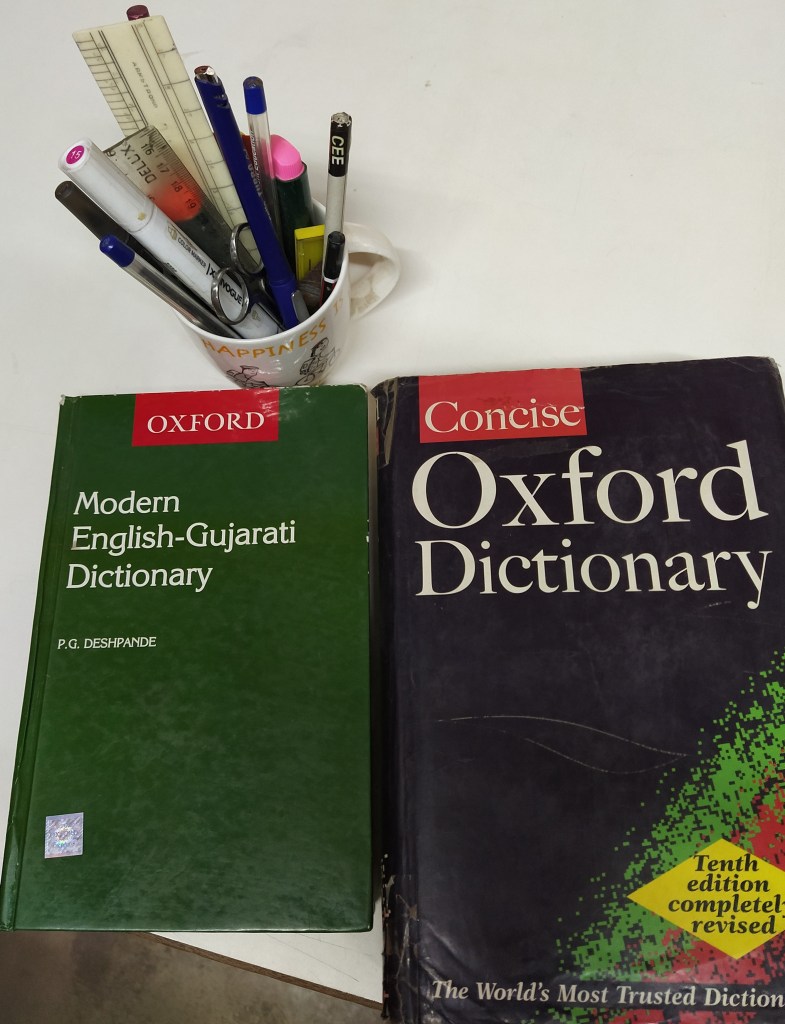
It made me feel a bit guilty as I have begun to succumb to the same short cut, but I still keep my trusty Concise Oxford Dictionary and my bilingual dictionary within hand’s reach on my table, and yes, I do look up words from these tomes. As my erstwhile colleagues may recall, the COD was a permanent fixture on my desk at work. This old friend continues to give me a sense of familiar comfort, as well as continuity in my work and play with words.

While COD is the friendly go-to dictionary, it is the Oxford English Dictionary or OED, which is widely regarded as the accepted authority on the English language. The OED today, is an unsurpassed guide to the meaning, history, and pronunciation of 600,000 words, past and present, from across the English-speaking world. It contains not only not only present-day meanings, but also the history of individual words from over 1000 years of the English language, traced through 3 million quotations from a wide range of sources, from classic literature to cookery books.

What is equally fascinating is the history of the early development of the OED.

Until the 19th century, the English language did not have a complete dictionary. In 1857 the members of the Philological Society of London decided that it was time for a complete re-examination of the language, and embarked on an ambitious project to compile a comprehensive compendium of the English language.

The new dictionary was planned as a four-volume, 6,400-page work that would include all English language vocabulary from the Early Middle English period (1150 AD) onward, plus some earlier words if they had continued to be used into Middle English. It was estimated that the project would be finished in approximately ten years. However, no one realized the full extent of the work, or how long it would take to achieve the final result. After the first grand announcement, the project took a while to take off. And five years after it was launched the editors had only reached as far as the word ‘ant’.

Then in 1879 James Murray a little known school teacher and philologist was given the editorship of this challenging project. His first task was to advertise in all the leading newspapers of the day that the project was looking for ‘volunteers’ in the English-speaking world to send him quotations which would show how the meanings of words had changed over time.

This early experiment in crowdsourcing attracted many volunteers. The most prolific and systematic contributor was a man called Dr William Chester Minor. He regularly sent in meticulously detailed slips tracing the etymology of words, accompanied by relevant examples and quotations. The return address on his letters read simply: Broadmoor, Crowthorne, Berkshire.

For almost a decade, Murray assumed that his favourite volunteer was a reclusive doctor of literary tastes with a good deal of leisure. Then, by chance, Murray discovered that Minor was a murderer who had been committed to the Broadmoor Criminal Lunatic Asylum, which was less than 40 miles from Oxford where Murray was based. In 1891, ten years after they had started corresponding, Murray visited Broadmoor and met Minor. This was the start of a close friendship between the two men that continued for the next twenty years. And one that enriched the OED immeasurably.

Minor’s own story was tragic, as well as inspiring. Born in America, he qualified as a surgeon and joined the Union Army just before the Battle of Gettysburg in 1863. After being released from the Army, Minor left for London in 1871 with his books and paints in the hopes of starting a new and more peaceful life. However the war experiences left deep scars on the sensitive and clever young man. He became delusional and paranoid. In one such moment he unintentionally shot a man and killed him.

Minor’s ‘insanity’ plea helped him to avoid going to prison. But he was incarcerated in the Broadmoor mental asylum in 1872. He was a well-behaved, quiet, scholarly inmate. With the approval of the asylum authorities, and using his US army pension he managed to accumulate and build a library of rare and antique books in his cell. It was this collection that provided the useful information about nearly 10,000 words, and examples of their usage, which he shared with Murray. The subsequent close friendship between the two which was marked by a common love for words and their history, scholarship, mutual respect and drive, was crucial in the compilation of the OED–the last word on words for over a century.

Murray acknowledged Minor’s invaluable contribution when in 1899 he said “we could easily illustrate the last four centuries from his quotations alone.” Murray also petitioned tirelessly for the release of his friend arguing that a mental asylum was no place for a man of his intellectual calibre. Sadly, Minor’s mental condition deteriorated. Finally he was released, and died in obscurity at his home in 1920.

The two men who gave half their lives to a project of unprecedented historical and cultural importance, did not live to see the publication of their magnum opus. It took roughly forty years for the first edition of the Oxford English Dictionary to be completed.

So it was, the story that made the words, rather than the words that made the story!

–Mamata

Once Upon a Time…

These four words open up windows to entire universes—unexplored, or familiar. This is how many a story begins. Stories are a life force that have imbued human life with that something extra, since the dawn of civilization. Stories are a way to convey history, culture, language, spirituality, and identity. One way to keep stories alive is storytelling. Storytelling is one of the oldest forms of communication.

20 March is celebrated as World Storytelling Day–a day to remember and remind ourselves of the magic and power of stories. What began in Sweden, on this date in 1991, as All Storytellers Day has now become a global celebration of the art of oral storytelling. On World Storytelling Day, as many people as possible tell and listen to stories in as many languages and at as many places as possible, during the same day and night.

On this day I celebrate a storyteller who collected, recreated, and created a timeless repertoire of stories. Generations of children have grown up with these tales, told and retold by parents and grandparents over the last one hundred years. This was my grandfather Gijubhai Badeka, one of Gujarat’s foremost educationists and storytellers.

In Gujarati, as in most Indian languages, the child reader had remained somewhat neglected till the middle of the nineteenth century. There was hardly any specific literature for children; only stories retold from classical Indian literature, or heroic stories from Western literature, in not very satisfactory translations. Gijubhai pioneered the creation of special literature for children that also contributed to preserving the oral tradition of literature through exploring and compiling the rich legacy of folk literature. His search for folk tales crossed the boundaries of language and country. This journey of exploration he described thus, in his seminal work titled Vaarta nu Shastra (The Art and Craft of Stories) published in 1925. “So many stories have travelled in foreign lands, so many stories have changed their religion and form; it is an adventure to trace their journeys. If we become wandering travellers with the stories, we will discover that we find one story in Tibet and will see the same story in Africa; we will discover the same story wrapped in snow at the North Pole, and yet if we wander in the Arabian desert, there it will be, but uncovered and bare…but still we recognise the story. Some stories adapt to their land, taking on the form and language of their adopted home, while others retain their origins wherever they may settle. Some stories follow the creed of universal brotherhood, they see the world as their home and go wherever they get a chance to serve and please. Some settle firmly in different countries and come to be recognised as belonging to that place. They are then only translated to reach other countries.”

Many of Gijubhai’s stories are members of this travelling band. Gijubjai transformed and localised these stories, so that they are steeped in the sounds and colours of Gujarat, and have today become not only Gujarati, but uniquely ‘Gijubhai’s’ stories. They are simply told tales characterised by a mixture of prose and rhyme. The repetition of rhymes makes for lively storytelling which listeners join in. Gijubhai retold delightful tales of ordinary people, and familiar birds and animals. With equal panache he churned out stories of common folk with common trades—tailors, potters, barbers, shopkeepers, but also kings, queens and princesses. The characters reflect basic human traits—greed, envy, fear, desire for one-upmanship. Animal tales reflect a close and symbiotic relationship between animals and people. Many open with “once upon a time”… and end “happily ever after.” A hundred years after they were written these stories still touch a cord in the child, and also the child in each of us.

Stories are older than us, they are smarter than us, they keep going, and they are a part of us even though we do not realise this. But stories need human beings to reproduce, much as we need food… we need things to keep ourselves alive.

Hungarian-born American polymath Thomas Sebeok said “…what we can do, I think, is try and create stories that are interesting enough and important enough that our grandchildren might want to tell those stories to their grandchildren — because that’s the purpose of stories, that’s what they’re for: They make live worth living and, sometimes, they keep us alive.

In my own small way, I try to carry forward the legacy of my grandfather by translating and retelling these timeless tales.

–Mamata

Forth and Back

“Madam I’m Adam”. When I was young I was amused by this clever phrase because one could read it the same way from left to right and right to left. As my interest in words and love for word play grew along with me, I was always looking for such words or phrases. Somewhere along the way I discovered that a word, sentence, verse, or even number, that reads the same backward or forward was called a Palindrome. The English word Palindrome was created in the early 1600s based on Greek roots that literally mean “running back on itself” (palin meaning ‘again’ or ‘back’, and dromos meaning ‘running’.)

I began to collect examples of these, and was excited whenever I found one; one highlight being ‘A man, a plan, a canal-Panama’. Until I discovered that there were more avid collectors, and loads of such examples. Here is sharing some, from the daily use ones (that we do not even register as being palindromes) to the funny, clever ones.

Family–sweet and simple in any form: Mum, mom, amma, pop, dad, sis.

Moving on to mechanics–rotor, level, racecar, radar, refer, reviver, rotator, and repaper… (graduating to the next level as ‘Won’t I repaper? Repaper it now!’

Some simple (and sometimes silly) ones:

palindrome.jpg
Source: Google

Dennis sinned.

Don’t nod.

Never odd or even.

No lemons, no melon.

We panic in a pew.

Won’t lovers revolt now?

Sir, I demand, I am a maid named Iris.

Eve, mad Adam, Eve!

Never a foot too far, even.

Nurse, I spy gypsies, run!

Delia sailed as sad Elias ailed.

Ned, I am a maiden.

Some clever ones:

A hitman for hire: Murder for a jar of red rum.

A gross creature: Oozy rat in a sanitary zoo.

Call your mother: Mum

Sane advice: Do not start at rats to nod.

Weather forecast: Too hot to hoot.

Teutonic pride: I, man, am regal; a German am I.

Philosophical musing: Do geese see God?

Old cats: Senile felines.

On ET’s menu: UFO tofu

Bad eyesight: Was it a car or a cat I saw?

A moral dilemma: Borrow or rob?

And one curious one–Murdrum (the crime of killing an unknown man).

And our own and bona fide one: Malayalam!

A wonderful one that sounds like what it means: Tattarrattat—meaning a knock on the door. It was coined by James Joyce and used in Ulysses in 1922. It is also the longest palindromic word in the Oxford English Dictionary.

And last but not the least, there is even a palindromic word for an irrational fear of palindromes—aibohphobia! WOW!

–Mamata