
I still believe in cash, and a monthly trip to the ATM is an essential part of my routine. When I look at a ₹10 note, it seems to me, it probably has had a far more interesting life than I have. It may have travelled through a vegetable market, an auto-rickshaw, a school canteen and a neighbourhood shop, survived being folded into someone’s pocket, squeezed into a wallet and perhaps even taken through a washing machine.
This is where an organisation most of us have probably never heard of becomes interesting. Security Printing and Minting Corporation of India Limited, or SPMCIL, is the Government of India’s specialist organisation for making many of the physical objects that underpin our monetary and security systems. It took birth as an entity in September 2006, but it inherited production units whose histories go back much further. Today, its responsibilities stretch from banknotes and coins to security paper, security inks, passports, stamps and other highly secure documents. In other words, while most of us think of money as something we earn, spend or save, there is an entire industrial world whose job is to manufacture it safely.
And this is not a small printing operation tucked away somewhere. SPMCIL operates several currency presses–the Currency Note Press at Nashik and the Bank Note Press at Dewas, as well as the India Security Press at Nashik and the Security Printing Press at Hyderabad. It also has four Government Mints, in Mumbai, Kolkata, Hyderabad and Noida, and the Security Paper Mill at Narmadapuram, besides the Security Ink Factory at Dewas. Each has a very specialised role, because when the product is a banknote, “printing” is really only the visible part of the job.
Consider what goes into making a note difficult to counterfeit. The paper itself is specially manufactured, and the inks are not ordinary printing inks. There are watermarks, security threads, fluorescent features, microprinting, intricate designs, numbering and other security elements, some of which are intended for us to recognise, and others for machines and financial institutions to authenticate. SPMCIL’s Security Paper Mill produced 7,661.61 metric tonnes of security paper in 2024–25, while its Dewas unit produced 601.31 metric tonnes of security inks. Its currency presses produced more than 1.2 crore banknotes in the same year. It also makes passports, stamps, certificates and other documents where authenticity matters. In 2024–25, for example, SPMCIL produced over 1.5 crore passport booklets, including more than a million e-passports, alongside its currency, coin and security-printing work.
The numbers become even more impressive when we step back from the factory and look at India as a whole. At the end of March 2025, there were approximately 1,550.7 crore banknotes in circulation, with a total value of about ₹36.87 lakh crore. That is in addition to coins and the rapidly growing digital forms of money. The ₹500 note dominated by value, accounting for about 86 per cent of the value of banknotes in circulation, while lower denominations such as ₹10 and ₹20 remain important in sheer numbers.
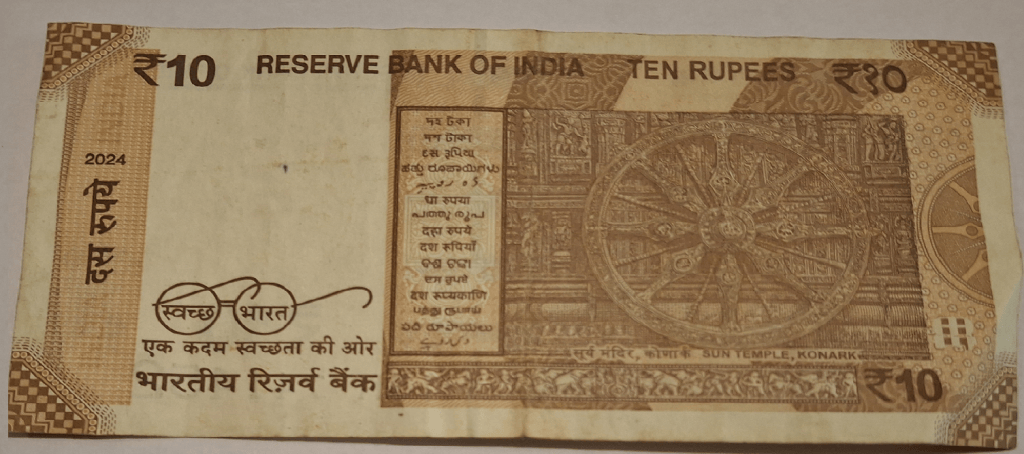
India is preparing to try polymer, or “plastic”, banknotes, beginning with ₹10 and ₹20 denominations. The Government has approved field trials of 200 crore notes altogether, worth ₹3000 crore. The intention is not to banish our familiar paper notes; the polymer notes will initially circulate alongside them, allowing the Reserve Bank of India to see how they survive Indian conditions.
Polymer notes are expected to last considerably longer than conventional cotton-based currency, and that matters particularly for low-value notes that are handled constantly and therefore wear out quickly.
The case for polymer currency becomes particularly interesting when we look at the life of a banknote. Low-denomination paper notes have a relatively short life because they are handled so frequently; internationally, polymer notes have been found to last around 2–4 times as long as conventional paper currency, according to RBI Governor Sanjay Malhotra. The actual life of the proposed Indian ₹10 and ₹20 polymer notes, however, will only be established through the planned field trials and their performance under Indian conditions. The scale is substantial: as of November 2024, India had about 2528 crore ₹10 notes and 1370 crore ₹20 notes in circulation — together nearly 3898 crore notes.
At present, when notes return from circulation, the RBI’s Currency Verification and Processing Systems sort them into fit and unfit notes; fit notes are reissued, while soiled or unfit notes are shredded through the Shredding and Briquetting System and compressed into briquettes. The RBI describes this mechanised process as an environmentally preferable alternative to the earlier practice of burning old notes. For the proposed polymer notes, however, there is as yet no publicly declared Indian end-of-life disposal or recycling system. This is an important gap in assessing their environmental credentials: a longer-lasting note could reduce the number of notes that need to be manufactured and destroyed, but the sustainability story would also depend on how the polymer notes are collected and recycled when they finally become unfit for circulation. International experience suggests that polymer notes can be recycled into other plastic products, but India has not yet announced its own specific recycling/disposal arrangements for the proposed notes
Polymer notes may last longer, but they are still made from a synthetic material, so their manufacture and eventual disposal have to be considered carefully. That is one reason a field trial makes sense. A banknote has to survive Indian heat, humidity, dust, monsoon rains, crowded pockets, ATMs, cash-counting machines and the wonderfully creative ways in which Indians manage to fold, crumple, staple and otherwise abuse currency, otherwise, it cannot be justified from a sustainability perspective. The RBI has specifically said that the notes will be tested for their durability and adaptability to Indian conditions before any wider decision is taken.
If polymer notes are introduced, the SPMCIL printing presses will probably remain central, but the Security Paper Mill’s role in those particular denominations would change. The challenge would move partly from making specialised cotton-based banknote paper to acquiring/producing, testing and securely handling a polymer substrate.
So change is in the wind! Hopefully we, including SPMCIL, can all adapt.
–Meena

