Musings on the Moon

The moon is in the news! This week marks 50 years since the first man landed on the moon, and the papers are full of it, including reminiscences of that milestone year–1969. This took me back to my own association with the moon landing. It was my final school year, and we were told by all our teachers that this was a sure bet as a topic for the essay in our English and Hindi Board papers. So we read all that we could find, and mugged up the names and the dates, and the famous quote “That’s one small step for man, one giant leap for mankind”—the first words by Neil Armstrong as he stepped onto the moon (20 July 1969), and wove them into our creative writing practice.

Those were simple times. Television had still not come to our home. The whole family would avidly listen to the All India Radio news read by familiar comforting voices as they conjured up word pictures of events at home and abroad (the highlight of which was the live broadcast of the Republic Day parade on 26 January). Newspapers in black and white print, and sometimes fuzzy photographs provided the visual support to the audio coverage. We first saw a colour picture of the moon landing in the Span magazine published by the American Cultural Centre.

Being a teenager in Delhi was more about innocent pleasures, than pressures and angst. We had real friends (not virtual) with whom we spent all our time, in school and at each other’s homes, plied with home-cooked food by the much-loved aunties. We had music playing on LPs—Beatles and Woodstock; and the occasional Beat Show, when one of the parents offered to pick us all up and ferry us home for a giggly night-spend together. But we also sated ourselves on the rich offering of music, theatre and art that was easily accessible in Delhi in the 1970s. Books were our BFFs, and sources varied, from the American Library to the hole-in-the-corner neighbourhood lending library.

We were one of the early (now reviled) Khan Market gangs, when ‘hanging out’ meant simply walking around Khan (then not so up-market), and treating ourselves to a coke! Choices were limited, and aspirations were achievable—to join the Administrative Services or become a college lecturer if you were an ‘arts type’, or to become a doctor or engineer. Cut-off marks in lists were in the 60s, and annual fees in the best colleges were still in three figures.

And yet we all got somewhere meaningful, in our own ways, even though by today’s standards we did not “arrive in style” as it were. And we are still there, doing our best to live by our values, in a very different age. It has, after all, been quite an age–half a century–since those days. Since then science and technology have indeed made a giant leap forward, We can be proud that very soon our own moon mission Chandrayaan-2 will be up and away on its way to land on the moon.

Even as we now have the ability to probe the crevices and craters of the distant moon, wonderfully, the moon has not lost its magic for the dreamers and the poets and painters. moon.jpg

We need the moon more than its needs us—look up at the full moon today, and you will know why!

–Mamata
 

UNDEAD

I think ‘undead’ means

The dead who will not die


What then is the term

For the living who do not live?

Who have no wish to live?

Who see no point in living?

For whom there is no joy in living?


Are they called the ‘unliving’?

–Meena

(Obviously suffering from GOT withdrawal symptoms!)

Hall of Rage

One of the things that completely fascinated me when I was told stories from the Ramayana by my grandmother was the concept of the ‘kopagraha’, made famous by Queen Kaikeyi.

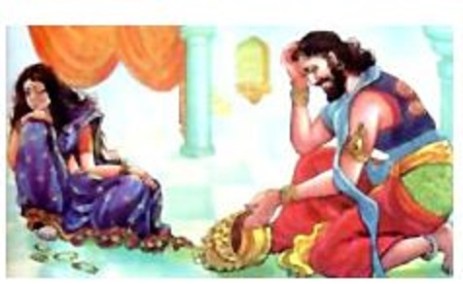
KaikeyaKaikeyi, goaded by Mantra, decides that her son Bharata must be crowned King of Ayodhya, in place of Rama, the first-born. But convincing her husband the King, was not going to be easy. As the first step, she retreats to her kopagraha (literally, Hall of Rage). She flings off her jewels, unfastens her hair, puts off her silks and flings herself on the bed, before sending word to the King that he better come there post-haste, or else…
What ensues is well-known. The King has to bow to her pressure. He decides to crown Bharatha king, exiles Rama to the jungle, and later, succumbs to a heart attack or stroke. But that is the subject of the epic, not this blog.

The kopagraha is the crux here. What a concept! A whole hall or palace to retire to, signalling your rage! A whole building legitimizing tantrums and bad behaviour! I wonder if the kopagraha was a common resource. Could anyone from the royal family just walk in and occupy it? If so, what would happen if two or more people wanted to use it at the same time? Maybe there were systems for bookings like we have for meeting rooms in offices? Or did each important person have one exclusively? Maybe it could be a perk—corporates could allot kopagrahas along with corner offices!

I have often imagined how I would design a kopagraha if I had a chance to have one. I think it would be painted the deep grey of dark clouds, and a bright angry red. The furnishings would all be red. Glass vases and tea cups and china bric a brac would be handy to fling against walls. The acoustics would be designed to catch the shrillest notes of querulous voices and amplify them. Bows and arrows, along with targets to substitute for whoever was the enemy of the moment.

Alas, while punching bags and ‘anger rooms’ and such are a part of some anger management programs, we do not now have the luxury of a palace to indulge our rage.

Interestingly, as I was looking for references to kopagrahas, I learnt that boudoirs were originally on the lines.  ‘Boudoir’ apparently means sulking or pouting room. It is derived from the French ‘bouder’, which means to sulk or pout. In the 1700s, the boudoir was a room to withdraw to, and apparently to sulk in!

Happy tantruming!

–Meena


Disillusioned!

Strange is the English language

‘Disillusioned’ is a word

But ‘illusioned’ is not!

Which seems to imply

That ‘illusioned’ is so status-quo

That it does not need to be discussed

That it is the state most people live in

That it is the ‘reality’, (Oh! World of contradictions!)

That there is nothing unusual about it

So taken for granted that is will not be mentioned often enough

To make it worth having a word for.


And that brings English in its core sensitivity

So close to the concept of Maya

–Everything in the world

A grand illusion


But whatever the philosophers and semanticists have to say

About the reality

Or the unreality

Of the world and words


I only know

That once you are disillusioned

It is very difficult to be ‘illusioned’ again!

–Meena

The Lacy Brittle: Beawar Til Papad

Indian sweets are yum to the Indian palate. But they don’t lend themselves to hyper-levels of visual appeal enhancements as do cakes and pastries and other sundry desserts, as portrayed in various TV shows.

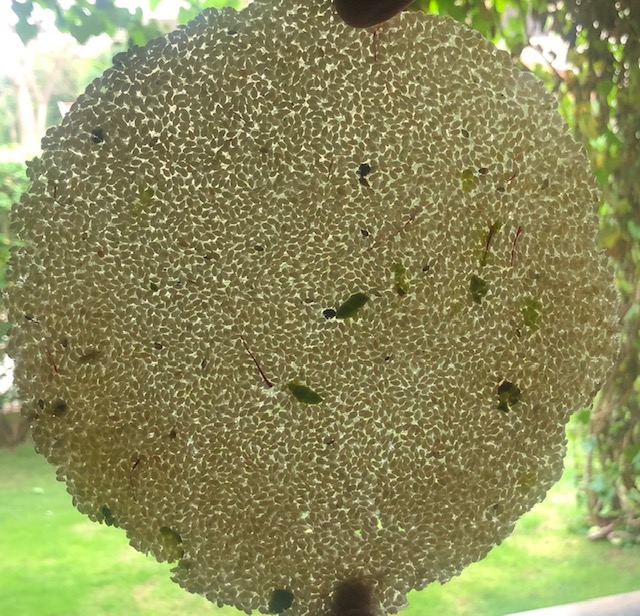
One traditional sweet which is intrinsically beautiful and delicate is the Til Papad from Beawar. A mono-layer of sesame and thinly sliced pistas and almonds in sugar syrup, each papad is see-through. Just hold it up to the light for a lacy view of the world beyond!

055F6DD4-BC24-4333-B75D-C362216E65A6

At some point in my life, I studied in Mumbai, and it was always an adventure to reach Jodhpur, where my parents were, for the vacations. One such journey must have entailed some portion being done by bus, because I distinctly recall wandering around the Beawar Bus-stop. And that is when my fascination with this sweet began. Several shops were making the til papad. Basically til and nut-slivers were cooked in sugar syrup, which was taken off the heat at just the right moment; balls made of the goo; and highly skilled cooks rolled them out, one til-thick. It was amazing to see them at work, for they had to work with hot goo, and roll it really fast and thin.

A few weeks ago, someone from Rajasthan kindly gifted us a box of til papad, and that brought all the memories back.

Digging a little deeper into Beawar, I found that it was not one of the ancient cities of Rajasthan, the story of whose founding is part-history, part-mythology. Beawar was established by a British officer, Colonel Charles George Dixon, in the 19th century as a military cantonment. Situated as it is at a tri-junction of Jodhpur, Jaipur and Udaipur, it gained and still retains importance as a trading centre.

The people of the area were apparently as brave and war-like as from any other part of Rajasthan, and the British had a healthy respect for them. One source tells me that the name ‘Beawar’ originated from the term ‘Be aware’.

In recent history, Beawar’s claim to fame is its link to the Right to Information (RTI) movement. The RTI movement started with a number of activists demanding  transparency, after conducting investigations into wide-spread corruption at panchayat and block levels. The then-CM of Rajasthan, Mr. Bhairon Singh Shekawat assured them he would bring in RTI. But even after a year, this did not happen. So on April 5, 1996, thousands of citizens and activists congregated in Beawar. The protest took place at a busy traffic roundabout called Chang Gate, and lasted 40 days. This laid the foundation for the RTI being brought in.

So sweet little Beawar is strong too!

–Meena


Distances Are Measured In..

Musings as the monsoons approach….


How strange to live in a world (or shall I say, a city)

Where distances are measured not in units of length

But in units of time!!

So that when Kiran says

“I am at Bannerghatta. How far is your place?’

I say not ‘10 kms or 12 kms’

But ‘40 minutes–keep your fingers crossed’.


And distances depend on time of day and day of week!

So that when Pramod asks me on a Sunday afternoon

‘How long will it take me to get to your place?’

I say ‘I will put on the tea. You can be here in 10 minutes.’

But when his wife calls on Tuesday evening and asks me the same question,

I say ‘Oh, oh! Our other guests will be here in 15 minutes,

And its going to take you at least 45!’


They also depend on time of year

For after the monsoons, when the roads are more holes than road,

A 1 km stretch is a 15-minute ride

While in winter, with the roads freshly—if superficially—done up,

It is a whiz-past of 2 minutes!


And did you know, distances depend on who is in town?

For when the PM or the FM or any other M visits,

We count distances in hours, not in minutes.


My science teacher, who poor soul,

Lived in as high an ivory tower as is possible,

Will be most deeply disturbed

Because it seems

That nothing is absolute anymore!


–Meena Raghunathan


PS: I live in Bangalore, most notorious of all cities in regard to traffic. But many others are not far behind, unfortunately. When will we plan for sustainable cities?

Game of Thrones:  Arya The Last Avatar?


In Hindu mythology, Vishu the preserver manifests whenever evil overtakes the world, to destroy the wicked and wickedness, so that the good may take over. There are 10 avatars or forms that he takes, one following the other, to do this. And this is an endless cycle.

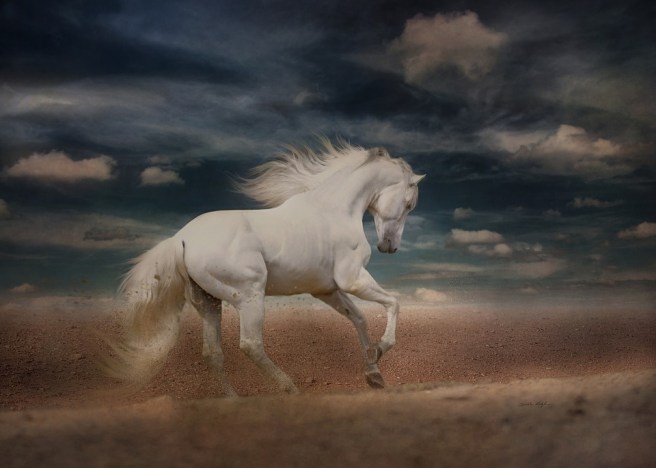
white-horse-4031101_960_720

While is no complete agreement on all 10 avatars, there is no doubt on who the last one is. Kalki, the rider of the white horse.

Kalki avatar, it is said, will manifest at a time when the world is in a crisis because of a wicked and tyrannical ruler. The coming of Kalki will lead to the destruction of evil and the earth will be rid of its suffering and sorrow. Kalki will rejuvenate existence by ending the darkest and most destructive period and usher in the Satya Yuga (Era of Truth).

Shiva is said to have given Kalki a sword and said : ‘I give you this sharp, strong sword and so please accept it. The handle of this sword is bedecked with jewels, and it is extremely powerful. The sword will help You to reduce the heavy burden of the earth.’

Does George RR Martin–or Weiss and Benioff considering we are referring to the last season of GOT–have any interest in/acquaintance with Hindu mythology?

If they did, I would say that Arya shows shades of Kalki! The Seven Kingdoms seem to be at the peak of wickedness. There is a going-off-the-rails ruler waiting to take over from a positively wicked one. So the time is right for an avatar. Arya now seems to be shunning violence. She seems to be in a phase where she may well make it her mission to destroy evil and restore good.

Like Kalki, her chosen weapon is a sword, given to her by a preceptor, Jon.

And the biggest sign of all– she now rides a white horse!

And more than anything else, should not the saviour, for once, be a woman! It will be good for at least one avatar to be a woman! And it will help GOT, which is being criticized for bringing down all strong women, or the good in strong women, in its last season.

So one more theory to add to the flurry of theories which are inundating us from all sides—Arya as Kalki!

–Meena


The Naming of Cyclones

T.S. Eliot said, about the naming of cats:

‘The Naming of Cats is a difficult matter,
It isn’t just one of your holiday games’

The naming of cyclones is surely at least as serious!

We have just been reckoning with the damage caused by Fani. Thanks to the excellent predictions and forecasts, as well as the concerted efforts of government authorities, damage has been minimized. Yet, lives have been lost and there is much rehabilitation to be done. We all need to do our bit.

But why was the cyclone named Fani? Why do cyclones have names at all? Doesn’t it sound a bit like trivializing a serious matter?

Well, no. Cyclones are given names to simplify communications and avoid confusion. It is important for forecasters to keep in touch with each other, and for governments to give information on cyclones to the general public. Since the storms can often last a week or longer, and more than one cyclone can be occurring in the same region at the same time, names can reduce the confusion about what storm is being described. The normal practice is that once storms produce sustained wind speeds of more than 34 knots, names are assigned from predetermined lists depending on which basin they originate.

Every region forms a committee of nations who are more prone to cyclones or hurricanes. For the Indian ocean region, Bangladesh, India, Maldives, Myanmar, Oman, Pakistan, Sri Lanka and Thailand form the Committee, and the governing body is the Regional Specialised Meteorological Centre (RCMC), New Delhi. This is the body which assigns names for cyclones originating in our region.

Each nation making up the Committee prepares a list of ten names which they think are suitable to be assigned to a cyclone. Out of each country-list, RSMC selects eight names and prepares eight lists which consist of the names approved by the governing body. The names of cyclones are not allocated in alphabetical order, but rather, the countries are arranged alphabetically, and the names selected from each country in the list, one by one.

Fani is a name contritued by Bangladesh. Names contributed by India are Jal, Agni, Vayu, Akash, Bijli, Lahar, Megh and Sagar.

Starting World War II till about 1979, cyclones were generally named after women. This practice was modified in 1979 by adding men’s names. Now names are by and large not personal names. Most are names of flowers, animals, birds, trees, or even foods, etc, while some are descriptive adjectives.

So at least in this matter, some amount of gender sensitivity has been brought in, and destructive forces are not tagged with exclusively feminine names!

–Meena

The Worshipful Bull

In Indian mythology, Nandi the bull is both the guardian of Mount Kailash, and the vehicle of Lord Shiva. The worship of Shiva and Nandi goes back to the time of the Indus Valley Civilization. The bull-seals found in Mohenjodaro and Harappa  have led some researchers to conclude that Nandi worship goes back many thousands of years.

A statue of a seated Nandi is often found in front of Shiva temples, facing the God. In metaphysical terms, Nandi represents the individual soul, looking to unite with the universal soul or Shiva. At a mundane level, people often use Nandi as a communication medium, whispering wishes into his ears, so that he may convey them to Shiva, who may listen to him more readily than to us!

Why suddenly this interest in Nandi? Because I was in Orissa this week, and did a three-hour road journey and also visited 5-6 villages.

Still doesn’t explain it?

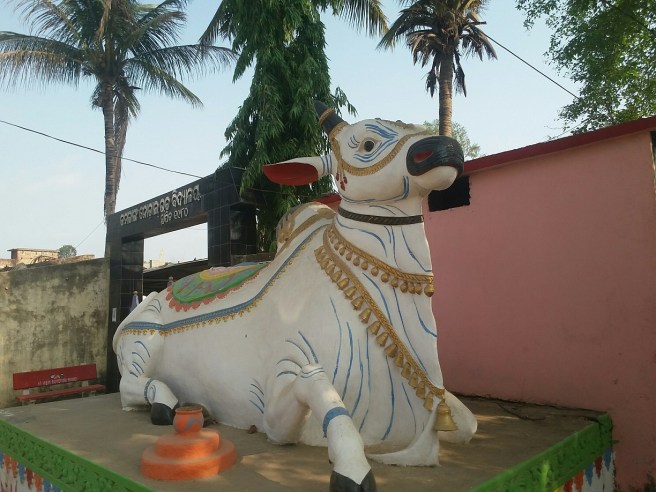
nandi

Well, it was the number of Nandi statues I saw in this time. Almost every hamlet and village had one. Pretty big and prominent. Sometimes the shrines they were in front of were smaller than the Nandis. And there were also some stand-alone Nandis! They were in all shapes and sizes.  A few small, most medium sized and a few really large. Some smiling, some serious, some with inscrutable expressions. Some puny and under-fed, some healthy. Some in proportion and some not-so.  But Nandi, after Nandi, after Nandi.

I have travelled to several states. I have seen ever-increasing number of stand-alone Hanuman statues; and several Shiva statues. But as far as I can recall, I have not come across so many Nandis. I am not sure why there should be so many in Orissa particularly, because traditionally, large Nandi statues are more prevalent in the South—Andhra Pradesh, Karnataka, Tamilnadu. But I do not recall that Nandi statues are found so commonly in these states.

The largest bull statue is in the Mahanadiswara Swamy temple in Kurnool, AP. It stands 15ft by 27 ft. This is followed by the bull in the Lepakshi Temple, also in AP. Other prominent Nandis are the ones at Chamundi Hills, Karnataka, Brahadishwara Temple, Tamilnadu, and of course, Banagalore’s own Bull Temple. Orissa does have one of the big 10 Nandis, at Bhanjanagar town.

But I think the state must beat all simply in the number of Nandis dotting the state scape. These are not old—would not think many are over a decade in age. It would indeed be interesting if someone could undertake a study to understand why there is such a proliferation in recent times. Wish it could be me, but sadly, I don’t think I can do it at the moment. So when I go back to Orissa, I will content myself with just looking out for them, counting them and clicking them

–Meena

When is a Flower not a Flower?

When it is a bougainvillea!

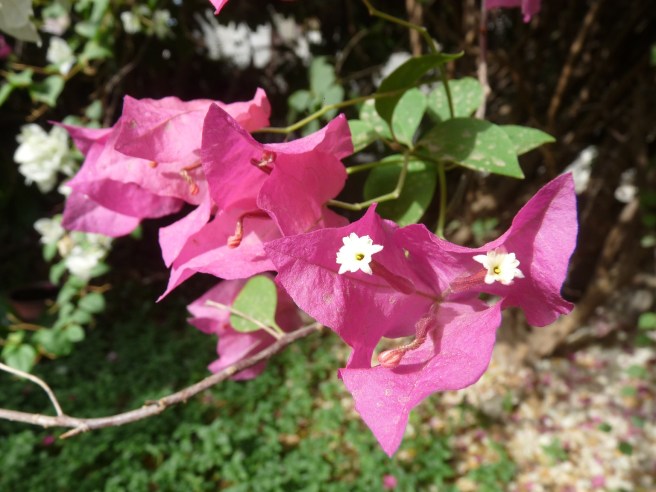
Yes, I learnt pretty late in life that what I thought were the petals, are actually bracts! And what pray are bracts? Well, seems bracts are modified leaves! They grow above all other leaves, but below the petals. And no, bracts are not to be confused with sepals, which are the green, leaf-like things which cover the petals when the flower is still in bud stage!

Confused? Well I was. But when I looked more closely at the bougainvillea, I got it. Look closely and you will see small white flowers at the centre of what you would a minute ago have called a pink flower. (There are three such small flowers within each set of bracts, though you cant quite see them in the pic.)

bougainvillae flower

Bracts are often brightly coloured and have evolved to attract flowers. Our friend the bougainvillea is a great example of this, with bracts of magenta, pink, yellow, white, orange and every other colour! Another flower that is not a flower you think, is the poinsettia. The bright coloured petals are bracts. In grasses, each floret is covered by two bracts, and each group of florets has another pair of bracts at its base! The dried bracts are the chaff we remove from the grain!

A seemingly simple cheerful plant, which happily blooms for us on road-medians, along compound walls, in gardens. Fairly easy to grow as long as it gets enough sun and we take care not to over-water. But I have found three levels of complexity:

  1. The spelling. I just cannot get it right without the spellcheck! Yes, I know it is named after a person. But please can we do something about it?
  2. This bract-petal confusion.
  3. The woman who discovered it, while disguised as a man and who never got the credit (see our post ‘Colour and Cheer’, 15 Nov, 2018).

Simple is the new Complex! Or do I mean Complex is the new Simple?

–Meena