Women of Substance

Some people know the name Savita Ambedkar. Fewer know the name Gyan Patnaik. These were women who were achievers in their own right, but decided to stay in the background, while their husbands took the larger stage. A small peek into their lives…

Savita Ambedkar: Dr. Savita (born Sharada) Ambedkar was the wife of Dr. BR Ambedkar. Born in 1909, she belonged to a very forward-looking family which gave great importance to education. This enabled her to pursue her MBBS in a day and age when it was not very common for women to even complete school. After graduating from Grant Medical College Bombay, she was appointed as Medical Officer in a major hospital in Gujarat. However, due to ill-health, she gave up her job there and returned to Bombay in a while, and started assisting a senior doctor in his practice. It was at this time that she met Dr. Ambedkar at the house of a common acquaintance He was immersed in his work as Labour Minister in the Viceroy’s Council. The acquaintanceship began with a few conversations about women’s rights, Buddhism, etc., and continued for many years. . Dr. Ambedkar had lost his first wife and had resolved not to marry. During the writing of the Constitution which obviously must have been a very stressful time,  Dr. Ambedkar’s health suffered and he came to Bombay for treatment. Dr. Savita was closely involved in his treatment, and they had many conversations about social change, literature, religion, etc. Their friendship grew, and they decided to get married in 1948. After that, she not only lent her intellectual support in his many tasks, she also acted as his personal doctor-nurse, and was involved in social work. Dr. Ambedkar has credited her with increasing his life-span by 8-10 years.

Tragically, after his death, she was accused of having poisoned him. Govt. of India set up committee to look into the circumstances of his death. The committee found no indication of foul play. While during Dr. Ambedkar’s life, she was a very respected figure in the Dalit-Buddhist movement, after that, there were allegations that she was not really committed to it, given her Brahmin birth. However, after some years, there was a reconciliation and she actively participated in it once again. She was responsible for the preservation of many documents and papers related to her husband and received the posthumous Bharat Ratna on his behalf.

Gyan Patnaik: Fiesty Gyan was the wife of the flamboyant Biju Patnaik.  She was one of the first women-aviators in India, and probably the first woman to get a commercial pilot’s license in the 1930s. It was their joint love of flying that brought the Punjabi Gyan and the Odiya Biju together.  He piloted his baraat across the country for the wedding, and was known as Punjab’s son-in-law.

Gyan participated fully in the nationalist movement with Biju. She co-piloted the plane with him in his daring rescue of Indonesian leaders from Dutch-occupied Java. She went back there on several missions with Biju to bring humanitarian aid to the beleaguered people. She was also very active in supporting the freedom struggle in Nepal in the 1950s. She flew several sorties to Burma along with her husband to rescue British families as the Japanese invaded the country during World War II.
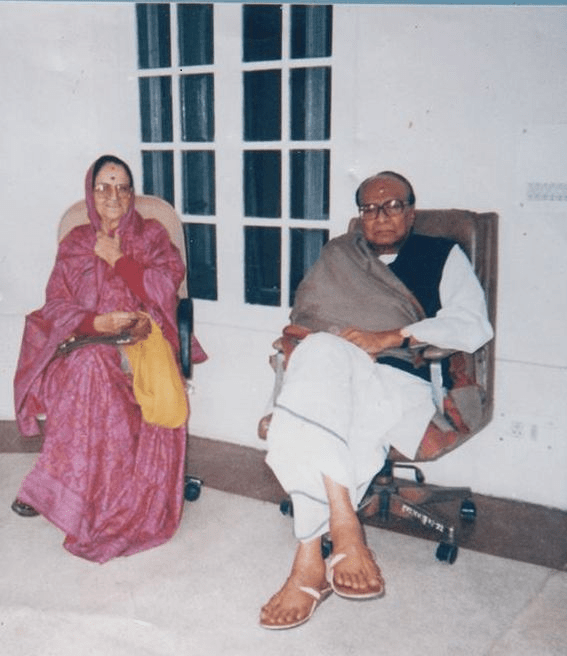
Gyan Patnaik with her Husband

She was passionately interested in science and the use of science for improving people’s lives, and provided leadership to these initiatives through the Kalinga Foundation. She was a wise counselor not only to Biju Patnaik, but also to many leaders in Orissa. However, during the later years, Biju preferred that she live away from Orissa so as not to get caught up in the rough and tumble of state politics.

A woman-doctor and a lady-pilot in the 1930s were on path breaking journeys and would have made waves. Being married to prominent men brought them to the public eye and they garnered accolades in a different way—one where they were seen more as supporters of men on the national stage, rather than achievers in their own right.

On International Women’s Day, we claim back the stage for them and many others like them, and wish all readers.

–Meena

PS: We started our blog on International Women’s Day, 2018. Four years and 480 posts–an opportunity for immense learning and sharing. A big thank you to all our readers!
Serendipity is the Best Travel Guide

Last week, along with dear friends, we had driven to Shimoga to see the Jog Falls, maybe visit the Bhadravathi Sanctuary, and do the other local sights.

Alas, trouble broke out there and we decided to cut short our visit and drive back—fortunately after seeing the Falls. While we were not heart-broken to return a day early, there was an air of slight disappointment in the two cars.

When…

…we suddenly saw a sign ‘Welcome to Amrutapura: City of Ancient Amrutesvara Temple’ (Karnataka has a wonderful practice of labeling its towns, from Chennaptana: Toy Town, to others which are Silk Towns, Arecanut Towns, Coffee Towns etc.).  We recollected that the Hotel Desk had cursorily told us that Amrutapura was a possible place to visit, but we hadn’t really registered it it was a casual mention.

But now that we were here with a day to spare, we decided to explore the possibilities.

And what an experience awaited us!

Amruthavarsha Temple, Karnataka
Gopuram of Amruthavarsha Temple, Karnataka

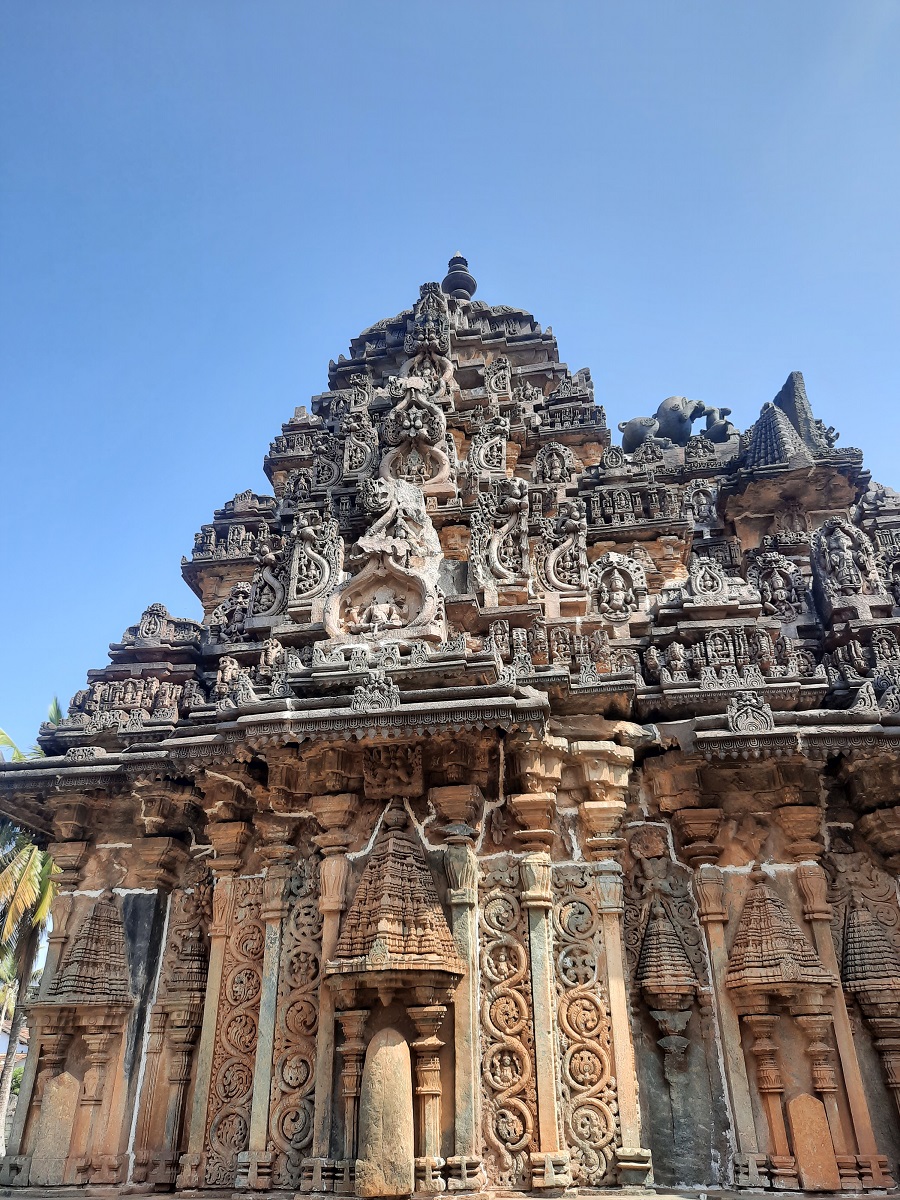
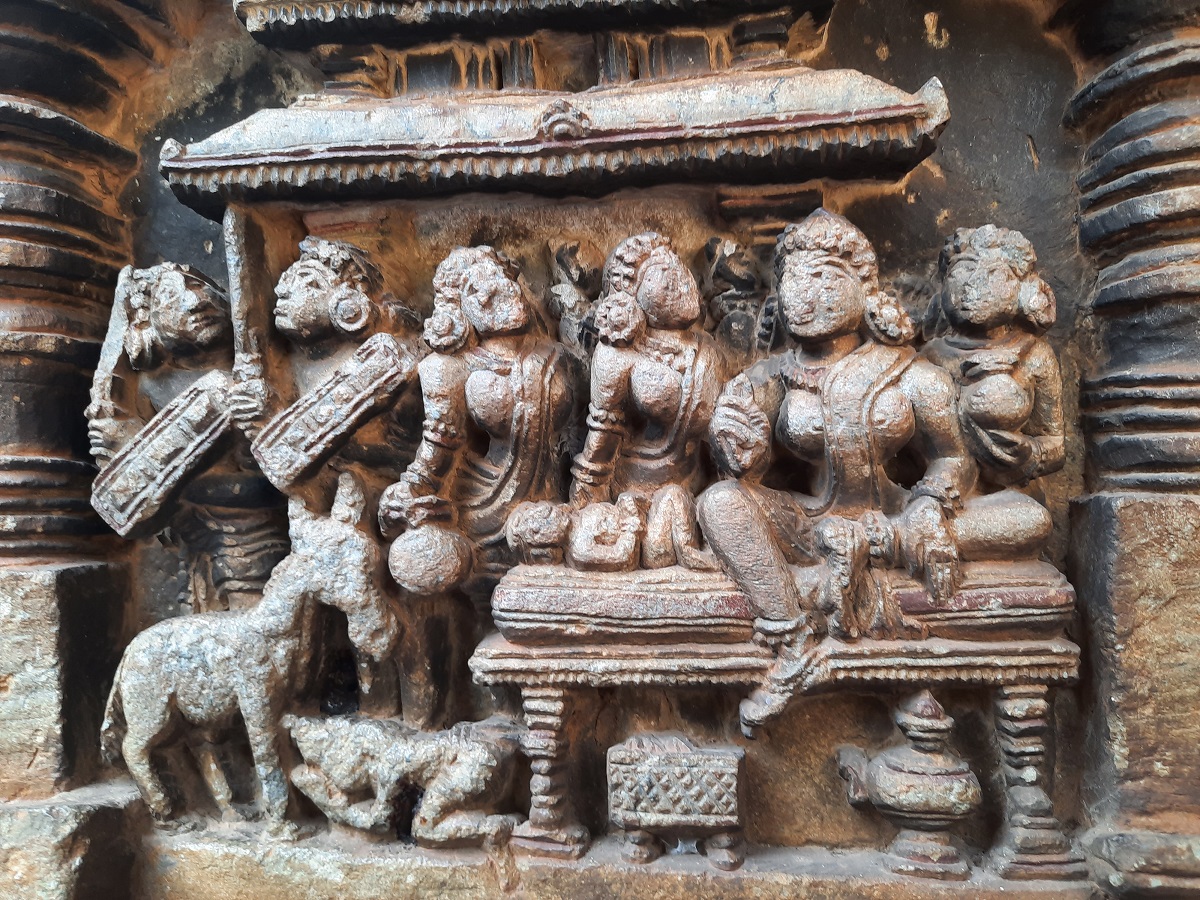
Built in what experts deem the older Hoysala style, this 12thcentury Shiva temple was commissioned by Amrutheshwara Dandanayaka, one of the commanders of Veera Ballala II, the Hoysala King. The beautiful little temple, where worship still happens, is dense with an amazing array of sculptures. Friezes from the Ramayana adorn one side of the structure, while stories of Krishna and tales from the Mahabharatha decorate the other. One tower has a detailed panel of Shiva slaying Gajasura. Another tower showcases the emblem of the Hoysalas, a young man battling a lion. As per folklore, a young man, Sala, saved his Jain guru, Sudatta by striking dead a lion near the temple of the goddess Vasantik. The name of the dynasty itself comes from this incident– ‘Hoy’ meaning strike, and ‘Sala’ for the young man’s name. (I am a little confused about this story, not being able to make out the connection between Sala and the dynasty–did he found it? Was he one of the scions? Obviously, more research is called for on my part. But what really intrigues me is the killing of a tiger to save a Jain muni. Surely the teacher could not have approved of this?). There is also a large stone embedded in the premises, with a poem inscribed on it, which is believed to have been written by Janna, one of the most famous poets of the region and times.

Vasudeva praying to the Donkey, Amruthavarsha Temple, Karnataka
Vasudeva praying to the Donkey

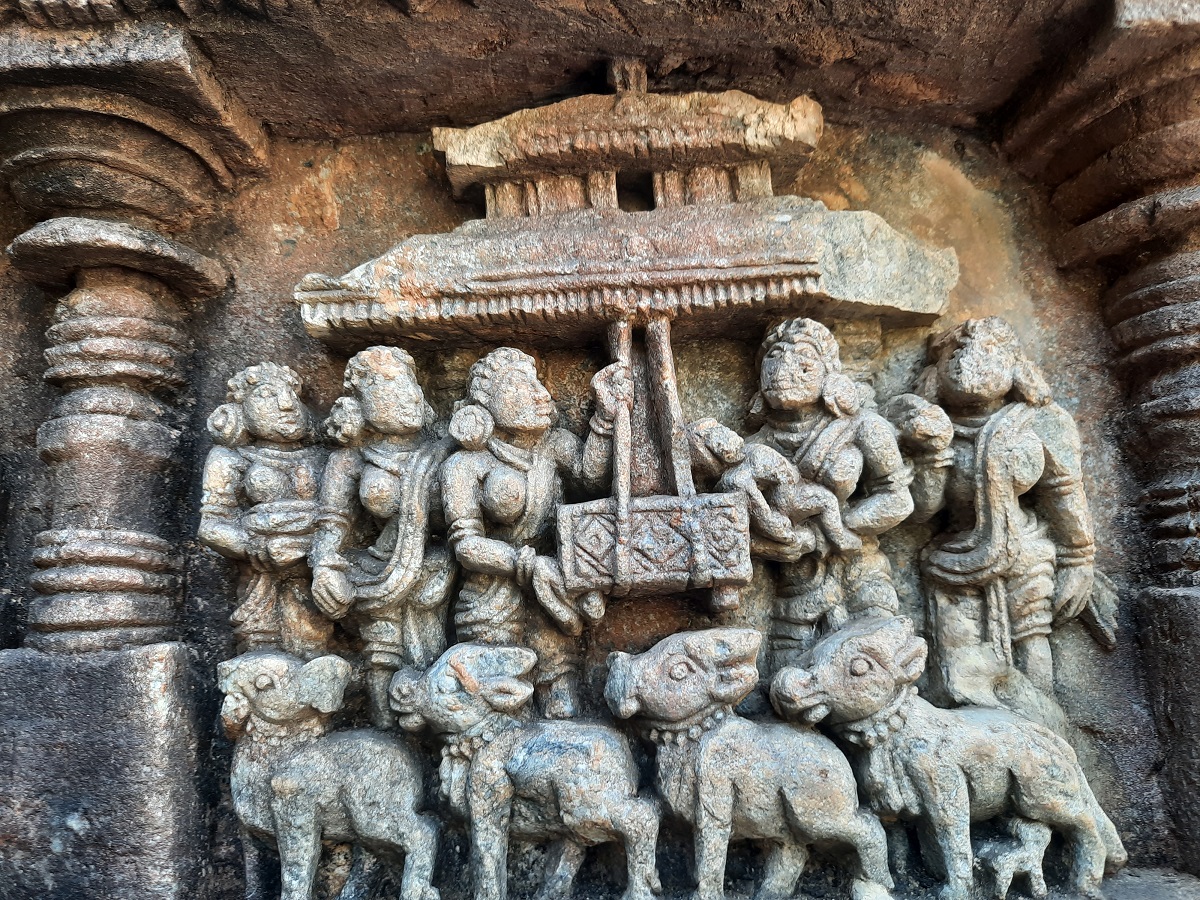
It would seem that a lot of thought had gone into selection of the incidents to be depicted on the friezes. Krishna’s birth, the events subsequent to that, the various attempts of various hideous demons to kill him in his infancy, and his mischievousness as a child form a large part of the display. The most intriguing was of one of a man bowing to a donkey. We could not figure it out, but the temple priest was kind enough to tell us the story. It seems that when Vasudeva was preparing to smuggle Baby Krishna out in a basket on the night he was born, to deliver him to Nand at Mathura to save him from Kamsa, there was a donkey outside the prison gates, all ready to bray aloud and attract the attention of the guards. Vasudeva prostrated himself in front of the donkey, pleading with it not to make a noise. And it finally agreed, thus allowing the clandestine operation to proceed smoothly.

Krishna's Cradle Ceremony, Amruthavarsha Temple, Karnataka
Krishna’s Cradle Ceremony

There is of course the aesthetic beauty of the temple created in ancient times. But at a time when my 7-year old house has leaks and cracks and sundry problems, it is amazing to see how the 12th century structure is still so well maintained and standing so strong. And then, the peaceful and serene ambience of the temple, the spotless cleanliness, the well-maintained greenery. Kudos to the ancient masters, the priests who have taken care of the temple for 900 years+, and now the ASI, which seems to be managing it. But also a small request to ASI: how about a sign somewhere on the temple with its name (no, there was no hint that it was indeed the Amruthavarsha Temple)? How about some information on the temple itself, apart from signs warning of dire consequences of defacing the structure? How about a little more publicity for such a wonder? How about public conveniences built somewhere in the vicinity for travellers who drive many miles to get here?

But no complaints. The temple just blew our minds.  Maybe it is only in India that one would serendipitously happen on a 12th century masterpiece while driving along desultorily. 

–Meena

Ayahs Remembered

Recently I read the memoirs of a member of a wealthy and renowned family of Gujarat. The author describes how when she was a young girl, her family used travel to Europe, and even spend considerable time living in England. This was in the early 1900s when not many Indian families did so. She also recalled that when the family returned from England, they brought back with them two English nannies. She remembers that in addition to being instilled with all the polite and proper English manners, the regimented life that she and her siblings led under the nannies; there were even allocated times when they could meet their parents.

While ‘nannies’ have had a long and characteristic role in English literature, it was interesting to read an Indian experience of English nannies. 

Coincidentally, the same week I read a very interesting account of the Indian nannies or ayahs as they were called, in the colonial period. Ayahs were essentially nannies from colonial India and other parts of Asia who were charged with looking after the children of English families in India. The practise probably began with the large numbers of British who came to India to work in different capacities under the East India Company. While most of these came from ordinary families, and were not very highly paid, the cost of living in India was so low as compared to England, that here they could afford to live luxurious lives, supported by a retinue of servants. The ayah who provided round-the-clock child care was an important part of this support system.

When the families returned home, it was common for them to take back the ayahs, especially to continue their duties during the months-long sea voyage back. But these ayahs were most often taken without any kind of formal contract or understanding about their terms of employment. And as the history indicates, many of these ayahs were dismissed or simply abandoned by the English families once they reached England. The employers often did not even arrange or pay for their return passage home. Several were ill-treated and abused by their employers. The ayahs, many of them young girls themselves, were literally thrown out on the street, with no money, employment nor place to stay. There was often no record of these women, even on the ship’s manifest, they were not listed by name, but only as ‘nanny’ of the family.

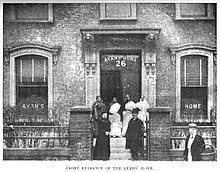
At one stage in the mid-1800s there were a considerable number of such homeless and helpless ayahs (and Chinese amahs) in London causing concern, especially among Christian charities. This led to the founding of what was called the Ayahs’ Home in 1825. Set up by the London City Mission, the house provided a refuge for abandoned or ill-treated ayahs. The ayahs stayed there until they could find alternate work, or find their return passage home. There was an interesting arrangement whereby the family that brought the ayah from India would pay the cost of the return fare to the Home, and the same would be sold to a family returning to India who would take the ayah back. There was on average 100 ayahs living in the Home, for varying periods of time. 

The original Home moved to another location in 1900 and once again in 1921 to what remained its location at 4 King Edward Road in Hackney. The Ayahs’ Home became an important landmark. It was the only such institution in Britain with a named building. Over time its history began to be forgotten.

In 2018 Farhanah Mamoojee a young British woman of Indian descent discovered, by chance, some stories about ayahs, and tried to find out more. She was fascinated to discover that she lived not far from the building in Hackney that used to be the Ayahs’ Home, but there was no signage indicating this, nor information available about the site.  She made it her mission to draw attention and bring recognition to ayahs who were part of British history. She started the Ayahs’ Home Project through which she started collecting untold stories about the forgotten and often ‘nameless’ ayahs; and organising events with a spotlight on this little known group. She also started a campaign to petition for the building to be awarded a Blue Plaque. A Blue Plaque is a permanent sign installed in a public place in the United Kingdom to commemorate a link between that location and a famous person, event, or former building. Mamoojee felt that the Ayah’s Home needed to be commemorated as the Home symbolized the collective struggles of a group of unrecognised women, and their shared but nearly forgotten histories.

Mamoojee’s efforts have borne fruit. Recently there was news that this year the building will be honoured with a Blue Plaque.

Ayahs may have been part of colonial history, but even today there is a new stream of domestic helpers from India and South and South East Asia being taken abroad to work for rich employers. And every now and then one hears disturbing stories of them being ill-treated by the employers, and being helpless and stranded in a foreign land. Perhaps there is as much need for a safe refuge for these indispensable, but often callously treated women as there was two hundred years ago.

–Mamata