The Flowers of War

The media has been full of the 50th anniversary of the Carnation Revolution over the last week. It happened in Portugal. And apparently, Portugal wasn’t even a respectable democracy 50 years ago! Since a coup in May 1926, Portugal was under an authoritarian regime. In 1932, Antonio Salazar took over as Prime Minister, and remained at the helm of affairs till 1968 and continued to hold the reins of power tightly, with little say for the people in anything. He alo would not give up Portugal’s large overseas territories including Goa, Daman, Dadra and Nagar Haveli. In India of course, the Indian armed forces invaded, and supported by the local freedom fighters, took over in 1961. Portugal continued fighting long-drawn colonial wars in other parts of the world. Within Portugal also, it was an authoritarian rule. Finally, in 1974, the people of Portugal lost patience. On 25th April, there was a largely peaceful coup led by members of the Armed Forces Movement and backed by civilians from all walks of life. It began to be called the Carnation Revolution because there were almost no shots fired. It being the carnation season, the markets were full of carnations, and people started giving them to each other and also placed them in the muzzles of the soldiers’ guns, as well as in their button holes.  It was a happy ending!

Flowers
Bouquet of Flowers in a Vase Georgius Jacobus Johannes .Getty Open Access

Many subsequent peaceful revolutions have been named after flowers, including: The Tunisian revolution of 2010-11 is called the Jasmine Revolution in honour of the country’s national flower In the Rose Revolution in Georgia in 2003, Opposition leader Mikhail Saakashvili carried a rose into parliament when he demanded the resignation of President Eduard Shevardnadze, while protesters in the streets gave long-stemmed roses to soldiers called out to stop them. The President resigned. The 2005 Tulip Revolution in Kyrgyzstan forced President Askar Akayev to flee the country. 

But the association of wars with flowers goes further back than that. The famous War of Roses was a long-drawn series of inter-generational wars for the British throne. Fought over 30 years starting 1455, the war was between the House of Lancaster and the House of York, descendants of two sons of Edward III who reigned from 1330-1377. Amidst  claims and counter-claims to the throne almost as complicated as between the Pandavas and Kauravas, the war raged till Henry Tudor (later Henry VII) who represented the claim of the House of Lancaster, won the Battle of Bosworth, and sealed the claim by marrying Elizabeth of York, the daughter of the Yorkist King, thus uniting the two houses. The War of Roses is so called for the symbols of the two sides—the white rose of York and the red rose of Lancaster. After the marriage of Henry and Elizabeth, the symbol was combined in a way that overlaid the white and red roses.

But the oldest of flower-wars has to be war over the parijata tree fought between Krishna and Indira. The origin of the story goes back to the Harivamsam (1st or 2nd century BCE). In this tale, Narada gives Krishna a single enchanting blossom of the parijata flower from the special tree in Indra’s garden. Krishna is with his senior-wife Rukmini at the time, and gives it to her. When the junior-wife Satyabhama hears of this, she is angry beyond belief and is only pacified when Krishna promises to fetch her the tree itself from the heavenly garden. However, Indra refuses to part with the tree, and Krishna has to fight a mighty battle—which of course he wins. And the parijata is brought to earth and planted here. (See ‘Heaven’s Flower’ https://wordpress.com/post/millennialmatriarchs.com/164)

So flowers can cause wars. And they can stop wars.

It’s a choice we have to make today!

–Meena
Words Maketh Books

This week Meena wrote about World Book Day on 23 April. Not exactly coincidentally, this day is also marked as English Language Day. English Language Day is the result of a 2010 initiative by the UN’s Department of Global Communications, establishing language days for each of the Organization’s six official languages (English, French, Spanish, Chinese, Arabic, and Russian).The purpose of the UN’s language days is to celebrate multilingualism and cultural diversity, and to promote equal use of all six official languages throughout the Organization. English Language Day celebrates the English language and promotes its history, culture and achievements.

Books certainly come in all the languages of the world, but the very fact that we are, at this moment, reading and writing in English, is a testimony to the fact that English is indeed one of the languages that unites word lovers across the world. English is one of the languages of international communication; it enables people from different countries and cultures to communicate with each other in a common language, even if it is not their first language.

April 23, as English Language Day, celebrates the life and works of William Shakespeare, who not only died on this day, but is also believed to have been born on the same date in 1564. The day is a tribute to the enormous contribution that Shakespeare made to the English language.   

Shakespeare’s prodigious output of sonnets and plays was remarkable as a body of creative work. These literary works were expressed in thousands of words, many of which (1700 it is believed), he created himself! When he embarked on his literary marathon, there were no dictionaries that Shakespeare could dip into. The first such reference to meanings of words in English was A Table Alphabeticall that was published in 1604. Texts on grammar appeared only in the 1700s. Thus Shakespeare did not have ready resources which could be used to populate his vocabulary.

Scholars believe that Shakespeare’s vocabulary owed to a combination of sources. It is likely that he lent an alert ear to the commonly spoken language of the time, and drew words from there which were written into his plays and verses. Thus he can certainly be credited with the ‘first recorded uses’ of numerous words. But he was equally a master of wordplay. He coined new words himself, often by combining words (eye and ball to make eyeball) changing nouns into verbs (from ‘elbow’ to ‘elbow someone out’), adding prefixes and suffixes into preexisting words. He anglicised foreign words, such as creating ‘bandit’ from the Italian ‘banditto’, and the word ‘zanni’ which referred to characters in sixteenth-century Italian comedies who mimicked the antics of clowns and other performers, and used it as a noun–zany.

These introduced words were soon adopted into the English language, enriching it considerably.

I must admit that in my younger days, I did not take as easily to Shakespeare in the original as may have been done by the more “literary types” of my generation. Whatever Shakespeare we were exposed to was in the form of the ‘abridged and simplified’ versions that made their way into English language textbooks year after year. Yes, we knew that “a rose by any other name”, and  “all the world’s a stage” and “all’s well that ends well” was quintessentially Shakespeare, but I for one did not know that so many words that we use today, imagining them to be ‘contemporary’ language were coined and couched in William’s prose and poetry!

Here are some very ‘modern’ terms that first appeared in Shakespeare’s writing.

Addiction, assassination, auspicious, baseless, barefaced, bedroom, champion, cold-blooded, critic, elbow, fashionable, generous, gloomy, hint, hostile, lackluster, lonely, majestic, manager, obscene, overblown, puking, pious, radiance, reliance, skim milk, submerge, swagger, watchdog!

Here are some that have not travelled intact through the centuries. Today some of these are “Greek to us” (incidentally it is Shakespeare who first coined this phrase!).

Mobbled: With face muffled up, veiled.

Foison: Abundance, plenty, profusion

Ganesome: Sportive, merry, playful

Noddle: The back of the head

Fleshment: The excitement associated with a successful beginning

Gratulate: Greet, welcome, salute

Kicky-wicky: Girlfriend, wife

Bawcock: Fine fellow, good chap

Buzzer: Rumour-monger, gossiper

Gallimaufry: Complete mixture, medley, hotchpotch

Garboil: Trouble, disturbance, commotion

Miching: Sulking, lurking, sneaking

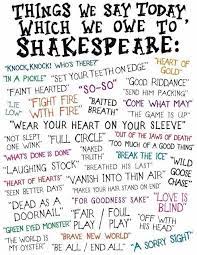
For Shakespeare “all the world was a stage” and he also coined a number of colloquial phrases that added drama to the dialogues of his many characters, from Romeo and Juliet to Othello, from the Merchant of Venice to Hamlet and Macbeth. These “as good luck would have it” continue to enrich our speech even today.

All that glisters is not gold

A sorry sight

Bated breath

Break the ice

Cold comfort

Come what may

Dead as a doornail

Devil incarnate

Eaten me out of house and home

Fair play

Green-eyed monster

Laughing stock

Naked truth

In a pickle

Seen better days

Set your teeth on edge

The world is my oyster

Too much of a good thing

Vanish into thin air

Wild-goose chase

What’s done is done

And, it is not Sherlock Holmes but Shakespeare who first said “the game is afoot!”

Shakespeare may be “as dead as a doornail” but he remains the most quoted writer in English of all time. How zany is that!

Well, words maketh a book, and Shakespeare maketh words!

–Mamata

A Mark of Citizenship

When we were children, and very much into Enid Blyton’s mystery and adventure stories, a fascinating element in some of these was the notes/letters that appeared to be blank, but which revealed secret messages when warmed. The excitement was heightened when we ourselves tried to make ‘invisible ink’. This usually involved some lemon juice with which we wrote on paper. Once the juice dried, the paper appeared to be blank, until a hot iron was run over the paper, or it was placed close to the flame of a candle, upon which the words would slowly show up. Many a summer afternoon was spent in this ‘mystery’ activity, with much excitement and anticipation on the part of message writer and receiver!

These memories came back recently when another kind of ink is soon to be in the news, except that this ink is far from invisible, it is indelible! The purple mark on the forefinger is inextricable linked with election season. As soon as the voting process begins, this mark becomes the symbol of a citizen who has exercised their right, as well as duty, to participate in the process to vote-in a democratically-elected government. In a country like India in which millions across the country take part in the electoral process, this mark is a great common indicator of participation, as well identification. An inked finger identifies a voter not just when they emerge from the polling booth, but until the ink on the finger ‘wears’ off, a period that may last from a few days to a couple of weeks. The key word is ‘wears’ off rather than washes off. And that is where the search for, and use of, indelible ink in elections began.

In the early 1950s, in newly independent India, there was concern that fraudulent voting could upset a free and fair electoral process. There needed to be a common, easily applicable and low-cost way to ensure that the ‘one voter one vote’ principle was adhered to in letter and spirit.

Research on this started in the National Physical Laboratory of the Council for Scientific and Industrial Research (CSIR-NPL). The research and experiments led to the formulation of the chemical formula for indelible ink which could be used on the finger of a voter who has just cast their vote. This ink was unlike other inks that were commonly used to fill the fountain pens that were the main writing instruments of the day.  A key component in this special-formulated ink was silver nitrate which is photosensitive, it reacts when exposed to light (sunlight or even indoor light). The water-base ink also contained a solvent like alcohol which allowed for faster drying, as well as some other dyes. The composition was optimized such that it diffused into the skin spontaneously to make a mark which could not be chemically or mechanically manipulated. The precise proportions, formula and protocol for making this ink were a closely guarded secret, and was patented by the National Research Development Corporation (NRDC), New Delhi. But for the ink to be produced in vast quantities, it needed a professional ink-making company.

The NRDC approached Mysore Paints and Varnish Ltd. (MPVL) to manufacture and supply the ink. An agreement to this effect was signed by the Election Commission of India in collaboration with the National Physical Laboratory and NDRC with MVPL. The factory was established during 1937 by Maharaja Krishnaraja Wodeyar IV, then the Maharaja of Mysore province. It was originally called Mysore Lac and Paint Works Ltd.It was renamed as Mysore Paints and Varnish Ltd. (MPVL) in1989.

The original rationale behind the establishment of the factory was to provide employment opportunities for the local people, and for effective utilization of the natural resources of the forest, specifically lac, which was used for the manufacture of sealing waxes. Apart from lac, the factory manufactured paints which were supplied to Government departments, especially to the Defence Department, particularly for war tanks, during the early days.

The factory was converted into Public Limited Company during 1947 as one of the Public Sector Undertakings (PSU). The company continues to be among the prominent undertakings of the Government of Karnataka, meeting the requirements of PSUs, Central Government, State Government, PSUs, private industries and the paint dealers. Although the Company also manufactures and supplies industrial coating paints, decorative paints, wood polishes, varnish and thinners, the largest chunk of its output is the manufacture and supply of indelible ink for elections.

The indelible ink was used for the first time in Indian elections in 1962 and has MPVL has remained the sole supplier since then. MPVL initially supplied ink only for parliamentary and assembly elections, but over the years it has also been supplying ink for elections to municipal bodies and cooperative societies. The concentration of silver nitrate in the ink varies depending on its usage. For example, in 2017, MPVL was commissioned to manufacture special marker pens to mark children during the polio drops drive in South India. The silver nitrate ink used in these pens was less concentrated, keeping in mind that children are prone to put their finger in the mouth.

According to MPVL, the high-quality indelible ink dries out completely in less than 40 seconds, but it leaves its impression even after a one-second contact with skin. The ink darkens with exposure to light and can remain on the voter’s fingernail and skin for at least two days, and up to 3-4 weeks, depending on a person’s body temperature and the environment. It cannot be simply washed away mechanically, or removed by any known chemical or solvent.

As the ink is photo-sensitive, it needs to be protected from exposure to direct sun rays. Earlier it used to be stored in brown-coloured glass bottles; now amber-coloured plastic bottles are used. The bottles used are designed in such a manner so as to prevent any kind of reaction with sunlight until they are opened. The ink is distributed in 5 ml, 7.5 ml, 20 ml, 50 ml and 80 ml vials. A single 5 ml vial is sufficient for an approximated 300 voters. The Election Commission of India places orders for the ink based on the number of registered voters involved in the election. The ink is then supplied to the Chief Electoral Officers who subsequently distribute it to individual voting centres.

The MPVL is the sole supplier of voter’s ink in India since 1962. The PSU also exports the ink to at least 25 other countries including Canada, Ghana, Nigeria, Mongolia, Malaysia, Nepal, South Africa and the Maldives. This ink is made as per the respective country’s specific use of the ink.  For example, in Cambodia and the Maldives, voters need to dip their finger into the ink, while in Burkina Faso the ink is applied with a brush, and nozzles are used in Turkey.

So this election season, as we walk into a polling booth and walk out with the small purple line on our finger, we know what has gone into making this distinguishing mark!

–Mamata

Happy Hampi

Hampi. On the list of history-buffs. On the list of backpackers. On the list of pilgrims. On the list of UNESCO World Heritage Sites.  It is indeed a ‘listed site’!

This is what UNESCO has to say about it:

‘The austere and grandiose site of Hampi comprise mainly the remnants of the Capital City of Vijayanagara Empire (14th-16th Cent CE), the last great Hindu Kingdom. The property encompasses an area of 4187.24 hectares, located in the Tungabhadra basin in Central Karnataka, Bellary District.

Hampi’s spectacular setting is dominated by river Tungabhadra, craggy hill ranges and open plains, with widespread physical remains. The sophistication of the varied urban, royal and sacred systems is evident from the more than 1600 surviving remains that include forts, riverside features, royal and sacred complexes, temples, shrines, pillared halls, Mandapas, memorial structures, gateways, defence check posts, stables, water structures, etc.’

Hampi
Lakshmi Narasimha Statue, Hampi

On a recent visit to Hampi (I know, I know. Who goes there in April???) we were of course awed by the architecture and the sculptures there. At a landscape level (over 4000 hectares as UNESCO says) like Angkor Wat, one can believe that this was the capital-complex of one of the most powerful and rich kingdoms India has ever seen.

So much has been written about this by experts, I don’t think there is much I can add. Of course, we were there only for two brief days, and in fact sight-seeing was not even top of the agenda. But personal impressions are unique, and I shall share them.

  1. There is no charge to visit any of the sites except a nominal charge to go into the Vithala temple. Pre-Covid, the number of visitors to Hampi was about 7 lakh annually, and is likely to be much higher today. Many of these people go for worship to the temples. But for those purely on the tourist trail, surely it makes sense to charge something? Maybe Rs.100/monument or Rs. 500 for a day pass or something? Surely the case cannot be that our archaeological sites don’t need money for conservation and upkeep? Or that tourists who travel all the way to Hampi and spend on hotels will grudge the small amount for actually seeing what they have come to see? But it felt that the locals see this as a sign of hospitality, with two guides telling us ‘No charge to see anything here. Happy Hampi!’ That is rather nice!
  2. Another thing was that the guides were not overwhelming or too persistent. Just appropriately persistent! In fact, we did not encounter too many of them, maybe because it was off-season.  As well-informed and articulate as any to be met anywhere in India—which means they all told more or less the same stories and the same jokes, but pleasantly.
  3. There were not enough toilets, and those there were, were not inviting! They were not dirty per se, but definitely yellowing, stained and wet, exhibiting a lack of an active effort to keep them up. This also probably circles back to the point on charging for entrance. If there were more money to spend on toilets, would there be more of them and would they be better kept? (Of course, in the convoluted system of incomes and allocations to such sites, there is little correlation between the two!). The strangest thing was that while the sites open 8.30 a.m., we found the toilets locked on arrival, and informed that they would open at 9.30 a.m. only!
  4. And Hampi and other sites do have some structures in the name of toilets, we simply do not provide for drinking water. While most of us carry water these days, what about the unfortunates who forget? In a place like Hampi, it is quite possible for someone to come down with a heatstroke, and having access to clean, potable water is an essential that must be provided, not a luxury.

Hampi

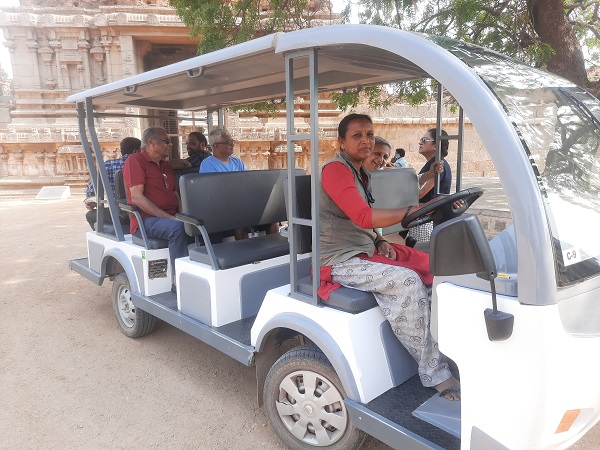
5.A very welcome move by the State Tourism is the introduction of e-vehicles to take the tourists to the various sites. Cars have to be parked at a certain point, and only these electrical vehicles run by the government are allowed beyond that. They charge a nominal amount. And it gets better! All these vehicles are driven by women. Our feisty driver went through a training of 15 days after selection, and confidently drove us around!

Hampi is divided into three core zones–the Sacred Centre, the Royal Centre and the Islamic Quarters. We got to see some parts of the Sacred Centre, so a lot is waiting.

Hampi is happy indeed, but with a little care, could be so much more so.

Here is to Happier Hampi!

–Meena

Feisty Fighter: Jayaben Desai

In the last few months there has been a lot of news about Junior and Senior doctors in the UK going on strike to draw attention to their demands. There are often pictures of the picketing medicos. These include a large number of Asian and other ‘non-white’ faces. Today the non-English population makes up a large portion of the work force in the UK. While there is a continuing stream of migrants making their way to the UK for higher education, and often continuing to work after their studies, there is an equal number of second generation immigrants who have made UK their home over the last century. These are the descendants of the first immigrants who laid the path for the future of this generation.

There are numerous stories of these early immigrants who arrived in a totally alien, and often hostile, environment but who by dint of hard work, struggle, and ambition fought all the odds. One such feisty lady is still remembered for breaking many barriers.

Jayaben Desai began her life in Gujarat in India, where she was born on 2 April 1933. She moved to Tanganyika after her marriage to Suryakant Desai a tyre-factory manager. There she led a comfortable life as part of the large community of British subjects of Indian origin who had long settled in East Africa. In the 1960s the situation changed with many of the newly-independent countries in East Africa moving towards “Africanisation’ policies which led to declining economic opportunities and security for the East African Asians. Many of these chose to move. As British passport holders they headed for Britain. Jayaben and her husband joined this exodus.

Life in Britain was very different. The new migrants did not enjoy the economic and social status that they had done in East Africa. Despite being British citizens they had to struggle at every step to establish new lives and livelihoods in an unwelcoming environment. Most of them were educated and professionally qualified, but in England they were compelled to take whatever work they could get; most of which was unskilled labour with poor wages. They faced a great deal of discrimination, racism and prejudice in every aspect of life.

As one of these women recalled: “There was no question of whether you wanted to or not – you had to work, so you did. And wherever you found work, you had to take it. It wasn’t that you were educated, so you only wanted certain kind of jobs – we had to work in factories and that’s how we brought up our children. …We used to have people working for us, and now we had to work for others. That’s life. …Of course I felt sad.”

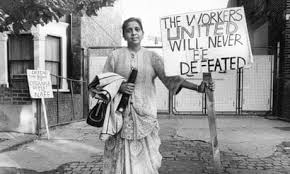
Jayaben started part-time work as a sewing machinist in a sweatshop, while bringing up her two young children. She then moved to work at the Grunwick film processing factory in North-West London. Grunwick employed a large number of Asian women who were perceived as being hard working and submissive. The factory paid low wages, and was run in an atmosphere of fear and control, with workers being humiliated in many ways.

The simmering unrest began to surface when the managers sacked a young Indian worker, and three colleagues walked out in solidarity with him.  Soon after, on Friday 20 August 1976, Jayaben Desai was confronted with a short-notice demand for overtime.  She refused. The manager derogatively called her and her fellow workers “chattering monkeys”. She responded by telling the manager: “What you are running here is not a factory, it is a zoo.  There are many types of animals in a zoo.  Some are monkeys who dance to your tune, others are lions who can bite your head off.  We are those lions, Mr Manager.” 

Jayaben and almost 100 other workers spontaneously walked out in protest. Thus far, previous strikes by black and Asian workers had not received the support of  trade unions. But the Grunwick strikers were supported by the Brent Trades Council; they were encouraged to form a union and received strike pay. Thus the strike was significant because it got trade union recognition, and also demonstrated the greatest solidarity So between the white and coloured working class.  As Jayaben stressed during the strike, ‘We will not back down now.  We want to bring this factory to a standstill.  Our fight is for all our rights, and for our dignity.  We hope all trade unionists will stand by us.’  

Jayaben, and the striking workers travelled across England and addressed workers in other factories and workplaces about their fight, and this managed to persuade trade unionists from far and wide to come to their aid. By June 1977, as support for the strikers grew, the size of the mass pickets increased from a few hundred to several thousands. The strike began in 1976 and continued for two long years until 1978. This was possible, as the strikers received strike pay from the trade unions, which was comparable to the low pay they received at Grunwick. It was highly unusual for that time for unions to support ethnic minority groups and migrant workers. But the response rattled the Labour government who put pressure on the Trade Unions leadership to withdraw support. This did not deter the strikers led by Jayaben who started a hunger strike in November 1977.  But even this action could not change the unions’ mind, and so they had to call off the strike. The strike came to an end without the workers getting their jobs back. However, one of its outcomes was the introduction of some concessions relating to existing and future workers’ pay and pensions.

As she later recalled: “Because of us, the people who stayed in Grunwick got a much better deal. When the factory moved, the van used to come to their home and pick them up because it was difficult for them to get to the new place. Can you imagine that? And they get a pension today! And we get nothing. That was because of us, because of our struggle.”

Despite its eventual failure, the Grunwick strike became a symbol for its demonstration of determination and solidarity. As Jayaben said: “The strike is not so much about pay, it is a strike about human dignity.” It is remembered for the way in which thousands of workers, black and white, men and women, united to defend the rights of migrant women workers. The feisty Jayaben who had catalysed the movement also changed the stereotype of South Asian women as being passive and submissive.

In recognition of her contribution to the struggle for workers’ rights, Jayaben Desai was awarded with a gold medal by the GMB trade union in 2007. She retained her indomitable spirit until she passed away at the age of 77, in December 2010.

–Mamata

The Colours of Life

We just marked the day of colours. Yes, Holi of course.  

But another one too–the International Colour Day which just went by on March 21. This Day celebrates all aspects of colour and the impact they have on our lives, and how they make the world a better place.

Now who would declare a day for colours? Well, an organization called the International Colour Association (ICA). This is an old and respected institution, which counts the National Colour Associations of over 30 countries among its members. It aims to ‘encourage research in all aspects of colour, to disseminate the knowledge gained from this research, and to promote its application to the solution of problems in the fields of science, art, design and industry on an international basis.’

The idea of an international colour day was proposed in 2008, and adopted in 2009. The particular date—21 March—was chosen because it is the summer equinox—the day when the sun shines directly on the equator, and the day and night are of equal length.

International Colour Day
International Colour Day Logo

If there is a day, can a logo be far behind? Well, not too far! The International Colour Day logo was adopted in 2012. The creator was Hosanna Yau of Hong Kong, who explained the logo thus: ‘two circles form an eye, with an equal half of rainbow color and black representing light a nd darkness, day and night, everyone feast one’s eye on the international color day.

The study of colour is known as chromatics, and is basically about light and its interactions with matter. Colorimetry, which sounds so much more likely a candidate for this, is actually about a related field—‘ the measurement of the wavelength and the intensity of electromagnetic radiation in the visible region of the spectrum. It is used extensively for identification and determination of concentrations of substances that absorb light.’

Colours because of their ubiquity and the emotional and psychological impacts they have, often become a shorthand for other things.

Coming to one of the colour-related matters which has recently been much in the news in India is the Pink Tax. A viral video put out by Sanjay Arora, an advertising veteran, and commented on by several well-known people including Dr. Kiran Mazumdar-Shaw has kept this in the headlines. I have to admit, I had never heard of this, so thanks Mr. Arora!

What is Pink Tax? As the World Economic Forum explains it: ‘Men and women often buy similar day-to-day products. But research shows that consumer products targeted and advertised to women are sometimes more expensive than comparable products marketed to men. This disparity is referred to as a so-called pink tax.’  The video gives several everyday examples, from deos to haircuts, where the  women’s version is more expensive. A research study in the US looked at 800 gender-specific products from nearly 100 brands and found enormous price disparities across product categories.   For instance, personal care products targeted to women were 13% more expensive than similar men’s products. Dry cleaning costs for women’s dress shirts was  almost double that for dry cleaning of men’s shirts!

You will find plenty of examples close to home. Next time you are browsing or shopping, just do a quick comparison Such differential pricing imposes an extra burden on women, who anyway earn less and have less economic power.

My Colour Day resolution is to boycott products which have stark disparities. I will be happy to buy a men’s deo—I don’t there is any difference anyway.

–Meena

Belated Happy Holi!

Namer of Clouds: Luke Howard

Cloud water colour by Luke Howard https://blog.sciencemuseum.org.uk/

23 March is World Meteorology Day. A day when there will be many scientific discourses on the science of the atmosphere and the weather. While not many adults may look up at the sky and marvel at the beauty of clouds as they drift up high, children will look up and imagine, in the continuously changing cloud shapes, everything from elephants to cotton candy! Perhaps few will make any links between the poems and paintings of this beauty with any form of scientific study.

While clouds are almost as old as the earth when it was formed, the science of clouds is much younger. Before the 19th century, the general understanding was that each cloud was unique, unclassifiable and in a state of temporary existence. Instead of strict descriptions clouds, were recorded by colour or individual interpretation. The scientific study of clouds may have said to have begun at the dawn of the nineteenth century, when a young man did more than admire the shapes of clouds, and set out to observe, study and devise a classification system for clouds. This was Luke Howard a London pharmacist and amateur, but ardent, sky gazer.

Luke Howard was born in London on 28 November 1772, the first child of a successful businessman. When he completed school Luke was apprenticed to a retail chemist, and went on to develop his own business, setting up a firm that manufactured pharmaceutical chemicals. While he ran his business, Luke also indulged his childhood fascination for nature, and especially the numerous facets of weather. He built a laboratory at home to observe, collect weather-related data and analyse this; he also maintained meticulous records of his observations.

In 1802 the modest young Luke made a presentation to a small gathering of young science-minded intellectuals in London who called themselves The Askesian Society. The lecture was titled On the Modification of Clouds (Modification referring to classification). In the talk, Howard proposed a common system for naming the recognisable forms of clouds.  In order to enable the meteorologist to apply the key of analysis to the experience of others, as well as to record his own with brevity and precision, it may perhaps be allowable to introduce a methodical nomenclature, applicable to the various forms of suspended water, or, in other words, to the modification of cloud.

Howard proposed a common vocabulary to describe different forms of clouds. The proposed system used Latin names like those that were being used for plants and animals in the Linnaean system. Combining detailed observations with imagination Howard introduced three basic cloud types:

Cirrus (Latin for ‘a curl of hair’) which he described as “parallel, flexuous or diverging fabrics, extensible in any or all directions”.

Cumulus (meaning ‘heap’), which he described as “convex conical heaps, increasing upward from a horizontal base”.

Stratus (meaning ‘something spread’), which he described as “a widely extended, continuous, horizontal sheet, increasing from below”.

He combined these names to form four more cloud types:
Cirro-cumulus
, which he described as “small, well-defined roundish masses, in close horizontal arrangement”; Cirro-stratus, which he described as “horizontal or slightly inclined masses, attenuated towards a part or the whole of their circumference, bent downward, or undulated, separate, or in groups consisting of small clouds having these characters”; Cumulostratus, which he described as “the cirrostratus blended with the cumulus, and either appearing intermixed with the heaps of the latter, or super-adding a widespread structure to its base” and Cumulo-cirro-stratus or Nimbus, which he called the rain cloud, “a cloud or system of clouds from which rain is falling”. He described it as “a horizontal sheet, above which the cirrus spreads, while the cumulus enters it laterally and from beneath”. 

This was a historic lecture for many reasons. His classification brought a sense of order and understanding to a subject that had lacked coordinated thought. There were at the time no documented theories as to how pressure, temperature, rainfall and clouds might be related. Howard’s observations and classification marked the beginning of meteorology, a previously unrecognized area of natural science. The three families he proposed—Stratus, Cumulus and Cirrus , are today included as examples of the ten main cloud types – known as the cloud genera, which are defined in terms of their shapes, their altitudes and whether they are precipitation bearing. Howard’s simple, science-based system of classification was accepted by the international scientific community, and the terms that he coined are still used by the meteorological community across the world.

Howard was not just an observer and recorder, he was also skilled at painting skyscapes with clouds. He was however not adept at painting landscapes and people and a painter friend used to fill in these to complete the picture. He used these paintings to illustrate his talks and publications about cloud classification. Howard’s 32 page cloud book The Modifications of Clouds, published in 1803, is illustrated with his water colours.

Even as Luke Howard was studying clouds, for three decades he also kept daily recordings of temperature, rainfall, and atmospheric pressure in and around London. His comparison of the data allowed him to detect, describe, and analyse the fact that average temperatures are higher in cities than in the countryside. As he described it, the temperature of the city is not to be considered as that of the climate; it partakes too much of an artificial warmth, induced by its structure, by a crowded population, and the consumption of great quantities of fuel in fires. Through his observations Howard was the first to recognise the effect that urban areas have on local climate, many decades before the phenomenon of Urban Heat Islands became the hot topic that it is today.

He published his findings for his “fellow citizens” as volumes titled The Climate of London deduced from Meteorological Observations at different places in the Neighbourhood of the Metropolis in 1818 and 1820, followed by an extensive second edition in 1833. Howard thus became one of the pioneers of urban climate studies.

Luke Howard was elected a Fellow of the Royal Society on 8 March 1821 and joined the British (now Royal) Meteorological Society on 7 May 1850, only a month after the society was founded. He died in London on 21 March 1864.

As we look up at the clouds in the sky, let us remember the one who gave them names.

–Mamata

Easy as Pi!

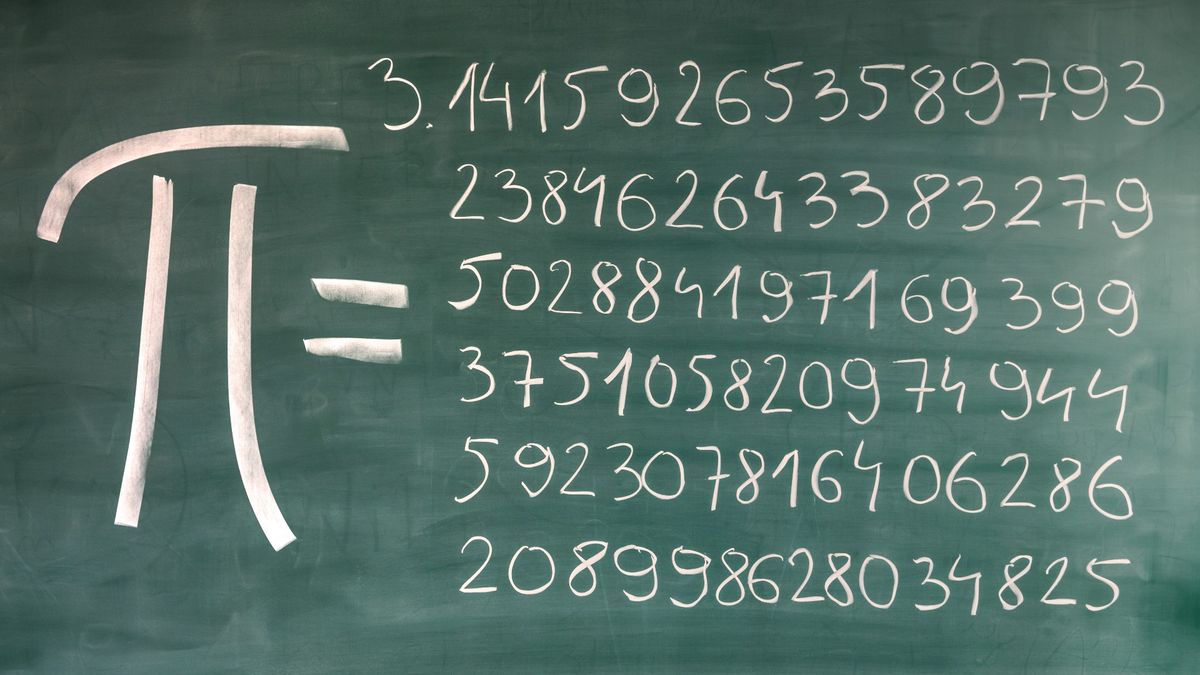
Well, most people do not think of ‘pi’ as easy. This constant is the bugbear of many a student. The general reaction is ‘The ratio of the circumference of a circle to its diameter is a constant. Something like 3.14…. So what’s the big deal?’

Well, Pi plays a crucial role in many, many calculations within and beyond mathematics and science. It is one of the most widely known mathematical constants and is applied in various calculations, from basic geometry, trigonometry, calculus to complex physics equations and in engineering applications. It is central to calculations related to motion, gravity, and electromagnetic radiation. In engineering, Pi is used in design and construction of circular structures such as bridges, tunnels, and pipes. And in astronomy, it is employed in calculations involving the orbits of celestial bodies and the study of planetary motion. Pi is also important in computer science, where it is used in algorithms for numerical analysis, machine learning, and cryptography. 

Pi

Humanity has been fascinated with Pi for over 4000 years.  The earliest recorded calculations of Pi date back to the Babylonian, Egyptian and Hebrew civilizations—it even appears in a verse in the Hebrew Bible(written around the 4th century BC). The Indian mathematician Aryabhata (476-550 CE), in his work Ganitapada approximated value of Pi as 62,832/20,000 = 3.1416 (more accurate than Archimedes’ ’inaccurate’ 22/7 which was frequently used), but he apparently never used it for anything, nor did anyone else at the time. Famous mathematicians like Fibonacci, Newton, Leibniz, and Gauss dedicated a lot of time to studying the value of Pi, calculating its digits, and applying it in numerous calculations.

These centuries of fascination culminated in someone deciding to do something about it—declaring a DAY for it! On 14 March 1988, the first official large-scale celebrations of Pi Day were organized at the San Francisco Exploratorium by Larry Shaw, a physicist. The events to mark the day included several participants marching around a circle and consuming fruit pies. Since then, it has gained popularity and the U.S. House of Representatives passed a notification in March 2009, recognising 14 March as Pi Day.

Why 14 March? Well, that date is also written as 3.14! And, by coincidence, is also the birthday of Albert Einstein! Pi Day celebrations across the world include calculating more and more digits, and memorizing their value!

Pi has been calculated to over 60 trillion digits beyond its decimal point. As an irrational and transcendental number, it will continue infinitely without repetition or pattern.

Pi has also inspired literary genres! Pilish is a genre which is written in such a way that each digit of pi denotes the number of letters in each word. So, the first word has 3 letters, the second 1, the third 4, and so on. The only novel in Pilish is by the American Mike Keith, with the title: Not A Wake: A Dream Embodying π’s Digits Fully For 10000 Decimals

Mike has also invented the “piku”, which is a Pilish poem based on haiku. And here is something he wrote for Pi Day some years back:

It’s a moon,

A wheel revolving on golden earth, and lotus blossoms.

Mountains embrace windmills, and it all reflects this number, pi.

On the other hand, to celebrate the day, NASA’s Jet Propulsion Laboratory has come up with a series of science and engineering questions that are related to some of the agency’s Earth and space missions.

Well, to each their own favourite Pi or Pie!

Happy Pi Day!

–Meena

New Superfood: Popcorn

What is a whole grain high in dietary fibre, contains protein, vitamins and minerals, is low in fat and sugar, contains no cholesterol, is gluten-free, and helps boost heart health? Among the ever increasing list of ‘super foods’ is, what sounds an unlikely candidate. It is popcorn!

The snack that is commonly associated with brimming buckets in movie theatres and the overflowing bowls within easy reach of couch potatoes has been generally labelled as ‘junk food’. The fluffy crunchy nibbles have more to their history than their addictive aroma and innumerable flavours.

While the most common association of popcorn is with all things quintessentially American, the roots (literally) of its mother grain do not lie there. When we use the word ‘popcorn’ it usually refers to puffed kernels of corn. The word, in fact, refers to a whole grain, which belongs to a group of seeds that come from crops that include barley, millet, oats, rice, and wheat. Popcorn is a strain of maize characterized by especially starchy kernels with hard kernel walls, which help internal pressure build when placed over heat.

This was one of the first variations of maize cultivated from teosinte, a wild grass, in Central America about 8,000 years ago. The popcorn variety of maize was domesticated by Pre-Columbian indigenous peoples by 5000 B.C.E. It is believed that the first use of wild and early cultivated corn was popping. Early Spanish invaders to the Central and South America recorded their discovery of this multi-use maize. Ceremonies of the Aztec Indians involved the use of popcorn, not only as food but also as adornments, in ceremonial head dresses and, necklaces, and as offerings to their gods.

There is also evidence to indicate that the Native Americans also knew of, and consumed this form of popcorn maize. In the early 1600s European explorers who began travelling to the New World recorded that the Iroquois Native Indians in the Great Lakes region popped corn with heated sand in a pottery vessel and used it to make popcorn soup, among other things.

The folklore of some Native American tribes told of spirits who lived inside each kernel of popcorn. The spirits were quiet and content to live on their own, but grew angry if their houses were heated. The hotter their homes became, the angrier they would become, shaking the kernels until the heat was too much. Finally, they would burst out of their homes and into the air as a disgruntled puff of steam.

What is the science behind the pop? A kernel of popcorn contains a small amount of water stored inside a circle of soft starch. The soft starch is surrounded by the kernel’s hard outer surface. As the kernel heats up, the water expands, building pressure against the hard starch surface. Eventually, this outer layer gives way, causing the popcorn to explode. As it explodes, the soft starch inside the popcorn becomes inflated and bursts, turning the kernel inside out. The steam inside the kernel is released, and the popcorn is popped, hot and ready to eat.

The discovery of the exploding kernel may have reached the early colonial settlers to the new World, who were probably the earliest European-American popcorn makers. They tried several methods of popping corn—throwing kernels into hot ashes, cooking popcorn in kettles filled with hot lard or butter, or cooking over an open fire in a wire box with a long handle. By the mid-1800s popcorn became a favourite snack. But it remained largely a home-grown crop used for family consumption. 

In the 1820s it began to be commercially sold throughout the Eastern United States under the name Pearl or Nonpareil. By the 1840s the popularity had spread across the continent. By 1848 the word ‘popcorn’ was included in John Russell Bartlett’s Dictionary of Americanisms. It would be another few decades before the large-scale production of popcorn became possible. This happened when a Chicago entrepreneur named Charles Cretors built the first commercial popcorn-popping machine. Starting with a peanut roasting machine, Cretors went on to develop a machine powered by steam that ensured even heating, and popping, of popcorn kernels. One of the first such machines for popping corn appeared in 1885. Since the machine was mobile, and could mass-produce popcorn without a kitchen, the invention also increased the amount of people who had access to popcorn and thus, the popularity of the snack in America.

Popcorn really caught on during the 1890s. Street vendors, pushing steam or gas-powered poppers, became a common sight at circuses, fairs, and parks. By 1900, the enterprising Cretors introduced a horse-drawn popcorn wagon, and initiated a massive popcorn wave.  In fact, there was really only one entertainment site where the snack was absent: the theaters. Theatre owners felt that the buttery snack would stain their carpets, and the crunching would be a noisy distraction; this was still the age of silent films. Talking movies made their debut in 1927, greatly increasing movie-going audiences, and also customers for in-house snacks. As theatres were still hesitant to install popcorn machines, business for street vendors boomed. They brought their popcorn machines and sold just outside the theatre. Some theatres banned popcorn inside, which increased its attraction! 

The theatres had practical reasons for the not installing popcorn machines. They lacked proper ventilation, which would lead to a build-up of smoky popcorn odours. However, with increasing demand for popcorn they initially leased ‘lobby privileges’ to vendors who could sell there for a daily fee, and whose business continued to boom. Until the theatre owners finally realized the kind of profits that they were missing by not having their own popcorn machines, and went on to make and sell popcorn in the lobby. This proved to be timely; as America plunged into the Great Depression in the early 1930s, movies and a bag of popcorn was all that most families could afford for entertainment. Thus when many businesses collapsed the movie-popcorn combination thrived. And as they say, that was the turning point. Ever since, and up till this day, movie theatre lobbies are inextricably linked with the smell of hot popcorn, in many parts of the world!  

The advent of television in the 1950s made a big dent in movie-going and popcorn consumption. That is until people started making popcorn at home, leading once again to a surge in consumption. The introduction of the microwave, and micro-waveable popcorn was as significant a milestone in its history as was Charles Cretors’ first commercial popcorn-popping machine.  

America continues to be the largest consumer of popcorn in the world. So deeply is this snack entrenched in their lives that Americans have declared a National Popcorn Day to be celebrated on January 19 every year, and a National Popcorn Lovers Day on 14 March. Today popcorn is a favourite snack across the world. From the utterly butterly delicious plain popcorn, to a variety of flavoured ones, everyone has their favourite. Surely a good reason for all popcorn lovers to celebrate!

As a huge popcorn fan myself, cheers to happy Popcorn Lovers Day!

–Mamata

A DAY TO REFLECT

It is March 8, and the newspaper pages are dominated by a plethora of “offers” especially for women. There is much on offer–from designer clothes to jewelry, from cosmetics and ‘make-overs’, to a day of indulgence at a spa or fancy restaurant, and even special health check-ups, all cleverly designed to “celebrate the woman in you!” This day follows on the heels of Valentines/Galentines Day which was all about ‘sugar and spice and all that’s nice’ to make every woman feel special. Tucked away between the gloss and glamour, are stories of ‘women of substance’ and women achievers who overcame many odds to get where they are today. These women certainly inspire a few, but they are quite out-shadowed by the ‘influencers’ with their countless followers.

In all the razzmatazz, not much is remembered about the origins and intent of the day that is today marked as International Women’s Day. The day, ironically had socialist origins and then became a marker of the movement for women’s rights to equality and dignity.

In its official history, the spark was ignited by a march in New York City on February 28 1908 by thousands of women garment workers who were striking to protest poor working conditions and wages. The march was spearheaded by the Socialist Party. However the history of the struggle for women’s rights can be traced further back to 1848 when two American women ‘activists’ Elizabeth Cady Stanton and Lucretia Mott who were attending the World’s Anti-Slavery Convention in London, were outraged at the denial of official recognition to several women delegates because of their sex. On return to America they organized the nation’s first women’s rights convention in New York. The resulting Declaration of Sentiments and Resolutions which detailed the inferior status of women, demanded civil, social, political and religious rights for women. This triggered the American women’s rights movement.

The concept of a day to register women’s voices crossed the Atlantic and reached Europe around 1911. Clara Zetkin, a German communist and advocate for women’s rights, including the right to vote, proposed that the day become an international event at an International Conference of Working Women in Copenhagen in 1910. She believed that if women across the world were synchronised in pressing for their demands, then their collective voice would be too hard to ignore. Her proposal was unanimously backed by the 100 women from 17 countries who were at the conference. The first International Women’s Day was celebrated in 1911, in Austria, Denmark, Germany and Switzerland with rallies campaigning for women’s rights to work, vote, be trained, to hold public office and end discrimination. At the time, celebration was not tied to a particular date.

It was in 1917, that on the last Sunday of February, Russian women, led by Alexandra Kollontai, began a strike for “Bread and Peace” in response to the death of over 2 million Russian soldiers in World War 1. Opposed by political leaders, the women continued to strike until four days later the Tsar was forced to abdicate. As a direct consequence of the marches and demands for universal suffrage in which thousands took part, the provisional Government granted women the right to vote in 1917. Thus Russian women got the right to vote a year before Britain and three years before the United States. Interestingly it was New Zealand that was the first country to grant women the right to vote in 1893.

The date the women’s strike in Russian commenced was Sunday February 23 as per the Julian calendar then in use in Russia. This day matched March 8 on the Gregorian calendar in use elsewhere. And thus the date became associated as a milestone marker in the movement for women’s rights.

In the years that followed, different countries embarked on different paths towards granting women their rightful rights, starting from the right to vote, and embracing equality of access to other opportunities and avenues for growth and development. Ironically, this day is not highlighted in the United States, because of its associations with its Socialist roots and later with communist Russia. However the United States marks the entire month of March as Women’s History Day.

It is only in 1975 that the United Nations marked International Women’s Day for the first time. In December 1977, the General Assembly adopted a resolution proclaiming a United Nations Day for Women’s Rights and International Peace to be observed on any day of the year by Member States, in accordance with their historical and national traditions.

Today, more than a century after the day was marked, there have been many more milestones in the journey of women for their rightful status in all spheres of life—personal, professional, social and political. Every generation has had its challenges and these have thrown up the challengers who have often made it their life mission to carry forward the torch. We have often written about these feisty women in this space.

At the same time, even as women are breaking new glass ceilings, it is still a far cry from becoming ‘a woman’s world’. Women and children are bearing the brunt of war in many parts of the world; women are the most directly affected by the ravages that climate change is wreaking across the globe; women in many countries are at the receiving end of extremist religious beliefs, and women are still fighting for the right to make their own decisions about their own bodies, and minds. There are many new avenues and media to reach out, raise voices, and come together. The same media have the potential to become toxic, to denigrate, to divide and even to destroy. 

Perhaps today is a good day to reflect on this, even as we reminiscence about the women who have made our road to this point less rocky, who have led the first ascents to the seemingly inaccessible peaks, women who have led quiet revolutions at home, in the work place and in society. Let these true women of substance be our role models and inspirations, not just today but every day.

For the Matriarchs, this day marks the starting point of our own journey of sharing thoughts, angst, wild ideas, and laughter. It has been five years of a beautiful celebration with friends, known and unknown. We are truly grateful, and celebrate all our fellow travellers.

–Mamata and Meena

In the century since it was first established, International Women’s Day has come to be marked just as frequently with celebration as it is with protest, but the day’s legacy remains steeped in the struggle for women’s rights — an element that has gained renewed relevance in recent months, particularly as the #MeToo movement has taken on global dimensions.

Image: UN.org