Finger Wrestling: The Sport Where One Finger Can Make You a Champion

We use our fingers for all sorts of important things these days: typing, texting, scrolling, swiping and, occasionally, pointing out to someone that they have been on their phone too long.

But in Bavaria, one group of people puts a rather different value on their fingers. They wrestle with them.

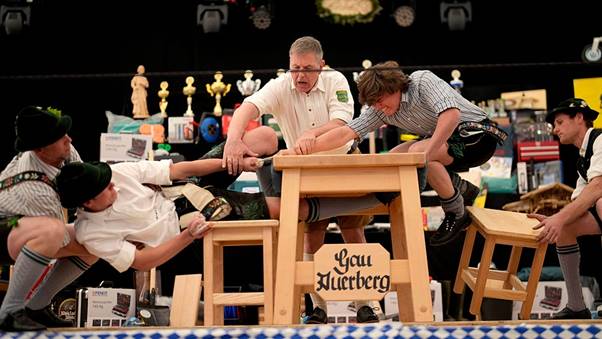
Welcome to Fingerhakeln, or finger wrestling—a wonderfully peculiar traditional sport in which two people sit across a table, hook their middle fingers into a leather loop and try to pull each other towards themselves.

And before you dismiss this as something that happens after too many beers at a German village festival, consider this: it has rules, clubs, training, weight and age categories, referees and national championships.

The rules are almost comically simple. Two competitors sit opposite each other at a specially designed table. Their middle fingers are hooked into a short leather strap. At the signal, they pull. The objective is to drag the opponent’s finger across a marked line.

Except that pulling another person’s finger with maximum force is apparently considerably harder—and more painful—than it sounds.

A bout may be over in just a few seconds, although the toughest can last nearly a minute. That may not sound like long enough to constitute a sporting ordeal, until you remember that the entire time is spent exerting enormous force through one finger. Competitors train specifically for the sport, strengthening their hands and fingers and learning how to use leverage, body position and technique.

So if you are now looking at your own hands and thinking, Surely I could do that, please resist the temptation to challenge your spouse, colleague or unsuspecting dinner companion. This is not an after-dinner game. There are good reasons not to underestimate the sport. The finger is subjected to considerable force during a contest, and injuries can occur. Competitors warm up, condition their hands and fingers and develop techniques for pulling and bracing.
               PIC: https://www.euronews.com/

From Alpine tradition to national championship

Fingerhakeln is particularly associated with Bavaria and the Alpine regions of Germany and Austria. Its precise origins are difficult to establish, but the tradition goes back generations. Like many folk sports, it appears to have started as a simple test of strength. Who was stronger? There was no need for a boxing ring or wrestling arena. Just sit down, hook fingers and find out.

Over time, the pastime became organised competition. Today, finger wrestlers compete in different age and weight categories, with regional championships and a German national championship. The sport has managed to remain both fiercely competitive and closely connected to local culture.

In an age when sporting events can involve billion-dollar broadcasting deals and athletes who are global celebrities, Fingerhakeln remains resolutely local. It is rooted in the Alpine region, but the annual German championship gives its strongest competitors a national stage.

The seriousness of the sport becomes obvious when you watch the competitors. There is very little movement and certainly none of the dramatic action associated with conventional wrestling. The struggle is concentrated in the hands and arms, while the two competitors sit almost motionless, each waiting for the other to give way. And then, often within seconds, it is over.

That combination of stillness and sudden force is part of what makes Fingerhakeln so fascinating to watch. It looks almost absurdly simple, until you realise just how much strength and pain tolerance are packed into those few moments.

For all its eccentricity, Fingerhakeln has the trappings of any serious competitive sport: champions, categories, training and even sporting families. At the 2025 Bavarian championships, Franz Foos won the heavyweight title, Andreas Sturm took the lightweight category, while Gerhard Sturm won the senior category for competitors over 60. The Sturms are a nice example of how traditional sports can become family traditions, with skills and enthusiasm passing from one generation to the next.

The Bavarian championship is a regional competition, however, and is distinct from the German national championship. That was held on August 23 in Pflugdorf-Stadl, where around 150 competitors took part. Ferdinand Seitz won the senior title, and afterwards described the experience of competing as “excruciating”—which seems a fairly convincing endorsement of the seriousness of the sport.

For the competitors, the few seconds at the table represented months and years of preparation. And that perhaps brings us to the more interesting question raised by this wonderfully odd sport: what exactly makes something a sport?

We tend to associate sport with speed, spectacular physical feats, enormous stadiums and global audiences. But strip it down and the essentials are rather simpler: physical effort, skill, training, rules, competition and the determination to win. Fingerhakeln has all of them.

It may never become an Olympic sport, but it does not need to. Its appeal lies partly in its connection to place and tradition. In a world where the same sports are watched from New York to New Delhi, Fingerhakeln remains distinctly Bavarian—a competitive tradition tied to its community and passed from one generation to the next.

There is something rather appealing about that. We spend so much time trying to make everything bigger, faster and more spectacular. Finger wrestling goes in the opposite direction. It strips competition down to its essentials: two people, a leather loop, considerable strength and a very determined finger.

For most of us, fingers are increasingly instruments of the digital age, busy with keyboards and screens. In Bavaria, some people still use theirs to settle a much older question: Who is stronger?

The answer, as it turns out, can be decided by a leather loop, a wooden table and a very determined middle finger.

Who knew one finger could carry so much sporting ambition?

–Meena
A Full Cycle

This week, newspapers have been headlining the news of Pune hosting a UCI-sanctioned international cycle race. The Bajaj Pune Grand Tour 2026, the country’s first UCI-category multi-stage professional road race, aims to put Pune into the centre of the global cycling world. The race — scheduled from January 19 to 23— will feature 171 elite riders from 29 teams representing 35 countries, and for the first time India is fielding its own national squad in a UCI event of this scale. Riders will pedal through 437 km of varied terrain, from urban loops to the Sahyadri foothills and rural plains.

The race has significance for India. The Union Cycliste Internationale (UCI) is cycling’s highest governing authority — the body that sets global rules, certifies races, ranks riders, and decides what counts as legitimate professional competition. When a race is UCI-sanctioned, it means it meets international standards of safety, equipment, timekeeping and anti-doping. Riders earn global ranking points.

For many readers, that the Indian riders’ cycles cost–upwards of ₹10 lakh–was the headline novelty. To put it in contrast, in1947, a new bicycle cost roughly ₹60 to ₹120 — a substantial sum at a time when a schoolteacher or clerk earned ₹50 to ₹100 a month. A cycle was not casually bought. It was saved for, negotiated over, sometimes purchased second-hand, and treated as a family asset. Owning one meant time saved, distances conquered, and opportunities expanded.  And some service-providers like postmen depended on it, as did newspaper delivery boys, vendors, etc. In a fuel-poor, infrastructure-scarce nation, the bicycle was mobility itself.

Indian-made bicycles were only just beginning to gain ground in the 1940s. Many cycles in circulation were British brands or locally assembled models using imported parts. After Independence, companies such as Hero, Atlas, Avon and TI Cycles would expand production rapidly, bringing costs down over the following decades. Ludhiana emerged as a manufacturing hub, producing sturdy roadsters designed for rough roads, heavy loads and endless repair. These were not glamorous machines, but they were indestructible — and that was the point.

By the 1960s and 1970s, Indian bicycles were already travelling far beyond Indian roads. Manufacturers exported extensively to Africa, the Middle East and Southeast Asia — markets that valued exactly what Indian cycles offered: affordability, durability and ease of maintenance.

Then, gradually, cycling slipped out of aspiration. Motorisation took over the national imagination. Cycles remained everywhere — in villages, campuses, small towns — but rarely in headlines. What we are witnessing now, through urban cycling clubs, endurance events, and races like Pune’s, is not a new culture but a resurfacing one.

Girls go Cycling

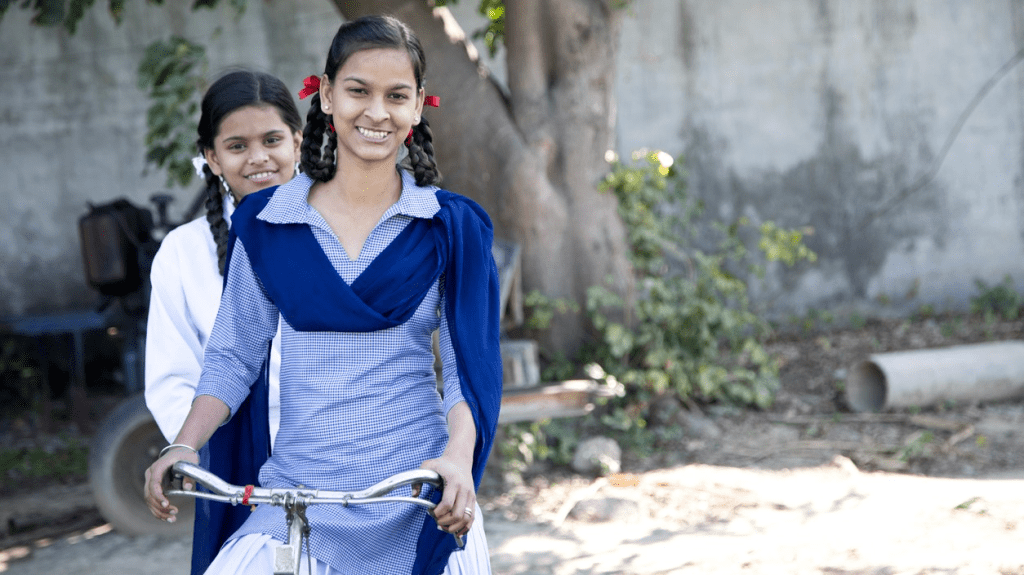
In 1947, a girl owning a bicycle was rare — often limited to fancy schools or unusually progressive families (and heroines in movies who not only cycled but also sang at the same time!). But things slowly changed. Manufacturers, once slow to respond, eventually followed demand, producing lighter, better-fitted cycles designed specifically for girls. What had once been radical became normal.

In 2001, Tamil Nadu launched a free bicycle scheme for students, including girls, under the Jayalalithaa government. The bicycles were procured and distributed by the state. Then in 2006 in Bihar came the game-changer. Mukhyamantri Balika Cycle Yojana, a statewide initiative launched by the Nitish Kumar government targeted girls entering Class 9, particularly in rural areas, and provided funds to purchase a bicycle rather than distributing cycles directly. Girls cycling in groups along rural roads became such a familiar sight that it changed public perception. With the success of the scheme, many states followed. . Few development interventions in India have delivered such disproportionate impact at such low cost.

Hearteningly, the cyclist who has brought India international fame in the past is a woman. Deborah Herold, from the Andaman & Nicobar Islands, is India’s standout name in track cycling. She won three gold medals at the 2019 South Asian Games, setting records, and went on to become the first Indian woman track cyclist to qualify for the UCI Track World Championships. She has represented India multiple times at World Championships and Asian Championships and won medals at the Asian Track Cycling Championships. In 2021, she received the Arjuna Award. Arpita Biswas and Minati Mohapatra are other women who have dominated the international cycling circuits. Esow Alben and Ronald Bira have also brought us glory.

Seen through this lens, the Pune race is not merely a sporting event. It is a cultural signal. It tells us that the bicycle is once again being taken seriously — as sport, as industry, as solution.

God speed!

–Meena

Pic: Deccan Herald

The Little Red Caps: Olympic Phryges

We are well into the Olympics—complete with controversies, exhilarating triumphs and heart-breaking failures. And we will see more super-human achievements in the weeks to come.

Overseeing all the fun, festivities and sports are the Olympic mascots of Paris 2024, the Phryges. The phryges are little red hats. This is somewhat unusual, because the mascots are often, but not always, characters—often indigenous animals or birds, or human forms representing the cultural heritage of the host country.  Generically, mascots are ‘a person or thing that is supposed to bring good luck, especially one linked to a particular organization or event; a person, animal, or object adopted by a group as a symbolic figure especially to bring them good luck’

Why is a red hat the mascot for the Paris Olympics? Well, the phryge holds a lot of significance for the French, and is a deep part of their cultural heritage. The phryge is a soft hat, generally red, which was first worn by freed slaves in Phrygia, an ancient Greek kingdom (in present-day Turkey). The storming of the Bastille prison in July 1789 marked the beginning of the French Revolution. Revolutionaries who were involved in the storming wore phryges. And slowly the hats came to symbolize the Revolution itself, and since then have since been known as a symbol of liberty and the revolution. Even today, protesters don them as they march. Marianne, the personification of France, is often shown wearing a Phrygian cap.
The Paris Olympics have two Phrygres: one for the summer Olympics, and one for the Paralympics. The Paralympics mascot  which ‘has a visible disability also sends a strong message: to promote inclusion.’

Both the Phryges are blue, white and red — the colors of the French flag.  They sport a gold “Paris 2024” logo on their chests. Their eyes are made out of a “cockade of France” –a knot of ribbons that is the French national ornament.  Each Phryge has its own personality. The Olympic Phryge is ‘the smart one” with a “methodical mind and alluring charm.’ The Paralympic Phryge is ‘a party animal, spontaneous and a bit hot-headed.’ 
Olympic mascots have been around  since 1968. They symbolize the Olympic spirit; spread the values highlighted at each edition of the Games; promote the history and culture of the host city; and give the event a festive atmosphere. They bring a personality to the Games, capturing the styles, traditions and cultures of the host country. The mascots are especially meant to connect with youth.

The very first Olympic Mascot was‘Shuss’, a little man on skis in the skiing position to which his name alludes.  He wears a two-coloured head, resting on a zig-zag flash-shaped foot with the Olympic rings featuring on his head. He symbolized the winter Olympics that took place in Grenoble, also in France. Waldi was the first Summer Olympics mascot. This dachshund, a very popular animal in Bavaria known for its endurance, tenacity and agility, was the symbol of the Olympics held in Munich in 1972.

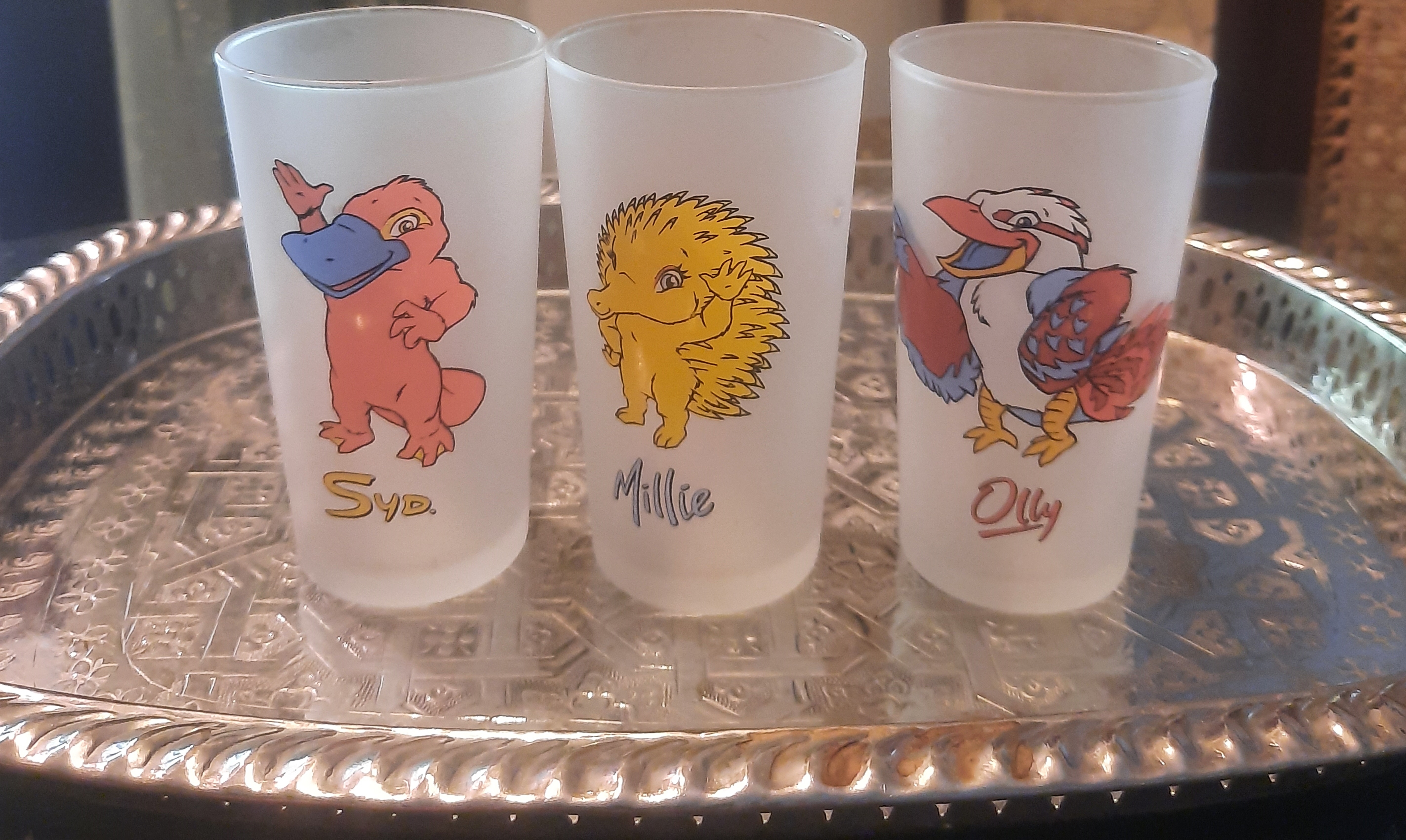
Sydney Olympics Sovernirs
Sovenirs from Sydney Olympics Year!

Since then, the Olympics have featured various animals, birds and objects. Unusual objects have included Schneemandl’  a snowman wearing a red Tyrolean hat (Innsbruck winter Olympics); Magique, a little imp in the shape of a star and a cube (Albertsville); Neve a snowball; Gliz an ice cube (Turin) etc. There are some mascots which are not an animal, nor a human figure, nor an object. One of the most unusual was Wenlock (London 2012) made from one of the last drops of steel used to build the Olympic Stadium in London. The light on his head was similar to those found on London’s famous black cabs. The shape of his forehead resembled the Olympic Stadium roof. His eye was the lens of a camera. He wore five bracelets in the colours of the Olympic rings.

India has not yet hosted the Olympics, but the 1982 Asian Games mascot Appu the Elephant, and the 2010 Commonwealth Games Shera the Tiger, were much beloved. The Phryges follow in this beloved tradition.

So here is to the spirit of the Phryges which aim to show that sport and its values can do great things, and that sports are about fraternity, solidarity and can help society grow.

–Meena