
Pain is one of those things we know intimately but understand surprisingly little. We know it when we stub a toe, burn a finger, bite our tongue, pull a muscle or discover that the corner of the coffee table has been lying in wait for our little toe. We know exactly what to say: “Ouch!”
But what exactly is happening when we say it?
September is Pain Awareness Month, an annual campaign dedicated to improving understanding of pain, pain management and the experience of people living with pain. It was established in 2001 and is now marked internationally. This September, the International Association for the Study of Pain (IASP) is particularly focusing on understanding, advocating, partnering and advancing pain science, with 2026 also being its Global Year on Neuropathic Pain.
Which seems like a good time to ask a rather basic question: why does pain hurt?
The body’s alarm system
The old-fashioned explanation was wonderfully simple. Something goes wrong in the body, nerves send a message to the brain, and the brain says: That hurts.
There is some truth in this, but modern pain science has made the story considerably more interesting.
When we touch something dangerously hot or injure ourselves, specialised nerve endings called nociceptors detect potentially damaging stimuli. They send electrical signals through nerves and the spinal cord towards the brain. But pain itself is not simply the signal travelling along a nerve. It is the brain’s interpretation of those signals, influenced by a whole set of factors including context, memory, mood and expectation. This is why pain is both remarkably useful and remarkably complicated.
People born with rare conditions that prevent them from feeling pain demonstrate just how important that unpleasant sensation is. Without the warning system, burns, fractures and other injuries can go unnoticed, sometimes with devastating consequences.
When the alarm refuses to switch off
Acute pain generally has a useful purpose. You injure yourself, the area hurts, the body repairs itself and, eventually, the pain subsides.
But pain does not always follow this tidy script.
It can persist long after an injury has healed, or occur without an obvious injury. Chronic pain can become a problem in its own right, while neuropathic pain arises from damage or disease affecting the somatosensory nervous system. It can feel burning, shooting, electric or stabbing, and can be extraordinarily difficult to treat.
There is another fascinating category: nociplastic pain, in which altered pain processing is involved without clear evidence of ongoing tissue damage or a lesion of the somatosensory system. In other words, pain is not always a faithful reporter standing at the scene of the crime.
But can pain actually be measured?
This is where things get delightfully strange.
If someone tells you their pain is 7 out of 10, what does that really mean? Is your 7 the same as my 7? And is either of us using the same scale as the person who describes childbirth, a broken bone or a paper cut as “about a five”?
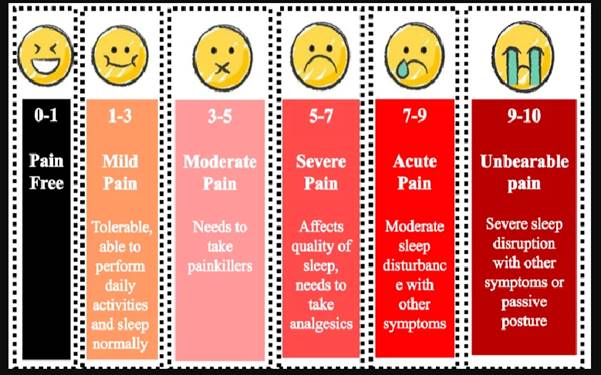
Pain is subjective, which makes it notoriously difficult to measure objectively. As an article in National Geographi article explains, scientists still do not have a reliable physiological instrument that can simply be attached to a human being and announce: “Your pain is 6.73.”
Enter Justin O. Schmidt, the American entomologist who apparently looked at the problem and decided that the obvious solution was to get himself stung by lots of insects– more than 150 species.
Schmidt spent decades studying insects and recording the character and intensity of their stings. His work eventually produced the Schmidt Sting Pain Index, a scale from 0 to 4 that ranks the relative pain of insect stings. The honeybee, familiar to many people, scores 2 and became a reference point for comparison. Schmidt also asked other experts to provide their assessments.
The Pain Olympics
At the bottom end are relatively mild stings. Fire ants and paper wasps score 1. Then comes the upper end of the scale. The tarantula hawk wasp, warrior wasp and bullet ant all reach 4. The bullet ant is particularly notorious, and Schmidt’s description of its sting is so dramatic that it sounds less like entomology and more like a rejected line from an action movie.
Schmidt’s descriptions are one of the most entertaining features of the index. He did not merely write “pain = 3.” He attempted to describe what the pain felt like. His yellowjacket entry compares the sensation to a hot, smoky experience involving a cigar. The warrior wasp, at the top of the scale, provoked the wonderfully candid question: “Why did I start this list?”
One can only admire the commitment to science.
Pain is not the same as damage
Schmidt’s work also illustrates something important about pain: the intensity of pain does not necessarily correspond directly to the amount of physical damage caused.
Venom has multiple effects. Some components can trigger intense pain, while others contribute to toxicity and tissue damage. These are related but not identical phenomena. A sting can hurt spectacularly without producing equivalent lasting tissue damage.
There is an evolutionary reason for this. For many stinging insects, the purpose of venom is not necessarily to kill a predator. A predator that survives a painful encounter can learn a valuable lesson: perhaps don’t eat that particular insect again.
As one of the scientists quoted by National Geographic puts it, a painful experience can be more useful as a defence if it leaves the predator alive to remember it.
Which brings us back to us humans.
We tend to think of pain as the enemy. But pain is actually one of the body’s oldest protective systems. It tells us when to withdraw, when to protect an injured part, when something may be wrong and, sometimes, when we need to seek help.
The trouble begins when the alarm becomes the illness itself.
Pain Awareness Month is therefore not simply about telling people that pain exists. It is about recognising that pain is real even when it cannot be seen, that different people can experience the same stimulus differently, and that persistent pain deserves to be understood rather than casually dismissed. IASP’s 2026 campaign puts this neatly into a broader framework of understanding, advocacy, partnership and better care.
And as for the Schmidt Sting Pain Index, there is a final lesson.
You can measure pain comparatively. You can describe it, investigate it and study the biology behind it. But there is still no universal “pain-o-meter” that tells us exactly what another person is feeling.
Perhaps that is why pain requires not only science, but empathy.
And perhaps, when somebody says, “This really hurts,” we should resist the temptation to reply, “It can’t be that bad.”
Unless, of course, they are volunteering to test the bullet ant!
And perhaps we should occasionally thank pain.
Preferably after it has gone away.
–Meena

