We use our fingers for all sorts of important things these days: typing, texting, scrolling, swiping and, occasionally, pointing out to someone that they have been on their phone too long.
But in Bavaria, one group of people puts a rather different value on their fingers. They wrestle with them.
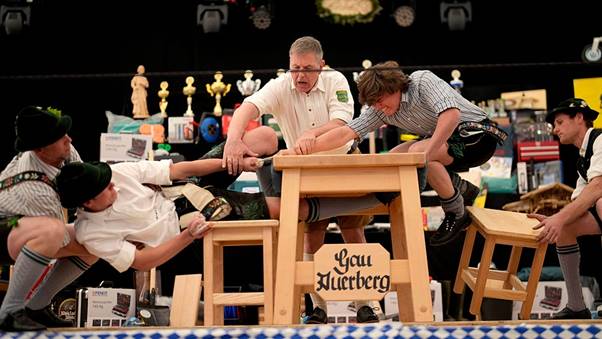
Welcome to Fingerhakeln, or finger wrestling—a wonderfully peculiar traditional sport in which two people sit across a table, hook their middle fingers into a leather loop and try to pull each other towards themselves.
And before you dismiss this as something that happens after too many beers at a German village festival, consider this: it has rules, clubs, training, weight and age categories, referees and national championships.
The rules are almost comically simple. Two competitors sit opposite each other at a specially designed table. Their middle fingers are hooked into a short leather strap. At the signal, they pull. The objective is to drag the opponent’s finger across a marked line.
Except that pulling another person’s finger with maximum force is apparently considerably harder—and more painful—than it sounds.
A bout may be over in just a few seconds, although the toughest can last nearly a minute. That may not sound like long enough to constitute a sporting ordeal, until you remember that the entire time is spent exerting enormous force through one finger. Competitors train specifically for the sport, strengthening their hands and fingers and learning how to use leverage, body position and technique.
So if you are now looking at your own hands and thinking, Surely I could do that, please resist the temptation to challenge your spouse, colleague or unsuspecting dinner companion. This is not an after-dinner game. There are good reasons not to underestimate the sport. The finger is subjected to considerable force during a contest, and injuries can occur. Competitors warm up, condition their hands and fingers and develop techniques for pulling and bracing.
PIC: https://www.euronews.com/
From Alpine tradition to national championship
Fingerhakeln is particularly associated with Bavaria and the Alpine regions of Germany and Austria. Its precise origins are difficult to establish, but the tradition goes back generations. Like many folk sports, it appears to have started as a simple test of strength. Who was stronger? There was no need for a boxing ring or wrestling arena. Just sit down, hook fingers and find out.
Over time, the pastime became organised competition. Today, finger wrestlers compete in different age and weight categories, with regional championships and a German national championship. The sport has managed to remain both fiercely competitive and closely connected to local culture.
In an age when sporting events can involve billion-dollar broadcasting deals and athletes who are global celebrities, Fingerhakeln remains resolutely local. It is rooted in the Alpine region, but the annual German championship gives its strongest competitors a national stage.
The seriousness of the sport becomes obvious when you watch the competitors. There is very little movement and certainly none of the dramatic action associated with conventional wrestling. The struggle is concentrated in the hands and arms, while the two competitors sit almost motionless, each waiting for the other to give way. And then, often within seconds, it is over.
That combination of stillness and sudden force is part of what makes Fingerhakeln so fascinating to watch. It looks almost absurdly simple, until you realise just how much strength and pain tolerance are packed into those few moments.
For all its eccentricity, Fingerhakeln has the trappings of any serious competitive sport: champions, categories, training and even sporting families. At the 2025 Bavarian championships, Franz Foos won the heavyweight title, Andreas Sturm took the lightweight category, while Gerhard Sturm won the senior category for competitors over 60. The Sturms are a nice example of how traditional sports can become family traditions, with skills and enthusiasm passing from one generation to the next.
The Bavarian championship is a regional competition, however, and is distinct from the German national championship. That was held on August 23 in Pflugdorf-Stadl, where around 150 competitors took part. Ferdinand Seitz won the senior title, and afterwards described the experience of competing as “excruciating”—which seems a fairly convincing endorsement of the seriousness of the sport.
For the competitors, the few seconds at the table represented months and years of preparation. And that perhaps brings us to the more interesting question raised by this wonderfully odd sport: what exactly makes something a sport?
We tend to associate sport with speed, spectacular physical feats, enormous stadiums and global audiences. But strip it down and the essentials are rather simpler: physical effort, skill, training, rules, competition and the determination to win. Fingerhakeln has all of them.
It may never become an Olympic sport, but it does not need to. Its appeal lies partly in its connection to place and tradition. In a world where the same sports are watched from New York to New Delhi, Fingerhakeln remains distinctly Bavarian—a competitive tradition tied to its community and passed from one generation to the next.
There is something rather appealing about that. We spend so much time trying to make everything bigger, faster and more spectacular. Finger wrestling goes in the opposite direction. It strips competition down to its essentials: two people, a leather loop, considerable strength and a very determined finger.
For most of us, fingers are increasingly instruments of the digital age, busy with keyboards and screens. In Bavaria, some people still use theirs to settle a much older question: Who is stronger?
The answer, as it turns out, can be decided by a leather loop, a wooden table and a very determined middle finger.
Who knew one finger could carry so much sporting ambition?
–Meena