August 12 is marked annually as World Elephant Day. It is a day dedicated to raising awareness about the urgent issues faced by elephants in the wild due to a number of factors including poaching for ivory, habitat loss and human-elephant conflicts. Initiated in 2012 as a plea to stop poaching, this day has grown into a full-scale movement linking scientists, rangers, and ordinary citizens with one goal: to keep elephants alive in their own habitats.
While this day brings together people from diverse areas of interest (perhaps for one day of the year), there are scientists who have dedicated their life to studying and understanding these majestic creatures. Research is an essential input for the management and conservation of elephants. In India, the scientific study on the ecology and the behavior of the elephant began as early as the 1970s. During this period a major study on elephants was carried out by the Centre for Ecological Sciences, Bangalore.
Following this, several scientific and research institutions in India have been studying various aspects of elephants in India.
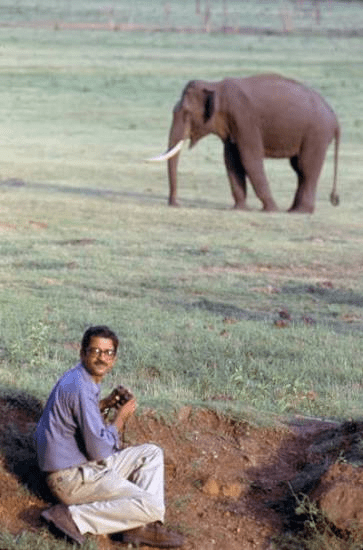
One of the earliest scientists to study elephants in India has been Raman Sukumar. His jumbo journey began almost five decades ago. What sparked his interest, which grew into a passion, and led to significant contributions to the study of elephants?
Here is his story in his own words.
There was no hint during my early days of what I was eventually going to do. I was the usual city-bred child interested in games and various hobbies. I was very fond of books, an interest that I attribute to my maternal grandfather who was a bookseller. My maternal grandmother seems to have recognized a streak of the naturalist in me quite early on. I recall that for some reason she used to call me a vanavasi much before I ever went to a forest.
It was only when I reached high school that my eyes opened to the profound beauty of living creatures. At that time the world was also waking up to the crisis facing our environment—caused by pollution and the reckless exploitation of nature. The modern conservation movement was gathering momentum.
I had a passion for science and wanted to work in conservation. With this goal in mind I pursued botany at Loyola College and later at Vivekanand College in Madras. I was fortunate to have teachers who encouraged creative pursuits outside the framework of the regular syllabus.
I was also fortunate to be in Madras, which is almost unique in having a national park, the Guindy National Park, within the city. I spent most of my weekends at Guindy Park in the company of Selvakumar who was pursuing his studies in zoology. He had an amazing ability to describe anything, from an ant to a whale.
I still did not have the faintest idea of getting involved with elephants, although a passion for these pachyderms must have been latent in me. My first sighting of a wild elephant was not at all spectacular. In fact, I doubt if I saw an elephant at all. Our class was on a botanical tour of Mudumalai which is well known for its elephant population. I was talking to the Warden of Mudumalai when a rickety car rolled up and a familiar figure leaned out and boomed: “Hey boy what are you doing here?” It was Siddharth Buch, a naturalist-photographer and one of my earliest gurus in wildlife pursuits. He and some friends had driven from Madras in a rickety old jalopy. He enquired whether I had seen any elephants. I explained to him that we had only just arrived. He asked me to hop in as they were going for a drive along the Mayar river.
We had hardly gone a kilometer when Siddharth stopped the car and pointed towards a hillock and said “There is an elephant moving up the slope”. I strained my eyes but could not see any elephant. “Can’t you see the black shape moving through the bushes? That’s the back of the elephant.” It was midday and the jungle was a patchwork of light and shadow. I guess I did see something darker than a shadow but I could not see it moving. It may have been a rock but I nodded dutifully, meaning that I could indeed see a dark shape. “There my boy! I have shown you your first wild elephant!” announced Siddharth triumphantly. Whatever the true identity of that object, with the benefit of hindsight I must caution readers unaccustomed to the ways of wild elephants that it is always better to mistake a rock for an elephant than an elephant for a rock.
In August 1979 I joined the doctoral programme in ecology at the Indian Institute of Science in Bangalore. Madhav Gadgil had established the country’s first academic programme in modern ecology. When the time came to select a research topic for my thesis Madhav suggested some problems, among them a study of elephant-human conflict. My ears pricked up when he mentioned elephants. I had wanted to work on large mammals and what was better than studying elephants, although I must confess that such a thought had never occurred to me earlier.
Thus began my study of elephants in southern India in 1980, and which continues for the rest of my life. Over nearly five decades I have been studying them, photographing them, chasing them, and being chased by them. To even begin to understand this fascinating animal one has to spend several years in the field. Every month, every year, one learns some new facet of its character.
Elephants can be funny. Elephants can be frightening. They can be heartwarming and their study can be addicting. If the tiger is the spirit of the jungle, secret and elusive, the elephant is its body, large, majestic, making its presence felt with authority.
We at CEE were fortunate to have interacted with Dr Sukumar, and gained tremendously from his long experience and patient guidance. This piece by him, written at our request, was originally published in a CEE publication Walking the Wild Path. Dr Sukumar was also one of the reviewers of CEE’s NatureScope India for the special issue on Endangered Elephants.
Raman Sukumar is Professor and Chairman at the Centre for Ecological Sciences, Indian Institute of Science, Bangalore, India, and Founder Trustee of the Asian Nature Conservation Foundation, Bangalore, India. He is the author of several books.
–Mamata

