All Alike

We live in a world, and in a time, of confrontation and conflict, a continuous battle for proving our might; so much energy poured into dividing rather than synergising.

At a time when “what makes us different” is more important than what binds us as human beings I remember a poem by one of my favourite poets that reminds us that we are really not different!

No Difference

Small as a peanut,

Big as a giant,

We’re all the same size

When we turn off the light.


Rich as a sultan,

Poor as a mite,

We’re all worth the same

When we turn off the light.


Red, black or orange,

Yellow or white,

We all look the same

When we turn off the light.


So maybe the way to

To make everything right

Is for God to just reach out

And turn off the light!

Shel Silverstein


If only something could make everything right!

Let’s take a minute to pause and ponder as the International Day of Peace is observed around the world on 21 September.

–Mamata

Business as Usual

 “Business history gave me the opportunity to look at the experiences of individuals. Individuals who built organizations; individuals who built companies, individuals who responded to situations and responded to change. Then I began to have some kind of understanding of what Indian society is like. What are the forces in the Indian society that egg people on to certain things” said Prof Dwijendra Tripathi, Kasturbhai Lalbhai professor of Business History at IIM Ahmedabad, and the founder of the discipline in India.

Like any historian, he believed that studying the past led to a better understanding of the present. Today, India wants to ‘Make in India’. It wants every graduate and school dropout to be an entrepreneur, a job creator rather than a job seeker. There cannot be a time when it is more critical to study Indian business history.

India was fortunate to have a pioneer like Prof Tripathi who laid the foundations of this discipline way back in the ‘60s and ‘70s. But even today there are few Indian Business Schools which teach the subject. I wonder if there are any pure history departments which teach it at all!!!

His passing away on Sept 5 this year has led to a flurry of articles and pieces (including this one). Maybe it will also lead to serious debates on the place of the study of Business History for the development of Indian Business.

Some things change, some don’t! It is up to us to learn from the past to plan for the future.

‘Another disincentive to movement was a network of customs barriers. According to Moreland, these barriers–chowkies, as they were called-existed in 1600 and later. Most likely, they existed even earlier. As a result, the cost of transportation over a distance of 200 or 300 miles doubled the price of the commodity. The harassing and corrupt practices of the customs authorities added to the trials and tribulations of the situation’.

Indian Entrepreneurship in Historical Perspective: A Re-Interpretation Author(s): Dwijendra Tripathi Source: Economic and Political Weekly, Vol. 6, No. 22 (May 29, 1971)

–Meena

For me, Prof Tripathi was a gentle presence on the IIM-A campus, a ready smile for anyone he met.

A Register of Opportunity

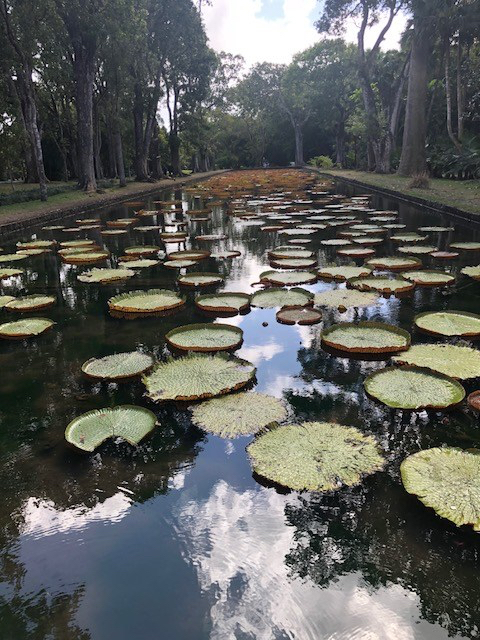
BDB307A0-742C-4A7E-B7E0-18323D154F33As botanic gardens go, the Sir Seewoosagu Ramgoolam Botanic Gardens in Mauritius are not large. 92 acres to Bangalore’s Lal Bagh of 240 acres to put it in perspective (but of course we need to factor in the size of the two countries!).  We don’t need to dwell on the variety of flora, both endemic and exotic, on display there. Nor the few but interesting animals—specifically some deer and some huge tortoises. The only endemic Mauritian mammal, a bat, the Peropus niger, may also be spotted on the trees, it is said.

But it was not all this that really fascinated me. Let me tell you what did.

Little shelters dot the gardens. At the shelter overlooking the beautiful lily pond was2C9A861B-73C8-4075-9652-6A6A1E1591B9 a table. And on the table was a register. I sneaked a peak into the register. And this is what I saw: Several entries each day on the condition of the pond, the leaves, the flowers; the birds and insects seen. And a sketch of the pond, done at the same time every day, showing where flowers had bloomed and where there were buds. And it was not only the lily pond. There was a similar register at the lotus pond, and some other spots in the garden. As I flipped the pages, I could see that no day was missed, no entry casual

What seriousness of purpose and systematic application, to a job that may seem not to have any particular outcome. But the person behind the system and the people implementing it obviously know the importance.  After all, scientific method consists of : ‘systematic observation, measurement, and experiment, and the formulation, testing, and modification of hypotheses.

The Botanic Garden in Mauritius is definitely doing its part! It is obvious that they know the value of keeping systematic notes and data. It may seem trivial, but who knows what it may lead to? After all, research is one of the stated objectives of Botanic Gardens, Zoos, Aquaria and all such facilities do. And keeping such meticulous notes may be the single most important contribution they can make.

Are we in India at all using such opportunities? I am not sure!

An excerpt from Darwin’s Beagle Notebooks. He observed and noted down everything around him—flora, fauna, geology, weather conditions, animal behaviour. And at the end of the day, changed human understanding of the world! Without his notes, he may not have reached his conclusions!

Extraordinary numbers of Turpin —

 drinking bury head above eyes — Will drink when a person is within 2 yards of them about 10 gulps in minute.

Noise during cohabitation.

Eggs covered by sand soil from 4 to 5 in number — require a long time before they are hatched.

Eat Cacti in the dry Islands

Yellow Iguana1 intestine full of Guyavitas & some large leaves

All morning descended highest Crater — Glassy Feldspar — red glossy scoriæ:

Iguana1 — shakes head vertically;, hind legs stretched out walks very slowly — sleeps — closes eyes — Eats much Cactus:

run walking from two other carrying it in mouth — Eats very deliberately, without chewing — Small Finc[h] picking from same piece after alights on back —

In the Tent generally 85-80˚ —

Trade wind & sun 77˚ or 78 —

On Rock out of wind 108˚ — —

http://darwin-online.org.uk/content/frameset?

The Great Babbler Mystery

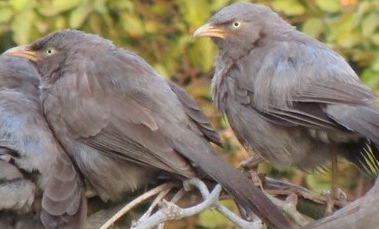
I call them Angry Birds! They are continually at war with the world, making their views heard with an incessant grating cacophony of sounds. Their beady eyes glint as they stare angrily at you, and their dusty khakhi-brown feathers are always dishevelled, as if they have just emerged from battle!

They are ubiquitous, making their bedraggled group appearance in the garden, on the sun deck, in the wash area and on the window ledges. They make their presence felt with their incessant quibbling and squabbling. In the morning they are busy poking at the lawn before our first cup of tea. In the afternoon they hop around in the verandah and outside the windows, peering through the glass and rapping sharply with their beaks as if to reprimand us for some misdeed. They are the band of vigilantes—sounding a harsh and strident chorus that makes the intruding cat slink away to safety. They fight like fishwives! Screeching, pecking, pulling, merging into a heaving mass of untidy feathers; and emerging with scrawny bare necks that reveal the wounds of war.

They are the Jungle Babblers or the Seven Sisters as they are called in English, and for some reason, Seven Brothers in some Indian languages.

And I wake up with the comfort of starting the day with them.

Until last week….

My angry birds have disappeared en masse!

At first I thought it may be the grey drizzly weather that we have been having after a long, blazing hot and dry summer that was deterring their forays. Then I thought that maybe they had decided to put in a late appearance; I watched for them morning, noon and evening. Not a straggly feather to be seen! I looked at all their haunts, their favourite foraging patches; the bare branches of the tree at the gate and the wires running overhead, but nary a glint of an eye could I see. I thought maybe they have taken off on vacation, but my bird book tells me that they like their home turf and are not likely to wander far.

How can they all vanish? I haven’t a clue!

jungle-babblers-in-Lucknow-India-bird-festival-uttar-pradesh-2 (2)
Missing from action!

Will they reappear soon? I do hope so!

Till then, the great babbler mystery continues!

–Mamata

Travel PANIC…..

I regret planning a holiday before I leave. And once I am ‘there’ I don’t want to think of home!

So here is a list of things I panic about:

  1. Packing: Have I enough clothes? Have I too many clothes? Have I the right clothes? How do I fit in the walking shoes and the formal shoes and the chappals? Is it going to rain? Do I need an umbrella? Is it going to be cold? Do I have enough woollies? Do I really need them? What medicines should I take? Did I pack my chargers? Am I going to read two books or three? Are the books too heavy?EB301699-D567-4B7B-A138-124C3458A90C
  2. Money: Do I have enough? Do I need all these credit cards? Have I got them safe yet handy? Am I going to lose my money? Are my cards going to get pinched? What is the exchange rate? Shall I change money at the airport or the city? What if I don’t change at the airport and don’t find an exchange easily? Am I going to get gypped?
  3. Documents: Did I put in all the papers I need? Do I have all the hotel contacts, the visa documents, the whatever, the whatever? Have I got copies of all of them? What if I lose them?
  4. Connectivity: Will my phone work? Are the charges going to kill me? Will I be able to regularly access email?

And of course..

  1. Work: Did I forget to do something important? Is what I sent the Boss OK, or is he/she going to want some changes? If so, how will it get done? Is there going to be a crisis just in this one week? Are the skies going to fall?
  2. Home: What about thieves and burglars and break-ins? Do all those wicked people know I am away? Are they watching for a chance? Are they planning for a break-in?

And the most predominant one in my life currently…

  1. Older people: Is my mother going to be OK when I am away? Even if she doesn’t fall ill, is she going to panic herself sick because I am away? What if the doctor doesn’t respond promptly? Does she have all her medicines? Does she have all contact numbers??

But the learning for life, which I have to remind myself about before every trip…..

Crises do break out, but they get managed somehow.

Wallets do get whacked, but there is not much one can do.

We do over-pack and under-pack, but never learn to do better next time.

And we do live to travel another day.

So no point worrying, just go!

–Meena

Yes, you got it right. Just got back from a holiday!

Inside Outside

Through the glass, curiously

IMG_20180805_120336063.jpg

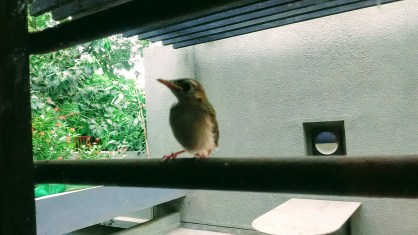
Little bird looking in

What do you see?

Strange giants pacing within.

Trapped in a cage of steel, stone and wood

In an existence that your kind has not understood.

Harried human looking out

What do I see?

A fledgeling just sprouting wings

To soar wide and free with a song to sing

Of the air and light, the trees and the sky.

Grow strong little one, spread your wings and fly

And I will wait for you to sometime come by.

–Mamata

Crotchety Me!

Knitting. Not my area of natural comfort. The only time I did knit was when I was forced to, back in school. And were those booties and bonnets and ponchos disastrous! My needlework teacher ‘frogged’ them regularly (to fully understand the term, continue reading!).

Then why do a piece on knitting-related terms?

Because a dear friend just gifted me a beautiful crocheted shawl. I have been looking at it all week and appreciating the beauty of the piece, the patience that has gone in, and the centuries of tradition behind it. So here is to my friend Mahashwetha and knitters and crotcheters across the world who bring beauty and warmth (pun intended) to our lives.

CB8E4CC3-FB0E-4E77-8EBB-D9EBB791C477

Since the gift is crocheted, not knitted, we will begin with ‘crotchety’ terms.

Crochet: ‘Crotchet’ is from a very old French word for ‘small hook,’ and the verb means ‘sewing with a hooked needle’. ‘Crotchet’ has been in use in this sense since the 15th century.

Crotchety: By late 16th century, ‘crotchet’ was also being used to mean ‘an odd whim or peculiar notion.’ The logic of this seems to be that strange ideas or unusual behavior are mental ‘twists’! A person with odd ideas and habits came to be described as ‘full of crotchets’ or simply ‘crotchety,’ a term which first appeared around 1847. “Crotchety” is now also used in place of “grouchy”.

Knitting commemorates people!

Cardigan: Knitted jackets or sweaters open down the front have been around for several centuries, but the term cardigan came into use in 1862. The cardigan was named after the seventh earl of Cardigan (a county in Wales) who sported such jackets during the Crimean War.

Raglan: The word raglan also came into use during the Crimean War. It is named after Cardigan’s commanding officer, the first Baron Raglan. During the war, Raglan wore a loose-fitting overcoat with sleeves that extended all the way to the neckline instead of stopping at the shoulder. Originally raglan referred to the overcoat; it now can also refer to the style of sleeve.
And animals too!
Frog: What happens when a knitting project doesn’t go well? Well, a knitter frogs it. Frog is knitting slang for “ripping out” knitting: taking the piece off the needles, and unraveling it quickly. It’s not unique to knitting: crocheters frog their work, and needleworkers also frog stitches that aren’t right.

As well as places…

English knitting: Also called right-handed knitting, this is the method of knitting in which the working yarn in is held in the right hand.

Continental knitting: This is a method of knitting in which the working yarn is held in the left hand.

Knitting terms confuse…

Ravel: The verb ravel can mean “to knit together.” It can also mean “to unspool, unknit, or unravel.” Ravel is a contronym (or Janus word), a word with meanings that contradict each other.
End note

If you thought only music had its own notation, turns out knitting does too! Just to start you off….

BO: bind off (cast off)

CC: contrasting color

cn: cable needle

CO: cast on

dec:: decrease

dpn(s): double-pointed needle(s)

inc: increase

kfb: knit into the front and back of the stitch (an increase)

knitwise: as if to knit

And so on…
–Meena
References:

http://en.wiktionary.org/wiki/crotchety
http://en.wiktionary.org/wiki/crotchet#E…
https://www.dummies.com/crafts/knitting/designs-patterns/terms-and-abbreviations-used-in-knitting-patterns/
• Terms and abbreviations used in Knitting Patterns. Kristi Porter.

Otherness and Sameness

When we were in school one of the most assigned topics for essay was Unity in Diversity. We prepared hard for this by finding out many examples from India to demonstrate this. We were proud of living in a country where people of such diversity could co-exist, and celebrated this diversity. We also sang with fervour a school song in Hindi that proclaimed that all people of Hind were one, even though there were many colours and features, attires and languages. Hind desh ke nivasi, sabhi jan ek hai, Rang, roop, vesh-bhasha chahe anek hai.

 My heart breaks today, day after day, to read about a country and a world where it is this very diversity that is broken into identity fragments that divide rather than unite; a world that is increasingly emphasising the ‘otherness’ to create chasms, rather than the ‘sameness’ that builds bridges.

This sentiment is beautifully expressed by Maria Popova:

“Where Walt Whitman once invited us to celebrate the glorious multitudes we each contain and to welcome the wonder that comes from discovering one another’s multitudes afresh, we now cling to our identity-fragments, using them as badges and badgering artillery in confronting the templated identity-fragments of others.”

And then, this past month there was a ray of hope in the World Cup with the multi-ethnic compositions of many of the teams, and much was written about how the not-so-long ago ‘outsiders’ had become integral parts of National teams. This was best demonstrated by the multicultural French team that lifted the Cup…where the Otherness was transcended by the Sameness.

“You gave me blue and I gave you yellow

Together we are simple green. You gave me

What you did not have, and I gave you

What I had to give—together, we made

Something greater than the difference.” (Alberto Rios)

Yes it can happen, and yes there is hope, even in these strange and uncertain times, as Barack Obama said in his centennial memorial lecture to Nelson Mandela, and reminding us of his words: “No one is born hating another person because of the color of his skin, or his background, or his religion. People must learn to hate, and if they can learn to hate, they can be taught to love, for love comes more naturally to the human heart.”

–Mamata


Well Spun!

Ponduru, a village in Srikakulam, Andhra Pradesh, arguably produces the best khadi in India. Well, at least Gandhiji thought so. He was highly impressed with the fineness of the khadi produced here and preferred it to other khadis. The best dressed (khadi-mode) contemporary politicians even today get their saris, dhotis and shirt material from here.

Ponduru khadi is hand-carded, hand spun and hand woven—truly khadi in letter and spirit.

What makes it special? Well, more than one factor, it seems. For one, the raw material itself is of a special quality—it is made from special varieties of hill cotton and red cotton which are grown in Vizianagaram and Srikakulam districts. For another, Ponduru khadi is very smooth, especially the higher count variety. This is because the jawbone of the Valunga fish found in Srikalkulam is used to comb the cotton  fibers to separate them from the seeds, and the process lends a soft sheen  to the cotton.

21637405-76C9-4CD8-B597-D2A608CB60E3

There was a time when every home in this village had a loom. But like in most of India, the number of khadi workers in Ponduru is falling. The low remuneration is of course a major reason. Those involved in the sector do not want their children to follow them—they would much rather they got a ‘professional’ degree and got a ‘secure’ job.

Fortunately, there are some efforts to improve the situation, including dedicated NGOs working in the sector. Chitrika is one such which has been working closely with the Ponduru khadi sector for over a decade now. They are helping the workers organize themselves into Producer Cooperatives, find newer markets, and improve their capacities. New and innovative designs are being brought in. All this is enhancing the incomes of the weavers, almost doubling them in the last decade.

But without a pull from the market, no government subsidies or NGO efforts are going to lead to sustainable results. An eminent Gandhian once mentioned that if every Indian bought one khadi garment a year, the sector would thrive and all our khadi workers would be able to earn decent incomes.

A small thing to ask! And this is in our hands.

So this piece today is a call to action. We are about a month away from Independence Day. Go out and buy some khadi! It is a practical and easy ‘good deed’ for 15 August!

Buy khadi, and specially buy Ponduru khadi, best of all khadis!

–Meena


Up My Wall

Of course house lizards must climb my walls in summer. They must eat up the nameless insects and the mosquitoes and the what-nots. I don’t love them, though I respect their role. And the translucent babies are amazingly cute.

Moths must rest on the walls of my room occasionally. Grey, brown, black, white, small, big. Love all of them. Also spiders.

I have found a slug or two climb the outside-wall. Don’t mind too much, though they do leave a yucky trail.

But the one that really stunned me was a tree frog up my bedroom wall, next to a portrait of my mother! The wall of my first floor room, on the side with no window. How did it even get up there? Climb a tree, jump through the open window, hop across the whole room and then climb the opposite wall? Wow!

D1CEBD2F-E21B-44E8-8827-E80D13734C2D

Ten minutes of full-on excitement. Lots of jumping around ( frog, Raghu and me, with the frog winning on agility and grace— hands down, or is it feet down??); screeching (mainly me, not at all the frog);  some sleight of hand with newspapers and a bucket. And we managed to get the frog out safely.

Oh, how boring  life would be without things that climb my walls!

5A9AB48F-7A43-461C-A334-E8B3DC79EE2D

78BE1532-E3D7-4514-93E7-39C5BC5FC5F6

—Meena