It Takes Guts!

‘Gut Ecology’ is the name of a book brought out by the St. Marks Academic Institute which is dedicated to ‘advancing scientific knowledge of colorectal disorders’. I think the book, which features topics like ‘The gut microflora: traditional and molecular identification techniques’, and ‘The ‘unculturables’’ deserves to be a bestseller. Not that I would understand the contents, but I have to admire the dedication and scientific spirit it takes to spend a lifetime researching and writing on such topics! Guts indeed!

But what exactly would the book be about? Let’s break it down. Ecology is the study of organisms and how they interact with the environment around them. An ecologist studies the relationship between living things and their habitats. ‘Gut’ is commonly used to refer to the stomach, entrails, parts or the whole of the digestive tract. So a ‘gut ecologist’ would study the insides of our digestive tract to understand the micro-organisms (collectively referred to as gut microbiota) that live there, and how they interact in our digestive system.

For very long, the presence and role of micro-organisms in our body was not known. It was in the 1670s and ‘80s when Antoine van Leeuwenhoek started using his newly developed handcrafted microscopes that scientists started studying them. Leeuwenhoek described and illustrated five different kinds of bacteria present in his own mouth and that of others, in a letter he wrote to the Royal Society of London in 1683. He later also compared his own oral and faecal microbiota, and proved that there are differences in micro-organisms in body sites. (See why I say it takes guts to be in this field!)

Gut bacteria
Gut bacteria

Now we know that the human gastrointestinal tract—from mouth to anus– is divided into sections, and each provides a different environment and different kinds of micro-organisms thrive in each section. In all, about 100 trillion micro-organisms (most of them bacteria, but also viruses, fungi, and protozoa) exist in the human gastrointestinal tract. In fact, the colon contains the highest microbial density recorded in any habitat on Earth, representing between 300 and 1000 different species. There are actually about as many bacterial cells in our bodies as there are human cells, and they contribute over a kilogram to our weight! So Stewart Brand, the American writer, environmentalist and editor of the highly influential Whole Earth Catalogue was right when he said, ‘If you don’t like bacteria, you’re on the wrong planet.’

These organisms are such an integral part of the functioning of the human body that they are sometimes called ‘the forgotten organ’.

A foetus has no bacteria at all in the system. Through the process of birth, it picks up a good number, and then in the first few years of its life, the child picks up a huge number of different bacteria from its environment. Fascinatingly, like fingerprints, a person’s gut microbiota composition is unique to each individual.

These micro-organisms influence our energy metabolism and many other areas of human health, from immunity and the progress of diseases, to appetite, to nutrition uptake, and even personality! They therefore greatly influence our health, well-being, weight etc.

External factors influence the composition of these micro-biota but by changing our diet or fasting can change the composition of these life-forms in our systems, in a matter of days or weeks, and this is why it is important to pay attention to what we eat. This is also the reason why medical science is increasing focus on  prebiotics and probiotics. If like me, you are confused about the two terms, here are simple definitions:

* Probiotics are foods or supplements that contain live microorganisms intended to maintain or improve the “good” bacteria (normal microflora) in the body.

* Prebiotics are foods (typically high-fiber foods) that act as food for human microflora. Prebiotics are used with the intention of improving the balance of these microorganisms.

Kudos to the scientists who work so hard to help us understand our bodies and their functioning, ready to spend their lives poring over microscopes to figure out how we can live healthier and better!

–Meena

Poppy for Remembrance

As a watcher of the BBC news channel, one thing that I have been noticing since this month began was that all the newscasters and other people who appeared on the channel have been wearing a lapel pin in the form of a poppy. This week there was also a picture of Britain’s new Prime Minister Rishi Sunak also wearing the same while flagging off the Poppy Appeal.

Why are poppies so much in the news? The crimson poppy flower has become a symbol to honour those who have fallen in battle over the years, and also symbolizes hope and gratitude. The history of this century-old tradition goes all the way back all to World War I.

 As the story goes, during World War I, after a particularly bloody battle in the fields of Flanders in Belgium, thousands of bright red flowers mysteriously appeared. These were common poppies. Interestingly, the common poppy (Papaver rheos) is technically classified a weed which can grow even in the most inhospitable of landscapes. Basically it sprouts naturally in areas where there is massive disruption of the soil and the natural environment, such as bare lands which had been disturbed by the movement of troops and battle equipment. It is believed that during the Napoleanic wars of the early nineteenth century poppies bloomed profusely around the bodies of fallen soldiers, painting the battleground blood red. The same thing must have happened at Flanders.

John McCrae, a lieutenant colonel in the Canadian Expeditionary Forces fighting in Flanders, who had just lost a close friend in the battle, was so moved by this spontaneous bloom that he wrote a poem about the flowers’ resilience and ability to grow in such inhospitable conditions. Titled In Flander’s Field, it was told from the perspective of the fallen soldiers buried beneath the poppies, and honoured the troops who lost their lives in that conflict. The opening lines of the poem:

In Flanders’ fields the poppies blow
Between the crosses, row on row,
That mark our place: and in the sky

The larks, still bravely singing, fly
Scarce heard amid the guns below.

McCrae’s poem was published in London’s Punch magazine in December 1915. It touched a chord in all those who were suffering the losses of loved ones in the war. The poem was read at memorial services, and reprinted it in many publications. Moina Michael, a professor at the University of Georgia in the United States, first came across In Flanders Field in the Ladies Home Journal and was so moved by it that she vowed always to wear a red poppy in remembrance of the lives lost in war. She found some poppies made of fabric in a store; and bought 25 silk poppies for herself and her friends. Once the war ended she herself began to make poppies out of red silk, and sell these to raise money to support the veterans returning from the war. She also lobbied for the poppy to be recognised as a memorial symbol. In 1920 the little red flower was recognized by the National American Legion as the official national emblem of remembrance.

The United States marks this memory on two days– Memorial Day is celebrated in May while 11 November marks Veterans Day. Over time, in the United States, the tradition of the poppy as the symbol of the day has been largely replaced by the yellow ribbon and red, blue and white ribbon campaigns. 

The poppy tradition however took firm root across the Atlantic, and continues to flourish. It first reached France through a French lady Madame Guerin who had seen the introduction of the poppy in America. She thought that selling poppies was a great way to raise money for children who had been affected by the war in France, and she engaged thousands of war widows in making paper poppies, and selling over a million poppies by 1921.  The Royal British Legion adopted the symbol immediately. The idea also spread to the other Commonwealth countries. The first poppy event was held on 11 November 1921.

Thus for over a century now, wearing a poppy has become a symbol of remembering the soldiers lost during World War I in many countries. The flower made of paper or fabric, is generally affixed to the left shoulder to symbolize the act of keeping those who have passed away close to one’s heart; the left shoulder is also one where military medals are worn. 

In the United Kingdom, Canada, France, Belgium, Australia and New Zealand, red poppies are worn in November, especially on 11 November. This date is marked as Remembrance Day as it commemorates the anniversary of the signing of the armistice that formally ended World War I “at the 11th hour of the 11th day of the 11th month” of 1918. This day is now an occasion to remember all those who have lost their lives in all conflicts since World War I.

While the original batch of poppies were bought from France, the first factory to produce poppies in England was set up in 1922, employing five disabled ex-military personnel. Today the Royal British Legion has a factory that employs 50 ex-servicemen all the year round to make poppies for fund-raising events. The poppy has transcended its purely commemorative status to become an object that provides financial stability for the war-affected. 

The annual Poppy Appeal flagged off by the British Prime Minister last week raises funds for The Royal British Legion to support the armed forces community who have served, or are currently serving in the armed forces, and have subsequently been affected physically, mentally or economically by war.

In an age that is even today more war-torn than ever, where young people are laying down their lives in brutal and meaningless warfare in so many parts of the world, this single flower serves as a powerful symbol not only of remembrance, but also a mark of honour, pride and support for those who still give up everything for the security and peace of nations.

–Mamata

Two States are Born

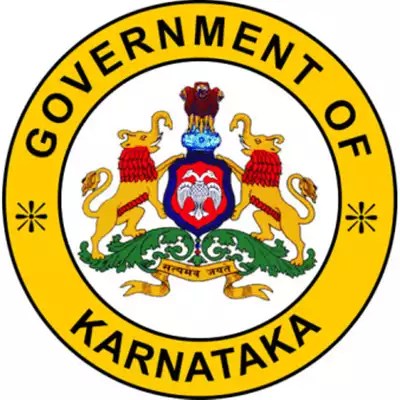
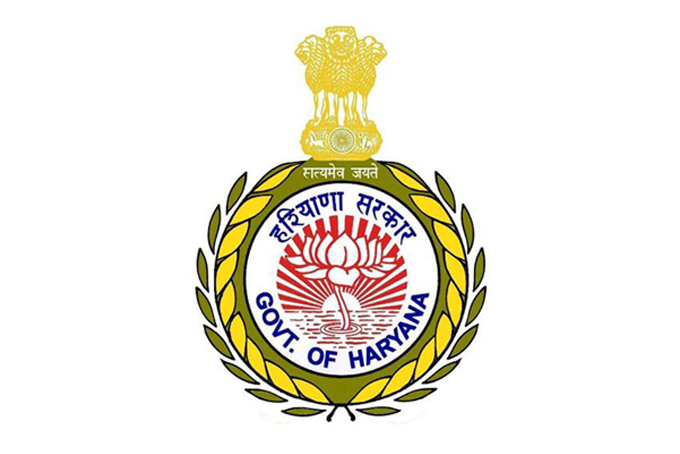
November 1 is marks the birth of two states in the country—Karnataka and Haryana.

Karnataka State Emblem

Karnataka came into being on this date in 1956, after the passage of the States Reorganization Act. It is also called the Unification of Karnataka. During the British Raj, the area now called Karnataka was part of many administrative units. About one-third was part of the Mysore Princely State. The rest was divided among Nizam’s Hyderabad, the Bombay Presidency, the Madras Presidency, and the territory of Kodagu.  The Kannadigas were minorities in all these areas, and felt that their language as well as socio-economic development were not being given priority. Hence started the movement to unite all Kannada-speaking people into one state. The demand started way back in 1856 and got a fillip with the formation of the Karnataka Vidhyavardhaka Sangha in 1890. But it gathered momentum when Aluru Venkata Rao made an appeal in 1903 for the unification of the Kannada-speaking area of Madras and Bombay Presidencies with Mysore State. The movement grew stronger over the years, with a literary thrust and the formation of the Kannada Sahitya Parishad in 1915. The initiative developed in parallel with the Independence struggle, and also gained political strength. The growing strength led to the approval of the formation of the Karnataka Pradesh Congress in 1920.

The Nehru Report of 1928 which appealed for dominion status for India, a federal set up, joint electorates etc., also recommended a separate state for Kannada-speakers. Nothing much happened during the Raj though the Congress pushed for it and the idea had the support of the Maharaja of Mysore. This was probably due to the British not being quite sure how they would manage this. At Independence, the portions of Karnataka that were a part of Nizam’s Hyderabad did not become free along with the rest of India, because the Nizam did not accede. It was only on 17 Sept 1948 that they became part of free India after the Nizam was overthrown. But at this point, neither the Congress nor the Maharaja showed any urgency in the matter of creating the State of Karnataka. In fact, it was only after violent protests, strikes and fasts that the unification was approved in Parliament, and the State of Mysore came into being. It was renamed Karnataka on November 1, 1973.

November 1 is marked as Karnataka Rajyotsava, and is a holiday in the State.

Harayana State Emblem

Haryana too was formed on 1 November 1966, 10 years after the unification of Karnataka. It was formed by the partition of the former state of East Punjab into Punjabi-speaking Punjab, and Hindi-speaking Haryana. In fact, the original clubbing of Haryana with Punjab was arbitrary. The area had been ceded to the East India Company in 1803. It passed to the British, who made it part of the North-Western Provinces and then merged it with Punjab in 1858. But it was never a happy union. The people of both Punjab and Haryana wanted the separation, though the Punjab side was more vociferous. The movement for separation started early in the 1900s, led by stalwarts like Lala Lajpat Rai and Asaf Ali in the early days, and spearheaded by the Punjabi Suba continuing into the ‘60s. The Union Territory of Chandigarh serves as the capital of both the states. Which is a another story!

Celebrating the spirit of federalism, diversity, many languages and cultures!

–Meena

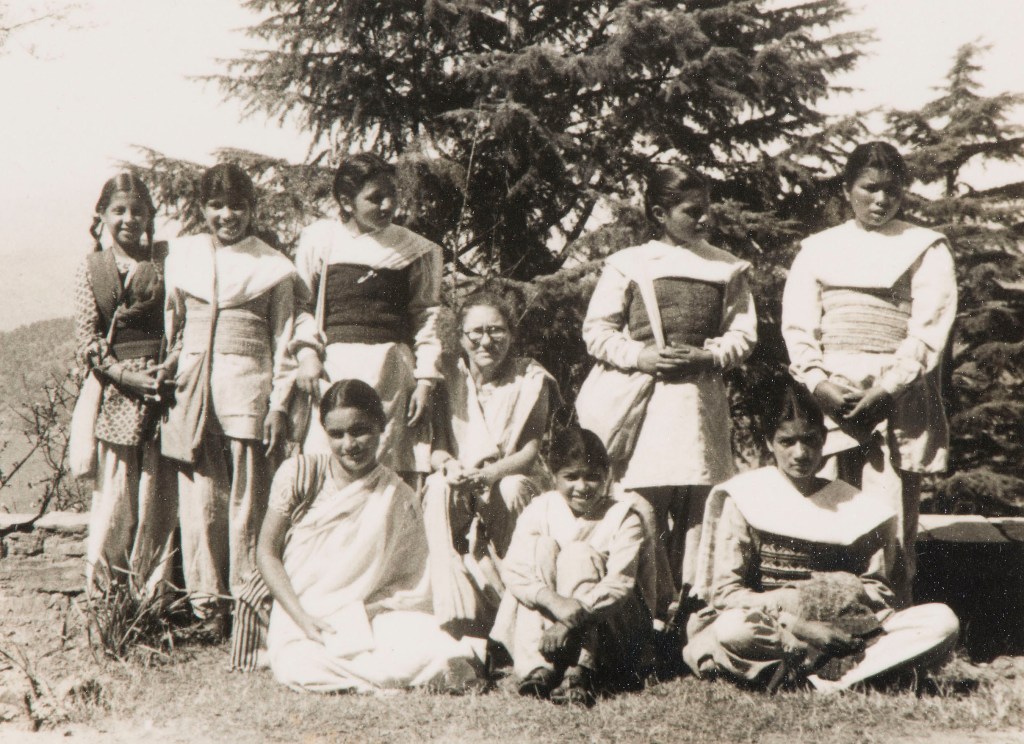
Saralabehn: Gandhian, Educator, Enviromentalist, Feminist

Of the many women who dedicated themselves to Gandhiji’s thoughts and practices, the name of his English disciple Mirabehn (nee Madeleine Slade) is well known. Perhaps not as much written about, but no less inspiring, is the story of his other English follower who took the name Saralabehn.

Catherine Mary Heilman was born in Shepherd’s Bush, London on April 5 1901. Her mother was English and her father was of German origin, who had come to England via France. As a child living in a bi-national and bi-lingual liberal family, When she was in her teens, Catherine was rudely shocked when her German surname led her to be stigmatized during the World War and its aftermath. Her father was wrongly jailed as an enemy, and the young Catherine was not allowed to take part in school activities, and deprived of a scholarship. At sixteen she had to leave her studies and work in an office where the hostility continued.

It was while she was in a London boarding house in 1920 that she met a group of Indians who became her friends. This is when she began to learn and understand something about the nationalist struggle that was going on in India against the imperialist colonial rule. She realised that the way her history books had presented the colonies as the “white man’s burden” was quite different from the accounts she heard from her new friends. She also learnt about the non-violent nationalist struggle that was being led by Mahatma Gandhi. She started following news of the movement as it was evolving in India, and began to empathize with his thinking and practice. As she later wrote: “For the first time in my life, I was exposed to ideas that resonated with me. Every statement uttered and every word written by this individual, Gandhi, clad in just a small dhoti, held true meaning”.  Even as her European friends warned and discouraged her from getting carried away by events that were happening in a country far away, Catherine was planning to go to India herself.

Catherine wrote to Gandhi to request permission to join his work but he was not very encouraging. She continued to explore ways of getting to India. She had no particular skills nor training, so she enrolled for a midwifery course which brought her in contact with English pacifist groups. Before she finished the course she received a letter inviting her to work at a school in Udaipur, so she transferred to a short programme in child education. In January 1932 Catherine finally reached India, and did not go back again.

She started work in Vidya Bhavan in Udaipur; work which along with teaching included manual work in fields, cleaning toilets, washing one’s own clothes and utensils. This gave her a sense of the typical chores that women did, as well as the dignity of labour. But she still did not feel that she had achieved what she had set out for—to participate in Gandhi’s Constructive Programme, which she considered to be “the true foundation of the freedom struggle”. She continued to write to Gandhiji, the man whose pull had brought her to India, but did not hear from him. In the meanwhile Catherine steeped herself in the life and culture of her new home, and at some point also took on the name Saralabehn.

In 1935 Saralabehn visited Mahila Ashram in Wardha. Gandhi was there at the time, and one morning the two finally met. Gandhiji asked her who she was and how long she was staying, and on being told ten days, he assigned her some work. Saralaben relocated to Wardha in 1936 and worked on the education of the girls in the Ashram based on the principles of Nai Talim. In 1941, when her health declined and Gandhi suggested that she move to cooler climes and concentrate on Nature Cure. There was a Gandhian Ashram in a village called Chanauda in the foothills of the Uttarakhand Himalaya and this is where she reached in August 1941.

As her physical health improved, Saralabehn began to get restless. She had her own routine which included learning how to spin Tibetan wool; she started travelling through the villages of the area and learning the local language. She also interacted with the villagers, especially the women, and began to discuss Gandhi’s ideas on Gram Swaraj or village self-reliance. She continued to be active in Gandhi’s nationwide civil disobedience movement.

The British placed her under house arrest for her involvement in the 1942 Quit India Movement. As soon as she was released, she again devoted herself to helping freedom fighters and to further preparations for the freedom movement. Hence in 1944 she was arrested and imprisoned again. After her release Saralabehn returned to her karma bhoomi. Having lived and work in the Kumaon villages she felt that the best way to carry forward Gandhiji’s constructive programme was to establish an educational institution for the local girls.  

A local Indian Civil Service officer offered a cottage which he had named Lakshmi after his wife, for the new venture. Thus was founded the Lakshmi Ashram in 1946. Beginning with three students, Lakshmi Ashram began imparting education based on the principles of Nai Talim—education for economic self-reliance where Hands, Heart, and Head should all develop in Harmony.

As there was no local tradition of sending girls to residential schools, Saralabehn had first to gain the trust of the parents. Saralabehn designed her own syllabi and taught the first girls herself. Her curriculum included science, mathematics, Hindi, history and geography. In keeping with the applied-learning focus of Gandhian education, field work which involved close interaction with the local community and manual labour was an important component. This provided the opportunity of learning directly from villagers, especially women, as well as interactive settings for ashram students and teachers to share information about hygiene and health, as well as social, ecological, and political issues. Students also learned to spin, weave, and sew khadi.

An important step was to make the Ashram self-supporting. Saralabehn and her first students worked together to do all the chores of the Ashram. Milk and yogurt came from their own cows, and they collected fuel wood and fodder from the forest. They dined on vegetables, spices, and fruit that flourished in terraced gardens that they established on the ashram grounds, and prepared simple meals over a wood-burning hearth. They did their own housekeeping and ran a khadi shop and a homeopathic dispensary in a roadside bazaar. The aim of the all-round education and exposure was to teach girls to become self-reliant, self-confident community activists who could meaningfully contribute to the Gandhian ideal of Gram Swaraj.

Lakshmi Ashram grew to accommodate more students. Saralabehn continued to engage herself not only with its programme but also with other movements for similar causes. She journeyed to Bihar to join the Bhoodan movement, which Vinoba Bhave had initiated in 1951. In the early 1970s, she went to the Chambal Valley to work with families of surrendered bandits.

By then many of her early students had themselves taken on unconventional leadership roles, pioneering social and environmental movements especially in the Uttarakhand region. These include the famous Chipko Movement, protests against large dams and strip mining, campaigns against alcoholism, and protecting the forests and natural resources. The important role many of her students played demonstrates how a different type of education can have a powerful impact.

Saralabehn continued to live and work in her adopted country until she passed away on 8 July 1982. She was cremated at Lakshmi Ashram where she lived and worked not just as an educator but as a visionary who helped change lives of Himalayan women, and equally fought for the cause of the environment.

–Mamata

The Post Lady Always Knocks Twice

9 October is marked as World Post Day. As an extension to this, the Indian Department of Post is celebrating 9 to 13 October as National Postal Week.

The last month has been unusual in that we have had more knocks on the door by our post lady than by couriers. In the last few years one had become so used to sending and receiving letters and parcels through courier services that we had almost forgotten what an important part post offices and postal services had played in our lives. In the days of ‘life in the slow lane’ the process of hand-writing letters, finding appropriate envelopes, going to the neighbourhood post office to get stamps, and slipping the letter in the post box afforded a great sense of satisfaction. Equally wonderful was the anticipation of receiving letters of response, and other exciting missives announcing results, admission notices, job interviews, and news from near and far. We didn’t consciously realize it then, but the postal service was an integral part of our life.

The history of the postal communication in India dates back to ancient times of kings who used to convey important messages, especially wartime news, through a relay of runners on foot. During the reign of Emperor Chandragupta Maurya, trained pigeons with small cachets of letters tied to their feet were used to send communications across the vast kingdom. This system of ‘pigeon post’ continued even during the time of Emperor Ashoka. The Mughals used a system of runner services which expanded to include horses. Horses were stationed at relay posts every few miles, and the messages were passed on from horseman to horseman. During the reign of Sher Shah Suri it is believed that there were 3400 horses with riders all along the Grand Trunk Road, for conveyance of news.

Post offices, as we know them, were first established in India by the East India Company. The Company opened its first post office in 1727 and the postal service was administered with the main aim to serve their own commercial interests. The post service was opened to the public in March 1774 with the establishment of the Calcutta GPO. This was followed by the opening of the Madras GPO in 1786, and then the Bombay GPO in 1794, and the Bangalore GPO in 1800.  The Post Offices were manned by the respective District Collectors or military officers acting as ex-officio Postmasters.

In addition to managing the postal services of British India, the Post Office was involved in the transmission of correspondence between England and India. This was done by the sea route, and one way travel time was up to three months. In the 1820s Thomas Waghorn, then a naval officer with the East India Company, investigated a possible overland route between Alexandria and Suez, which could cut down the time to just over a month. It took ten years for the British Government and East India Company to be convinced of the viability of this route, which it subsequently took over.

Lord Dalhousie appointed a Post Office Commission in 1850 and the approved recommendations of Commission were framed as Post office Act XVII, 1854. Under this Lord Dalhousie recognized the Indian Post Offices as separate organization of national importance. 700 Post offices which included what were called 55 Receiving Houses were placed, for the first time, under the unitary control of a Director General, Henry Phillip Archibald Buchanan Riddell, on 1st October 1854. The Head Quarters was at Bengal, and was responsible to Home Department of the Government of India.

Roadways were at the time the main form of transporting post. The first line of postal communication by railway was opened from 18th September 1854. Mail service by steamer was introduced between Calcutta and Port Blair on 28 May 1859. And it was in India that the world’s first official “airmail” was operated on 21 February 1911 when Henri Pequet, a French pilot flew a biplane carrying 6500 pieces of mail from Allahabad to Nainital—a distance of six miles.

The Indian Postal Service has come a long way since then, to become the world’s largest postal network managing more than one-and-a-half lakh post offices. The postal department has met the challenges of India’s diverse geography, catering innovatively to remote areas. There is a floating post office in a houseboat on the Dal Lake in Kashmir; and the world’s highest post office in a small cottage in Hikkim district in Himachal Pradesh. The Nagpur Post Office is located in a large Victorian-style heritage building which accommodates the post master’s residence, a parcel hub, a postal depot, a recreation club, and a canteen. And there is a small metal post box among the tea plantations of Munnar in Kerala which has been used for a hundred years now. Known simply as Postal Number 9, the oldest postal number in the country, the post office continues to deliver mail to thousands of plantation workers. 

The Indian Postal Service does much more than delivering mail. It offers a range of other services that help reach out to people and places which do not have access to variety of institutions like banks and other agencies. The post office remits money in the form of money orders (which is the only way of sending money for many Indians). The Postal Department also offers a variety of small savings schemes. It provides life insurance coverage under Postal Life Insurance and Rural Postal Life Insurance. It also plays an important role in discharging government services such as payment of pensions to senior and retired citizens. Wages under government welfare MGNREGA are also distributed through post offices. During the COVID lockdown the red postal vans were even used to deliver medical equipment like N95 masks, medicines, test kits and ventilators across states as part of their “essential services”.

My family has had pleasant experiences with India Post in the past few years. From efficient despatch and delivery of parcels both within the country, and even overseas (all the way to New Zealand!), to the Speed Post with its online Track and Trace (that is sometimes overzealous in informing about the journey of the post), it is indeed a service that calls for respect. This year we could also avail of the home visit by Postal Staff for taking biometrics of my 97 year-old father-in-law for his Jeevan Praman (Life Certificate for continuing pension).    

No wonder then that the post office (dak khana) and the postman (dakiya) on his trusted bicycle were always a component of “village life” in stories and movies in the past. Even today, when we get message on our phone that Tinuben our post lady is on her way to deliver a speed post, we await her scooter and her knock on the door. From pigeon post to speed post, India Post has come a long way indeed!

–Mamata

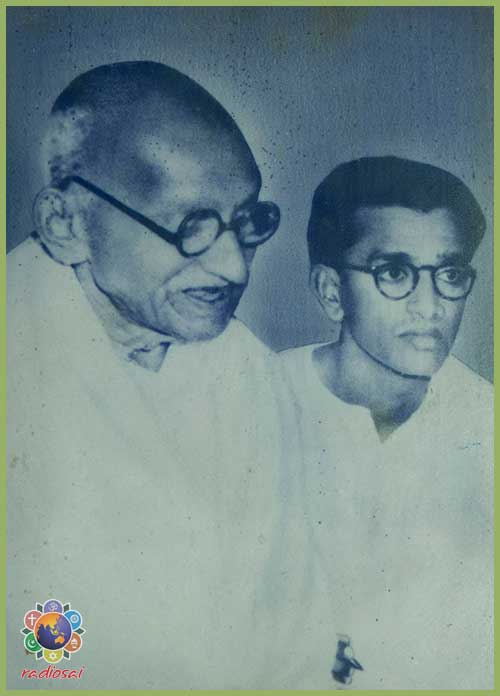
Gandhiji’s Amanuensis: V. Kalyanam

When one thinks of Gandhiji’s personal secretary, the name that immediately comes to mind is that of Mahadev Desai, also one of Gandhi’s close associates. Not as well-known is V. Kalyanam who worked as Gandhiji’s personal secretary after Mahadev Desai passed away, and remained with him until the end of Gandhi’s life. Kalyanam’s story is worth sharing.  

Like many people from South India in the early 1900s, Venkatram had moved to Delhi in 1914. This was where jobs could be found, working for the British government where the South Indian work ethic and knowledge of English were appreciated. Venkatram married Meenabal, and the young Tamil couple settled in Delhi. On 15 August 1922 a son was born to them; they named him Kalyanam.

In those days the entire apparatus of government used to work in Delhi for part of the year and move to the cooler climes of Shimla during the hot summer months. So also Venkatram’s family, with their son Kalyanam, who spent his school days shuttling between Delhi and Shimla. After school he studied at the Shri Ram College of Commerce in Delhi. Upon graduation the young man also found a job with the British government.

Kalyanam grew up as a thoroughly anglicized and faithful servant of the British, till then more or less oblivious of the growing nationalist movement in the country. Having started work, he took to reading the newspapers and found that they were full of news about a man called Mohandas Karamchand Gandhi. He wondered why this man was so adamant to free India from British rule. The Quit India movement had just started, but Kalyanam had no interest nor inclination for what was happening around the country. However on request of some South Indian friends, he agreed to help them to secretly slip some anti-British pamphlets under doors at night. Young Kalyanam had not read the pamphlets himself, but one night he was arrested by the British police and accused of treason. He ended up spending nine months in Lahore jail. After his release he returned home to find that he had lost his government job, but he found work in an insurance company. Little did he know that his life was very soon going to take him on quite another path.

During this time he was introduced to Gandhji’s son Devdas Gandhi who was also C. Rajagopalachari’s son-in-law. Young Kalyanam expressed his frustration at his secretarial job, and his love for all kinds of manual work, Devdas suggested that he go to Sevagram Ashram. Kalyanam knew nothing about the Ashram, nor did he then know about Devdas’ link to Gandhiji. But he was willing to visit what he thought was a spiritual Ashram, and luckily his boss gave him 2 months leave to do this.  Around the same time he accompanied his British Boss’s wife to a Khadi shop in Chandni Chowk. Here bought a handkerchief and towel for three rupees and a kurta pyjama for nineteen rupees. From that day onwards he never wore any western clothes.

In October 1943, Kalyanam arrived in Wardha after a two-day train journey, and presented himself to the manager of Sevagram ashram, still not knowing anything about the place. Gandhiji himself was at the time interned at the Aga Khan Palace in Pune. Kalyanam’s introduction to the very frugal and basic living conditions was an eye-opener for the city-bred boy. In addition to the common chores, everyone in the Ashram had the specific duties. As he knew good English, Kalyanam was assigned the work of segregating by language the many letters that arrived for Gandhi every day, from every part of the country and the world. The first lesson he was taught was how to open the envelopes in such a way that the unused side could be used by Gandhi for writing!

Kalyanam finally met Gandhi in Bombay when he was released from jail for medical treatment. He was introduced as “the Madrasi boy sent by Devdas.” Gandhiji was weak and ill, but he asked Kalyanam many questions. The last one was whether he could type. Kalyanam was surprised because he assumed that he was at the Ashram to do menial work that he enjoyed, and to avoid the secretarial work that he hated. But he admitted that yes, he could type, and that he was fluent in English and Hindi, as well as versed in Tamil.

Once more, Kalyanam’s life was about to take an unplanned turn. Gandhiji’s long-time and faithful personal secretary Mahadev Desai had passed away in prison in 1942; and Gandhiji saw in this young man a possible replacement. Kalyanam returned to Sevagram, and awaited Gandhi’s return on 1 October 1944. From that day on Kalyanam’s life changed. Till then he had been working in the garden and fields most of the time, but now he was assigned a new job as the Mahatma’s stenographer.  

With that he also became a part of Gandhiji’s daily routine which started at four o’clock every morning. Kalyanam’s job was to segregate the hundreds of letters by language, give each letter to Gandhi and take dictation for the replies that Gandhi personally gave for each letter. He then had to type the English letters, and give them back to Gandhi to correct. This was done from 5 to 6 every morning, except on Monday when Gandhiji observed the vow of silence. On this day he would write notes for Kalyanam, who found it hard to decipher his handwriting. Kalyanam recalled that he never saw Gandhi read a book. He did not read the daily newspapers either. It was Kalyananm’s duty to read the papers and type the important items on a piece of paper and place it before Gandhiji. His other duties included accompanying Gandhiji wherever he went and noting every word he said, replying to correspondence, scheduling interviews, preparing his English speeches and coordinating with the press. Kalyanam was on-the-job, as it were, from the time Gandhiji woke up till he went to bed at 9 pm. But as he recalled, he never felt tired as everything he did was interesting. Although it certainly did have many moments that challenged the young assistant.

One incident as recalled by him was when he was on the train with Gandhi; being his day of silence, Gandhiji drafted a note and gave it to Kalyanam to type. Kalyanam thought that this could be done when the train reached is destination. But in the evening Gandhi asked him for the letter and Kalyanam confessed that he was not carrying his typewriter. Gandhiji was not pleased. He muttered “When I send for a barber, I expect him to bring his tools.” Kalyanam somehow managed to get it typed on a typewriter belonging to some journalists who were travelling on the train.

Kalyanam remained as Gandhii’s personal secretary from 1944 till the minute  Gandhji breathed his last on 30 January 1948. Every moment of those four years were a unique learning experience for Kalyanam; and the frugal habits, discipline and commitment to a cause that were planted in those days became a way of life for him for the rest of his long life, until he passed away at the age of 99 years on 4 May 2021.

At the age of 93 years, V.Kalyanam had shared many reminiscences of his years with Gandhi with author Shobha Warrier, and these were published as a book titled His Days With Bapu: Mahatma Gandhi’s Personal Secretary Recalls. A fascinating and inspiring read. 

–Mamata

Inspired by Gandhi: Lal Bahadur and Lalita Shastri

October 2 is the birth anniversary of two greats who contributed to the building of modern India—Mahatma Gandhi and Lal Bahadur Shastri. The celebration of the first has always overshadowed the second (though with each passing year, both are fading from memory).

To make up, here are some gleanings building on a biography of Shastri that I recently had the opportunity to read (Lal Bahadur Shastri: Politics and Beyond. Sandeep Shastri–not a relative by the way, only an ardent admirer).

Shastri’s father was a school teacher and later clerk in government service. Sadly, he died when Lal Bahadur was barely 18 months old. His mother, the daughter of a teacher, moved back to her maternal house where the children grew up.

Shastri’s family was not particularly active in the Freedom Movement, but he was highly influenced by a teacher, Nishkameshwar Prasad Mishra, who was passionately involved in the Movement. Inspired by his teacher, young Lal Bahadur started reading the works of national leaders, and after attending a meeting addressed by Gandhiji and Madan Mohan Malaviya, he dropped out of school just 3 months before his Std. 10 exams,  to join the independence struggle. He later graduated in Philosophy and Ethics from Kashi Vidyapith, where ‘Shastri’ was the degree given, which then became attached to his name!

As a member of the Servants of the People Society, he worked under the guidance of Gandhiji for the betterment of Harijans. Under the Mahatma’s influence, he also became a member of the Indian National Congress 1928, and went on to play a leadership role in the organization and during various phases of the struggle, including the Quit India movement.

After Independence, he went on to the Central Government after a short stint in UP. He went on to hold several portfolios, before becoming the Prime Minister in 1964.

A few snippets and facts which are not widely known:

Shastri is known for the slogan ‘Jai Jawan, Jai Kisan’. But his respect for business people was no less. Exhibiting a very modern understanding of the linkages between business and society, as far back as 1965 he said businessmen had ‘an even greater role than that of an economist and the politician. Too often the community views the businessman’s aims as selfish gain.. (That) impression can be removed only when business becomes fully alive to its social responsibilities.’

He was the one behind India’s White Revolution–the national campaign to increase the production and supply of milk. It was his political leadership that saw the Amul milk co-operative take shape, and the creation of the National Dairy Development Board.  

Lal Bahadur married Lalita Devi in 1927. She too was an ardent Gandhi follower and lived a very simple life. Her unstinting support to her husband enabled him to live a life of service to the nation.

This story is a beautiful illustration of Lalitaji’s high ideals and principles.

Once when Shastri was in jail, he learnt that Lalita was unwell. He wrote to her, asking her to take a glass of milk every day. The reality was that the household was very short of money, and she just could not afford a glass of milk for herself. But she did not want to trouble her husband by telling him this. So she found an ingenious way to do what her husband wished. She found a tiny glass, such as used to feed infants, and took milk in this every day. She wrote to her husband that she was doing as he wished. It was only much after his release that he learnt about this. He was amazed by how she stuck to the truth and still helped him stay him untroubled by the everyday problems so that he could focus on his work.

To such people of integrity and principles do we owe our freedom. Every day the thought should trouble us as to whether we are living up to their vision.

–Meena


Thanks, but No Thanks: Awards Declined

Last week I was ruminating on KK Shailaja and her refusal of the Magsaysay award. She is not alone. There are several people across the world who for principles or personal choices refuse awards.

Arguably the most prestigious award in the world is the Nobel. But there are two people who have refused the Noble too.

The first was the author Jean-Paul Sartre, who in principle refused all official awards. He declined the 1964 Literature Prize, stating: ‘A writer must refuse to allow himself to be transformed into an institution, even if it takes place in the most honourable form.’

The other person who refused the Nobel was Le Duc Tho of North Vietnam. He and Henry Kissinger were awarded the 1974 Peace Prize together  ’for jointly having negotiated a cease fire in Vietnam in 1973’. However, Le Duc Tho refused the award ‘on the grounds that his opposite number had violated the truce’. He said ‘peace has not yet been established’.

Russian mathematician Grigori Perelman’s reason for declining the Fields Medal, considered the Nobel of mathematics, was similar to Jean-Paul Sartre. He said that he had no interest in money and fame and did not want to be on display like a zoo animal. Considering that the inaugural award was $1-million, that was a brave stand.

Arundati Roy
Arundati Roy

Protest against governments is often a reason to refuse awards. For instance, Arundhati Roy, Booker-winning novelist, refused the Sahitya Akademi Award for her collection of political essays  The Algebra of Infinite Justice saying she could not accept an award from an institution supported by the Indian government, whose policies on “big dams, nuclear weapons, increasing militarization and economic liberalism” she disagreed with.

Chinua Achebe
Chinua Achebe

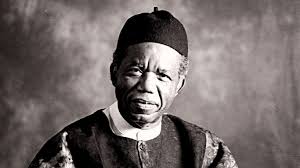
Another author who refused an award from his government was the renowned novelist Chinua Achebe. Nigeria offered him the ‘Commander of the Federal Republic’. But Achebe in a letter to the then-president Olusegun Obasanjo expressed his great discomfort with events in Nigeria. His letter said ‘I had a strong belief that we would outgrow our shortcomings under leaders committed to uniting our diverse peoples. Nigeria’s condition today under your watch is, however, too dangerous for silence.’ He again turned down the honour again in 2011

Not against the government, but Marlon Brando registered his protest against the establishment—in this case Hollywood. He refused the Oscar for Best Actor for the film Godfather in 1973, citing the ill-treatment of native Americans by the film industry as the reason.

Several Indians have refused the government’s high honours for several reason.  Maulana Abul Kalam Azad, freedom fighter and our first Education Minister declined the honour, taking the principled stand that those who were on selection committees for national honours should not themselves receive them.

PN Haksar bureaucrat and diplomat who served as Principal Secretary to the PM was offered the Bharat Ratna in 1973 specially in the light of his role in brokering the Indi-Soviet Treaty of Friendship and Cooperation, as well as the Shimla Agreement. He declined saying ‘Accepting an award for work done somehow causes an inexplicable discomfort to me’. Some other civil servants have also taken this stand.

A communist who probably set the standard for KK Shailaja was EMS Namboodiripad, General Secretary of the CPI (M) and the Kerala’s first Chief Minister who declined the 1992 Bharat Ratna–he said it went against his nature to accept a state honour.

Some others like Swami Ranganathananda have declined awards because it was given to them as individuals, and not to the organizations that they were part of—in this case, the Ramakrishana Mission.

Two prominent journalists—Nikhil Chakravarty and K. Subrahmanyam (who was also a civil servant)—refused Padma Bhushans because they thought it was not appropriate for journalists to accept awards from the government. As Nikhilda put it ‘journalists should not be identified with the establishment.’

Romila Thapar the distinguished historian refused to accept the Padma Bhushan twice. Her stand was that she would accept awards only ‘from academic institutions or those associated with my professional work.’

Several distinguished people have refused or returned honours due to specific incidents, as a mark of protest against the government. These include Hindi author and parliamentarian Seth Govind Das, and Hindi novelist and playwright Vrindavan Lal Varma, both protesting against the amendment of the Official Languages Act to allow for the continued official use of the English language. The famous Kannada novelist Shivram Karanth  returned his award to protest against the declaration of Emergency. PM Bhargava, scientist and founder-director of Centre for Cellular and Molecular Biology returned his award in protest of the Dadri mob lynchings and out of concern at the ‘prevailing socio-political situation’ in the country. Prakash Singh Badal ex-CM Punjab, and SS Dhindsa leader of the Shiromani Akali Dal (Democratic) party, returned their awards to show their support to the Farmers’ protests.

Some return awards because they feel the recognition has been delayed too long, or because they feel that people junior to them have been recognized before them. These include playback singer S. Janaki who felt it came too late. Sociologist GS Ghurye refused his award because he felt that people who had contributed less had been given more prestigious awards.

Whatever the reasons, when people of achievement refuse or return awards, governments and establishments need to seriously listen to the reasons. If they think the person is worth honouring, surely the point that they make by refusing the award must be worth listening to?

–Meena

Celebrating the Gurus: Teachers’ Day

Rabindranath Tagore was the one who gave Gandhiji the title of Mahatma. Gandhi in turn called him ‘Gurudev’ in reverence to his wisdom and his learning, and saw him as a teacher to humanity.
Gurudev and Radhakrishnan at Shantiniketan where Oxford Univ held a special convocation in 1940 to honour Tagore
Gurudev Rabindranath Tagore gave India a different vision of education, of teachers and the teaching process. It is appropriate to remind ourselves of his views on these subjects on the occasion of Teachers’ Day, Sept 5. Trying to paraphrase him would be useless.  So better, I thought, to share a few quotes:
About teachers:
‘A teacher can never truly teach unless he too continues to teach himself. One lamp can never light another unless it continues to burn its own flames. Similarly, the teacher who has come to the end of his subject, and has no living traffic with his knowledge but merely repeats his lessons to his students, can only burden their minds, he cannot inspire them.’
‘Good teachers activate children’s minds instead of helping them to assimilate and collect information, and inspire children through their own self-development. They encourage them to work on the teacher’s own original projects and thereby travel together on their journey to more understanding.’
Gurudev always looked for gurus for his schools and educational institutions, rather than teachers. According to him, gurus are ‘active in the efforts to achieve the fullness of humanity”. They ‘will give their whole selves to their students instead of merely sharing the material as prescribed by the curriculum’.
His message to teachers:
‘Do not be preoccupied with method. Leave your instincts to guide you to life. Children differ from one another. One must learn to know them, to navigate among them as one navigates among reefs. To explore the geography of their minds, a mysterious instinct, sympathetic to life, is the best of all guides.’
He wanted teachers and school administrators to recognize the importance of letting children discover the joy of learning and what nature has to teach them. Nothing sums this up better than an excerpt from a lecture he gave in London in 1933, where he recounts one of his encounters with a more ‘traditional’ educator:
‘I well remember the surprise and annoyance of an experienced headmaster, reputed to be a successful disciplinarian, when he saw one of the boys of my school climbing a tree and choosing a fork of the branches for settling down to his studies. I had to say to him in explanation that ‘childhood is the only period of life when a civilized man can exercise his choice between the branches of a tree and his drawing-room chair, and should I deprive this boy of that privilege because I, as a grown-up man, am barred from it?’ What is surprising is to notice the same headmaster’s approbation of the boys’ studying botany. He believes in an impersonal knowledge of the tree because that is science, but not in a personal experience of it. This growth of experience leads to forming instinct, which is the result of nature’s own method of instruction. The boys of my school have acquired instinctive knowledge of the physiognomy of the tree. By the least touch they know where they can find a foothold upon an apparently inhospitable trunk; they know how far they can take liberty with the branches, how to distribute their bodies’ weight so as to make themselves least burdensome to branchlets. My boys are able to make the best possible use of the tree in the matter of gathering fruits, taking rest and hiding from undesirable pursuers. I myself was brought up in a cultured home in a town, and as far as my personal behaviour goes, I have been obliged to act all through my life as if I were born in a world where there are no trees. Therefore I consider it as a part of education for my boys to let them fully realize that they are in a scheme of existence where trees are a substantial fact, not merely as generating chlorophyll and taking carbon from the air, but as living trees.Ideal Teachers: Gurus vs. Schoolmasters.’
On Teachers’ Day, as we commemorate Dr. S. Radhakrishnan, another of India’s great educators, let us think about what education means in this changing world, and how the role of teachers must evolve.
–Meena

Sweet Offerings

Meena’s biscuit trail led me to look into the history and story of what is perhaps one of the favourite pan-Indian sweets—the modak or laddoo. This seemed appropriate in a week marked by the preparing, offering and the partaking of this sweet for Ganesh Chaturthi.

The connection between the elephant-headed God and his love for modaks can be traced back to ancient lore and legends. One story goes thus. One day, Anasuya, the wife of the ancient rishi Atri invited lord Shiva, his wife Parvati, and their baby son Ganesha for a meal. Shiva was ready to start eating but Anasuya said that the adults could eat once the Bal Ganesha was fed. She laid out a sumptuous spread, and Ganesha immediately started to partake of the goodies. He ate and ate everything that was before him, but just did not seem to have had enough. His parents and hostess looked on in wonder. Anasuya then went in and brought a single piece of sweet and offered it to the seemingly ever-hungry Ganesha. As soon as he ate it, Ganesha let out a loud burp. At last, he was sated! At exactly the same time, by now  the very-hungry Shiva also burped 21 times. Parvati was curious to know what this wonder sweet was that seemed to have satisfied the hunger of both father and son. Anasuya told her that it was a modak. Thereafter Parvati expressed her wish that all devotees of Ganesha should offer him 21 modaks. This tradition has carried on to this day.  

While the traditional modak recipe is said to have its origins in Maharashtra, modaks  are prepared across India in a variety of ways, and are known by various names– mothagam or kozhukattai in Tamil, modhaka or kadubu in Kannada, or modakam or kudumu in Telugu. Modaks are made both by steaming, and by frying. Their traditional recipe includes fillings of grated coconut and jaggery with a hint of cardamom or nutmeg, encased in a covering made of flour.

Churma laddoo

While in several parts of India, modak refers to the steamed and stuffed version, in some states like Gujarat the word modak and laddoo are synonymous. The word laddoo is used to refer to the spherical sweet primarily made from flour, ghee, and sugar or jaggery. Laddoos themselves have a long history, both in lore as well as in the culinary culture of India.

An interesting folktale traces the origins of what may have caused the difference between laddoo and modak. The story goes that Ganesha’s maternal grandmother Queen Menavati used to indulge her grandson by feeding him with laddoos that she made. As he grew, his appetite for the sweet was insatiable. Grandmother could not keep up with his endless capacity to gobble them down, especially as making  laddoos is a laborious and time-consuming process, as each ball has to be individually moulded and set . She thought that by making a similar stuffed sweet that could be steamed together in larger numbers would hasten the process. Her grandson was equally delighted with this variation. And thus came about the steamed modaks, and Ganesha’s moniker Modakpriya—lover of modaks.

The history of laddoos can be traced back a long way. The term ladduka first finds mention in the Mahabharata. Sushruta Samhita the classical Sanskrit text on medicine and surgery also has references to laddoos. It is believed that Indian physician, Sushruta, used ladoos as an antiseptic to treat his surgical patients. In the 4th century BC, he used a concoction of ingredients like sesame seeds, jaggery and peanuts which had nutritional properties, to make laddoos which provided strength and energy. Even today new mothers and pregnant women are given laddoos with special additional herbs and seeds to boost their immunity, and improve lactation. Old texts also mention laddoos being carried during long journeys, and wartime because of their long shelf life.  

The wonderful diversity of culinary traditions across India has led to a mouth-watering array of ‘speciality’ laddoos made with different ingredients. Over the years, people from different communities started experimenting with the ingredients and replaced them with whatever was readily available in their region. Other elements like geography, weather and diets of communities also play a significant role. For example laddoos with gond (edible gum) are eaten in winter as they are believed to give warmth and energy. The Sankranti festival in Gujarat is incomplete without the variety of laddoos made from seasonal ingredients like sesame, peanuts and jaggery. 

From the besan laddoos which are common to several states, the boondi or motichur laddoo that is originally said to hail from Rajasthan and Uttar Pradesh, churma laddoo from Gujarat and Rajasthan, coconut ladoo and rava laddoo from the southern states, the Assamese black sesame laddoo–each region-specific laddoo has its distinct identity, and has specific associations with the local traditions and culture.

The laddoo also has associations with celebrations. While traditionally the partaking of laddoos is a part of certain festivals, the distribution and sharing of laddoos is an important part of any happy or auspicious occasion—an engagement, a wedding, the birth of a baby, exam results, a new job appointment. All “good news” was heralded by sending and receiving a box of laddoos.

Times are changing though. In urban areas, the time-honoured tradition is now being represented by boxes of designer chocolates, and gift hampers with imported goodies. Celebrity chefs are conjuring up fusion recipes for old sweets to create innovative desserts. And yet, for many of us, there is sense of nostalgia and comfort that the very word laddoo or modak brings. For me it evokes memories of my mother-in-law’s literal labour of love in making trays full of churma laddoos coated with poppy seeds, family feasts where these were consumed with gusto, and the wonderful feeling of being happily replete before sinking into a deep siesta. A modak by any name tastes just as sweet!

–Mamata