
Slimy, sneaky, slithering, scaly, creepy, fanged and deadly, these are some words that are used to describe snakes. These members of the natural world are rarely bestowed with the more complimentary adjectives that their walking, leaping, swimming fellow members often are. Thus, snakes are universally feared, avoided, badmouthed, and when encountered, the first instinct is to eliminate them.
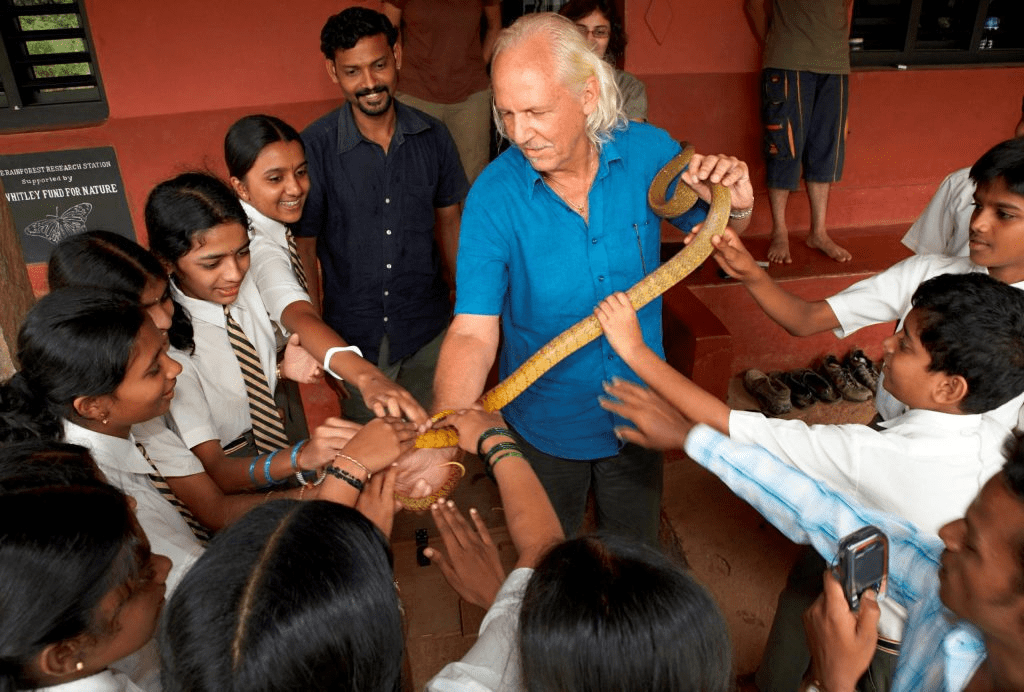
Fortunately, every snake has its day, and July 16 it is. This is celebrated as World Snake Day, a global observance which aims to reduce this negative stigma, dispel common myths, and highlight the ecological significance of these species. This day brings to mind my own journey of learning about snakes, and the person who sparked it. And to celebrate Romulus Whitaker who was one of the earliest champions of the snakes in India.
My snake story began probably in the first week that I started my career as an environmental educator. As part of our orientation, we went to Sundarvan, a small animal park with a collection of snakes. There we saw a Snake Show, as part of which, we were asked to touch a snake! The snake was a Red Sand Boa—a non-venomous snake. For someone who was, at that time, far from being a passionate wild-lifer, this was indeed an experience that served to dispel the many myths that one had grown up with. One of these were that snakes were “slimy”, and to be avoided at all costs. The skin of the sand boa felt dry and smooth, and we learnt that most snakes are in fact non-venomous.
And there began my long and fascinating journey in the natural world. A journey along which I had the most wonderful encounters with some of India’s best known naturalists and educators. One of these was Romulus Whitaker–the Snakeman of India.
Not so long after my induction by snakes, Romulus himself came to CEE and fascinated us with snake tales and the importance of breaking the myths that associated snakes with all things creepy and vile, and communicating the vital role of snakes in the ecosystem, especially as friends of farmers because they eat the rats that destroy crops.
A little later, Romulus graciously accepted to write a piece for a book that Meena and I were editing. In this he recounted how his early childhood years were spent exploring the fields and forests of northern New York State where he was born. Even as a toddler he was catching bugs and spiders, and soon graduated to catching snakes and keeping them in a terrarium in his room. At that point he was equally into dinosaurs and did not imagine that reptiles would one day become his passion as well as his profession. He was seven years old when his family moved to India. He recalled how “the snake charmers at Juhu Beach in Bombay were my first tutors but it wasn’t long before I outgrew their mixture of magic and nonsense.” His school days spent in Kodaikanal, amidst forests, gave him ample opportunity to roam in the wilderness. He returned to the United States for college studies, where he also worked at the Miami Serpentarium, then the biggest snake venom production lab in the world.
Romulus’s own journey is a testament to how a childhood fascination can grow into a not only a profession, but also a meaningful lifelong mission to champion the snakes. In his own words: So you see, that a child’s single-minded interest in creatures that most people think are slimy and scary can develop into a profession that is totally fulfilling. My own, very self-centred fascination with reptiles has grown by leaps and bounds and resulted in the Snake Park, Croc Bank and exciting educative films. These are ways of sharing a love and passion for the creatures that have given me such an enjoyable life.
When he returned to India, Romulus was determined to set up a serpentarium, and start a long-term study of reptiles. In the meanwhile, he also had to earn a living. He started writing articles for newspapers and magazines, often accompanied by a photo. He also started writing his first scientific notes on interesting things that he had observed about reptiles for the Journal of the Bombay Natural History Society. At the same time, he was also scouting around for a place to start a Snake Park; Madras (now Chennai) seemed to be the best choice. As he recalled: “To make a long story very short, I badgered and bothered people in the Forest Department and the Secretariat in Madras and finally got permission to set up India’s first Snake Park within beautiful Guindy National Park, the green heart of the city.” The Snake Park was attracted a lot of visitors who had the opportunity of observing snakes at close quarters, as well as knowing more about these usually maligned creatures.
Romulus’s real knowledge about snakes came from the Irula, an indigenous community of traditional snake catchers of Tamil Nadu. They became his friends and mentors, sharing their experience in every aspect of these reptiles—from finding and catching them unharmed, to snake bites. While studying incidents of snakebites in India, Whitaker discovered that numerous lives were lost due to inadequate production and distribution of anti-venom serum. That is when he mobilised the Irula community to form a snake catchers’ cooperative, who under licenses from the Wildlife Department, extract and freeze-dry venom from snakes and sell it to anti-venom producing laboratories before releasing the snakes back into the wild.
His passion to show and tell more people about reptiles led Romulus to start making documentary films. Rom was aware that films were a medium that could reach out to large audiences. Rom teamed up with two school friends John and Loise Riber, and a young filmmaker Shekar Dattatri to make a film on India’s snakebite problem. Made on a shoestring budget, the film Snakebite went on to win several awards. Later many of his films were supported by National Geographic Television, and have won international awards.
Romulus Whitaker has won many accolades including an Emmy Award, Whitley Fund for Nature Award, Rolex Award for Enterprise, Peter Scott Award for Conservation Merit, Salim Ali Award for Nature Conservation. In 2018 Romulus was awarded the Padma Shri for nature conservation.
In one of the interviews following the award Romulus said “I believe that touching a snake opens people’s minds and changes it forever.” I personally can totally vouch for that!
Thank you Romulus Whitaker for helping to open a new world not just for me, but for generations of young people. And for being a lifelong champion of the snakes.
–Mamata

