Every year, 26 June is observed as International Amber Day, a celebration of one of nature’s most extraordinary creations. Unlike gemstones that are forged under immense heat and pressure deep within the Earth, amber begins life as something far more ordinary—sticky tree resin. Over millions of years, this resin hardens and fossilizes into a warm, golden substance that has fascinated people across cultures for thousands of years.
Amber is often called “sunshine trapped in stone.” Its rich honey, butterscotch, cognac, and cherry hues have inspired myths, jewellery, medicine, scientific discoveries, and one of history’s greatest unsolved mysteries—the disappearance of the legendary Amber Room.
Nature’s Time Capsule
Amber is not tree sap, as is commonly believed. Sap carries water and nutrients within a tree. Resin, on the other hand, is a protective substance produced when a tree is injured, sealing wounds and defending against insects and disease.
When resin flows over small insects, spiders, feathers, leaves, flowers, or even tiny lizards, these organisms can become trapped. If conditions are just right, the resin is buried under sediments and, over millions of years, transforms into amber. Unlike most fossils, which preserve bones or shells, amber often preserves entire organisms in astonishing three-dimensional detail.
These inclusions make amber invaluable to scientists. Tiny air bubbles reveal the atmosphere of prehistoric forests. Preserved pollen helps reconstruct ancient ecosystems. Even microscopic bacteria and fungi have survived inside amber for tens of millions of years.
For palaeontologists, amber is less a gemstone than a perfectly preserved archive of life on Earth. In fact, amber entered popular imagination through Jurassic Park, whose opening premise is that a mosquito that had fed on a dinosaur millions of years ago becomes trapped in sticky tree resin, which later fossilizes into amber, supposedly preserving the dinosaur’s blood—and its DNA—inside the mosquito’s abdomen. Scientists in the story use this DNA to clone dinosaurs, making amber the unlikely hero of one of cinema’s most iconic scientific adventures. While the preservation of insects in amber is entirely real, the survival of usable dinosaur DNA for 66 million years is not supported by modern science. Even so, the film brilliantly transformed a little-known fossil into a symbol of prehistoric mystery, inspiring countless people to take an interest in palaeontology and the natural world.
The Gold of the Baltic
Although amber is found in several parts of the world—including Myanmar, the Dominican Republic, Mexico, Canada, and even parts of India—the finest and most abundant deposits occur around the Baltic Sea.
For over 5,000 years, Baltic amber travelled across Europe through the famous Amber Road, an ancient trade route linking northern Europe with the Mediterranean. Long before the Silk Road became famous, merchants carried amber southwards in exchange for wine, glass, spices, and precious metals. The Romans valued amber so highly that it sometimes fetched prices exceeding those of gold by weight.
Many cultures also believed amber possessed healing powers. It was worn to ward off illness, ground into powders for medicine, and even carried as a protective charm.
The Eighth Wonder of the World
If amber itself is remarkable, its most famous artistic creation was extraordinary.
The Amber Room was one of the most lavish interiors ever built.
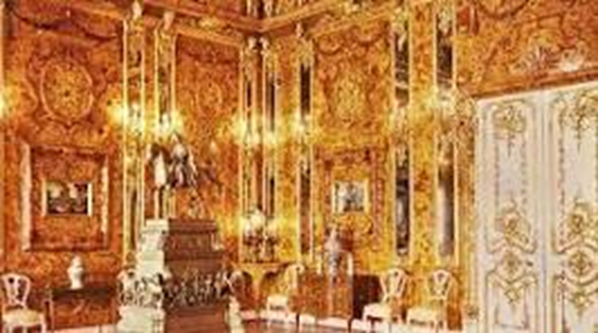
Constructed in the early eighteenth century in the Kingdom of Prussia, it featured over six tonnes of amber painstakingly carved into intricate decorative panels. Craftsmen combined amber mosaics with gold leaf, mirrors, gemstones, and exquisite carvings to create walls that glowed with warm golden light.
In 1716, Frederick William I presented the room as a diplomatic gift to Peter the Great, symbolizing growing ties between Prussia and Russia.
The room was eventually installed in the magnificent Catherine Palace, where generations of visitors marvelled at what many described as the “Eighth Wonder of the World.”
Sunlight reflecting from thousands of amber tiles created an almost magical glow unlike anything else in European architecture.
A Treasure Lost During War
The Amber Room’s greatest chapter is also its saddest.
During the Second World War, German forces invaded the Soviet Union in 1941. Conservators attempted to protect the fragile amber panels, but the material had become too brittle to dismantle safely. Instead, they covered the room with wallpaper in the hope that occupying forces might overlook it.
The attempt failed.
Specialist German units removed the entire room in just over a day, packed it into dozens of crates, and transported it to the Königsberg Castle, where it was publicly displayed once again.
Then, it vanished.
As Allied bombing intensified and the war drew to a close, the Amber Room disappeared. Whether it was destroyed in fires, hidden in underground bunkers, loaded onto ships that later sank, or concealed in forgotten mines remains unknown.
Despite decades of investigations across Germany, Poland, Russia, and the Baltic region, no verified trace of the original Amber Room has ever been found.
The mystery has inspired countless books, documentaries, archaeological expeditions, and treasure hunters. Every few years, reports emerge claiming that the room has finally been located in caves, tunnels, castles, or shipwrecks. None has yet been confirmed.
The Amber Room remains one of the greatest missing treasures of the twentieth century.
Recreating a Masterpiece
The story, however, did not end with its disappearance.
In 1979, Soviet conservators embarked on an ambitious project to recreate the Amber Room using surviving photographs, architectural drawings, and traditional amber-working techniques.
The painstaking restoration took more than two decades. Craftsmen had to relearn skills that had nearly disappeared, sourcing thousands of kilograms of Baltic amber and hand-carving each decorative panel.
The reconstructed Amber Room was formally inaugurated in 2003, coinciding with the 300th anniversary of Saint Petersburg.
Visitors today can once again experience something close to the original splendour, even though the fate of the authentic masterpiece remains unknown.
Why Amber Still Matters
On International Amber Day, perhaps the greatest lesson is that the most valuable treasures are not always those that glitter the brightest. Sometimes they are those that preserve the memories of worlds long gone—whether hidden inside a tiny fossilized drop of resin or concealed somewhere, perhaps still waiting to reveal the final chapter of the Amber Room’s remarkable story.
–Meena
PIC: SMITHSONIAN MAGAZINE