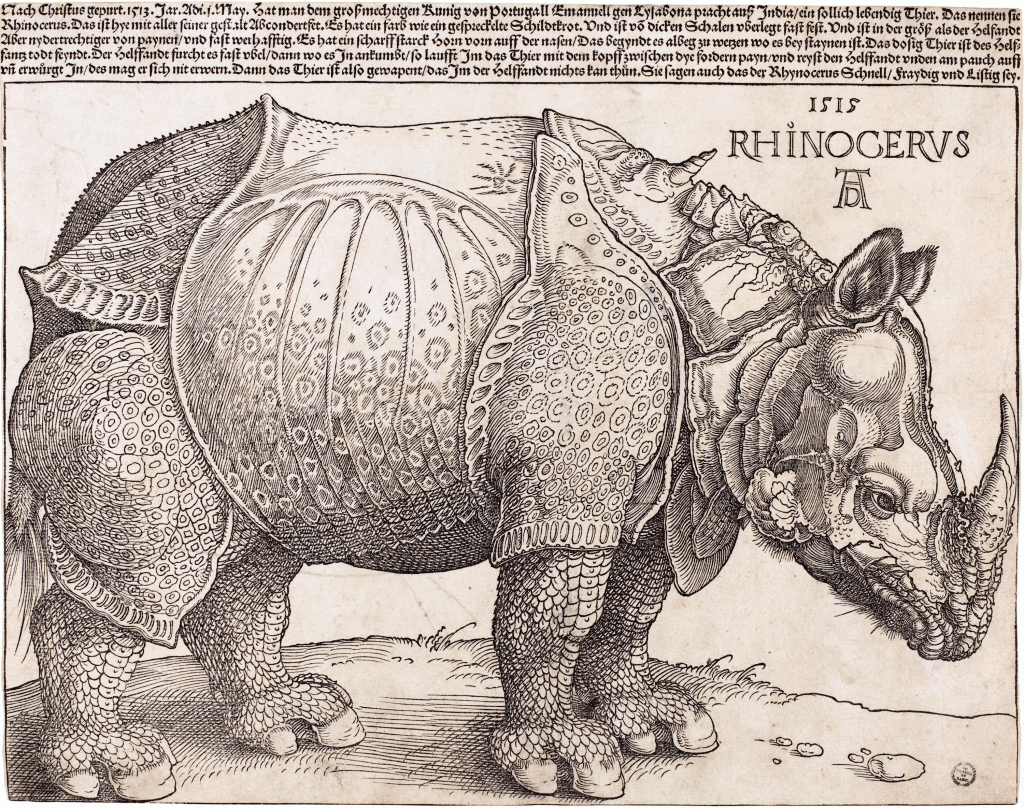
In the sixteenth century, trade and merchant ships used to carry plants, spices and exotic animals from the colonial outposts of the ruling powers to Europe. In 1515, among the ship load of gifts despatched by the governor of Portugese India, Alfonso d’Albuquerque, to King Manuel I in Portugal, was a curious animal known by its Gujarati name of genda, and its Indian keeper, named Ocem. This rhino was the first to arrive in Europe since the days of the Roman Empire, and it caused quite a sensation. The animal was examined by scholars and the curious, and letters describing the fantastic creature were sent throughout Europe.
Albrecht Dürer, an artist, mathematician, engraver and painter living in Nuremberg read about this strange animal and based on the description, he began a pen sketch which became a woodcut. Dürer’s 1515 RHINOCERVS became famous. Dürer himself had never seen a rhino and hence his rendering was more fanciful than accurate.
In many ways a rhinoceros is an odd-looking creature. Even its name, literally meaning a creature with a horn on its nose, belies its unusual appearance. Much before Dürer, even for those who had seen a real rhino, its strange form and peculiar characteristics spawned a variety of tales. Tribes in Africa and Asia where the rhinoceros is found in the wild, have their folk tales that imagine how this creature came to be what it is. Here are some abridged versions.
A folk tale of the Tharu people of the Terai grasslands at the foothills of the Himalaya describes how the beast was created by the Hindu god Vishwakarma. He picked the best parts of many animals on earth and stitched them together. His creation had the skin of an elephant, the hooves of a horse, the ears of a hare, the eyes of a crocodile, the brains of a bear, the heart of a lion, and horns like Nandi, Shiva’s bull. Viswakarma creatively twisted, moulded and further modified these parts, even fusing two horns into one. The result was beyond his expectation, a masterpiece of the art of imperfection.
The naturalist and wildlife writer Edward Pritchard Gee recounted an ancient Indian myth that explains the ‘armour plating’ of the rhino. It is said that, once, Lord Krishna decided to use rhinos in place of elephants in battle. However, when the creature, all covered in armour for battle, was brought in, it was found to be too stupid to obey commands. Therefore, it was sent back to the forest. Unfortunately, they forgot to take off its armour—and so it remains until this day.
One African tale tells of how the rhino got its skin. Long long ago, when all the animals were without a skin, God gave each one a needle and told them to sew a skin for themselves. The animals got to work, each creating for themselves beautifully patterned and fitting skins. But Kifam, the first black rhino, was clumsy and short sighted. As he started on his skin, he dropped his needle; so he charged back and forth looking for it, but being short sighted, he could not find it. In frustration, he snatched up a thorn and started stitching, trying to put something together. When he put on his hastily assembled patchwork coat, it hung in wrinkles and folds. The other animals all laughed at him; this made him very cross; he was sure that they had hidden his needle. Since then the rhino charges at everything that crosses his path.
Another African folktale explains the rhino’s habit of scattering its dung. As the story goes: In days long ago when animals could talk, Elephant always used to tease rhino about his near-sightedness and bad temper. One day Rhino really lost his temper. He challenged Elephant to a contest. The contest was to see who could produce the largest dung heap. Imagine two very large animals and the vast quantities of vegetation they eat, and you can imagine the lot of dung that they both make! But in the contest, Rhino made the larger pile of dung. The elephant was enraged. He attacked the poor rhino with his trunk and tusk and beat him till he cried for mercy. Finally the Elephant stopped the beating but made Rhino promise that he would never again challenge Him—the mighty Lord of the Beasts. Rhino never forgot that dreadful beating, and he is afraid to ever offend Elephant again. And that is why he always kicks at his dung heap, scattering it until it is quite flat, so that it always looks smaller than that of the Elephant.
While Rhino’s looks may be perplexing, it is the Rhino’s survival in the wild which is a pressing issue for wildlife conservationists. Rhinos also have the unfortunate distinction of being one of the most endangered animals on earth.
Of the world’s five species of rhino, two are found in Africa–the Black Rhino and the White Rhino. The other three species are found in Asia. These are the Greater One-Horned (Indian) Rhino, the Sumatran Rhino and the Javan Rhino. While each of these species faces a different level of threat, some of the common threats that all of them face include poaching for their horn, habitat loss, and extreme climate events like floods and tsunamis.
Around 2010 less than 30,000 rhinos were alive in the wild. The plight of the Rhinoceros was not widely known around the world, and most people didn’t know just how close to total extinction majestic species was. So WWF-South Africa announced World Rhino Day in an effort raise awareness about this beast in peril, in an effort to save the world’s remaining rhinos.
Today this has become an international event. How this came about is another, modern-day, story of two determined and dedicated women.
In mid-2011, Lisa Jane Campbell of Chishakwe Ranch in Zimbabwe was preparing for World Rhino Day. She searched online for ideas and potential collaborators, and found a blog by Rhishja Cota-Larson from Saving Rhinos in the USA. Lisa Jane sent Rhishja an email, and the two found they shared a common goal of protecting rhinos. In the months that followed, they worked together to make World Rhino Day 2011 an international day of celebration of all five species of rhinos, and awareness of the threats that they face. The two continued to work together to promote this day every year.
22 September–World Rhino Day has since grown to become a global phenomenon, uniting NGOs, cause-related organisations, businesses, and concerned members of the public from nearly every corner of the world!
This is my small celebration of this quirky creature with a horn on its nose!
–Mamata




 September is observed as Nutrition Month in India. And God knows we need to do all we can, considering how poorly we are faring. Just to reiterate some of our national statistics:
 The school showed amazing results. Soon the children exhibited great interest in working with puzzles, learning to prepare meals and clean their environment, were calm, orderly, self-regulating, and engaging in hands-on learning experiences—essentially teaching themselves.