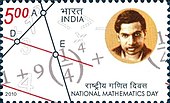
April 26th marked the 101st death anniversary of one of 20th century’s greatest mathematicians, Srinivasa Ramanujan. By coincidence, I was finishing ‘The Indian Clerk’ by David Leavitt at just about this time. And then went on to watch ‘The Man Who Knew Infinity’.
When it comes to the book, even with its various digressions, the mystic mathematical genius of Ramanujan comes through. The trials and tribulations of lower-middle class lad from the deep South of India, steeped in religious tradition, totally unprepared for the England of the 1910s, are heart-rending. The mathematical genius is an uncomfortable social being–moody, vulnerable, lonely, awkward, under-confident. Never mind food for the heart and soul in terms of companionship and friendship, he does not have enough food to keep in good health. First his strict vegetarian regime and various taboos make it imperative to cook for himself. But more seriously, as the First World War breaks out, he does not even get basic rations, vegetables and fruits. This, coupled with the cold, had lasting impacts on his health, which not only led to serious bouts of illness and hospital stays, but his tragically untimely death at the age of 32.
Away from anything familiar, longing for his wife, and with only a few Indian friends, how lonely life must have been!
But whatever the body, the heart and the soul missed, the mind just went on! And in Prof Hardy who was instrumental in bringing him to Cambridge, England, he had an intellectual companion, albeit they did not always agree on ‘ways and means’. Ramanujan’s refusal to provide systematic proof for his intuitive mathematical assertions led to many an argument. His insistence that his mathematical claims and insights were written on his tongue by the Goddess Namagiri irritated and baffled Hardy.
Ramanujan’s legacy was in the form of 37 published papers, as well as three notebooks and a ‘lost’ notebook (discovered only in 1976) with approximately 4,000 mathematical claims, most without proofs. Almost all of these have now been proved, in the century and more after his death. They continue to inspire modern-day mathematics and expand its boundaries.
I got a sense of all this from the book.
Coming to the movie, starring Dev Patel as Ramanujan, I found it sadly unsatisfying. To begin with, I could not reconcile the tall, debonair and poised Patel with my image of the short, stout, badly dressed and awkward Ramanujan. However good the actor, there have to be some physical similarities. It cannot be that the first Indian at hand is cast in a movie with an Indian protagonist. Ben Kingsley’s looks were as important as his acting, in bringing the Mahatma to life.
And then, small trivial details about life and mores in Tamilnadu of a century ago. Just a little fact-checking could have made it so much better.
Though both are for a general audience and cannot by definition get into too much math, of course a book can deal a little better with math than a movie can. So there is that too.
Both play up the ‘saas-bahu’ drama between Ramanujan’s mother and wife to the hilt, the movie a little more sympathetic to the MIL than the book.
All in all, worth it for anyone to spend some time on. It will surely awaken a sense of wonder about the unimaginable achievements of a short life—not only blazing paths that no Indian had trod, but impacting the course of mathematics for times to come. And give a sense of genius which is beyond rational explanation.
‘Man Who Knew Infinity’ by Robert Kanigal, is a more serious, and hence somewhat heavier read. There is also a movie titled ‘Ramanujan’, which I have yet to see.
April has been the “cruelest month” as TS Eliot wrote in The Waste Land. As we are swept and tossed in the tsunami of the pandemic; as numbers take on names and faces; as we find ourselves struggling to take each step in the dark tunnel which seems no have no light at its end, we are engulfed by despair.
Now more than ever before we feel the need to reach out, to connect, to be reassured that we are not alone. A time when we seek words that offer solace and hope.
While we feel alone and helpless in these grim times, may we get some comfort from these wise words.
They were written by Muriel Rukeyser, an American poet, playwright, biographer, children’s book author, and political activist. For Rukeyser, poetry was the strand that encompassed both science and history, that of the past and of the present. In the introduction to her 1949 book of essays The Life ofPoetry she writes:
In times of crisis, we summon up our strength.
Then, if we are lucky, we are able to call every resource, every forgotten image that can leap to our quickening, every memory that can make us know our power. And this luck is more than it seems to be: it depends on the long preparation of the self to be used.
In time of the crises of the spirit, we are aware of all our need, our need for each other and our need for our selves. We call up, with all the strength of summoning we have, our fullness. And then we turn; for it is a turning that we have prepared; and act. The time of the turning may be very long. It may hardly exist.
In this moment when we face horizons and conflicts wider than ever before, we want our resources, the ways of strength. We look again to the human wish, its faiths, the means by which the imagination leads us to surpass ourselves.
If there is a feeling that something has been lost, it may be because much has not yet been used, much is still to be found and begun.
Now, when it is hard to hold for a moment the giant clusters of event and meaning that every day appear, it is time to remember [poetry], which has forever been a way of reaching complexes of emotion and relationship, the attitude that is like the attitude of science and the other arts today, but with significant and beautiful distinctness from these — the attitude that perhaps might equip our imaginations to deal with our lives — the attitude of poetry.
However confused the scene of our life appears, however torn we may be who now do face that scene, it can be faced, and we can go on to be whole.
With these words, remembering two dear friends with whom one had exchanged, over many years, so many words of joy and sorrow; comfort and excitement; wonder and wisdom, and much more. You will be sorely missed.
In times such as we are passing through, poetry is catharsis; it is a way to share emotions and feelings; it represents the triumph of creativity even in difficult situations; it brings a ray of hope and humour, albeit often black.
And so naturally, there have been thousands of poems on COVID all over print media and social media. In fact, the Washington Post focused its annual kids’ poetry writing competition on Corona this year, with “Poetry of the Pandemic” as the theme of their 2021 poetry contest.
Corona Poetry has taken such proportions that there are several appeals against more of the genre.
So this piece will now stop talking about Corona and move on to trivia about other well-known nursery rhymes.
A widely-held belief—though some scholars disagree—is that ‘Ring-A-Ring of Roses’ has its origins in another pandemic, the Great Plague. The ‘roses’ are the red rashes which are a symptom of the disease; the ‘posies’ are the herbs that were carried as a protection against the infection; and the ‘Atishoo, atishoo’ (which at least in my childhood version became ‘husha-busha’!) represents the final sneezing before falling down dead.
But moving on to some poems with non-pandemic associations:
The rhyme ‘There was a little girl, who had a little curl’ is believed to have been written by the famous American poet Henry Wadsworth Longfellow for his daughter Edith, on a day she was throwing tantrums about having her hair curled. Well, I suppose that is the difference between poets and others—most parents’ reaction to a tantrum is a raised pitch rather than a rhyming verse!
‘Humpty Dumpty’ is very ancient and there are variants all over Europe. This is obviously a riddle whose answer is ‘egg’, but seems to have lost that connotation, especially as most illustrations of the poem clearly show an egg, not leaving any suspense.
‘Tinker, tailor, soldier, spy’ is played with counters, and is supposed to indicate what the child will become when it grows up.
The historical event of the Norse King Olaf destroying the London Bridge in the 11th century probably gave rise to the popular ditty ‘London Bridge is falling down’.
Children across the world wistfully recite ‘Rain, rain go away’ when downpourings stop their games. The poem’s origins go back to ancient Greece, and it is supposed to be a charm to keep rain away.
‘Little Miss Muffet’ was probably written Dr. Thomas Muffet, an entomologist of the 16th century, who was fascinated by spiders for his daughter Patience. ‘Incy winsy spider’ or ‘Itsy bitsy spider’ the other popular spider-verse was first published around 1910, thought it may be older. It is a ‘finger song’ and children mimic the actions of a spider climbing up and down.
A popular poem about an insect is ‘Ladybird, ladybird fly away home’. It is to be recited when a ladybird lands on your hand or arm, as harming these creatures is supposed to bring bad luck.
‘This little pig went to market’ is a toe game played with toddlers while counting off their toes.
While the origins of many nursery rhymes is speculative, the author of ‘Twinkle, twinkle little star’ is known definitively to be Jane Taylor, who published this in 1806. She and her sister Ann were popular nursery-rhyme writers.
And to end, a story about a poem which is not very popular today.
Three wise of Gotham
Went to sea in a bowl.
If the bowl had been stronger
My story would have been longer.
It does not rhyme particularly well, and sounds pretty abrupt. But the origin-story is very interesting. Apparently, in England during the reign of King John (about 800 years back), when the King passed through any road, that road became a public road. Now the King on one of his journeys planned to pass through the village of Gotham. The citizens of that village did not want their village road to become a thoroughfare. So they came up with a strategy. They all decided to start acting completely silly when the King’s advance party came around. So some went in pursuit of a cuckoo, and spread the word that they were doing it to capture it and hence have perpetual summer. Others tried to drown an eel in a pond. The King’s guards were convinced that the villagers were all mad, and advised the King to change his route, which he did. So the ‘mad men’ were actually wise, and saved their village.
If only we could strategize, cooperate and subvert the more unreasonable of the plans of our rulers like this!
I recently read a beautiful poem and I was curious to know more about the poet Maria Sabina. I assumed that she would be a modern poet, but what I discovered was a fascinating story.
María Sabina Magdalena García was born over a century ago in a community of Mazatec, an indigenous people of Mexico who live in Oaxaca in southern Mexico. Maria Sabina spent her entire life in the remote village of Huautla de Jiménez, up in the Sierra mountains in this area. Maria Sabina belonged to a family of traditional curandera (healers) and shamans. Among many indigenous peoples the healer or shaman has a very important function in the community. It is believed that these healers communicate with this world and that of the gods, and thus have the ability to cure both physical and spiritual conditions, and even predict the future.
The healing ceremonies of the Mazatec included the use of hallucinogenic mushrooms (which they called “holy children”) as a method of contact with divinity. It is said that when Maria was just eight years old she and her sister were sitting under a tree when they noticed some of these mushrooms growing wild, and ingested them. The little girls had a terrifying hallucinatory experience, but during this Maria heard an otherworldly voice that told her about some herbs that would cure her uncle who was very sick at the time. She followed the instructions about where to find these, and the herbs cured her uncle.
The young girl became known in the village as a sabia or wise one. Maria seemed to have intuitively developed a knowledge of the ancient Mazatec rituals and the healing power which was attributed to the ritual intake of a particular species of fungi (Mexican Psilocybe) which grow only in mountain range of Sierra Mazatec.Thus began Maria’s lifelong use of ‘magic mushrooms’ for special healing sessions known as velada. Local people visited Maria not only to be healed physically, but also for spiritual guidance. Under the influence of the hallucinogenic mushrooms she guided the patients through out-of-body experiences that revealed the cure for the illness. She claimed that the mushrooms produced wisdom in her; as she said much later in life “I am the woman who looks inside and examines.”
Maria was totally dedicated to her healing ceremonies with mushrooms that included ritual chanting, tobacco smoke, consumption of mescal (an agave plant), and ointments extracted from medicinal plants. Therapeutic laughter was also a part of the ceremony. The rituals were conducted at night because it was believed that the healer was guided in the journey by the stars. The veladas were held purely for medicinal purposes, to purge illness and heal the sick.
Maria Sabina would have continued to live her life as the local curandera and sabia in her remote mountain village, and she and her practice of magic mushrooms or “holy children” as she called them, would have died unknown to the outside world. But destiny had planned another ending to her story.
In the early 1950s, an American Robert Gordon Wasson and his wife who were interested in ethnobotany were looking at the use of hallucinogenic plants in the rituals of indigenous groups in different parts of the world. As they were travelling in the Mazatec Sierra region, they heard of a famous healer of Huautla. In 1955, they travelled to the remote mountain village, and to gain access to her, pretended that they had come to be treated by Maria Sabina. As a curandera, Sabina would never deny a request for help. By then she was already in her sixties and her ceremonies were not known outside her immediate area. She conducted several veladas using the mushrooms with the foreigners, who also documented the entire experience in photos and recordings. When they returned, they also took back with them samples of the fungi which was identified as Psilocybe Mexicana. The fungus was cultivated in Europe and its primary ingredient, psilocybin, was isolated in 1958 by Albert Hofmann, the discoverer of LSD.
In 1957 Life magazine published an article which chronicled the Wasson’s experiences with Maria and her magic mushrooms. Maria Sabina became famous; people from all over the world began to visit her. By the mid-sixties, at the height of the hippie culture, there was a deluge of visitors to Huautla de Jiménez–media, tourists, artists, intellectuals, anthropologists, researchers, and celebrities (including among others, John Lennon, Walt Disney. Aldous Huxley, and Carlos Castaneda). Sadly, many of these visitors were interested purely in getting high on the magic mushrooms, and psychedelic recreational pursuits, and were disrespectful of local culture and traditions. The wanton rush to gather the mushrooms also eroded the delicate ecological balance of the mountain slopes and forests.
The unwanted attention completely altered the social dynamics of the community and threatened to destroy an ancient Mazatec tradition. The people of Huautla de Jiminez put the blame on Maria Sabina and accused her profiting from their tradition. Villagers attacked and tried to burn down her house several times; they tried to run her out of the village. The police accused her of being a drug dealer. Maria Sabina was ostracised by her community.
Interestingly, she accepted her fate as if it were pre-determined and had been told to her during one of her ceremonies. But she regretted that she had opened up the ceremony for a foreigner, and felt that the sanctity of the velada had been irredeemably desecrated by the recreational use of her “holy children”. She realised that “From the moment the foreigners arrived, the holy children lost their purity. They lost their force. They ruined them.” Later in life she became bitter about her many misfortunes and how others had profited from her name. She spent her last years in abject poverty and malnutrition, and died in a hospital in 1985 at the age of 91 years.
While she may have later attained notoriety for her magic mushrooms, María Sabina is regarded as a sacred figure in Huautla. She is also respected and honoured as one of Mexico’s greatest poets. She did not know how to read or write; her verses were either spoken or sung like chants in her native dialect. She said that it was not her words that she expressed, but the voice of her ninos santos or holy children who spoke through her. She claimed to see the mushrooms as children dancing around her, singing and playing instruments. She was simply their interpreter and she treated them with great respect. She added cadence to her words and expressed them with her entire body. Her chants were first translated from her native Mazatec into English and, only later, into Spanish.
Sharing the poem that led me to this incredible story.
Cure yourself with the light of the sun and the rays of the moon. With the sound of the river and the waterfall. With the swaying of the sea and the fluttering of birds.
Heal yourself with mint, with neem and eucalyptus.
Sweeten yourself with lavender, rosemary, and chamomile.
Hug yourself with the cocoa bean and a touch of cinnamon.
Put love in tea instead of sugar, and take it looking at the stars.
Heal yourself with the kisses that the wind gives you and the hugs of the rain.
Get strong with bare feet on the ground and with everything that is born from it.
Get smarter every day by listening to your intuition, looking at the world with the eye of your forehead.
Jump, dance, sing, so that you live happier.
Heal yourself, with beautiful love, and always remember: you are the medicine.
Today is Earth day. What better way to celebrate than to savour these words and make them our mantra for life and living.
In between the first COVID wave and the second ongoing one, we were tempted to get a little adventurous. We scouted around for sites which we could visit on day-trips.
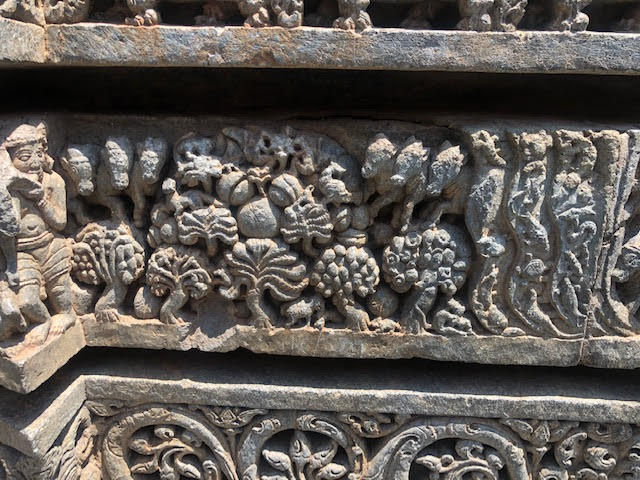
It is in this process that we got to know about a beautiful Hoysala-style temple situated in Somanathapura, which lies about 130 kms from Bangalore. This is the Chennakeshava Temple built by the Hoysala commander, Somanatha, in 1268 A.D.
And we made our way there with some friends.
It is an astounding structure, made completely of sandstone, with the most intricate carvings, built at the peak of Hoysala architectural excellence.
Chennakeśava means ‘handsome Keshava’, and the temple is dedicated to three forms of Vishu—Keshava, Janardhana and Venugopala. The main temple is on a star-shaped platform with three garbagrahas, each dedicated to one on the three forms. Besides this, there are 64 corridor shrines, set in magnificent pillared corridors. The main temple is surrounded by a pradakshina patha, all along which are carvings from the Ramayana, Mahabharata, Bhagavata Purana etc., which unfold as one undertakes the pradakshina. The ceilings are decorated with intricate sculptures depicting different stages of the unfolding of a lotus. The massive stone pillars supporting the inner shrine were turned in ancient animal-drawn lathes.
The temple took several decades to build, but was in worship for only 60-70 years before it was sacked by invaders. Since the statues and the structure were defaced and broken, worship could no longer take place there, as per tradition.
It is a wonder that such an old and disused structure still stands in such good shape today—it is nearly 700+ years after it stopped being an active temple. It is in the hands of the Archaeological Survey of India (ASI), and one must appreciate their efforts to have the site in such good shape, standing in such well-maintained grounds. Even the toilets are fairly functional and clean.
But….
And it is a big BUT.
It is plagued by some problems which many of our heritage sites suffer from. For instance, we did not see a single signage anywhere on the roads telling the passers-by of the existence of such an amazing monument close by. Or to direct those who were looking for it.
Within 25 kms of the structure—leave alone on or near the premises—there is not a decent restaurant or even a picnic ground for those who had their own food.
But for the first time we came across a tech-challenge in such a place!
When we reached the gates of the monument and looked around for a ticket window, there was none. Instead there were a few flex posters, informing us of the rates (Rs 20 for online tickets), and a barcode to scan and pay. There were about six groups of tourists, all desperately trying to scan but no one was successful. After about five minutes, the helpful security guard came up to us and told us that it was not working. He suggested we should try to log into the ASI site, pay online and get our tickets. We all tried dutifully. But the signal was at best patchy and the site slow. My friend could get in. The names of each one of the group had to be entered. And the Aadhar or PAN of the person doing the booking. When she tried to pay, it got into a loop which there was no coming out of. We looked around, and many other people were in the same soup. We asked the Guard if he could not just take the money and give us tickets, but he told us that was not allowed. By this time, one person from another group was successful in getting his ticket from the ASI site. So using typical Indian jugaad, we begged him not to exit, but to do our ticketing online, and that we would pay him the Rs. 20/head in cash. He obligingly did this for some of us.
The whole process took us about 20 minutes and was pretty stressful.
And then we went in to visit the monument. Which fortunately was amazing enough to make it all worth while.
But it left us wondering what the point was. Does anyone who wants to visit a heritage site HAVE to have a smartphone? In a country where literacy, let alone digital literacy, is not to be taken for granted, should lack of these prevent a person from such basic access (never mind that it is a barrier even to COVID vaccination!). Is there an inherent age-discrimination–many older people are uncomfortable with all these scan-and-pay modes. If the wifi does not work at a site, are people to go back the 150 kms they came to visit the monument? And why is the name of every visitor needed for buying entry tickets? Why is Aadhar or PAN information needed? Where does this information go, and what becomes of it?
If the purpose of technology is to make life easier for citizens, then this is surely not the way! The system is good in that it provides a nudge for digital payment (if you scan and pay it is Rs. 20, and if you could buy a physical ticket it is Rs. 25 per ticket). Nudges are good for bringing about behavior change. But taking away options is discriminatory and against basic rights. As is seeking information which is not relevant to anything!
Why does something like a visit to our own heritage sites have to become a battleground about rights?
As summer holidays approach so do memories of vacation pastimes with family and friends. One favourite pastime for us was games of Scrabble—the word building game that made us focus, squabble and compete for points as we triumphantly built words with triple scoring letters, or bemoaned the fact that we were left with all vowels, or no vowels, to build our words.
Scrabble is one of the games that is universally known and popular across continents and languages.
The story of Scrabble is an interesting one. In 1924, a young man Alfred Mosher Butts graduated from University of Pennsylvania’s school of architecture. It was a time when New York’s skyline was rising upwards, and the young architect joined a prestigious New York firm where he was assigned to design elegant country homes for the rich. In just five years the bubble burst, and as the economy crashed, the United States was plunged into the Great Depression. Butts was among the millions who lost their jobs. He was just 32 years old, and his career path looked hazy.
Butts had always loved word games and games of strategy like crosswords and chess. Crossword puzzles were already a popular pastime in the United States in the 1920s. Alfred Butts noticed that a new game called Monopoly was becoming very popular, and was also commercially successful. He found that there was no word game in the market. Butt began toying with the idea of developing a word game that combined both skill and chance. He began by studying the front page of The New York Times to calculate how frequently each letter of the alphabet was used. He found that just 12 letters (E, T, A, O, I, N, S, H, R, D, L and U) accounted for 80% of the letters that are normally used. Butt used his analysis and his free ‘unemployed’ time to develop a word game that involved knowledge, strategy and chance. He cut 100 wooden tiles by hand, each with a letter of the alphabet, and drew a grid of squares on a playing board. Each letter had points assigned. The players had to draw nine letter tiles, which were placed face down, at random, and arrange these to form words on the squares. The first players were Alfred Butts, his wife Nina and their friends. Nina, as it turned out, knew more words and had better spelling than her inventor husband, and always scored more than him. As Alfred admitted “she beat me at my own game,” literally.
Alfred could invent an interesting game, but just could not find the right name for it. He first called it Lexico, then changed the name to IT, then to Criss Cross and then Criss Cross Words, but none of them really clicked. He was equally unsuccessful in trying to register the trademark of his new game. In 1933 he approached all the major games manufacturers, but they rejected the game. Butts in the meanwhile, continued to innovate—he made a15x15 square board for the game, and added values to some of the squares to double and triple the score of the letter placed on them; he reduced the number of tiles to be picked at a time to 7. He even manufactured 200 sets himself, and offered them at $2 a set plus 25 cents for shipping. But the big games manufacturers were still not interested. By then Butts had been reemployed as an architect and could no longer spend as much time on further promoting his game. But the game continued to played by his friends.
One of these friends who had bought one of Butt’s handmade sets had a friend called James Brunot who was impressed by the game. Brunot offered to make and sell the game. In 1948 Butts sold the management of the game’s production to Bruno, but he retained the patent, and it was agreed that he would receive royalties on the sales. Bruno made modifications to the game, changing the colours on the board, and the scoring system. He also came up with the name SCRABBLE a word meaning ‘to scrape or grope around frantically with your hands’ from the Dutch ‘schrabben’ to scrape or scratch. Brunot trademarked Scrabble in December 1948.
Even under Brunot the game had a shaky start. Just as Butts had done more than a decade earlier, the first sets were hand produced, initially in Brunot’s own house and then in an abandoned schoolhouse by his wife and friends, laboriously stamping out one letter at a time on wooden tiles. Thus the production was slow; in 1949 they produced 2400 sets; and lost money, but the game was gaining in popularity.
The breakthrough came in the early 1952 when, as the story goes, the chairman of Macy’s, one of New York’s biggest department stores saw the game being played when he was on vacation. On his return he was surprised to discover that Macy’s did not stock this game, and he immediately placed a large order. The game was an instant hit; within a year everyone ‘had to have one’, and Scrabble sets had to be were rationed in stores around the United States.
Meanwhile, the Brunots had to cope with the escalating demand by expanding their production facilities. The popularity and demand snowballed so rapidly that the production and marketing had to be taken to a different level of commerce, with different companies getting into the venture. In 1955 the game crossed the Atlantic and began to sell in the UK.
The rest as they say is history. It took over two decades for Butt’s Criss-Cross Words to make it big. Scrabble is now available in 31 languages and sold in 121 countries worldwide. Over one hundred and fifty million sets of Scrabble have been sold. The Scrabble craze spawned a number of other commercial enterprises—dictionaries, books on strategy, tournaments, and more.
Unlike the inventor of the safety pin, Butts did earn royalties on his invention, which it is believed were about three cents a set. Butt said ‘One-third went to taxes, I gave one-third away, and the other third enabled me to have an enjoyable life’ until he died at the age of 93 on 4 April 1993. Butt spent a creative life; he designed buildings, he was a painter, and a stamp collector. He also continued to invent board games, including one called Alfred’s Other Game, when he was in his eighties. But he is best remembered as the inventor of Scrabble. And his birthday on 13 April is celebrated in the USA as National Scrabble Day.
A good time to pull out that old Scrabble board and build some words!
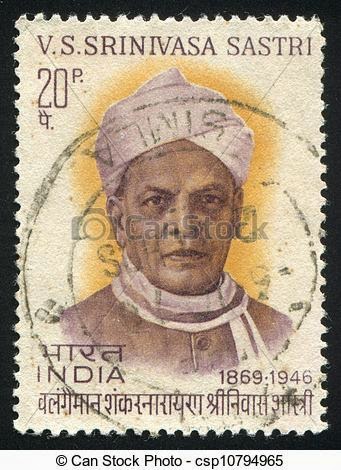
As a student, he corrected passages in JC Nesfield’s “English Grammar” (the standard grammar textbooks used in India in those days). He was often consulted over spellings and pronunciations by the English. His mastery over the English language was recognized by King George V, Churchill, Lady Lytton and Lord Balfour. Many rated him among the five best English-language orators of the century. He is the man of whom the Master of Balliol declared, ‘I never knew that the English Language was so beautiful till I heard Sastri speak it.’ He is the man who found 27 mistakes when Gandhiji sent him the first copy of his newspaper “Harijan” for review. He is the man to listen to whom the British Prime Minister Lloyd George postponed a cabinet meeting. He is the man conferred with the title of ‘Silver-tongued Orator of the British Empire’.
This was Srinivasa Sastri, born to a poor priest in 1869 in the small village of Valangaiman in Tamilnadu. He was a brilliant student who did his education in Kumbakonam. He graduated in Sanskrit and English, and went on to become a teacher, and later the Principal of the Hindu High School, Triplicane, Madras. Though he went on to be many things—freedom fighter, politician, diplomat, administrator—he probably remained at heart an educator.
His foray into public life began from academic roots—he founded the Madras Teachers’ Guild when he was Headmaster of the Triplicane School. He was also a pioneer of the co-operative movement in the country, and started India’s first co-operative society, the Triplicane Urban Co-operative Society (TUCS) in 1904.
He is said to have been so influenced by a pamphlet written by Gopala Krishna Gokhale that he gave up his job and joined the Servants of India Society, going on to become its President. He joined the Indian National Congress in 1908, and was nominated to the Madras Legislative Council in 1913. He was later also a member of the Privy Council.
He was a part of delegation which visited England in 1919, a delegate to the Imperial Conference and the Second session of the League of Nations in 1921. He played a key role in getting the Government of South Africa to drop legislation which would have led to the segregation of Indians there. In 1927 he was appointed India’s first Agent to South Africa.
Gandhiji and Sastri were lifelong friends, and respected each other deeply. The Mahatma always referred to him as ‘Anna’ , never letting him forget that he was 10 days older! However, Sastri’s views and stands were often controversial. He was seen as too accommodative of British actions. He opposed the Non-cooperation Movement on the grounds that it was subversive of the law and would set a wrong precedent. This and other similar stances brought him in conflict with Nehru and others in the Congress, and he resigned from the Party in 1922, and subsequently founded the Indian Liberal Party.
Late in life, he returned to his first love, academia, serving as Vice Chancellor of the Annamalai University, Chidambaram. He was a legendary teacher. Far ahead of his time, he believed that students were ‘comrades engaged in a common task and whom one should meet with a smiling face not only in the school room but on playfields ..’. He persuaded Mahadeva Iyengar, then Head of the Tamil Research Department of Annamalai, to translate Kalidasan’s epic poem Abhignana Sakuntalam in Tamil. His lectures at the Annamalai University packed the halls, with faculty competing with students for seats.
He headed a Committee set up in 1940 to frame a set of general principles for coining words for scientific and technical terms in vernacular languages. The report of this Committee was controversial, since it recommended the continuation of Sanskrit loan-words in Tamil technical language and this was violently opposed by Tamil adherents.
It was his tenure in Annamalai University that has special meaning for me. At this time, my grandfather Shri Anantavaidhyanathan was Head of the Dept. of Chemistry there, and the Right Honorable Srinivasa Sastri became a family friend, and mentor to my father A. Nagaratnam who was a student there.
Our family dictionary was a Cambridge Dictionary gifted by him to my father with the inscription ‘To Nagaratnam, with a grandfather’s blessings’, and signed. Alas, when my mother closed up her house, the dictionary (still in decent shape, if in two pieces, disappeared).
What a loss of a family heirloom! But still, I like to think that the pages my grubby childhood hands touched, had been touched by the legendary Silver-tongued Orator!
–Meena
He passed away on 17 April 1946. This week marks his death anniversary.
Lost a button, snapped a strap; need something to hold it, or fix it? It’s the thing to reach for in an emergency. From the diaper to the toddler’s hanky, the sari pallu to the Scottish kilt, from the school badge to the split seam, this is what holds it together. It is the simple but multipurpose safety pin! Of all the many inventions that have made our day-to-day life simpler, it is these small but unsung ones that hardly ever make it to the headlines, but without which we would be quite lost.
The story of the safety pin is one of those. Its inventor Walter Hunt came from humble beginnings. He was born on a small farm in Lewis County, New York in 1796, the eldest of 13 children. He started his education in a one-room school, and dropped out of formal education in his early teens to take to farming. While Hunt was not keen on the 3Rs, his mind was sharp and curious, and he was fascinated with mechanical objects. This led him to help out at a nearby textile mill where several of his family members worked. With his love for tinkering, he worked out some improvements to the flax spinning machine used there. The owner took out a patent on this, but Hunt was not included in that. Hunt however went on to develop an even better flax spinning machine which he patented. But he could not find any investors who would support the production of these machines. Eventually, in frustration, he sold the patent, just to support his family, and relocated to New York.
This was in the days before the motor car. One day he saw a little girl being knocked down by a horse carriage which was the mode of transport. These carriages had air horns to warn the pedestrians who shared the roads, but the driver could not use the horn as he had to hold the reins with both hands. Hunt observed this issue, and developed a foot-operated metal gong to sound the horn. In 1827, he filed a patent for this device. Once again, he could not find an investor to manufacture this device, and so once again he sold the patent. And never made any money from the profits from the sales of his invention.
This was to be the pattern of Hunt’s life. He was always in the need for quick money to support his family, and so he sold his patents outright rather than holding on to them, or opting for the longer-term profits from royalties. Luckily for him, he could also come up with invention after invention.
It was one of those patents that he sold in 1849 that gave us the nifty device we call the safety pin. Here too was a case of a quick invention for quick money. In this instance, he was being pressured to settle a 15-dollar debt, which had to be repaid the following day. As was his default setting, he sat at night tinkering with a piece of wire, while wondering what new product he could invent and sell the next day. The wire reminded him of a pin, which in those days was straight length of metal with a sharp edge. Hunt wondered how he could make the pin less prone to poke the user, and thereby more safe. In 3 hours, he worked out a sketch, and made a tiny model of a new type of pin. He used a brass wire, coiled it at the centre which provided a springing mechanism, and formed a clasp or catch on one end which shielded the wearer from being the sharp point when worn. He called this a ‘dress pin’.
As he described in his patent application: “The distinguishing features of this invention consist in the construction of a pin made of one piece of wire or metal combining a spring, and clasp or catch, in which the point of said pin is forced, and by its own spring securely retained.”
He then sold the patent outright for $400, and never got a single penny more for a product that has sold in trillions across the world, over more than a hundred and seventy five years.
The dress pin was only one of Hunt’s many inventions. Earlier, in 1834, he had designed one of the world’s first eye-pointed-needle sewing machines. But his daughter talked him out of commercializing the device by warning him that it would lead to massive unemployment among seamstresses. He created a prototype in wood of the sewing machine, and sold the idea to a company that made it in metal. And in history, the credit for the invention went to Isaac Singer, and the Singer sewing machines became a household name.
Hunt continued his prolific spree of improving upon, inventing, and patenting numerous other daily-use objects. These included for a saw for easily cutting down trees, a flexible spring attachment for belts and suspenders, and an attachment for boats to cut through ice. He developed a machine for making nails, hob nails for boots and shoes, a knife sharpener, an inkstand, a fountain pen, bottle stoppers, paper shirt collars, and a non-explosive lamp. He developed a repeating gun and cartridge that was eventually adapted by Smith and Wesson. He even invented an suction apparatus that could be attached to shoes so a person could walk upside down on a ceiling. The contraption was used by circus performers as late as 1937.
Walter Hunt died on June 8, 1859 at the age of 62, with perhaps as many inventions under his hat as his years on earth. All his life he continued to outright sell his patents, and did not reap a single penny in royalties. His only claim to fame, if not fortune, is that 10 April has been designated as International Safety Pin Day, to mark the day on which he received his patent for the safety pin!
Let’s hear it for the safety pin–a handy little friend in need!
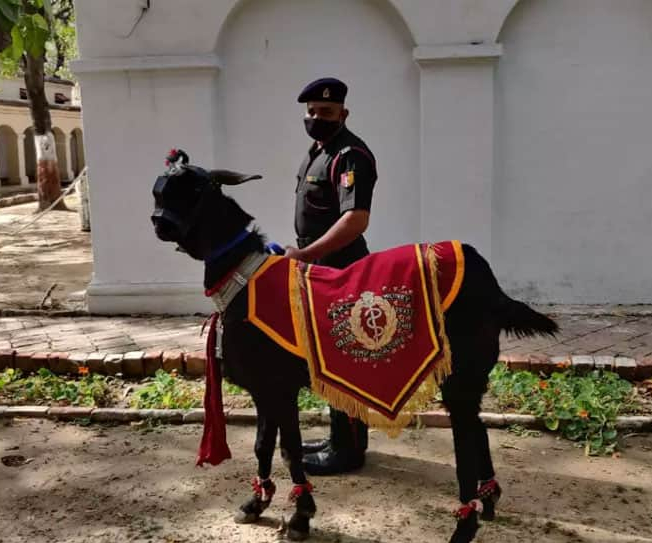
Last week, newspapers reported that when the Army Medical Corp Centre at Lucknow marked its Foundation Day, the marching band was led by Munna Havaldar. Mr. Munna is not a man but a goat, serving as a non-commissioned officer in the Regiment. And he is not the first! There has been a Munna Havildar in the regiment since 1951, the title handed down without break from one handsome Marwari goat to the next!
This is in keeping with the tradition of animal mascots that many army regiments, not only in India, but across the world have. Probably a tradition popularized by the British. Today, the British Army has nine animal mascots, from goats to ponies.
The Spanish Legion has its own goat mascot, ‘Odin’. The Bengal Tigress ‘Quintas Durga’, is the mascot for the 5th Battalion Royal Australian Regiment. ‘Chesty XV’ an English Bulldog is a mascot to the US Marine Corps. The Sri Lankan Light Infantry mascot is an elephant. This is a tradition since 1961, and they are all named after the most famous elephant in Sri Lanken history, ‘Kandula’. ‘Brigadier Sir Nils Olav’ is a King Penguin who is the mascot of the Kings Guard of Norway. Toronto Zoo is home to the Canadian Army’s mascot, ‘Juno’, a female polar bear. ‘Bill the Goat’ is the mascot of the United States Naval Academy.
Armies have both official and unofficial mascots or pets. Official mascots have a rank, and are maintained at the expense of the State. As with human soldiers, they too can even be promoted and demoted!
For some reason, goats are very popular mascots. In fact, they may be among the first-ever army animal mascots. The Royal Welsh Fusiliers have adopted goats as mascots since the 1770s, starting from the American War of Independence, during the famous Battle of Bunker Hill in 1775, when a wild goat entered the battlefield and led the Royal Fusiliers from the field.
Of course, goats are not very well-behaved or tractable. Lance Corporal William ‘Billy’ Windsor, mascot of 1st Battalion The Royal Welsh, earned a demotion in 2006 when he deviated from the parade he was leading in front of the Queen and tried to head-butt the drummers marching ahead of him.
Which reminds me of another goat which was a mascot not of a Unit in the Army, but of a road in Vastrapur, Ahmedabad. This strip of road (extremely narrow, bumpy and non-straight), lined with shops, parked vehicles, thelas and carts, temples and milling humanity, was a vital one connecting IIM, PRL, ISRO Colony etc. to the ‘other side’.
And it was ruled by a huge goat. He lay down in the middle of the road when he felt like, and all traffic had to flow around him. If he decided to take a walk and charge any pedestrian, they just had to make their way to safer ground. He was fed and pampered by all the shop keepers and denizens of the street. He had his pick of the choicest vegetables and fruits from the carts. If he felt like some sweets, he just had to make his way to one or the other sweet shop in the market. On festival days, he was festooned with garlands and daubed with paint. He was given to smoking, and the paan gallawallahs used to light beedies and put them in his mouth for him to puff at.
Sadly, the goat which gave the road so much character passed away of old age some years ago. Not being an Army Regimental Mascot, he was not replaced.
But thankfully, the road has been widened and smoothed!
When we were in school this was the day when we were on high alert—looking over our shoulder, and wary about opening packages and envelopes; while at the same time planning silly pranks to play on family and friends. Whether the attempts on both sides were a hit or a flop, perhaps the highlight was the gleeful shouts of “April Fool”!
Interestingly, this is one day that does not have any specific geographical, cultural or religious significance but it is universally marked by fool-hearted fun and frolic. And yet, it is a day with a long, and somewhat hazy history. While it has been celebrated for many centuries by different cultures, there are several theories about its exact origins.
Some historians speculate that it may have originated in 16th century Europe when France switched from the Julian calendar to the Gregorian calendar. Traditionally, the spring equinox which fell around the first of April was thought of as the beginning of the year in the Julian calendar, but in 1582, with the adoption of the Gregorian calendar, January 1 was designated as the start of the new year. As the stories go, it was a while before everyone found out about this change, and adopted it. Those who were ignorant about the change, or who refused to accept it, and continued to celebrate it in March-April were the butt of derision and pranks, and were called ‘April Fools.” One of the popular pranks was to paste a paper fish on their backs, and calling them “poisson d’avril” (April fish), which referred to a young, easily caught fish, symbolising a gullible person.
Other historians feel that its precedents lie even further back to a Greco-Roman festival called Hilaria, honoring Cybele, an ancient Greek Mother of Gods, which was celebrated with parades, masquerades and jokes. In fact most cultures have some kind of festival to mark the end of winter and the return of spring which is marked by the vernal equinox. These “renewal festivals” were an occasion to invert the traditional social order for a day—children could challenge the authority of parents, and servants of masters—and tensions were diffused with boisterous hilarity and playful pranks. Anthropologists see 1 April as a modern form of a renewal festival where forms of behaviour that are normally not allowed (lying, deception, playing pranks) become acceptable, for this one day.
It is only in the 18th century that April Fools’ Day spread through Britain. With time, different parts evolved their own traditions and events to mark the day. In Scotland and Ireland, a popular prank was to send people on phony errands; someone was asked to deliver a sealed message that supposedly requested help. In fact, the message read “Dinna laugh, dinna smile. Hunt the gowk another mile” which translated means “don’t laugh, don’t smile, send the messenger another mile“. Each recipient upon reading it would send the person on to the next person with an identical message. This version of a wild goose chase was called “hunting the gowk” as gowk means a cuckoo bird, which symbolises a fool.
With time, even as its history became more blurred, the spirit of April Fools’ Day spread across the world, triggering challenges to devise and play the most elaborate and outrageous hoaxes. These were no longer confined to slapstick pranks and juvenile jokes. Newspapers, radio and TV stations and websites also joined the tradition by publishing or broadcasting reporting outrageous reports and news that would convincingly fool their audiences.
One of the best remembered hoax was pulled off by none other than the BBC, which had an old and solid reputation for its reliable reporting. On 1 April 1957, the BBC show Panorama gave the news about a bumper spaghetti harvest in Switzerland and aired a three-minute segment showing people harvesting spaghetti from trees. Viewers were totally taken in; many wrote in asking how they could grow their own spaghetti trees! The BBC even replied: “Place a sprig of spaghetti in a tin of tomato sauce and hope for the best!”
In 1962, before the days of colour TV, a ‘technical expert’ on the Swedish national network told the public that viewing its black-and-white broadcasts through nylon stockings would enable them to view these in colour. Many Swedes seriously tried this, ruining many stockings in the effort!
The neighbouring Germans have contributed their bit of April foolery too. In 1994, a Cologne-based radio station ran a story saying that local joggers should keep their speed below ten kilometres an hour so as not to disturb squirrels during mating season; while in 2004, Berlin paper Tageszeitung reported that the American embassy would be relocating to get away from the French embassy across the street.
As the world leap-frogged from print and broadcast to virtual communication, the pranks continued, in more high tech and sophisticated forms. Google became known for its clever annual pranks on its different platforms, cooked up by its best tech minds. It goofed however when it announced the real trial launch of Gmail on 1 April 2004, and everyone thought it was a joke! Last year, April 2020, for the first time since it began its April Fools tradition in 2000, Google did not put up any pranks and jokes, as a mark of respect for the unprecedented Covid situation that the entire world had been plunged into. And Stop Press! It has decided not to do so this year also.
Once upon a time, hoaxes were a once-a-year bit of fun and games, with the guileless gowks running around to carry so-called news. Today with social media flooded 24/7 with news, views, gossip and rumours, it is becoming increasingly difficult to sieve the fake news from the real. We no longer need to wait for April 1, to fool and be fooled. The joke is on gullible us, the always-in-a-rush consumers, who unquestioningly lap it all up, and spread it far and wide. That is not funny; that is foolish. More fool me and more fool you!