Many moons ago, my husband and I were on a short trek on the Annapurna Trail. Late one afternoon we reached a small village where we would spend the night. As we sat, enjoying the unmatched feeling of contentment after a beautiful day’s walk, we were joined by a young man. He bowed low, as only the Japanese do, and joined us in quiet contemplation. After a while, in broken English, he asked if we may be so kind as to join him in a small ceremony. We were happy to do so.
The young man led us to a large spreading tree around which was a built platform, and gestured to us to sit. From his backpack he took out a beautiful bowl and a brush, and with fluid movement cleaned the bowl. He then put in it some tea powder and hot water from his flask, and carefully stirred. With a low bow, he respectfully held the bowl in both hands and passed it to my husband, so that he may take a sip. He indicated that the bowl be passed on to me to do the same, and then he did the same when I passed it to him. All this was done in peaceful silence. When we had finished the bowl of tea, he explained, half in words and half by gestures that this was a traditional Japanese tea ceremony and that his guru in Japan had asked him to share it in a beautiful place with the right people. We were humbled that we had the privilege of this sharing amidst the breath-taking majesty of the mountains, the song of birds, and the crisp air.
It was one of the most meaningful and beautiful moments of sharing that we have ever experienced. The memory is vivid even after so many years.
We later discovered that our host had meticulously followed both the form and spirit of the chado or Japanese tea ceremony, an experience that is centred on respect, beauty, and simplicity. As is the tradition, before the ceremony begins, the host and the guests prepare their mind and spirit for the experience by leaving worries behind, and focusing on harmony and tranquility. The rest of the ceremony gently unfolds just as our young friend had done.
The history of the tea ceremony is equally engaging. The tea plant was brought to Japan in the 9th century by a Buddhist monk named Eichū on his return from China, where tea had been in widespread use for centuries. Eichū served the drink to an emperor, and not long after, an imperial decree was issued to start cultivating tea plantations in Japan. Initially tea drinking was limited to the social elite and only later it spread to other levels of Japanese society. It would take another three centuries before tea ceremonies would become a spiritual practice.
In the 15th century, Murata Jukō a Buddhist introduced the four core values of the ceremony–kin, or reverence; kei, respect for food and drink; sei, purity in body and spirit; and ji, calmness and freedom from desire.
In the 16th century, another Buddhist, Sen no Rikyū incorporated the philosophy of Ichi-go ichi-e (‘one time, one meeting’), the idea that each individual encounter should be treasured as such a meeting may never happen again.
Our chance encounter with the Japanese tea ceremony and our host was literally and spiritually “one time, one meeting”.
Tea and rituals related to tea have an important role in Oriental cultures. In China, where tea is said to have originated, one of the first written accounts about the tea ceremonies dates as far back as 1200 years ago, during the Tang Dynasty. The serving of tea was also named cha dao which meant ‘the way of tea’. Attention to tea preparation and serving became the preoccupations of the Chinese tea connoisseurs, which transformed the way tea was regarded by the Chinese.
The Chinese tea ceremony is a blend of the philosophies of Confucianism, Taoism and Buddhism and is based on the respect for nature and need for peace. The traditional tea ceremonies were described as he which translates as ‘peace’, jing which translates as ‘quiet’, yi which means ‘enjoyment’ and zhen meaning ‘truth’.
The tea ceremony remains one of the most significant traditions, even today, in Chinese weddings. The ceremony is conducted on the day of the wedding and sees the bride and groom respectfully serve tea to their parents, in-laws, and other family members. This symbolises the union of two families, the respect for the elders on both sides, and the elders’ acceptance of the marriage. In Chinese, the expression “drinking a daughter-in-law’s tea” is used to represent a wedding. What a simple but eloquent symbol tea can be.
While Japanese and Chinese poets have written lyrical odes to tea, the British approach to their cuppa is much more “stiff upper lip” and mundane! As William Gladstone said:
If you are cold, tea will warm you;
If you are too heated, it will cool you;
If you are depressed, it will cheer you;
If you are exhausted, it will calm you.
As for India, as with all other things there are myriad versions and preparations of the ubiquitous chai! Every home and every family has its own special brew, and chatting over chai is a national pastime.
In my home, the long morning tea session is an unbroken tradition, complete with a big teapot and numerous cups of ‘English tea.’ It is a time to sip, and savour our little garden while we each peruse the morning papers. It is a comforting and happy way to start a new day. And to remember the words of the Vietnamese spiritual leader, poet, and peace activist Thich Nhat Hanh:
Drink your tea slowly and reverently, as if it is the axis on which the world earth revolves—slowly, evenly, without rushing toward the future. Live the actual moment. Only this moment is life.
What brought on these ramblings about tea? Every year, since 2005, tea-producing countries have been celebrating International Tea Day on December 15th. The day seeks to draw the attention of governments and citizens around the world to the impact that tea trade has on workers and growers. Last year it was proposed to expand this celebration to all countries around the world and to move the day to May 21st.
December or May, for tea drinkers every day is Tea Day.
–Mamata






 September is observed as Nutrition Month in India. And God knows we need to do all we can, considering how poorly we are faring. Just to reiterate some of our national statistics:
 next few days the hype will build up. There will be a marketing blitz reminding us that Friendship Day nears, and that the best way to be friends is by buying and gifting for each other, and that the proof of friendship is the number of cards and presents that one gets.
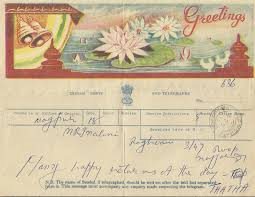 The last telegram in India was sent at 11.45 p.m. on the 14th of July, 2013. The telegram service in the country started in 1850 on an experimental basis, and was made available to the public in 1854. It connected us across the vast country, the harbinger of joys and sorrows. The arrival of a telegram definitely did give rise to butterflies in the stomach and a rise in blood pressure.