International Day of Women and Girls in Science, 11 February

Gagandeep Kang: Virologist, Professor, Department of Gastrointestinal Sciences at Christian Medical College, Vellore, India.  First Indian woman to be elected as a Fellow of the Royal Society.  At the forefront of COVID science.

Kiran Majumdar Shaw: Chairman-MD of Biocon India Group known for its breakthroughs in clinical research. The first Indian company to export enzymes to the United States and Europe, the first Indian company to gain the approval of the U.S. Food and Drug Administration for the manufacture of a cholesterol-lowering molecule.

Vijayalakshmi Ravindranath: Chairperson at Centre for Neuro Sciences at Indian Institute of Science, who leads research that will help us understand and cure Alzheimer’s and Parkinson’s.

Tessy Thomas: Expert in ‘solid propellants’, which fuel India’s Agni missiles developed by Defence Research and Development Organization (DRDO). Called Agniputri by media, after the missiles she has helped develop.

Ms J Manjula:  DRDO Outstanding Scientist, and Director, Defence Avionics Research Establishment.

Minal Sampath, Systems Engineer working on India’s mission to Mars. Anuradha TK, senior-most women officer at ISRO. Nandini Harinath, Project Manager Mission Design, Deputy Operations Director, Mars Orbiter Mission, ISRO. And the many other Mars-Mission Women.

Inspirations, one and all. And they are not the only women-achievers in science and technology.

But still such a minuscule number!

Not just India, but the world and Asia too have this challenge of attracting and retaining women in these fields.

For instance, worldwide:

  • Only 35% of all higher education students enrolled in STEM-related fields are female.
  • Only 28% of all of the world’s researchers are women

Recently, UNESCO Bangkok brought out a report on STEM (Science, Technology, Engineering and Math) education for girls and women in Asia, 2020. The report points to a cycle which hinders girls for pursuing STEM education and hence careers in science.  It highlights the reality that right from a young age, girls receive messages that these subjects are not suitable for girls. One of the issues is that girls do not see any role models of successful women scientists around them. Even when girls do take up this stream of education, there are several barriers to success—from discrimination, to having to handle multiple responsibilities outside the job, to glass ceilings.

It is in recognition of these challenges that the United Nations in 2015, decided that ‘In order to achieve full and equal access to and participation in science for women and girls, and further achieve gender equality and the empowerment of women and girls, the United Nations General Assembly adopted resolution A/RES/70/212 declaring 11 February as the International Day of Women and Girls in Science’.

The theme for this year is ‘Women Scientists at the forefront of the fight against COVID-19’. Indeed it is a matter of pride that so many women are indeed there—whether as researchers, as doctors, healthcare professionals or in manufacturing vaccines and medicines.

The journey has started, but there is such a long way to go. Leaving 50 per cent of humanity’s brainpower and entrepreneurial energies out of the search for fundamental scientific truths and putting these to the service of humanity, seems a sad waste indeed!

Make a resolution today to encourage a girl in science. Take her to visit a Science and Technology museum. Buy her a science kit. Take her on a visit to a Scientific Institution on its Open Day. Tell her stories of women-scientists. Gift her a book about science and scientists. In fact, gift a few boys some books about women scientists too!

Do anything, but do something…

–Meena

PS: Two books by women, to get the reading list started:

The Spark that Changed Everything. Veena Prasad. Hachette.

Fantastic Adventures in Science—Women Scientists of India. Nandita Jayaraj, Aashima Freidog. Puffin Books.

Remember Surabhi?

Yes, the weekly culture-magazine that Doordarshan viewers so looked forward to in the 1990s! I was surfing the channels one afternoon, and came across something called DD Retro, where Surabhi was airing. I scrolled down to see other programmes scheduled for the day. They didn’t resonate, but I have started tuning in whenever possible to catch Surabhi.

It was path-breaking in many, many senses of the word. It ran 9 seasons and clocked an incredible 415 episodes (as compared to 236 of Friends!). It was India’s longest-running cultural programme, and had among the highest audiences ever for a TV show of that time (without any TRP fixing!).

Long before such information was literally at our fingertips, Surabhi brought the length and breadth of the country into our drawing rooms, and introduced us to wonders selected most eclectically–from the ‘classical’ arts to the ‘folk’ arts; architecture to sculpture to music, dance, etc. etc. ; museums and individual collections; natural wonders to manmade marvels. It introduced us to parts of the country which in that era are even-less known than they are now, especially the North East and the Andamans. It went deep into the nooks and corners of the country. It made us proud of our art and craft traditions, and even more, brought home the sense that these were living traditions, not some artefacts in the confines of a museum.

It terms of format, it was not a documentary as was the wont those days for giving serious, highbrow information on culture. It was a lively magazine format with short segments covering a wide variety, with no particular discernable theme for the day. Something for everyone and just enough information to whet the appetite.

The key to the success was probably the anchors: Siddharth Kak who brought a gravitas to the proceedings, and Renuka Sahane who lit up the screen with a million-volt smile. Both spoke with so much sincerity and were backed with good research. Never flippant or frivolous, the script was informative and in pretty high-level Hindi, but never seemed to intimidate. Probably because the excitement of the anchors on each new discovery and their genuine joy in sharing it were so palpable.

Audience participation was another key. Many of the items covered were suggested by viewers and after due research, the Surabhi team showcased them. And the competitions! Each episode ended with a question posed by the anchors to the audience. And what a response they used to get. According to the Limca Book of Records, they once got 14 lakh responses in a week! And it was not about clicking something on the screen. People had to make the effort to go to the Post Office, buy a postcard, write down their answers, go to a post box and post it. The Indian Postal service is said to have introduced a special ‘Competition Postcard’ costing Rs.2 (as opposed the normal 15 paise) thanks to Surabhi!. Week after week, how did they even go through all the responses? But they did, and then all the correct responses would be piled up in the room in a special segment, and children would come in to pick the lucky winners from among them.

The prizes for the competitions were bang on in keeping with the spirit of the programme. Usually sponsored by state government tourism corporations and Indian Airlines, they went from air tickets and a few days stay at beach, mountain and tourism resorts of the states, to gift coupons to be used at State Emporia; to gifts of Mysore crepe saris and Mysore sandal soaps!

My family’s close encounter with Surabhi was a lovely one. I wrote in to them describing Raghu’s unique collection of old Indian locks, and unlike today, when one can write 10 mails to ‘info@’ and not get a response, they responded in a few weeks. After seeking more information and sending a local team to take a look, a time for the final shoot was set up, and the team including Siddharth Kak were at home! The airing of the collection on Surabhi is definitely an integral part of the story of Raghu’s lock collection!

Re-watching Surabhi, I felt it was still as interesting today (albeit a few things will look quaint to today’s viewers). Would surely be worth showing at better times and creating more publicity around it? And if there could be an easy-to-find Youtube channel with all the programmes, that would be amazing!

–Meena

Never Say Die: A Tribute to Dr. V. Shanta

A Tribute on Republic Day to Builders of our Institutions of Excellence

The story of Dr. V. Shanta (1927-2021), is the story of The Cancer Institute, Adyar. For her, the institute and its mission were everything. She admitted that work was her only interest,  that she was not social, had few friends, and did not keep in touch with those she had! So tied up was her life to the Institute that when she felt unwell a few days before her death, she said to those around her: “If I die, sprinkle my ashes all over the institute. I don’t want to leave this hospital,”

She joined the Institute in 1955, just a year after it was founded by another remarkable lady, Dr. Muthulakshmi Reddy. Dr. Shanta served there till she passed away last week at the age of 93, still seeing patients and managing the institute as Chairperson. Dr. Shanta, who was related to two of India’s Noble Laurates (Dr. CV Raman and Dr. S Chandrashekar), was a Magsaysay Award recipient (2005) and a Padma Vibhushan (2015).

Her Magsaysay citation mentions: “In an era when specialised medical care in India has become highly commercialised, Dr Shanta strives to ensure that the Institute remains true to its ethos, ‘Service to all’. Its services are free or subsidised for some 60 percent of its 100,000 annual patients […] 87-year-old Shanta still sees patients, still performs surgery and is still on call twenty-four hours a day.”

Adyar Cancer Institute was only the second comprehensive cancer centre in India. It pioneered many areas of cancer care, becoming the first in the country to set up a Nuclear Medical Oncology Department; to set up a Medical Physics Department; to set up a Pediatric Oncology Department; to start a Medical Oncology Unit; carry out the country’s first rural cancer survey; create the first super-specialty course in oncology in India; set up the first cancer registry..and many, many more.

While it stays at the cutting edge of medical developments related to cancer, the core of the Institute is its Mission to provide quality care for every patient, irrespective of their ability to pay. In fact, of the 535 beds in the hospital, only 40% are fully-paid beds; 20% patients pay a nominal amount; 40% beds are free, where not only do patients not pay for treatment, but boarding and lodging is free too–living up to its Mission ‘To provide state of art to any cancer patient irrespective of his or her economic status.’

This was the lifework of Dr. Shanta, along with Dr. S. Krishnamurthi, son of the founder Dr. Muthulakshmi.

May the legacy of Dr. Muthulakshmi and Dr. Shanta continue to live on, and may their dream of a world free of suffering and pain come true!

–Meena

In memory of my father, Shri A. Nagaratnam, one of the country’s early Medical Physicists, who had the privilege of professional interactions with Dr. Shanta.

Father Valles, whom Mamata wrote about a few weeks ago in ‘The Mathematical Priest’ has been bestowed posthumously with the Padma Shri. A fitting tribute indeed.

Save the Paradox!

An impossible creature like the platypus cannot but fascinate.

  • It has the beak of a duck; the tail of a beaver; the feet of an otter.
  • It is a mammal but it lays eggs.
  • It is bio-luminescent–a rare charecteristic for a mammal.
  • It is a rare venomous mammal–the males of the species have a spur on the hind feet which can deliver venom.

No wonder early scientists thought it was a hoax—that the preserved specimen they were shown had been made up by sewing together parts of various animals.

It was certainly an animal which changed world views.

It shook up the scientific world. Robert Persig, the American author and philosopher thought this pointed to the inadequacy of scientific thinking, when he said, “…when the Platypus was discovered, scientists said it was a paradox. But Pirsig’s point was it was never a paradox or an oddity. It didn’t make sense only to the scientists because they viewed the nature of animals according to their own classification, when nature did not have any.” ― Robert M. Pirsig, Lila: An Inquiry Into Morals.

It also shook up the world of religion, with anti-evolutionary theory proponents using it to cast doubt on Darwin and his theories.

The animal is found in Australia and Australia alone. Till recently, the overall conservation status of the platypus was not a matter of very deep concern. But recent reports are throwing up some red flags. Platypus habitat is reported to have shrunk by almost 25% in the last three decades. In the last decade or two, they have not been sighted in some of the areas which they traditionally inhabited. The reasons are not difficult to find—urban sprawl encroaching upon creeks and waterways which are platypus habitats; land clearing; disruption of the natural flow of rivers; building of dams and weirs; erosion of river banks; and unstable climate and increased droughts due to climate change.

Fortunately, conservation scientists don’t think the situation is beyond repair, but feel it is time to sit up and take steps. And let us hope they do! The world cannot lose this creature, for then, where would be our sense of wonder? Where the hope of a world which still holds secrets waiting to be discovered? Of the sense that ‘There are more things in heaven and earth, Horatio, than are dreamt of in your philosophy’?

The platypus has inspired its share of lore, legend, stories and poetry. My visit to an aquarium in Australia was the only time I ever saw a platypus. And a story from Native Australian lore re-told there inspired me to write ‘Who Will Rule’, a children’s book brought out by Tulika and translated into many languages.

And to end, a classic platypus poem:

THE PLATYPUS

by: Oliver Herford (1863-1935)

A sad example sets for us: From him we learn how Indecision

Of character provokes Derision.

This vacillating Thing, you see,

Could not decide which he would be,

Fish, Flesh or Fowl, and chose all three.

The scientists were sorely vexed

To classify him; so perplexed

Their brains, that they, with Rage at bay,

Called him a horrid name one day,–

A name that baffles, frights and shocks us,

Ornithorhynchus Paradoxus.

–Meena

Wisdom of the Ages: Thiruvalluvar Day

What was his name?

What was his faith?

What was his occupation?

When did he live?

Who knows? And more importantly, who cares?

For the heritage of poetry, philosophy, dharma and wisdom he has left us is beyond all these.

Thiruvalluvar, the revered Tamil poet, whose Thirukural even today is taught in every school in Tamil Nadu, and whose couplets on a range of subjects, from love and family life to economics and politics, are quoted by politicians, movie stars, professors, and common people alike, to clinch any argument.

I am but a poor Tamilian, who can neither read nor write Tamil, and am hence missing out on the riches of one of the world’s most ancient languages. Maybe to make up, I decided to do this blog on Thiruvalluvar on the occasion of Thiruvalluvar Day, Jan 15. The Tamil Nadu government has been observing this day as part of Pongal celebrations for many decades now.

Very little is known about him. Even his name is not certain—his works do not name an author! In fact, the Thirukural as a book itself does not carry a name! The French translator Ariel has referred to it as ‘the book without a name by an author without a name’.

His works have been dated by various scholars from 4th century BC to 5th century AD! In 1935, Govt. of Tamilnadu recognized 35 BC as the Year of Valluvar.

He may have been a Hindu. Equally, he may have been a Jain. Some claim Christian influences in his work. Many scholars hold he was beyond religion. For instance, Mu. Varadarajan says he probably “practiced religious eclecticism, maintained unshakeable faith in dharma but should have rejected religious symbols and superstitious beliefs.”

He may have been a weaver, a farmer, a priest, a drummer or an ‘outcaste’.

What is of moment are his works, especially the Thirukural, a collection of 1330 couplets. Each couplet consists of just seven words (termed ‘kural’), but pithily encapsulates wisdom. The 1330 verses have been divided into three sections by the author: the first is Arathuppaal which gives norms and codes for a virtuous life; the second, Porutpaal deals with the right way of acquiring wealth and expounds the fundamentals of politics and statecraft; the last, Kamathuppaal deals with family life and love in all its manifestations.

While urging you to visit any of the many sites devoted to the Kural and its translations, here is just a taste to whet the appetite:

Verse 211: Kaimmaru venda kadappadu marimattu ennarrun kollo ulaku.

Meaning:  

The benevolent expect no return for their dutiful giving.

How can the world ever repay the rain cloud?

Verse 541: Orndhukan notaadhu iraipurindhu yaarmaattum therndhusey vaqdhe murai.

Meaning:

Investigate well, show favor to none, maintain impartiality

Consult the law, then give judgment-that is the way of justice.

Verse 1032 : Uzhuvaar ulakaththaarkku aaniaq thaatraadhu ezhuvaarai ellaam poruththu.

Meaning:

Farmers are the linchpin of the world

For they support all those who take to other work, not having the strength to plow.

–Meena

Based on Wikipedia (of course!), as well as ‘Tirukkural-Arathuppal’ Prof SN Chokkalingam, Vanitha Press; https://ilearntamil.com/thirukural-with-english-meaning-athigaram-104/ and https://tamilnation.org/literature/kural/kurale1

What Will 2021 Mark?

Hopefully, safe and effective vaccines against COVID, a fair, equitable and swift distribution of the same, and life back to normal!

It will also mark, as decided by the international community, several other things:

World Health Organization has appropriately designated 2021 as the International Year of Health and Care Workers in recognition of the dedication and sacrifice of the millions of health and care workers at the forefront of the Covid-19 pandemic, unanimously

United Nations (UN) has, through various resolutions, decided that 2021 shall be marked as:

  • International Year of Peace and Trust
  • International Year of Fruits and Vegetables  
  • International Year for the Elimination of Child Labour
  • International Year of Creative Economy for Sustainable Development 

The first three are self-evident, and much needed, especially in the post-Covid world. But I was not familiar with the fourth—i.e., what is a Creative Economy?

Well, it seems that Creative Economy is not easy to define, and there are about 27 definitions floating around. Apparently the term was introduced by Peter Coy in 2000, and at its crux, it is an economy driven by “the growing power of ideas.”  John Howkins was the next to define it, and referred to it as ‘a new way of thinking and doing that revitalizes manufacturing, services, retailing, and entertainment industries.’ Ana Carla Fonseca  says that creative economy is about ‘products and services that rely on creativity to generate innovation, added value and differentiation”.  According to UNESCO and Ernst and Young, as of 2015, about 3% of the world’s GDP (more than US$ 2.25 trillion in revenue) pertained to creative economy.

As per a fairly accepted classification, there are four major sectors of the creative economy:

Media

– Editorial (books, magazines and digital content)

– Audiovisual (video content, television schedule and broadcast in general)

Consumption

– Architecture (building, landscape and environmental design, space planning)

– Design (products and visual and multimedia content)

– Fashion (clothing design)

– Advertising (creation of publicity pieces, marketing, market research and event organization)

Culture

– Arts and Cultural Heritage (museology, cultural production and heritage sites)

– Music (recording, edition, creation and music interpretation)

– Performing arts (acting, production and direction of shows)

– Cultural expressions (handcraft, folklore, cuisine and festivals)

Technology

– Research and Development (academic research)

– Biotechnology (bioengineering and lab research)

– Information technology (software, systems development and robotics).

Well, I suppose that doing a blog is a creative enterprise. So I shall count myself as a part of the creative economy (though sadly this one adds nothing to the GDP nor our personal bank accounts, so I wonder if it is an economic activity!).

And on a more serious note, this blog shall do its best and its bit to mark the other themes– Peace and Trust; Fruits and Vegetables; Elimination of Child Labour; and Health and Care Workers.

Happy 2021. May it be Peaceful and Healthy!

–Meena

The Artful Microbes

2020 has been a year dominated by a microbe. In our imaginations and our nightmares, microbes are demonic creatures which have brought the world to its knees, and are out to destroy us. The year has served to reinforce a general belief that bacteria and viruses are villainous creatures behind disease and death.

However, as all of us who have gone through middle-school biology know, on the balance, microbes as a class do more good than harm.  To recall, microbes are microscopic living organisms, too small to see with the naked eye, There are five main groups of microbes: bacteria, viruses, fungi, algae and protozoa. While some of them do cause disease, many microbes are beneficial, and many, many others do neither active harm nor good but are an intrinsic part of the ecosystem. Bacteria and fungi in the soil are essential for decomposing organic matter and recycling old plant material. Some soil microbes form relationships with plant roots and help provide the plant with important nutrients like nitrogen or phosphorus. In fact, we could not digest food without gut bacteria. They protect against infection and even maintain reproductive health. We would not have bread or yogurt without microbes. Scientists say that nearly fifty percent of the oxygen that is present in the atmosphere is produced by bacteria.

But listings are boring and a picture is worth a 1000 words! And that is what the work of the American Society for Microbiology does for microbes through its annual ASM Agar ArtContest. The results of the 2020 edition were just announced. And they help us appreciate microbes–not through a recital of benefits, but by creating art with them!

First Prize: “Strands of Antisense” by Riley Cutler, Mississippi State University Starkville.

This annual contest is for ‘art created in a petri dish using living, growing microorganisms. Creators use either naturally colorful microbes, like the red bacteria Serratia marcescens, or genetically modified microbes, like the yeast Saccharomyces cerevisiae transformed with violacein genes, as ‘paint’ and various types, shapes and sizes of agar as a ‘canvas.’

The contest has been gaining popularity and this year’s edition had close to 200 countries entries from 29 countries across the world. It vindicates Fleming (yes indeed, the discoverer of penicillin) who was probably the first agar artist but whose art form was not appreciated in his time. He would fill Petri dishes with agar (a medium used to grow microbes), and then use a lab instrument called a loop to introduce different types of bacteria on different parts of the agar. He created many ‘paintings’ by culturing microbes of different natural colours—brown, violet, pink, yellow, orange etc., in Petri dishes, planned in way to create colourful patterns. It is not that simple either. Because he had to find the right colour of bacteria and dexterously introduce it on the exact spot on the dish. Further, different bacteria grow as different speeds, and hence have to be introduced at different times, with the end result in mind. And the art is ephemeral, because soon one bacteria will grow into another’s space and blur things out.

Second Prize: “Microbial Peacock: Balaram Khamari. Sri Sathya Sai Institute of Higher Learning, Puttaparthi, India

Agar art thus is not just about creating beautiful things where they are least expected. But today, is also being recognized as a part of the art curriculum in some countries, and incorporated into biology curricula in some, since it has the potential to help students learn so much about microbes in such a hands-on way.

Thank you ASM, for showing us beauty where we least expect it, for helping us to put things in perspective, and for providing a platform for art to take wings! In 2021, may we too be able to do this in our everyday lives! May the year bring victory over the ‘bad’ microbes!

–Meena

Though these words did not make it to any listings, here are two words without which it is impossible to study microbes:

agar

agar (noun) · agar-agar (noun)a gelatinous substance obtained from certain red seaweeds and used in biological culture media and as a thickener in foods.

Petri dish

A Petri dish is a shallow transparent lidded dish that biologists use to hold growth medium in which cells can be cultured, originally, cells of bacteria, fungi and small mosses. The container is named after its inventor, German bacteriologist Julius Richard Petri. It is the most common type of culture plate. The Petri dish is one of the most common items in biology laboratories.

Pics from: https://asm.org/Events/ASM-Agar-Art-Contest/2020-Winners

Go Figure: National Mathematics Day

December 22, the birthday of the mathematical genius Shri Srinivasa Ramanujam, has been observed as National Mathematics Day in India since 2012, the start of the celebration of his 125th birth anniversary. The Day has, since then, been marked in schools and colleges by special events like maths quizzes, competitions etc. Hopefully, the enthusiasm will be carried over to the digital medium this year.

Those of us who fear math will also recall they feared their math teachers. In fact, the fear of math stems in most of us because we just did not understand what was happening in the class. And math teachers seldom felt the need to do anything differently to help students understand the abstract concepts better.

It is in this light that Mathematics Educators like Shri AR Rao stand out. He dedicated his life to math education and inspired generations.

Born in the small village of Jakka Samudram of Salem district, Tamilnadu, he had his initial schooling at Tanjore—not far from Kumbakonam, where Ramanujam and studied lived when he was young.  He studied chemistry, not mathematics at graduate level, and then took a post graduate degree from Chennai. But his karmabhumi was Gujarat. He joined Bahauddin College, Junagadh in 1933, as a Professor of Mathematics and spent 27 years there. After that he taught in various other colleges in the state.

After ‘retirement’ in 1974, he started his second innings. He became a mathematician at VASCSC (Vikram Sarabhai Community Science Centre), a pioneering science education facility in the county. The teacher of formal mathematics became the flag-bearer of non-formal mathematics as a means to popularize mathematics. His mission was to make mathematics enjoyable for students and everyone else.

His innovative mind came up with dozens of puzzles, games, models and teaching aids towards this.

He set up India’s first Mathematics Laboratory at VASCSC. He traveled, attended workshops and seminars, and spoke all over the country to popularize these ideas.

I had the great good fortune of having interacted with Shri AR Rao to some extent. When I was helping at VASCSC, his 90th birthday came up. It was decided to throw a surprise party at the Centre. Just to ensure that he did come in that day, a message was sent to him that the Trustees wanted to meet him.

I still remember the joy and the excitement of the many students and bhakts who came for the party. And at last the guest of honour, Shri AR Rao, walked in. He was truly surprised and thrilled. He almost broke down when it was his turn to speak. He said that he had come in very nervously, thinking that the Trustees had wanted to meet him to ask him to retire now that he was 90! Such was his love and passion for spreading the word on mathematics education that he wanted to come in to work at this age. And indeed he did, till the age of 100. He passed away on 4th April, 2011.

If today the teaching of mathematics in India has become more comprehensible to the average student, if students appreciate and enjoy the beauty of mathematics, and if teachers have begun to employ innovative methods to teach the subject, Prof. AR Rao had a lot to do with it.

It would be appropriate to end with a quote from him:

“Although everyone concedes that without mathematics, modern science and technology can hardly make any progress, it is common knowledge that the students everywhere consider mathematics as a very difficult subject. Of the many reasons that can be found for this, perhaps, the most important are, some defective methods of teaching, over emphasis on exams and indiscriminate cramming of materials from the text books and the so-called guides. So what is really needed is inculcation of a power of understanding and a capacity of creative thinking.” AR Rao.

Blessed indeed to have met such people!

–Meena

Much of the material has been drawn from http://www.vascsc.org/images/pdfs/Glorious-Innings-of-Prof.A-R-Rao.pdf.

Stamp on Numbers

Actually, that should read ‘Stamps on Numbers’. But ‘Stamp on Numbers’ is something I would have liked to say to my Math teachers, so let me work it out my system!

Browsing through the books in the home bookshelf is an obsessive COVID activity with me, as with many others. In this exercise, I came across a book entitled ‘Wonder of Numbers’ by Clifford Pickover. While I am sure the book has lots to teach on mathematics, what I found most interesting was a snippet that the country of Nicaragua had, in 1971, issued a series of stamps called the “The 10 mathematical formulas which have changed the face of the world”. The ten selected formulae:

  • 1 + 1 = 2
  • Pythagorean law for right-angled triangles
  • Archimedes’ law of moments
  • Napier’s law of logarithms
  • Newton’s law of gravitation
  • Maxwell’s law of electromagnetism
  • de Broglie’s law of light waves
  • Tsiolkovskii’s law of rocket motion
  • Boltzmann’s law of entropy, and
  • Einstein’s law of relativity.  

The back of each stamp apparently has a small explanation of the formula. No one is quite sure how these particular formulae were selected, but what I found most fascinating was that a country would think of putting out such a series!

Delving a little more taught me that there were several hundreds of stamps across the world, devoted to mathematics and mathematicians.

Several countries have brought out stamps on Mathematics Education. https://mathematicalstamps.eu/news/100

Nicaragua, Iran and Mexico have brought out stamps on the theme of ‘Counting on Fingers’. There are several stamps which highlight calculating instruments like Pascal’s Mechanical Calculator, William Schickard’ calculating device, the Slide Rule, etc.

A number of stamps have featured statistical themes, such as a graph showing the Norwegian gross national product growth from 1876 to 1976, and one depicting the decline in malaria.

There have been many stamps devoted to games and pastimes based on mathematical reasoning. Chess and Go—a Chinese game—have quite a few each. But so do other lesser known ones–Senet an early form of backgammon; an Egyptian game from 1350 BC played by two players on a 3 x 10 board; the African game of eklan which consists of a board with 24 holes, arranged in concentric squares into which sticks are inserted etc.  Of course, the Rubik cube, invented by the Hungarian engineer Erno Rubik, a coloured cube whose six faces can be independently rotated so as to yield 43,252,003,274,489,856,000 different patterns, has a stamp or two.

The metric system was introduced in 1960 and gradually, most countries have adopted this system of weights and measures. There are quite a few ‘metrication stamps’ including:

  • a Brazilian metric ruler
  • a Romanian stamp demonstrating that a metre is one ten-millionth of the distance from the north pole to the equator
  • a stamp from Pakistan demonstrating the metric units of weight, capacity and length
  • two Australian cartoon stamps featuring the metric conversion of length and temperature
  • a Ghanaian stamp indicating that a metre of cloth is a little more than 3 feet 3 inches.

Since 1897, International Congresses of Mathematicians have been held at which thousands of mathematicians from around the world gather to learn about the latest developments in their subject. These meetings usually take place every four years. Several of these congresses have been commemorated by stamps.

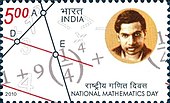
India has a few mathematical stamps too. Aryabhatta, Ramanujam and DD Kosambi are celebrated on Indian stamps. Jantar Mantar, the remarkable observatory designed by mathematicians and astronomers figures on a stamp too. The decimal system which originated in India and is a fundamental contribution, is actually celebrated in a stamp brought out by Nepal through a depiction of an Ashoka Pillar from Lumbini, which portrays this.

My search engine wanderings led me to a world which I did not know existed, and from where I have gleaned most of this information. The world of people who love mathematics, stamps and mathematical stamps .

Some of these, which are also the sources of much of the above information:

https://mathematicalstamps.eu/news/100

http://users.wfu.edu/kuz/Stamps/stamppage.htm

Stamping through Mathematics. Robin J. Wilson. Springer.

Mathematics and science : an adventure in postage stamps. William L.Schaaf. Reston.

Have fun!

–Meena

Peanuts for Bulls

One of Bangalore’s landmarks is the Dodda Basavana Gudi (Big Bull Temple), which is situated–surprise, surprise, on Bull Temple Road, Basanvangudi, South Bengaluru. It was built by Kempe Gowda, the founder of Bangalore, around 1537. It is dedicated to Nandi, the vahana or mount of Lord Shiva, and the monolithic statue has a height of 4.6 metres and a length of 6.1 metres. This Nandi is probably the biggest in the world.

But where do the peanuts come in? Well, apparently, this was a prolific peanut-growing area many centuries ago. But year after year, a wild bull would rampage through the fields just when they were ready for harvest, and would destroy the crops. Over time, the problem grew so worrisome that the farmers were desperate. They vowed to build a temple dedicated to Nandi if only the bull would stop. They did so, and miraculously, the bull stopped its depredations.

A board at the temple has a slightly different version. According to this, one of the angry farmers whose peanut fields the bull was destroying, hit it with a club. The stunned bull sat down motionless and turned into stone. But then it started to grow and grow! The worried farmers prayed to Lord Shiva. A trident found near the feet of the bull was placed on its head, and at last it stopped growing. The grateful farmers then built a small temple, which was later enlarged by Kempe Gowda.

And in gratitude, farmers also decided to hold an annual peanut fair (Kadalekai Parase) in the area around the temple. It is held on the last Monday of the month of Karthik (that is next Monday, 14 December). Originally, farmers would make an annual visit to Bengaluru to sell their peanuts, but today most sellers here are traders who buy from the farmers and sell. Not only can groundnuts be bought and stored for the year, but peanut connoisseurs will  find a large variety of snacks to choose from–spiced, fried, boiled, roasted and sugar-coated groundnuts.

Not just a tasty snack, groundnuts are good as a source of protein. It is of course a major oil crop—in fact India’s most significant one. The green or dried leaves are used as cattle-feed. Being a leguminous crop, it does the soil good too, by fixing nitrogen. Approximately 85 lakh hectares of agricultural land in India are under groundnut cultivation and the annual production is about 7200 thousand tonnes.  

Well, COVID is bound to interfere with beautiful traditions like the peanut fair, but its importance in our lives will not wane. And hopefully Kadalekai Parase 2021 will give us all our nut-fix!

–Meena

See also: ‘The Worshipful Bull’, https://wordpress.com/post/millennialmatriarchs.com/823