28 February marks National Science Day in India–it is the day in 1928 when Sir C. V. Raman discovered the Raman Effect. For his discovery, Sir C.V. Raman was awarded the Nobel Prize in Physics in 1930.
The discovery of the Raman Effect itself happened at Calcutta, but Bangalore was also Sir Raman’s ‘karma bhoomi’, in that he worked at the Indian Institute of Science from 1933 till his retirement in 1948, after which he founded the Raman Research Institute in the city, and continued working there till his death in 1970.
So on this Science Day, here is a little information on one of the exciting science education venues coming up in Bangalore. Science Gallery Bengaluru, under construction in Hebbal (not too far from IISc and the Raman Research Institute), ‘will be a dynamic new space for engaging young adults at the interface between science and the arts’. The under-construction centre anticipates a footfall of about 40,000 people a year, with a focus on 15-25 year olds. It is a multi-stakeholder collaboration, including Govt. of Karnataka, Trinity College UK, Indian Institute of Science, etc.
Scheduled to open in 2021, the Science Gallery is already active, having put up several events including ‘Submerge’ a major exhibition on Water.
And keeping with the theme of Science Day 2020 which is “Women in Science”, the Executive Director of the Science Gallery is Dr. Jahnavi Phalkey, a historian of science and technology. The Board is chaired by Dr. Kiran Mazumdar-Shaw, and includes Dr. Geetha Narayanan.
Bodes well for Science and Women Scientists!
Let us hope that the Science Gallery will help to infuse young people with the spirit of what Sir CV Raman said: ‘Ask the right questions and nature will open the doors to her secrets.’
Last week we wrote about Uncle Moosa and his single-handed mission to take books and reading to the remotest parts of North East India.
Here is the story of another man with a similar mission, one that he has been pursuing with undiminished passion and fervour for over 70 years! He is Mahendra Meghani. And this is the story of Lokmilap, the bookshop that he started, and which became a symbol of all that he has devoted his life to. And one to which I too have old links.
Photo credit: Ajay Desai
In the summer holidays when we used to go to Bhavnagar, our ancestral hometown, one of visits most looked forward to, was the one to Lokmilap. For us this was treasure house from which we were allowed to select a few books. More precious, because it was perhaps the only one that stocked English language books, in addition to some of the best literature in Gujarati. We often met Mahendrabhai there, who was also a family friend, and he would show us the new arrivals including the beautifully illustrated children’s books from the Russian People’s Publishing House.
In those days this was as much as we knew about Lokmilap. Over the years as we grew, we learnt more about Mahendra Meghani and his tireless mission to take literature to “the people” in every way possible.
Mahendrabhai’s own lineage in literature goes back to his father, the famed Gujarati litterateur Zaverchand Meghani, who was given the title Lok Shayar or People’s Poet by Mahatma Gandhi. It is said that while Zaverchand took literature from people’s tongues to people’s hearts, Mahendrabhai took literature to every person, home and society.
Born in 1923, Mahendrabhai, graduated from high school in Mumbai, and joined L. D. Arts College in Ahmedabad for further education. It is said that when he was getting ready to move from Mumbai to Ahmedabad, his father advised, “It gets very hot in Ahmedabad, so make sure you cover your head with a topi”. Complying with his father’s suggestion, Mahendrabhai started wearing the khadi cap which became an integral part of his attire, and remained so through the years. After two years in Ahmedabad he returned to Mumbai to join the Elphinstone College, but left that to join Gandhi’s Quit India movement. He did not return to college, but instead helped his father with his journalistic work. After the death of his father in 1948, Mahendrabhai went to the US to study journalism at Columbia. Living in the International Student’s House in New York, he would, every day, buy two newspapers and peruse the many pages. It is here that he also discovered Reader’s Digest. And he found his calling! He decided to return to India and start a similar magazine in Gujarati. And so, on 26 January 1950, India’s first Republic Day, was born Milap, a monthly journal in Gujarati which set high standards of language and literature, and yet garnered a wide and faithful readership.
Tired of the hectic life in Mumbai, Mahendrabhai moved to Bhavnagar in Gujarat where the journal Milap engendered the publishing house as well as the book shop Lokmilap (meeting of people). It is through these that Mahendrabhai lived his passion to take good literature, at affordable prices, to as wide a reading public as possible. The bookshop, as he said, “included books from all publishers, but not all books from all publishers.” Lokmilap’s vision was not simply to sell books; they wanted to open windows to the best in world literature, to give people a perspective about life, and how to live life. They published hundreds of original Gujarati books, but also translated and abridged versions of classics of world literature (many of them translated by Mahendrabhai himself). More critically, the books were very nominally priced, to suit even the shallowest pocket. They introduced “pocket books”, initially to take poetry to the people, but later diversified to include a vast range of literature. Priced then, as low as 50 paise, the books sold in lakhs.
In 1969, the Gandhi Centenary year, he compiled a special collection of 400 books that celebrated Gandhi’s life and message, and a booklet titled Discovering India Book Exhibition. The books were exhibited in many countries across the world with the condition that the sponsoring organisation would buy the set, and donate it to a local library or community centre.
Mahendrabhai himself has travelled far and wide, always clad in his simple khadi attire, sharing his love for language and literature with wide and diverse audiences. In Bhavnagar he was a familiar sight, riding his bicycle no matter what the weather. His tireless quest to share the best with everyone had many facets—at one point hand grinding wheat and baking bread which he distributed, to starting a film club which screened some of the classics of world cinema, and to which he would bring people who had never before been exposed to such experiences.
The man and his mission have inspired and touched millions across generations and nations. Last month, on India’s 70th Republic Day, Lokmilap also marked its 70th anniversary by announcing its closure. Expressing the sentiment that everything that has a start will have an end; what better than the end that is brought about by the ones that made the start? For all of us whohad taken Lokmilap as one of those comforting points of stability and continuity in lives and cities that have changed so much, it is a sense of losing moorings. But secure that the seeds of the institution have been planted deep and strong.
A man whose mission has brought the love of letters to millions, Mahendrabhai, at age 97, carries on with his writing and reading, somewhat frailer in body but indomitable in spirit.
When I saw the name Sathyanaryanan Mundayoor on this year’s Padma Shri list, a recognition for playing a ‘seminal role’ in spreading
Photo credit: Bapenlu Kri
education in Arunachal Pradesh, I was delighted. He epitomises for me a true passion for books and reading, and an inspiring story of a lifetime devoted to this mission. I first heard of him and his library mission, over a decade ago, from my old colleague and friend Ambika Aiyadurai. I sent him some of the books that we had developed in CEE, and over the years we corresponded sporadically. I have not yet been able to meet him in person, but truly hope to do so sometime. In the meanwhile I feel that his work needed to be shared. What could be better than a first-hand account from Ambika who has known him and seen his work over the years.
Thank you Ambika for sharing this!
–Mamata
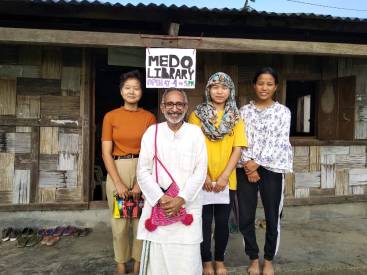
I first heard about Sathyanaryanan Mundayoor, way back in 2006 when I started my research work in Arunachal Pradesh. School teachers, students, engineers, administrators, doctors and local villagers in Lohit district of Arunachal Pradesh suggested I meet him. In Lohit and later Anjaw district, where I started my field research, every one fondly spoke of ‘Uncle Moosa’, a name that people of Arunachal had given him. It was only after two years, in 2008, that I had a chance to meet him at Wakro (Lohit district). My accommodation was in the Circuit House, and he had come there to meet someone. With a pleasant smile, a gentle, fragile-looking man greeted me with a ‘namashkaram’. What struck me was his dress. That evening, in the chill of October, all Uncle Moosa had over him was a sweater and shawl, and a cotton veshti. In fact, I have only seen him in a veshti all these years.
Uncle Moosa invited me to visit Bamboosa library the next day. The days were short, so I decided to visit the library at 3 p.m. A group of children was in the library, sitting on a carpet on the floor, reading books. Few sat on chairs placed along the wall. Soon, another set of students arrived. With an assortment of books neatly arranged on the shelves, this single room is a wealth for local children. Students were free to choose any book, read on their own, or in groups. This library in Wakro is a result of Uncle Moose’s mission to inculcate reading skills and promote a reading culture among children in Arunachal Pradesh. And he has spent the last 30-odd years on this mission to connect rural children of Arunachal Pradesh with books. Starting with the Bamboosa library in Tezu, followed by Apne library in Wakro, and Hutong library in Yatong in Anjaw district, by now 13 libraries have been set up in the state, as part of the youth library network.
Uncle Moosa’s first visit to Arunachal Pradesh was in the year 1979 as part of a Vivekananda Kendra Vidyalaya mission. He took this up after quitting his government job in the income tax department in Mumbai. Till 1996, he worked with VKV, dedicating his entire time to the library movement, and never went back to Mumbai nor to his home state of Kerala. In addition to running libraries, Uncle Moosa would invite scholars and other visitors to give a talk in the library and interact with the students. Uncle mentored senior students to become reader activists and there are several events organized during Gandhi Jayanti, World Environment Day and Independence Day where students affiliated with the library movement would perform plays, skits, reading sessions and poem recitals. Those who have known him for several years tell me that Uncle Moosa would carry books in small trunks and suitcases to remote villages to set up reading camps. Hopping onto state transportation buses, and in places with little road connectivity, he would walk for several kilometers to reach a village.
Not many know about Uncle Moosa’s frugal living. A small single room with a bed and a shelf was his accommodation in Wakro. His day begins at four in the morning by doing yoga and meditation. His favourite breakfast is upma, and he prepares his own food himself every day. Full of energy, and with a kind, ever-smiling face, talking with him is a joy. His dedication to the library movement and helping students with their education has earned him love and respect, both from adults and children. He continues to live in Arunachal Pradesh, and is now based in Roing. Many years have passed, and I have completed my PhD, but every time I go back to Arunachal Pradesh, I look forward to meeting Uncle Moosa!
Uncle Moosa has dedicated his life to promoting education and fostering a culture of reading in the remote areas of the North-Eastern state. May his tribe increase!
This is thanksgiving week in many parts of India. A week of festivals marked with celebration and gratitude for nature’s bounty that feeds and sustains us. With the winter season drawing to a close, it is time to reap the harvest of the long months of labour and prayers. Lohri in north India, Pongal in south India, Makar Sankranti in the west, and Magh Bihu in the northeast of the country celebrate the harvest with joy, festivities, and food.
Interestingly, in many other parts of the world, it is autumn, before the winter sets in, that is the season of harvests. In America Thanksgiving weekend is marked by families joining hands in gratitude over sumptuous meals; in Japan generations of poets and painters have tried to capture the spirit of the annual cycle of seasons in Haikus and brush strokes. Other parts of the world have their traditional ways of marking the cycle of sowing and reaping. Increasingly, as more of the world’s population moves from direct links with the soil to urban life, we seem to revel more in the food and festivities related to these festivals, often forgetting these very elements of nature—sunlight, air, water and soil–that make all life possible.
This week also marks the start of a new calendar year, and the start of the period when the sun begins its northward journey. A good time to give thanks for what has made all this possible, and a reminder to value and cherish every new morning.
This poem by Mary Oliver captures the sentiment beautifully.
Why I Wake Early
Hello, sun in my face.
Hello, you who make the morning
and spread it over the fields
and into the faces of the tulips
and the nodding morning glories,
and into the windows of, even, the
miserable and the crotchety –
best preacher that ever was,
dear star, that just happens
to be where you are in the universe
to keep us from ever-darkness
to ease us with warm touching,
to hold us in the great hands of light –
good morning, good morning, good morning.
Watch, now, how I start the day
in happiness, in kindness.
Mary Oliver was an acclaimed and award-winning American poet whose work reflects a deep communion with the natural world in an age of excesses of modern civilization. She died, almost exactly a year ago, on 17 January 2019, at the age of 83.
Harvard is on top of the pile of institutions when it comes to Nobel Laureates, with 56 currently on the faculty and 160 being associated with the University at some stage of their careers, either as students or faculty. Cambridge University comes second, with 120 Laureates being associated with it; University of California at Berkeley third with 107, followed by University of Chicago at fourth place with a round 100.
I imagine that at any of these places, the probability of bumping into a Nobel would be quite finite.
However, such a possibility is pretty remote in any city or town of India. Until last week, at Bangalore ….
January 3 saw Prof Steven Hell address the Indian National Science Congress held in the city. Prof. Hell is one of the directors of the Max Planck Institute for Biophysical Chemistry in Göttingen, Germany and received the Nobel Prize in Chemistry in 2014 ‘for the development of super-resolved fluorescence microscopy’. The next day saw Prof Ada Yonath address the same gathering. She is a protein crystallographer who was awarded the 2009 Nobel Prize for Chemistry. Both of them stressed the need for scientists to be open minded and for scientific research to be independent.
January 4 was also the day when Profs Abhijit Banerji and Esther Duflo were in conversation with Manish Sabarwal at the Bangalore International Center, and demystified RCTs, or Randomized Control Trials, the body of work which got them their newly minted Nobels. RCTs are an experimental method to do research on developmental issues like education and poverty, to find what can really be effective to solve the problems, and hence can help policy making.
January 7 saw the 1998 Economics Nobel, Prof Amartya Sen in the city, felicitating the winners of the prestigious Infosys Prize. Speaking at the event, Prof Sen said ‘There are deep links between friendship and knowledge. Our intellectual horizons expand when we learn from each other.’
January 15 will see Prof Venki Ramakrishnan, who shared the 2009 Chemistry Nobel with Prof Ada Yonath (above) and Prof Thomas Steitz for research on the ‘structure and function of the ribosome’ speak on Science and Society, once again at the Bangalore International Center.
It doesn’t rain, it pours!
Lucky Bangalore, to hear all these messages. And what a great unity in the underlying messages…the importance of evidence-based research, of the need for research to be independent and unbiased, the crying need to base policy on research, and the importance of cooperation and a barrierless world.
My friend Bharathi Kode recounts her experience of translating a book that aims to inspire the younger generation with a new set of role models: Meena
Everything starts with a dot. On a mid-summer day, I got a call from Reema Gupta, who is the co-lead of the Women’s Leadership and Excellence Initiative at Indian School of Business, asking if I could translate the book she had co-authored along with her two friends. The book “The Dot that Went for a Walk” was written in English by Reema and her two friends Sarada Akkineni and Lakshmi Nambiar who have made it a mission to create social change and empower young girls through inspirational stories. Inspired by the quote of artist Paul Klee “A line is a Dot that went for a walk”, the book was titled “The dot that went for a walk”. They wanted the book to be available in regional languages including Telugu.
She said they all were all first time writers and first time publishers. I said ‘And hence, you want a first time translator to do the translation?’ We laughed. And then I asked her how she how she had narrowed down to me as a potential translator. She said they had been searching for translators who are not only good at language but also somebody who shared their vision and would do the work with the same passion that they had. They approached a publishing house called Manchi Pustakam for suggestions, and the head of the publishing house had referred my name for this task. A dot connecting me to another dot J
The book features inspirational life stories of 51 Indian women. It starts with the story of Rani of Jhansi who fought the British, and ends with the story of Avani Chaturvedi, a MIG fighter pilot defending our country. Together they tell the story of the last 200 years of the country. The idea is that the young generation will connect with these role models, be inspired by them, think of career possibilities and fight harder against self-doubt.
I was excited and immediately said ‘yes’ without a second thought. In my area of work, I do interact with children and youth and I know how important it is to expose children to positive role models, especially in this digital age where children are exposed to lot of negative influences. I was not sure how much time and effort it would take for me to translate a book of about 150 pages. But still I committed, as I could see the influence that this book can have on the future of young children.
As a first time translator, it was quite exciting for me. I found translation as difficult as writing a book. At times I wanted to go beyond the ideas, thoughts and imagination of the author. But that was obviously not on. I found it also a great learning exercise. It improved my language skills in both English and Telugu. It helped me to get to know about some inspirational women whom I didn’t know about earlier. It took a lot of time, I had to put in so much effort. But it has been quite a satisfying journey.
The Telugu version was launched in November 2019 by the Missile Women of India Ms. Tessy Thomas, in Hyderabad.
The authors are going way beyond the printed word to get the message across effectively. They are organizing essay competitions, discussions around the book in the schools around Hyderabad to begin with. A content platform called ‘Dot Express’ is also being initiated where young generation can voice their opinions and interact with experts.
Even before it got published, sponsors came forward to distribute the book to 12000 children in govt. schools in Telangana. The journey of the dot has just begun. We have to see what patterns, masterpieces it will create in future.
Great job, Reema, Sarada, Lakshmi and Bharathi! We need many more books like this one!
We who worked at the Centre for Environment Education (CEE) were lucky. The list of luminaries with whom we had the opportunity to interact was beyond belief.
Mr. TN Seshan was one of them. During his stint as Secretary, Ministry of Environment and Forests, he was on our Governing Board, as CEE was a Centre of Excellence under the Ministry. Apart from that, since CEE was part of Nehru Foundation for Development founded by Dr. Vikram Sarabhai (whom Mr. Seshan counted as a guru), he took interest in the institution beyond his term also.
When he was on the Board, he made it a point to visit CEE whenever he was in Ahmedabad. And review the programs. He could pick holes in any presentation in a matter of minutes, if not seconds, and ask the most unanswerable questions. And his questions were certainly not put gently! While it was traumatic, when we dried our tears and reflected back on the experience, what he pointed out were indeed basic shortcomings in the program design or implementation.
All of us at CEE used to get all primed in the weeks preceding The Visit. We tried to ensure that everything was in order, but sure enough his perfectionist eye would catch just that smallest detail that we had overlooked. And someone had better have had a convincing answer for that! As Mamata remembers: “My personal Encounter with Mr Seshan was when I had to present some parts of a compilation of what was, in future, to become a publication titled ‘Essential Learnings in Environmental Education’. As someone who was still very new and untutored in the subject, this was an absolute trial by fire. Mr Seshan ruthlessly ripped apart every sentence, and reduced me to tears in front of the entire gathering of CEE! In the many years that followed, the Day that Mr Seshan Made Mamata Cry, became one of the memorable milestones in the institutional, and my personal history! As I grew older, and perhaps a little bit wiser, and Mr Seshan became a national icon, every time he was in the news, I remembered with greatest respect how he ingrained in me the importance of working towards ‘excellence’ in whatever one did”.
During his tenure as Secretary Environment, he gave CEE the task of doing a review of the state of Environment Education in the country. And a ridiculous deadline. In those unimaginable days before internet and Google and emails, we set about physically gathering reports, syllabi, textbooks from each state and UT. Almost 30 people worked day and night for about 20 days trying to make sense of the mounds of material. And then the day of the first presentation was upon us! Our director, Kartikeya Sarabhai and a small team of us were to take the 8 a.m. flight to Delhi. We were in the office till 4.30 a.m. putting the report together. While we went home for a quick shower, a team continued work printing and photocopying the report. We and the reports just made it onto the flight!
The meeting was set for 11 or 11.30 in the morning. It was a large Board room where about a dozen officials and our team were gathered. We had about 3-4 copies of the report. We put one at the head of the table where Mr. Seshan would sit. And waited, with butterflies in our tummies. He walked in almost on time; gave us barely a look of acknowledgement, picked up the report and rifled through it. For exactly about 7 minutes. And then tore us and the report to shreds! He started with the shortcomings in the framework that we had created for the analysis, the data gaps, the facets we had not even tried to look at, etc. etc. The meeting lasted about 15 minutes. He spoke in a flow for the latter 8 minutes, tossed the report back on the table, and told his office to fix another date for the next presentation the following week.
It was a learning like no other! We had worked on the report for days, but he was able to get a better perspective in 7 minutes!
The story had a fairly happy ending in that we completely re-thought our approach, and worked on the report over the next month, with interim presentations. The report became a baseline for our work on Environmental Education, and definitely impacted subsequent policy directions.
I had the chance to interact with Mr. Seshan on many occasions, including teaching him how to use the new Apple Computers, a big novelty at that time! He would often call us home for meetings early in the mornings, and his gracious wife would give us wonderful coffee. After the official work, over the coffee, he was not averse to chatting about this and that, including Mamata Kulkarni and Shilpa Shetty!
It is indeed a privilege to have seen Mr. Seshan in action, and worked with him in a small way. When media referred to him as Al-Seshan, he would joke that Bulldog might be more appropriate than Alsatian! Well, from my memory of him, his bark and his bite were both scary. But they did set India’s democracy on a solid footing!
What is more fun than a barrel of monkeys? A bunch of bubbly Bookaroons telling stories at the Baroda Bookaroo! No this isn’t a new tongue twister, nor the setting and characters from Dr Seuss. This describes the two-day Festival of Children’s Literature recently held at Vadodara in Gujarat.
Bookaroo, as the festival is called, is a celebration of the magic of books that brings together children and tellers and creators of stories (writers and illustrators). The Festival that focuses on Reading for Pleasure, began in 2008 with its first event in Delhi. In the decade since then, it had grown bigger, and also travelled to 13 cities in different parts of India. Besides the main two-day event that brings children to a common venue, Bookaroo also reaches out to those children who cannot come to the festival for various reasons, with authors visiting schools for the underserved, and with special needs; hospitals, construction sites, orphanages and remedial homes. Another form of outreach has been storytelling and art activities in public spaces like parks, metro stations, monuments, museums and public libraries.
I was privileged to be a part of this wonderful festival held in this past weekend. The venue itself was unique—the Art District in Alembic City with its sprawling lawns, old trees, and intriguing studio spaces housed in what was Alembic’s (remember those ubiquitous Yera glasses?) first factory, over a hundred years old! Imagine this coming alive with the colour, sound and movement of thousands of children—a vibrant tapestry seamlessly weaving the past, present and future.
The two days were packed with parallel events catering to children from ages 4 to 14. There was something for everyone—listening and reading, doodling and drawing, singing and crafting, meeting favourite authors in person, discovering new stories and books, and of course, making new friends. Gandhian Jyotibhai Desai, all of 93 years, with a twinkle in his eyes, answered children’s questions about Gandhi and his life, inspired each one to become a change-maker. Others carried children far and wide on the magic carpet of tales old and new.
The same excitement permeated the storyteller Bookaroons. The time that we spent together was bubbling with fun and laughter. A motley group from far and near, each of us passionate about telling tales in our own ways, all of us were immediately bound by our common love for words and passion to reach out to children. For those two dizzy days we Bookaroonas put aside our hats as mothers, daughters, mothers-in-law, daughters-in-law, and grandmothers, and donned our favourite kiddie-hats—giggling and teasing; chatting and chortling late into the night; sharing ice-cream rolls and shopping tips, and swapping ghost stories!
Bookaroo’s journey started in 2003 with the setting up of India’s first exclusive children’s bookstore Eureka–a place that children could call their own, choose books of their choice without parents or teachers dictating what a good book is. Bookaroo has travelled far since then, connecting children and books in so many ways. Bookaroo is a winner of the Literary Festival Award at the London Book Fair’s International Excellence Awards, 2017. It was the first time that an Indian children’s literature festival was recognised in the international arena.
For myself, who often agonises in this blog about the dying age of the printed word, and the joy of reading, it was exhilarating to see so many happy children with paint-smudged fingers clutching their new books, and looking for the authors to autograph them. Thank you Bookaroo for a wonderful reiteration and reassurance that all is not lost!
–Mamata
14 November is celebrated as Children’s Day in India. For Bookaroo, every day is Children’s Day!
Salim Ali’s birthday falls on 12 Nov. He was born in 1896 and passed away in 1987. He may be credited with single-handedly bringing ornithology to India. And this interest in ornithology, as it spread, led to interest in wildlife and biodiversity; in environmental issues; in conservation; and in sustainable development.
He inspired generations in India and created a culture of systematic and scientific study of wildlife. If his ‘Book of Indian Birds’ is the easy guide which every bird watcher starts with, the landmark ten volume Handbook of the Birds of India and Pakistan which he wrote with Dillon Ripley is the authoritative guide. Dr. Salim Ali was respected across the world, and decorated with the Padma Bhushan and Padma Vibhushan.
On this his birth anniversary, here are excerpts from an interview of Dr. Salim Ali (when he was 85+ years of age!), with Dr. HSA Yahya of Aligarh Muslim University, and taken from http://wgbis.ces.iisc.ernet.in/ envis/doc97html/biosalim24.html. My only contribution is to have picked out two sections that I found of particular interest.
MONEY MATTERS NOT A JOT
‘Then I told Prater ” look we have so many places in India and we know nothing about birds.” Hyderabad for instance, was a complete blank on the ornithological map. So I said ” if you write to the British Residents who are really interested in these kinds of things we can probably get some financial support. I do not want any pay. I only want my expenses paid and I will be quite happy to go, study and collect birds.”So the Society got in touch with the Hyderabad Government which had largely British heads of Departments. They were very glad. But it is really quite laughable, the amount we asked for and which we got and in which I was able to complete the survey. I think for the whole of the Hyderabad State survey for six months we got about 6000 Rupees (NOTE: THIS WAS WAY BEFORE INDEPENDENCE!). Yes, six thousand which included the food of the skinner, our own food, cost of travelling and everything (laughter)! We were able to do it with a lot of trouble, many of our camp shifts had to be done by bullock carts because there were no roads in the places where we were camping. After Hyderabad I did Kerala which was then two states, Cochin and Travancore. Then one after the other Central India, Gwalior, Indore, Bhopal. So all these were done under the same system: asking for small amounts and doing it. I could do it because I had the time, I mean, I was just doing it and nothing else and I did not have any ambition to try again for some bigger job somewhere and so on. Not because bigger jobs were not there and perhaps I would have not got them, but they were not in the line in which I was interested.’
ON THE IMPORTANCE OF A LIKE-MINDED PARTNER IN FOLLOWING A PASSION
‘I tried all kinds of jobs for a long time. Finally, I said that, well, I have all these trainings and I have my chief interest in birds so why should I not do this on my own. My wife had a little money and I had a little investment and so on. Then we worked out and found that we had just enough if we left Bombay, which was very expensive and went to live in some quieter place which would give more facilities for bird study, we will be far happier. My great fortune was that my wife who had had all her education in England and been used to quite a different sort of life to what she would have in the kind of work I wished to do. She insisted that I should take up only the work that I was interested to do. She said ” now we have enough to live quietly, we would go to some small place, I will be quite happy.” She was keen on poetry and Urdu and various kinds of reading and so on. Then she got very interested in birds too, and in outdoor life and in things she had never had any experience in England of.’
From: TRANSCRIPT OF AN INTERVIEW WITH SALIM ALI by Dr H S A Yahya Reader, Centre for wildlife & ornithology, Aligarh Muslim University, Aligarh.
–Meena
PS: ‘The Fall of a Sparrow’ his autobiography, is a must-read.
The verdant forests of Panna, Madhya Pradesh. We were able to visit two weeks ago. And were lucky enough to see a tigress and her cub. What a majestic sight! The tigress was pretty big and healthy, the cub frisky and curious. The mother was contemptuous of the humans in their vehicles going into contortions to catch a look, to take a pic, to exclaim to each other. She moved when she felt like, sat down and relaxed when she felt like. Not looking in the direction of the vehicles even once, though she knew we were there. She was the queen of her territory and saw no reason to acknowledge us.
It was a wonderful feeling. To see the healthy tigress and her confidence in her security. The active cub, about 5 months old. The number and variety of herbivores. And the thick forests and healthy, lush greenery.
It would be good to have seen this in any of our protected areas. But especially gratifying when we go into the story of Panna. Panna was declared a National Park in 1981, and subsequently a Tiger Reserve in 1994. The tiger population in Panna was down to zero in Feb 2009, thanks to poaching. It was a sad time indeed for India’s conservation efforts.
Things started to change with the posting of Mr. Sreenivasa Murthy, who took over as Chief Conservator of Forests and Field Director, Panna Tiger Reserve. They speak of the tough measures he took in securing the Park, coming down hard on all incursions, trespass, illegal activities and poachers. Even as he protected the area and worked on the morale of the Forest Staff, he built on the already initiated plan for re-introduction of tigers into the Park. Starting with one tigress in 2009, six of the species were introduced from different parts of the country. And it was not an easy task. As the Panna website tells it, one of the re-introduced males strayed out of the protected area into unsafe terrain, and 70 Park staff led by the Field Director followed it on elephants for 50 days, securing it from gunshots, poisoning and electrocution, till at last they were able to tranquilize it and bring it back into the safe area. All the hard work paid off and the re-introduction worked, with the first litter of cubs born in Panna in 2010. The results are obvious today, with the Park now home to 51 tigers. Several cubs have been born this year too.
Nothing is achieved by one man alone. But equally, individuals make all the difference. And in the case of Panna, this individual was Mr. Murthy. He has been posted out of the Park, but even today, drivers and guides speak his name in hushed tones, in tones of awe. And when respect and admiration penetrate to all levels, it is surely the greatest homage to the real difference someone made.
So a huge THANK YOU Mr. Murthy and all our Forest Dept. staff who work in extremely difficult situations to ensure that our biodiversity and natural heritage are safe. The thick forests of Panna, the variety of animals and birds we saw, of whom of course the tigress and cub were at the peak, the flourishing trees and plants—all of these stand testimony to your efforts.
–Meena
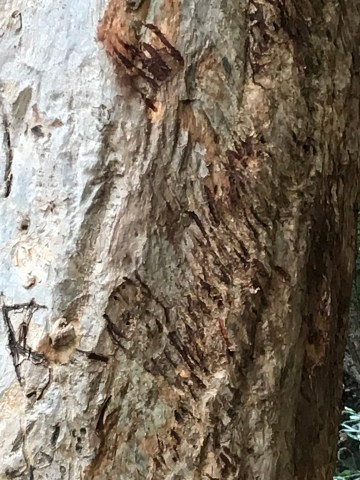
(There are many trees like the pic, with nail marks made by bears climbing them to get at honeycombs.)
PS: We did not get any pics of the tigers—we were too busy looking at them. And anyway, they were far away and our phone-cams were not up to the task.
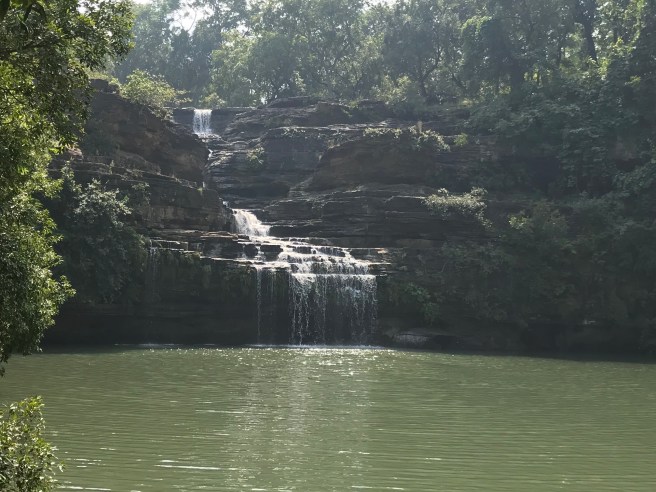
But a few other pics from the Park and Pandava Falls nearby. Photo credits: Prof Samir Barua.

 cutta, but Bangalore was also Sir Raman’s ‘karma bhoomi’, in that he worked at the Indian Institute of Science from 1933 till his retirement in 1948, after which he founded the Raman Research Institute in the city, and continued working there till his death in 1970.
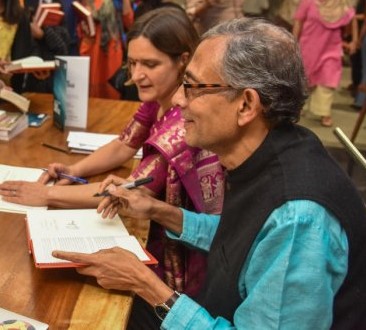 January 4 was also the day when Profs Abhijit Banerji and Esther Duflo were in conversation with Manish Sabarwal at the Bangalore International Center, and demystified RCTs, or Randomized Control Trials, the body of work which got them their newly minted Nobels. RCTs are an experimental method to do research on developmental issues like education and poverty, to find what can really be effective to solve the problems, and hence can help policy making.
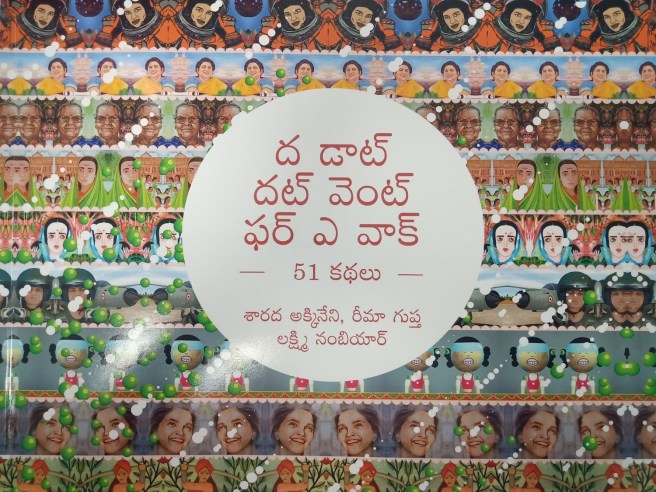 Everything starts with a dot. On a mid-summer day, I got a call from Reema Gupta, who is the co-lead of the Women’s Leadership and Excellence Initiative at Indian School of Business, asking if I could translate the book she had co-authored along with her two friends. The book “The Dot that Went for a Walk” was written in English by Reema and her two friends Sarada Akkineni and Lakshmi Nambiar who have made it a mission to create social change and empower young girls through inspirational stories. Inspired by the quote of artist Paul Klee “A line is a Dot that went for a walk”, the book was titled “The dot that went for a walk”. They wanted the book to be available in regional languages including Telugu.
 We who worked at the Centre for Environment Education (CEE) were lucky. The list of luminaries with whom we had the opportunity to interact was beyond belief.
 this past weekend. The venue itself was unique—the Art District in Alembic City with its sprawling lawns, old trees, and intriguing studio spaces housed in what was Alembic’s (remember those ubiquitous Yera glasses?) first factory, over a hundred years old! Imagine this coming alive with the colour, sound and movement of thousands of children—a vibrant tapestry seamlessly weaving the past, present and future.
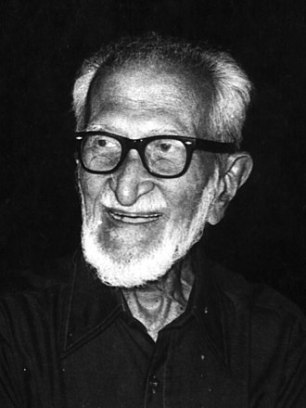 Salim Ali’s birthday falls on 12 Nov. He was born in 1896 and passed away in 1987. He may be credited with single-handedly bringing ornithology to India. And this interest in ornithology, as it spread, led to interest in wildlife and biodiversity; in environmental issues; in conservation; and in sustainable development.