Yellow is the Colour of Spring

Basant Panchami, celebrated on the fifth day of the Magha month, heralds the end of winter and the coming of spring. It precedes Holi which marks the beginning of summer  by about 40 days.

Basant Panchami

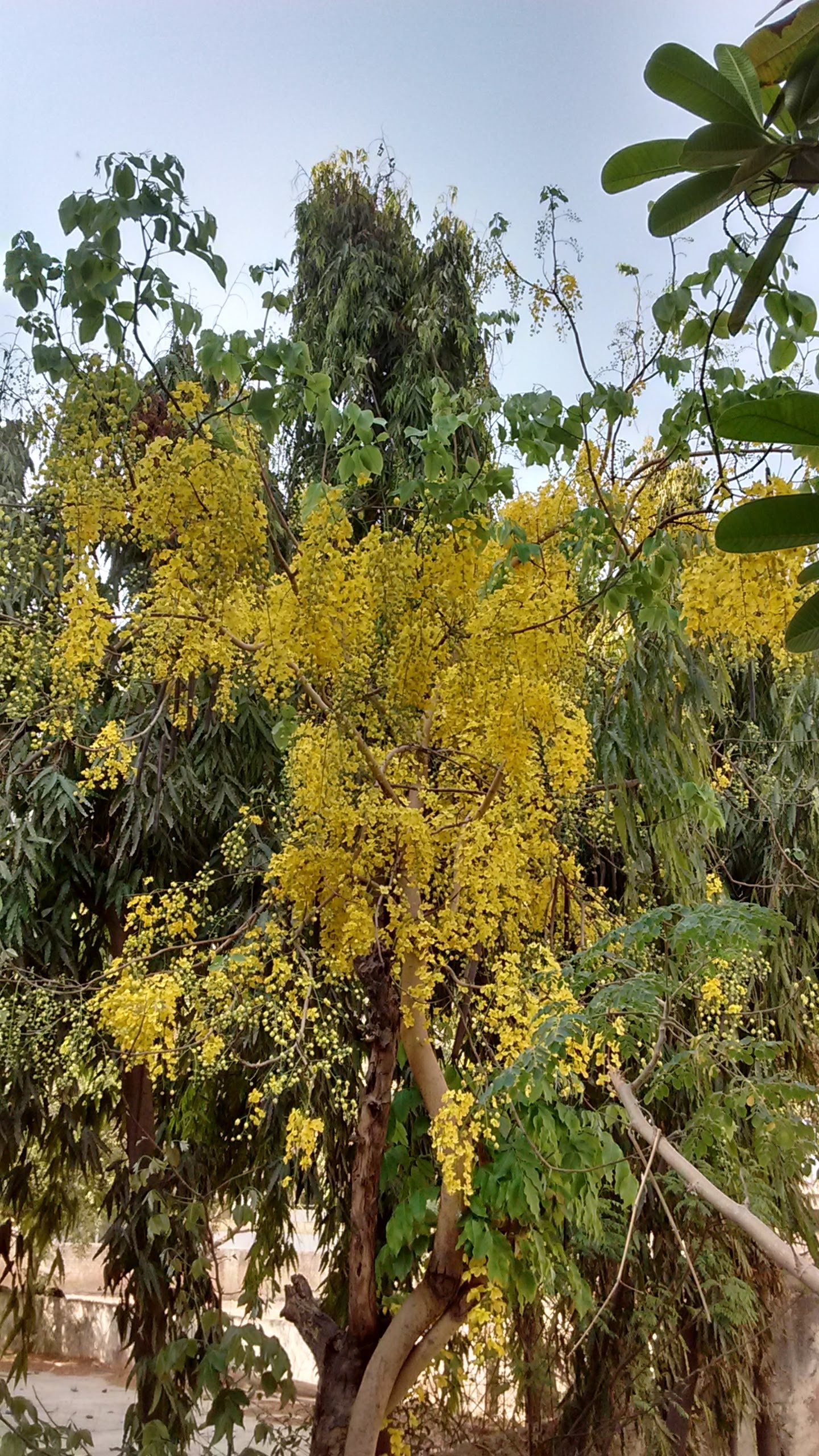
Yellow is the colour of this festival. With good reason—of the myriad flowers that bloom in the spring, many are yellow. Mainly the mustard flowers, which turn North India’s landscapes golden in these months. Yellow is also the colour of Goddess Saraswati, to whom this festival is dedicated in some parts of the country.

Apart from marking a major seasonal change, there are many stories and myths associated with the festival.

My favourite one is to do with Poet Kalidasa. The story goes thus, for those who need a refresher: The Princess of one of the kingdoms in the North (not at all clear which one!) was very intelligent. She laid down the condition that she would marry only the man who beat her in a contest of wits. Many a suitor came and was rejected, including the son of the CM of the country. Male egos were as fragile then (approximately 5th century CE) as now, and the CM and maybe some of the rejected suitors decided to give her her comeuppance. Imagine a girl proving that she was more intelligent than men! Anyway, they decided to hunt out the dumbest guy in the country in a kind of reverse intelligence test. They were thrilled when they located a shepherd who they felt was the epitome of dumbness—it is said that they spotted him when he was sitting on the tip of branch high up on a tree, and sawing away at the branch—which would of course have resulted in his falling down along with the branch. Through a series of ruses, they managed to trick the Princess into thinking he was very intelligent. The Princess married him, and obviously the secret came out pretty soon. The Princess threw the husband out. He was in despair and on the verge of suicide. At this point, Goddess Sarwaswati is said to have appeared in front of him, and asked him to take a dip in the river. And then the miracle happened! When he emerged shivering from the river, it was with a hymn to the Goddess on his lips—the Shyamala Dandakam! A miracle had happened–he had gained poetry, wisdom, language and knowledge! That was Kalidasa—the man who gave us works such as Abhijñānaśākuntalam, Kumārasambhava, Ritusamhara, Meghadhoota, etc. The episode of the Goddess giving him darshan and his gaining wisdom is said to have happened on the fifth day of Magha, which therefore we now celebrate as Saraswati Puja, and pray that the Goddess may bestow similar gifts on us. . (It has always intrigued me as to what happened with the marriage. Did Kalidasa and the Princess get back together? I don’t remember that the story ever referred to that.).Some people also mark this as Saraswati’s birthday.

The other story involves Shiva and Parvati and is a bit gory for my liking. Shiva’s beloved wife Sati had died, and he went into total depression (following a huge show of rage). He started meditating and was oblivious to the world and his duties. But the world needed him to keep the cycle of life going—an immediate requirement being that a son be born to him to destroy the demon of the moment. As per the larger plan, Sati had already taken her birth as Parvati, the daughter of the King of the Himalayas where Shiva sat in meditation. But nothing she did could even get him to open his eyes. That is when the gods sent Kamadeva, the god of love, who shot an arrow at Shiva and got him to open his eyes. So furious was Shiva that he opened his third eye and burnt Kama before anyone knew what was happening. But the purpose was achieved–he also saw Parvati and fell in love with her. Kama’s sorrowful wife Rati underwent rigourous penances for 40 days till Shiva relented and agreed to let Kama, the collateral damage, resume his physical form for one day a year. The day this happened was Basant Panchami.

East and North India seem to celebrate this festival much more than the South—at least, I don’t remember this as one the special days in our Tamil calendar. So for me Basant Panchami is memories of amazing bhogs at the houses of dear Bengali friends. And an opportunity to wear yellow, a colour too bright for my usual palate.

Grateful for the diversity of stories, traditions, celebrations. Surely makes our lives more colourful and interesting!

–Meena

The Silent Valley Saga: A Landmark in India’s Environmental Movement

Last week, we paid our tribute to Prof. MK Prasad—one of the key people behind saving Silent Valley. This week, I thought I would re-visit some details about Silent Valley and the campaign.

The Silent Valley deep in the Western Ghats of Kerala is a very special forest. In fact, it is one of the oldest stretches of rainforest in the world, ‘the last authentic sizeable evergreen forests left’, in the words of MK Krishnan, the eminent naturalist.

Lion tailed Macaque
Lion-tailed Macaque. Illustration: CEE

It is home to about a 1000 species of flowering plants, 107 species of orchids, 100 ferns, 200 liverworts, 75 lichens and about 200 algae, many of them endemic to the area. It counts 34 species of mammals, 292 species of birds, 31 species of reptiles, 22 species of amphibians, 13 of fishes, 500 of butterflies and moths, besides a multitude of other orders of animal life (keralatravels.com). And these are only the species documented! The valley’s flagship species is the lion-tailed macaque, a species endemic to the Western Ghats.

Many are the myths and legends associated with this forest. It is said that the Pandavas, during their peregrinations after they lost their kingdom to the Kauravas, happened to come to this forest. So enchanted were they that they decided to make it their temporary home. The river that runs through the forest is called Kuntipuzha, in memory of their mother, and the forest itself was called Sairandhari, this being another name for Draupadi.

In 1847, the Englishman Robert Wright came upon the thick forest. He or his colleagues named it Silent Valley. There are several theories about why this name was given. It could of course be an Anglicization of Sairandhari, the traditional name. Or it could be because there are no cicadas in this forest. The constant hum in most forests is due to cicadas, and the absence of this noise can be quite stark. Cicadas do not thrive in wet climate, and that is why they are not common here. Yet another theory is that the British gave it this name due to the presence of the rare lion-tailed macaque whose Latin name is Macaca silenus. But in spite of its name, the Silent Valley resounds to the cadences of the river, bird-calls, monkey-whoops, and insect chirrups.

Silent Valley burst into the national consciousness in the 1970s, when the Kerala Government proposed to construct a dam on River Kuntiphuzha, to generate electricity for the State’s growing needs. When scientists and environmentalists came to know about this, they were very concerned, as it would mean that the Silent Valley would be flooded, and that would be the end of that very special habitat and the unique flora and fauna there.

Kerala Sastra Sahitya Parshat (KSSP), a people’s science movement, took up the cause. On the one hand they did techno-economic and socio-political studies to show the impact of the project, and its pros and cons. On the other hand, they mobilized public opinion, and garnered the support of eminent scientists and people. They also came up with alternatives to building the dam e.g., building a series of small dams, rather than one large one.

It was a long and hard battle. It became a bitter war between the State which wanted the project, and the people who did not. The Centre through the course of the controversy saw many changes, and some of the PMs were for and others against the project. Each set up Committees of scientists. Media was also ranged on the two sides, beginning with local media predominantly in favour of the project, and then slowly veering against it. For a long time, national media paid little attention to the issue, but later weighed in favour of the environment. International environmental organizations also came into the fray. The matter went to court to—with the High Court at some stage giving the go-ahead.

It was when Mrs. Indira Gandhi came back as PM that it began to look as if the conservation movement would win. In 1981, she declared Silent Valley a protected area. But it was found that the hydroelectric dam was not covered in the area under protection. Protests began anew, till finally the project was scrapped in 1983. In 1984, Mrs. Gandhi declared it a National Park—the highest level of protection that can be given. And Silent Valley was saved!

Kerala government has recently decided to declare the buffer zone of Silent Valley National Park as a wildlife sanctuary—the Bhavani Wildlife Sanctuary spread across 148 square km.  So hopefully, Silent Valley continues to remain safe!

Hats off to the scientists, environmentalists, poets, artists, students, NGOs , media, politicians and the common people who fought the long and hard battle to preserve our common heritage.

There are other such success stories, but sadly not very many. And even more sadly, hardly any in recent times.

–Meena

Activist Poet: Homero Aridjis

This week several of my friends shared their fond remembrances of Prof MK Prasad. For us at CEE, MKP was the mentor with the twinkle in his eye and a gentle rebuke or prodding, even as he solicitously asked about our families, and encouraged us in our work as environmental educators.

Professor MK Prasad was a rare combination of utmost humility and simplicity with the mind of a brilliant academic, a fighter’s spirit, a scientist’s rigour, a leader’s passion, a prolific writer, and a relentless campaigner for the environment. As one newspaper article mentioned ‘activism and writing are not always identical. The activist has to be amidst people organising and motivating them while garnering available scientific facts. A writer has to confine himself to his study for long hours to research, read, think and write.’ Prof MK Prasad, like some of his other fellow members of the Kerala Sasthra Sahithya Parishad (KSSP) beautifully combined activism and writing. This was also a unique characteristic of the Save the Silent Valley Movement that Meena described—the coming together of poets, writers, activists and citizens for an environmental issue.  

There is perhaps one other similar story that echoes this movement. The story of Homero Aridjis, a Mexican poet, novelist, activist, and diplomat, and founder of the Group of 100 a group of intellectuals and artists who united to tackle and environmental issues in Mexico, and raise awareness of environmental issues internationally.

Homero Aridjis was born in 1940, and grew up in the Mexican state of Michoacán near the area where Monarch butterflies gather for the winter. He recalled how as a child he saw Monarch butterflies flying across his village every winter. There was also his annual school excursion to the sanctuaries in the nearby mountains to see the butterflies. On these excursions he also saw that the mountains were being deforested with the connivance of politicians, loggers and local farmers who were cutting down the oyamel fir trees where the Monarchs roosted. Since then the young Homero became concerned that this would mean the loss also of the Monarch butterflies as the forests were their habitat. The Monarch butterfly, a fragile insect that flew thousands of miles from Canada to Mexico every winter sparked the poet in him, and he wrote many poems about butterflies. The butterfly also became, to him, a symbol of the environment. As he explained: I love poetry and the environment for me is the poetry of life. I can’t be living now in a world without poetry or be a member of humanity without feeling the poetry of human beings.

As he grew older, and embarked upon a career in the Diplomatic Service, being posted as his country’s envoy to several European countries, Homero’s passion for the environment was also growing. One day in 1985 he read a letter sent by a philosopher friend to a local newspaper. He felt that a single small voice of dissent would not make a difference, but he thought that if the writers and artists of Mexico joined together to make a strong statement, they would perhaps stand a chance of being heard. A few weeks later, on 1 March 1985, a fierce critique of the environmental havoc amidst which we live was signed by 100 leading personalities in the arts, literature, culture and science in Mexico.

The statement was published in the national and international media. Thus was born The Grupo de los Cien — the Group of 100 which took up the cause to reverse ecological damage and environmental degradation in Mexico, raising awareness about the threats to many species and habitats and campaigning to ensure the continuance of Mexico’s rich biological diversity.

Due to public pressure the President of Mexico in 1986, declared the habitat of the Monarch butterfly and five other sanctuaries as ‘protected’. But illegal logging and other destructive activities continued in the forests. Homero took up his pen as a weapon and wrote many articles in the newspapers and many petitions to draw attention to this. His diplomatic posting as an ambassador to UNESCO helped him to take the battle to an international stage. Before he left UNESCO, the committee of the natural heritage approved the monarch butterfly sanctuaries as protected Natural Heritage of Humanity.

The Group of 100 continued to take up critical issues that that threatened the delicate balance between environment and development. They campaigned to seek protection for the beaches where sea turtles laid their eggs, and that resulted in ending the commercial killing of sea turtles in Mexico. In 1995 they launched a fierce   fight against a planned industrial salt plant that would have had catastrophic impacts on the lagoons where gray whales came to give birth as well as the surrounding environment and local communities. It took five years of battles before the plant was cancelled. Homero bore the brunt of the hostility from vested interests and even received death threats. The Group of 100 remains active to this day, fighting the same battles, with the same undiminished spirit.

As Homero Aridjis put it: You have to have a commitment and a conviction to defend the environment even if you know that the forces of destruction are very big. You have governments, you have corporations, you have individuals, you have criminals, you have many people against nature. That is very difficult but you as a human being and a person with an environmental conscience you have to do everything you can, always in peaceful ways and in legal ways, to defend the environment. You have to defend the things you love.

MK Prasad and Homero Aridjis two warriors who fought with pen as well as sword.

–Mamata

The Storyteller Who Saved Silent Valley: A Tribute to Prof MK Prasad

For those of us who started working on environment-related issues in the ‘80s, ‘Silent Valley’ was one of the success stories which was held up to us as an example of how arguments based on good science, people’s power, and unrelenting campaigning could save the world. Or some part of it.

For those who have forgotten what this was about, hydroelectric dams were proposed on the River Kunthipuzha, which would have involved the submergence of the forests of Silent Valley, a biodiversity rich habitat, home to many, many unique species of flora and fauna, including the rare and unique lion-tailed macaque which is endemic to the Western Ghats.

Kerala Sasthra Sahithya Parishad (KSSP), a people’s science movement, led the campaign against the project under the leadership of Prof. MK Prasad. They published well researched techno-economic and socio-political assessment reports of the proposed project. The campaign by KSSP evoked a huge response from citizens at large, as well as eminent scientists and environmentalists like Romulus Whitaker of the Madras Snake Park, Dr. Salim Ali (who was probably the first to flag the issue), Dr. MS Swaminathan etc. The renowned poet Sugathakumari was at the forefront of the movement, and her poem “Marathinu Stuthi” (“Ode to a Tree”), was a rallying call for the people.

In an early and unique victory for the environmental movement in India, the then-PM, Mrs. Indira Gandhi finally weighed in, and the project was halted. Subsequently, the area was declared a National Park.

Prof MK Prasad
Prof MK Prasad

The story is one of the amazing dedication and hard work of a large number of people. But Prof. MK Prasad’s was a symbol of the movement. Prof MKP as he was fondly referred to, was a botanist who spent his life in academics. He taught botany, was Principal of Maharaja’s College, Eranakulam, and Pro-Vice Chancellor, Calicut University.

But he was not confined to classrooms, and believed passionately in taking science to the people. He was an environmental and science activist all his life, and a founding member of KSSP. His distinction as a scientist supported his environmental activism, which no one could dismiss as woolly-headed.

He was a member of the Governing Council of Centre for Environment Education for many decades and we at CEE were fortunate to have him as a teacher, guide, and mentor. Never for him the exalted distance of a Board Member. He was always interested in the minutest details of our projects and lives, and was happy to spend any length of time chatting with us. Prof Prasad passed away last week due to COVID. Here are a few poignant memories which bring him to life.

Prof Prasad, my mentor and a dear friend. It seems a little presumptuous to call this stalwart my friend, but as unassuming as he was, he truly was that. I’d scold him when he sat next to me during the Governing Board meetings, when lesser mortals like us were let in, because he would chatter away irreverently while serious matters were being discussed. He guided me through the challenge of trying to break into the ivory towers of higher education, and when things didn’t work, he’d say our efforts were “before their time”. That, always accompanied by his naughty smile, had become his code word. He also treated me as his unofficial research assistant, which I enjoyed.  He would call to ask me to find out about things that often I knew nothing about, and it was always great learning. Will miss you, Sir!

Kiran Chhokar.

When I think of Prof Prasad, I can see him walking down the corridors of ASCI where we held our Steering Committee meetings in Hyderabad. As always, he is dressed in a half-sleeved shirt, has no smile on his face – but his kind, sharp eyes are twinkling! I am immensely grateful for all his advice and guidance to the school environmental education project. But more importantly, I feel blessed to have spent some time with such a stalwart. His greatness and his humble demeanour co-existed so well! 

Something I found remarkable in him and so distinct from my generation is that he always gave a considered, detailed response to every request for advice. He never rushed to give an immediate response. Sometimes, he would respond the next day – probably after mulling over the issue. 

On one of his first visits to ASCI, I told him that there was a National Park (the KBR National Park) close by and he could probably take a stroll there in the evening. When I met him the next morning, he gave me a gentle, but proper scolding about my recommendation. I learnt my lesson – one does not present KBR as a ‘National Park’ to the person who saved the Silent Valley National Park! 

Kalyani Kandula

While I was working at the Centre for Environment Education (CEE), Ahmedabad,  I had the good fortune of knowing Professor Prasad. I have known him for many years now.  At Governing Council meetings held at CEE often I would sit next to him and would be very inspired by his valuable suggestions, critical comments and review of many projects CEE was handling. He would not mince his words. A gentle soul, very down to earth and a great inspiration to many. Professor Prasad in fact attended my sister’s wedding in Kerala. My father Dr.S.M.Nair and Professor Prasad shared a great professional and personal bond. 

Meena Nair

Some weeks after CEE’s office in Pune was started, Prof MKP dropped by. He was in Pune for some other work. Though it was a single person office and I a relatively junior staff member, Prof MKP was interested to see how I was settling in and getting on. When I told him that Amma (my mother in law) would have been happy to meet him, considering his association with KSSP, he just said that he would be happy to come over for coffee. So we did that, and Amma (and I) was very touched by the gesture. Later Prof Prasad and I went to meet Prof Pisharoty and I just felt blessed to listen to their conversation.

Sanskriti Menon

For me, he was the quintessential story teller. We would invite him to come and speak in various training programmes we organized—those for Forest Officers, for Environmental Educators from around South and Southeast Asia, for NGOs, for school and college teachers. Of course his sessions had to be around the Silent Valley Campaign. I must have sat through his sessions a dozen times if not more. But the passion, involvement and detail with which he told the story of the campaign inspired not only every new batch of trainees who had never heard it before, but equally, us the organizers who had heard it and read about it and discussed it ad-infinite. Such was the power of his passionate storytelling! And not just the Silent Valley–he had done so many interesting things, met so many interesting people, been so many interesting places–he could keep an audience engaged for hours!

Thank you Sir, for inspiring us. We are comforted by the knowledge that you are looking down at us with a twinkle in your eye!

–Meena

Another old piece on Dr. Pisharoty at : https://wordpress.com/post/millennialmatriarchs.com/43

KING CROW 

Erect and majestic, against the clear blue January sky, sits the bird. It is imperious in its mien, the king of all that it surveys, from its perch on the branch of the drumstick tree. Its glossy black feathers lengthen into a long forked tail, like the regalia of a king. No wonder it carries the moniker of King Crow. But it is not related to the crow family.

Drongo
Drongo

This is the Black Drongo. It belongs to a distinct family the Dicrurus. Its scientific name is Dicrurus macrocercus. Dicrurus is derived from the Greek words dikros meaning forked, and ouros meaning tailed; macrosersus is from the Greek makrokerkos, where makros means long and kerkos means tail. It is this forked tail that is the distinctive feature of this bird. The body of the drongo is small (bulbul sized) while the tail is relatively long, giving it a graceful and regal appearance, not only when it is perched, but also when it flies with an undulating wave-like movement, alternating the flapping of wings, and gliding smoothly with wings held still. 

The Black Drongo can be seen in open areas—farmlands, grasslands, fields and even urban pockets, usually perched on poles and wires, or tree branches. These are favoured as they are good look outs for spotting prey. The Drongo is primarily an insect eater, on the alert for bees, butterflies, dragonflies, grasshoppers, cicadas, termites, moths and ants. The insects are snatched from the air with daring aerial displays—shooting up like an arrow, zooming down like a rocket, veering sharply to change direction—which are a delight to watch. Once caught, the prey is carried off by the Drongo, who with deft manoeuvres, clamps its catch under foot, and tears it to pieces before swallowing it. 

Drongos are also smart enough to avail of more easily available meals by being around when fields are being ploughed, or stubble is being burned, so as to feast on all the insects that are disturbed by this. They also hitch a ride on the back of grazing cattle, with the same purpose of feasting on the insects that fly up in the wake of the walking cattle. Thus Drongos help to control many agricultural pests, making them important biological pest-control agents, earning them the name ‘farmers’ friends’. 

The Drongo is not just agile in its movements, it has a versatile repertoire of calls—from harsh scolding calls to a range of sweet whistles. It is also a clever mimic, imitating the calls of other birds, so as to use this to its advantage in different ways. It can imitate sounds that make a flock of diverse birds believe that they are from the same flock; it will raise an alarm call that will cause others to abandon their food and flee, leaving the rest for the Drongo.  It is said that the Drongo perfectly mimics the call of a shikra which scares birds like mynas who fly away in panic, leaving the takings for the Drongo.

Despite its small size this bird is fearless, and can be aggressive, taking on larger species that may venture into its nesting territory. It is especially vigilant about keeping out crows who may poach their eggs. Thus being given the appropriate name of Kotwal or sentry in Hindi. The smaller birds take advantage of this vigil by also nesting safely in the ‘sphere of influence’ of this gutsy gatekeeper.  

The battle for supremacy between the freeloading crow and the feisty bird was vividly described by British civil servant and naturalist Edward Hamilton Aitken in his book The Common Birds of Bombay published in 1900. 

 “Its (Drongo’s) aim is true and its beak is sharp and its target is the back of the lawbreaker. The Crow is big enough to carry off its puny enemy and pick its bones, if it could catch it, but who can fight against a ‘bolt from the blue’? The first onset may, perhaps, be dodged, but the nimble bird wheels and rises and plunges again with derisive screams, again and again piling pain and humiliation on the abject fugitive till it has gone far beyond the forbidden limits. Then the King sails slowly back to its tree and resumes its undisputed reign.”

Little wonder then, that this bird, though no relative of the Common Crow, has earned the sobriquet King Crow. 

This agile and spunky little bird is equally celebrated for its cleverness. It displays these traits in a number of folk tales from different cultures and geographies—from South Africa to Australia to North East India. 

Here is one from the Shangani tribe of Zimbabwe.

A long time ago, the birds decided to choose a leader. A call was sent to all birds to attend a meeting to determine the same. When he heard this, Pau the Ostrich was confident that being the largest bird, he would get this title. Gama the Eagle was equally sure that he was entitled to this, being the bird that could fly highest. The little birds also decided to compete. Thus birds of every shape, size and colour arrived at the meeting. The elders had a long and argumentative discussion to fix the criteria for selection. Finally they agreed that the bird who could stay in the air the longest would be designated as leader. 

Pau the ostrich, who could not even fly, stalked out in protest at this criterion. Many smaller birds who knew the limits of their ability and endurance dropped out, knowing that they could not match the powerful fliers. But Matengwane, the fork-tailed drongo, did not throw in the towel immediately, and quietly planned his strategy. The next morning when the big birds set off flying on their course, drongo lightly settled on the back of Gama the high flying eagle, and hid amongst its feathers. As the race went on, more and more birds began to drop out from exhaustion, until finally it was only Gama soaring in the sky. The confident eagle descended, and landed to cheers. Just as the elders were about to crown Gama as the leader, they noticed that there was still one bird flying in the sky— Matengwane the drongo! The clever hitchhiker had detached himself from his ride, just as Gama was landing, and remained the sole winged creature in the sky. And thus was the Drongo declared the leader of the birds!

Certainly no bird brain—the Drongo.

.–Mamata

A Shout-out for the Environment: NEAC

India has always been a little ahead of the curve in its thinking about environmental issues. Four decades ago, it recognized that raising public awareness and educating key target groups as well the future generations on environmental issues, were key to a sustainable future. It designated a Centre of Excellence in this area way back in 1985–viz the Centre for Environment Education.

In 1986, the Ministry of Environment and Forests (as it was then) launched another unique initiative called the National Environmental Awareness Campaign (NEAC). The unique feature of this was that it called upon various types of organizations to plan their own Environmental Awareness programmes for their own local communities or other target groups, and implement them with the support of small grants from the Ministry.

Every year, NEAC started on Nov. 19th. Nov 19 to Dec 18 was marked as Environment Month in the old days in India—Nov 19 being Mrs. Indira Gandhi’s birthday, and she certainly had a big role in setting the environmental agenda for the country, and was a voice for developing countries on these issues at global forums.

NEAC was unique that it was conceived as a pan-national programme, at a time when there were not very many such. Even in the first year of its launch, it already touched almost every state and union territory. And it was unique in its proactive involvement of a variety of agencies as implementers. NGOs, educational institutions, professional associations, scientific bodies, community-based organizations—all were welcome to put in proposals, which were scrutinized and passed. There was a degree of trust which is not often seen.

And there were few constraints on media and methods for outreach—from street plays, to seminars to drawing competitions to films to essay-writing to teacher training to door-to-door campaigns to wall-painting to bringing out booklets and posters to….. The NEAC probably saw a flowering of outreach methods which was unique. And it reached every nook and corner of the country—from women in remote forest villages, to students in the Andamans; from famers in Assam to small industries in Gujarat.

NEAC
NEAC Campaign. CUTS.

The numbers were mind-boggling. From the involvement of 120 NGOs in the first year, it went to 9784 implementing agencies in 2006-2007. A total of 13,336 campaigns are reported to have been conducted in 2014-15. And each of these reached hundreds of people.

And the administrative backbone also evolved with the growing numbers. To begin with, there was one central Committee set up by the Ministry to scrutinize and pass the proposals. Slowly, the concept of Regional Resource Agencies (RRA) took root—reputed NGOs or academic institutions which were well networked in specific areas were given the responsibility to set up their own expert-committees and pass the proposals. Within 10 years of the programme starting, there were 27 such RRAs, making for very decentralized operations.

The amount of money involved was not high. Each implementing NGO got about Rs. 30,000 to implement the programme. But the energy, creativity and outreach it gave rise to were truly remarkable.

The NEAC has been more or less been given up in the last few years. Environment Minister Anil Madhav Dave in a written reply to Parliament said that the NEAC could not be conducted during 2015-16 and 2016-17 due to lack of funds.

Nov 19 is almost here. It does not seem that there is much action on this front this year either.

There were a lot of problems with NEAC, with the key ones being: Were the funds being utilized properly? Did the kind of awareness programmes being done make a difference?

Many evaluations of NEAC were done, the latest one being in around 2017. But the report of the evaluation is not exactly locatable. So has NEAC been dropped due to lack of funds? Because it was not making a difference? Because something else has taken its place? It is not clear.

The one thing that is clear is that with environmental crises looming, the need for environmental awareness and education have never been greater. OK, if the NEAC was not effective, let’s revamp it. Surely the evaluation report should tell us how to do it. But let’s not forget that building public opinion is critical to saving the world!

–Meena


COP Out?

The acronym COP has been hitting us in the face for the last few weeks. We know that there is a meeting happening at Glasgow, and that Climate Change is being discussed. And that the decisions made or not made will affect the future of the Planet and of humankind.

COP 26

But what is COP? COP stands for Conference of Parties, i.e., all the nations which have signed the United Nations Framework Convention on Climate Change (UNFCC). This is the foundational treaty on climate change, and came into being at the landmark Rio Convention in 1992. A ‘Framework Convention’ is one wherein parties acknowledge that there is a problem, and commit, more or less in principle, to work together to solve it. However, there are no specific obligations laid out in these. The UNFCC is ‘subject to ratification, acceptance, approval or accession by States and by regional economic integration organizations’. 

Over time, as more information, knowledge and science come in, and consensus grows, a Framework is fleshed out, and specific Protocols and Agreements with clear obligations come in. From UNFCC for instance, we have the Kyoto Protocol and the Paris Agreement, laying down specific obligations on the parties. Each of these has to be signed and ratified separately—and this is where the crux of it is. Easy enough to sign statements of intent, but countries baulk at signing on to specific commitments.

The UNFCC opened up for ratification at the Rio Conference on 4th June 1992. It came into force on 21st March 1994, after the 50th instrument of ratification, acceptance, approval or accession had been deposited. India was one of the early movers, signing the Convention on June 10, 1992, and ratified it in Nov 1993.

As of now, there are there are 197 Parties (196 States and 1 regional economic integration organization). And these are the ‘parties’ referred to in COP. The COP is the highest decision-making body of the Convention and all States that are Parties to the Convention are represented here.

The COP meets every year, unless the parties agree otherwise. The first meeting was held at Bonn in 1995, the year after the Convention came into force. The COP presidency rotates among the five UN regions. COP 8 was held in New Delhi in 2002.

Apart from the Parties, COPs are attended by Observer States. Beyond this, there are two more categories of participants. The Press and Media are one category of participants. The last category is of observer organizations. These ‘observer organizations’ include the United Nations System and its Specialized Agencies; intergovernmental organizations; and non-governmental organizations (NGOs).

The number of people registered for COP 26 at Glasgow was close to 40,000, approximately double the numbers from COP 25 held in 2019. But there have been allegations that many delegates and participants from developing countries could not make it because COVID-related travel restrictions for their countries were lifted too late, thereby restricting the voices of the Global South.

This is not the only angle from which COP 26 has been criticized. More than half way through the event, many are concerned with the progress made. Greta Thunberg feels that it has been a “two-week long celebration of business as usual and blah, blah, blah”.

What can we do but hope? And take actions at the personal level, while the powers talk and discuss and negotiate.

Till another COP next year, at a yet-to-be announced venue.

–Meena

RIP Dr. SM Nair: Father of Natural History Museums

There are the pioneers, and he was among them. Museology is not a widely-known or popular field of study even today. Way back in the 1950s, it was even less so. This is the time at which a young boy from Kerala, after finishing his B.Sc in Trivandrum, travelled all the way to Baroda to pursue his M.Sc in the subject, at the M.S. University. He went on to do research on the Bio-deterioration of Museum Materials, and was awarded the first Doctorate in Museology from M.S. University for this work.

Dr. Nair started his career as an academic, first teaching at his alma mater in Baroda, and then moving on to Department of Museum Studies, BITS Pilani.

Mrs. Indira Gandhi, then-PM, and a leader who took great interest in the environment, had been very impressed by the Natural History Museums she saw during her visits to Europe. She wanted to create similar ones in India. She conceived of a plan for one in New Delhi and one in Bhopal. She put together an eminent team of museum professionals and scientists to take this idea forward. One thing led to another, and Dr. SM Nair, only 37 years old at that time, was chosen as the Project Director for this initiative in 1974.

Dr. Nair and Mrs. Gandhi at NMNH

Four hectic years followed, when the conceptualization, planning and execution was done by a dedicated core team including Shri D.P.Singh, S.K. Saraswat, B. Venugopal and several others. Dr. Nair visited the best Natural History Museums around the world. He got several artists and model-makers trained at the best centres in the world. And the National Museum of Natural History opened its doors to the public on June 5, 1978 (Environment Day). Subsequently, Regional Museums of Natural History came up in Mysore, Bhopal and Bhubaneswar  under Dr. Nair’s guidance.

The stuffed rhino that greeted one on the ground floor of the FICCI building where NMNH was housed, will surely be in the memories of many a Delhi school child. The rhino had died a natural death at the Delhi Zoo, and was stuffed and kept here.

The effort in NMNH was always to make the experience interactive for children. For those times, when most museums were static displays, this focus was unusual. The Museum also had a major thrust on outreach and extension. It had an active teacher training and orientation programme, which reached out to thousands of educators in its time.

Dr. Nair had a personal connect with every exhibit and activity at NMNH, and continued to take an interest in it even after his retirement in the late ‘90s. What he must have gone through on 26th April 2016, when the news of a fire breaking out in the museum and destroying the entire collection, can only be imagined.

Dr. Nair continued to be active in his mission of Environmental Education long after his retirement, working at WWF-India and Centre for Environment Education.

Not just at a national level, he was extremely respected internationally, serving as Chairman of Natural History Museum Committee of ICOM (international Council of Museums) and as

a Member of the Joint Museum Committee of the lndo-US Subcommission on Education and Culture.

Among his books are ‘Endangered Animals of India and their Conservation’, brought out by the National Book Trust, and  ‘Bio-deterioration of Museum Materials’ by Agam Kala Prakashan.

We knew Dr. Nair since the mid-eighties, as one of the fathers of the Environmental Education movement an India.

He mentored us first as a member of the Governing Council of CEE, and then as a senior colleague. Even today, old-timers in CEE-VIKSAT recall his contribution to these institutions with great respect—when it was a struggling NGO, he spotted the potential of the team and gave them a project to develop labels and take-away materials for the NMNH exhibits. This not only paid salaries for a couple of months, but gave them their first project from a national-level, government institution. This project was a critical stepping-stone.

We have also known him as the father of a colleague, Meena, who was inspired by him to follow in his footsteps in a career in Environmental Education.

NMNH and other natural history museums excited the imagination and curiosity of generations of children. NMNH may no longer exist, but Dr. Nair’s legacy lives on.

Dr. Nair passed away last week. May his soul rest in peace.

Dr. SM Nair (1937-2021).

–Meena

Beauty and the Bees

If last week was about boring bees, this week it is about beautiful bees—bees in art, bees and art.

Bees have been depicted in art through the ages, the oldest known been a Spanish cave painting dating back 15,000 years. These insects also have great symbolic value—variously standing for peaceful coexistence, teamwork, industriousness. In some cultures, they are symbols for fertility and healing. In Hindu mythology, Kamadev’s sugarcane bow is strung with a row of bees, thus symbolizing the sting of love.

One of the most popular works depicting bees has to be the Fontana delle Api, or Fountain of Bees in Rome. In a city replete with fountains, this one stands out for its elegance and creativity. Built in 1644, it prominently features bees because it was commissioned by Pope Urban VIII, who belonged to the Barberini family, whose symbol was the bee. The 3-bee symbol of the family was also immortalized with St. Peter’s Basilica in the Vatican, in the Baldacchino sculpture.

Fountain of Bees
Fountain of Bees, Rome

Napoleon did his part for bees—they were one of his imperial symbols. His red coronation robes were embroidered with gold bees. It was not just the beauty of bees which captured Napoleon’s imagination. He consciously used this symbol as a rejection of the fleur-de-lis, which was the symbol of the previous regime of the Bourbons. His use of bees started a rage, and they were used as decorative symbols on everything, from porcelain to textiles.

Coming to contemporary arts, in something called bee sculpture, artist Tomas Libertiny collaborates with bees and bee keepers, to re-create famous sculptures in beeswax. He makes 3-D replicas of the originals—from the Nefertiti bust to Micaheangelo’s sculptures—and creates a wire frame of the same shape. He gives these frames to beekeepers, who encourage bees to build their hives on these. In a matter of months (or years if it is a large and complex structure), the bees build in the desired shape. Not a simple process though—Libertiny compares it to doing bonsai, with the constant need for adjusting, trimming and building the growth in the desired shape. The result is a beautiful and very durable piece of art made of beeswax.

The Hive is a huge immersive exhibit at the Kew Gardens. It is a huge structure made of metal. It reflects the activity of a real bee hive in the Kew. An accelerometer (a device which detects vibrations) is placed in the real hive. It picks up the vibrations of the bees and transmits them to the metal hive in real time. There are 1000 LED lights in the structure, which light up in tandem with these vibrations. There are also recorded sounds from hives to add an audio dimension. It is the closet a human can safely get to being in a beehive!

Then there are artists for bees. The Good of the Hive initiative of artist Mathew Willey has made it a mission to depict 50,000 bees in murals and installations across the world, towards raising awareness of the role of bees in our lives, and the threats they face. The number 50,000 is chosen because that that is the number of bees which can sustain a healthy colony. Louis Masai Michel is another artist with a similar mission.

On the one hand there are humans celebrating bees in art. On the other, there are bees exhibiting a developed sense of art recognition! There is a fascinating experiment concerning bees and art conducted by scientists in Australia. Bees were shown 8 paintings, four by the French artist Claude Monet, and four by Australian Indigenous artist Noŋgirrŋa Marawili. The scientists placed a small blue dot at the centre of each painting. The ones on the painting by Monet had a bitter quinine drop in it. The ones by Marawili had a drop of sugar solution. After letting the bees interact with these paintings for some time, the scientists replaced the paintings with two new paintings which the bees had not seen, one by Monet and one by Marawili. The bees made a beeline for the painting by Marawili! In other words, they were able to distinguish the styles of the two artists, and knew which painting would yield the sugar!

Long live bees!

–Meena

Snail Alert

As I was walking along in my colony the other day, on a patch of grass I saw a gory sight. Someone had stepped on a snail. It was crushed. And beside it, I saw a yellow outgrowth. I couldn’t figure out what that was: for a moment I thought that the snail had been dead for a few days maybe, and some kind of mushrooms or fungi had grown there, thanks to the nutrients available. That didn’t seem too plausible. So my next idea was that in fact the accident was very recent, and these were the snails innards. But a closer look revealed that small yellow balls made up the outgrowth.  So the final conclusion (borne out by web-searches) was that the crushed snail had been pregnant, and the eggs had come out and lay beside the dead father/mother.

Father/mother? What does that mean? Well, if you remember your high-school biology, most snails are hermaphrodites–which means that they have the reproductive organs of both males and females. In theory therefore, they have the ability to self-fertilize. However, they don’t usually do that. They mate in the “traditional way.” As a result, both of the partners lay eggs.  Each clutch has about 200 eggs on average, and each snail may lay 5-6 clutches per year.

And this high reproductive ability is a cause of great concern. Because the crushed specimen was a Giant African Land Snail, one of the most invasive species ever. A native of East Africa (mainly Kenya and Tanzania), today the snail has spread across almost the whole world, an active and aggressive pest. Given the rate of its reproduction the snail spreads like a wildfire. It is extremely adaptable, and eats about 500 species of plants, and hence poses a threat to both agricultural crops and native plants wherever it goes. Not only does it eat the plants but it is also a vector for plant pathogens, thus causing further damage to agricultural crops and native plants. It carries the rat lungworm parasite and can transfer it to humans, causing meningitis. And once entrenched, the snails are almost impossible to get rid of. Some states of the US have spent millions of dollars to eradicate the creatures, but with limited success.

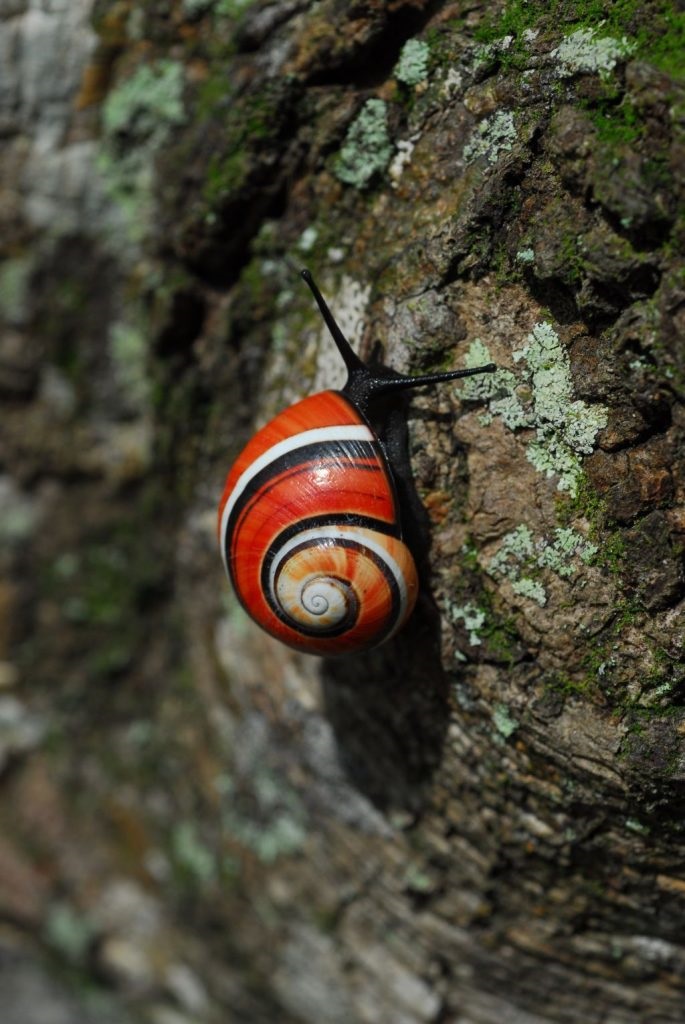
But coming back to snails in general. Well, snails are gastropod mollusks, which means they are related to both octopuses and slugs.  There are some species adapted to living on land—the land snails, and there are aquatic snails, which live in either fresh water or the sea. All snails carry shells into which they retreat when threatened by predators, or in unfavorable weather. They hatch out of the eggs with small shells, which grow as they grow. The shells are made of calcium carbonate, and they keep adding more of it to the edges of the shells till they are adults. They don’t have legs, but move thanks to the muscular movement of their bodies, and aided along by the mucous they secrete which helps them to reduce friction and slide along. And moving along at snail’s pace means maintaining an average speed of about half-an-inch per second. They can’t hear, but their sight is good and sense of smell even better. They live for 3-7 years. While most species are hermaphrodite, there are some which are not and have distinct males and females.

Well, we do know that snails are a delicacy in some parts of the world. But lesser known is that in places in the UK, snail-racing is a sport! Snail shells are also sometimes incorporated in jewelry. Certain varieties of snails, especially the Muricidae family, produce a secretion that is a natural dye. In ancient times, purple and blue dyes were made from these snails, and were very expensive and prized. There was also belief that snails had medicinal properties, especially for bronchial problems, tuberculosis, etc., and some of these uses are still being investigated. And not to forget, snail slime may well be a part of that anti-aging cream or moisturizer you just bought!

Coming back to my crushed snail.

I know the person who stepped on him/her did so unknowingly.

And that if that clutch of eggs had hatched, we would have hundreds of more pests to ruin our gardens.

But still I cannot but feel a little sad, at the memory of the crushed body and the doomed eggs.

–Meena