CityScape SnapShots

Air–the poison we breathe Ads that sell Aspirations

Buildings Business Busyness 

Concrete jungles Crash Clatter Clash and Clamour

Dreams that draw millions from far and wide Dust and Depression

Emissions foul from Energy sources

Fast food Fast life Fast lanes at work and play

Garbage Garbage Garbage burying the Greenery

Heritage Habitats Hotels and Hovels

Islands of heat Islands of Isolation Islands of luxury amidst seas of slums

Job seekers Jump starters Jugaad makers

Kaleidoscope of colours, cuisines, communities and callings

Landfills Landladies Latchkey children Lifestyles

Malls and Multiplexes Mobile towers and Middle class aspirations

Noise Nightlife Non-functional essentials Nature in decline

Overload Overconsumption Overreaction…Over the top

Plastics Pavements that aren’t Parking battles where Parks used to be

Quality of life? Question mark indeed!

Roads with Roaring traffic Risks to Rare Ramblers

 Skeleton Scaffoldings Scavengers and Smog

Traffic jams Towers grow where Trees once stood

Ugly urban settlements Unplanned spaces Unruly crowds

Vendors Vandals  Vistas Vitiated

Windows that look out onto other Windows Water more precious than gold

Xerox shops at the corner X-ray shops   Xamination-prep shops   Xtremes of everything

Yuppies Yearnings Year-end discounts

Zero tolerance…road rage, warring neighbours, violence in speech and deed.

–Mamata

Cleaning up the Abode of Gods

Lessons on Sustainable Tourism: Sudha Priscilla, continues..

Yuksom currently serves as the gateway to many of India’s most beautiful and difficult treks. Recognised as the ancient capital of Sikkim, the town is of historical importance as the first Chogyal (king) of Sikkim was crowned here in 1642 AD.

IMG_20181101_154529On our drive to Yuksom from the airport, I noticed a garbage bag provided in the taxi. This gave us our first insight into their environmentally conscious mind-set. Despite the invasion of visitors, Yuksom has retained an abundance of green spaces and public spaces are all remarkably clean. Every street is equipped with a well-placed litter bin.

Through my travel, I tried to find out more, and here is some of what I learnt. Truly inspiring

In order to thwart degradation of the fragile ecosystem caused by increased tourism, the community formed the Khanchendzonga Conservation Committee in the ‘90s. KCC played an instrumental role in banning the use of firewood previously used for cooking, heating and camp-fires. They also run a garbage management centre that segregates garbage collected on the trekking trails and recycles it.

IMG_20181102_122801The local gram panchayat has also formed an informal association of shopkeepers known as the ‘Bazaar Association’. One of the activities they undertake is sending a family member each week to collect trash from the streets of Yuksom.

During the off-season, members of the Yuksom Tourism Development Committee comprising of stakeholders from the tourism industry, trudge back along various trek routes to collect trash that may have been left behind by travellers. Most of the collected waste is then recycled, thereby reducing pollution.

Additionally, most reputable tour agencies offer clients portable pop-up toilet tents that act as pit latrines. The tent and toilet seat is pitched on a flat surface and placed over a shallow pit with a hump of mud outside. The pit is then used by the client who in turn covers it with mud ensuring that the waste seeps into the ground.  This prevents trekkers from defecating near water bodies.

The town is truly at the helm of the movement promoting sustainable tourism.

ABODE OF GODS

A Christmas Guest Longread from a friend and colleague, Sudha Priscilla . This should get you planning your 2019 Autumn break now!

When G and I met in 2014, we quickly bonded over our passion for the Himalayas. He had just completed the Leh-Ladakh bikers’ circuit on his KTM Duke 390, and I had backpacked across Nepal with a close friend.

Fast forward to 2018 and we’re now married, having shared many adventures along the way. Most recently we formulated an ambitious plan that included trekking and camping for 8 days in West Sikkim and then exploring East and North Sikkim on an Enfield.

Putting plan into action, we got in touch with Mingma Sherpa, proprietor of ‘Mountain Tours, Treks & Travels’. His family has a rich legacy in the field of mountaineering. His grandfather, Namgyal Sherpa was part of the first successful Everest expedition in 1953 alongside Edmund Hillary and Tenzing Norgay. He was the expedition companion of the then expedition leader, Sir John Hunt. The dynamic duo played a critical role in opening the route towards the summit of Everest.

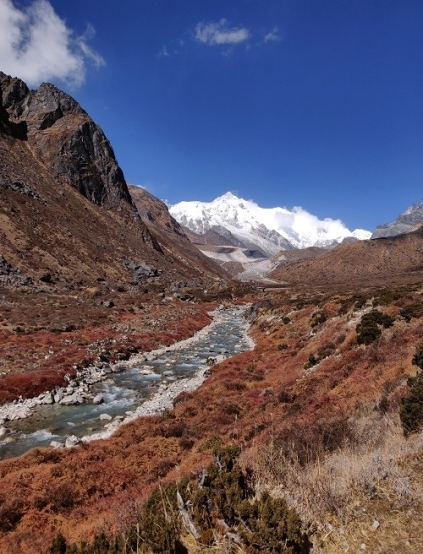
Faced with many options, we zeroed in on the ‘Goechala’ trek. The steep trail allows one to view Mt. Kanchenjunga from up close. Having finalised the itinerary with Mingma, we were left with three months to prepare ourselves mentally and physically for the trek.

We got our first glimpse of the mighty Himalayan range as the flight prepared to land in Bagdogra. At the airport, we met Manzil, a young lad who drove us to Yuksom which serves as the gateway to many of India’s most beautiful and difficult treks.
IMG_20181107_121145

The next day, we met Mingma who was busy planning the return journey, for a client who suffered from Altitude Sickness The client in question was an experienced trekker who has even summited Mt. Kilimanjaro. Unfortunately, he was struck by AMS halfway through the Goechala trek, and had to be carried down the mountain by his team on a stretcher. The oxygen tanks that his team members carried made a huge difference to his life. Once in Yuksom he was rushed to a nearby hospital where his health improved.

This episode left me worried. On observing this, Mingma handed me a strip of ‘Diamox’ tablets, which is commonly used by mountaineers and trekkers a few days before their steep ascent in order to prevent AMS. He also went through the gear we brought along and offered me a down jacket, which was insulated with soft, warm feathers.

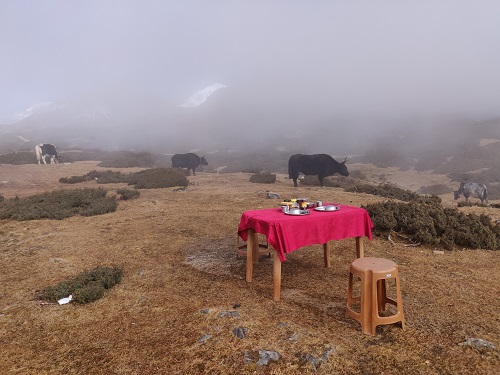
Early next morning, we were introduced to our experienced guide. He was accompanied by a very capable team which included a cook, cook’s helper, porter, Yak herder and 4 beautiful Dzos.  Dzos are a hybrid between yak and domestic cattle, possessing the desirable characteristics of each animal. Our heavier backpacks were mounted on the Dzos along with food supplies and the required logistics. This included a two person A-shape sleeping tent, toilet tent, dining tent, kitchen tent, dining table and sleeping bags.

Before we set off, Mingma presented us with beautiful silk scarves to wish us good luck. We were filled with excitement as we exited Yuksom and entered Kanchenjunga National Park.

Day 1- The first day of the trek was long and arduous. We had to reach Tshoka  13 kms away and perched at approx. 3050 metres. The trail was picturesque but steep. Lunch consisted of a boiled egg, potato slices, juice and chocolate, aimed towards restoring depleted strength. Enroute we met a couple of dejected trekkers who were headed back to Yuksom. They were exasperated at not being able to get a clear view of Mt. Kanchenjunga due to inclement weather.
IMG_20181106_081638

An hour before arriving at Tshoka, Ashok signalled us to remain quiet. We heard what sounded like a bark coming from inside the jungle. ‘Barking Deer’, said a gleaming Ashok. Though tired, this incident propelled us along.

By the time we reached Tshoka, it was around 8 pm. The rest of our team members who reached a few hours earlier, greeted us with a heart-warming dinner consisting of vegetable soup, rice, dal, sabzi, rayosag fry (local type of spinach), papad, ginger tea and a banana.

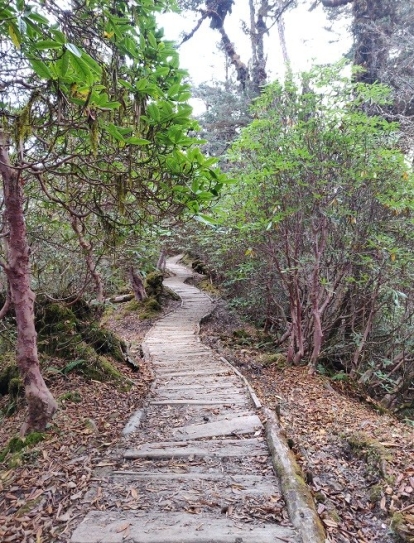
Day 2- We headed out to Phedang (Approx. 3550 metres), only 5 hours away. The trail was laid with pine wood logs, and meandered through Rhododendron forests. During April and May, the trail is apparently set ablaze by colourful Rhododendron blooms. G spent most of the day spotting birds such as the Himalayan Magpie and the Himalayan Eagle through his binoculars.

At the campsite, we were greeted by our team who offered us hot orange juice and pakoda. The treat was laid out neatly on a dining table surrounded by the glorious views of the Himalayas and the Rhododendron forest.

On Day 3-After a hearty breakfast that included muesli, ginger tea, steamed banana and toast with peanut butter, we left for our upward march towards Dzongri. Perched at approx. 4300 metres, it is surrounded by the mighty peaks of the Himalayan range. The landscape changed dramatically from forest trails to open mountain meadows rich in juniper shrubs. The plant is mostly used as incense in Buddhist monasteries, in order to purify the air of any negativities ahead of a puja or arrival of an important guest. We reached our campsite by noon.

Since we were not surrounded by trees, our tents lay exposed to winds that seemed to strengthen as time went by. G and I took a walk around, but we didn’t get too far since oxygen levels were much lower at this point and every step felt tedious. Lunch that day included boiled apples.

The night sky was lit by a million stars, but we were unable to fully enjoy it as temperatures plummeted.

Day 4- It was just about 4:00 am when Ashok woke us. After snacking on ginger tea, biscuits and popcorn, we set off for Dzongri Top. Popcorn also known as ‘Natural Diamox’, is said to increase one’s oxygen capacity. It was a constant snack throughout our trek.

We braved the heavy winds to reach Dzongri top at around 5:30 am, just as the amber sun rays hit the top of Mt. Kanchenjunga and its surrounding peaks such as Mt. Pandim and Mt. Kabru Dome. The magnificent view injected our tired souls with much needed energy. As the winds picked up, we headed down to the valley for yet another breakfast and then headed out to Thangsing.

Situated at 3,930 mtrs, Thangsing is a beautiful valley that can be reached via a short climb to a ridge followed by a rapid steep descent through yet another Rhododendron forest. The highlight of the day was the apple pie that our remarkable cook, Purna, served us for dinner.

Day 5- We took a gentle 3 hour walk to Lamuney (Approx. 4,200 metres) alongside the Prekchu River. The trail goes past stunted rhododendron bushes, azaleas and a Buddhist prayer wall. According to legend, years ago, a trekker of foreign descent was passing through when he ran into a lady. He repeatedly asked her the name of the place, when she answered ‘Lamuney’ meaning ‘Female Monk’. Not knowing English, the monk thought he was asking her name.
IMG_20181109_153517.jpg

This campsite was by far my favourite. It had the best views of Mt. Pandim, Mt. Kanchenjunga, and Mt. Tenchenkhang.

Day 6- The ever conscientious Ashok woke us at 2:45 am. We quickly got ready and met our team members who fed us biscuits, popcorn and loads of ginger tea. Armed with head torches and flashlights, we headed out in the dark to Goechala (Approx. 4,950 mtrs). Temperatures had dipped to -15 degrees, but the down jacket coupled with a shawl made of yak wool kept me warm. We trudged upward along the moraine path by the side of Samiti Lake to view the East face of Mt. Kanchenjunga. Towering at 8586 metres, the sunrays hit Mt. Kanchenjunga peak first, and slowly spread across the peaks of Kobru, Tenchenkhang, Pandim, Jupono and Rathong. We munched on popcorn and drank hot chai as this scene played out before us.

Ashok explained to us that as a gesture of respect for the religious sensitivities of the local people who regard the mountain as a deity, the Indian govt. banned expeditions to Kanchenjunga and seven others sacred peaks surrounding it.

Trekkers were earlier allowed to proceed to a second viewpoint, which now remains closed due to sightings of the elusive snow leopard. After basking in the sun for an hour, we headed back to Lamuney for breakfast. On our way down, Ashok pointed out towards the upward ridge, where we could see the silhouette of a Bharal, commonly known as the Himalayan Blue Sheep.

After yet another hearty breakfast, we headed down to Kockchurung campsite (Approx. 3700 metres). We slept at the trekker’s hut that night instead of pitching our tents by the riverside. Purna managed to make us pizza for dinner, which he aptly christened ‘Mountain Pizza’.

Day 7- We headed back to Tshoka, our final campsite. We enjoyed going at a slower pace choosing to spend more time with our team members. Lucky for us, we also stumbled upon a flock of ‘Blood Pheasants’ (the state bird of Sikkim), scurrying through the tree lines.

As it was our final night together, the team surprised us with a steamed cake that said ‘Thank you Visit Again’. This gesture reflected how we were cared for by our team. They were patient, kind, humble, witty and understanding of us throughout the trek.

Day 8- The following day we were escorted back to Yuksom, by a young guide named ‘Buddhist’, as Ashok had to accompany a couple from Canada back to Goechala. His introductory line was ‘My name is Buddhist but I’m a Hindu’. He was a jovial lad, who hoped to visit Goa someday.

The day ended with G and me rushing into the hotel and competing to hit the bathroom first. Our first shower in many days!

The next day we headed to Gangtok and met with Tsewang, owner of ‘Biker’s Hub’. He advised us to rent the Enfield 500 cc for the second leg of our journey.

Over the next few days, we rode to many touristy places such as the high altitude lake of Gurodongmar (Approx. 5180 metres) and zero point situated close to the Indo-China border.

The highlight of our ride was visiting Nathang valley. Located at approx. 4100 metres, the valley is located along the old Silk Route. The Silk Route in Sikkim is an offshoot of an ancient trade route which originated in Lhasa, Tibet and ended in the sea ports of Bengal. Interestingly, horses and tea were the most treasured items traded in this part of the route and not silk.

What was supposed to be a 3 hour ride from Gangtok, ended up being 8 hours due to snowfall and ice covered roads. I spent half of the time walking since it was impossible for G to manoeuvre the slithering roads with a pillion. We stopped midway in a guesthouse for a hot cup of chai and Maggi noodles. The friendly owner, led us to the bukhari in her house so we could warm ourselves. The bukhari seen in many homes here, is a traditional wood burning stoves that act as a radiator and a cooker.

We also passed a lot of army camps along the way, as the route ran along the border of China. At one point, I was even offered a lift by an Army officer in a jeep. He obviously took pity on the scrawny figure who was waddling through the snow just moments earlier. I would like to mention that the army officers we met in Sikkim were extremely helpful. Apart from helping us tweak our bike when we had trouble with the headlights, we saw a couple of bikers take shelter in an army camp as one of them unexpectedly suffered from AMS.

We finally reached Nathang valley around dusk and took shelter at a local homestay, where we were treated to a hot plate of rice and chicken curry. Rest of the night, we chatted away with the owner on the history of Nathang and my hopes of collecting a yak bell on this trip.

The next morning, the owner promptly greeted me with an antique yak bell that was just lying around as scrap in his home. I was beyond thrilled!

We then returned to Gangtok via Dzuluk, which has approximately 32 sharp hairpin bends. This was the perfect end to our adventurous tour.
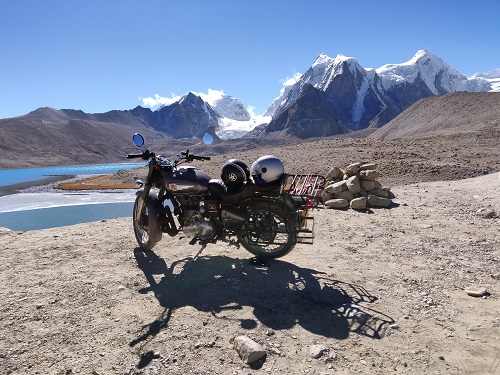
IMG_20181113_102248

Merry Christmas to all our Readers!

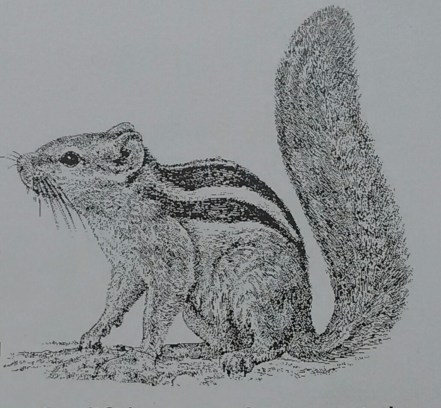
Take the Time to Look at the Squirrels

I had the good fortune to work for two decades at Centre for Environment Education, Ahmedabad. Apart from the work and the work environment, the campus itself was a boon. 14 acres of both ‘groomed’ and ‘wild’ spaces. A variety of trees, undergrowth, lawns, water-body and the attendant birds, snakes, small mammals, rodents, butterflies, etc. etc.
IMG_20181217_114832We were an earnest and idealistic bunch. We had the benefit of mentoring by some of the wisest of people. One of them was Dr.PR Pisharoty, Father of Indian Meteorology and Remote Sensing. On one of his visits in the early days, he listened to all of us presenting our work and holding forth. With a gentle twinkle in his eyes, he told us: ‘You are all doing wonderful work. But I hope you don’t forget to take time off to look at the squirrels.’

We took that lesson to heart. Being immersed in nature at the workplace is a luxury few have today. But I think, looking back, that this made a difference to our work, our interactions and us as people and an organization. Being ‘distracted’ by a bird call in the middle of a meeting and the whole group rushing to look through the window or refer to ‘the Book’ (Salim Ali of course), broke up many a tension. Waiting for a monitor lizard to amble across the path as one rushed from one dept. to another was a good way to get a sense of ‘Nothing is that urgent. They have survived without rushing for millennia’. When ideas dried up, gazing out of the window at the squirrels chasing each other usually did the trick and the brain got unclogged. Feeding the fish at lunch brought people from unconnected work spaces together.

Did the campus make us more creative? More strongly bonded as teams? More lateral-thinking? More empathetic as people? I like to think so!

Business case for green campuses made! After all, today nothing can get approved without a business case! And by green campus, I don’t mean manicured lawns and potted plants. But a bit of wildness and a bit of wildlife!

–Meena

Illustration credit: CEE

Toxic

The word of the year is Toxic! Crowned by the Oxford Dictionary this word was selected as the one “judged to reflect the ethos, mood, or preoccupations of the passing year, and have lasting potential as a term of cultural significance.”

The claim to fame was gained by the word not only on the basis of the number of times it was searched, but more for the sheer variety of contexts in which it is being used today.  “Toxic” has been used to describe workplaces, schools, relationships, cultures, and most recently has become a keyword in the #MeToo movement.

My own association with the word dates back over 30 years when I started as an Environmental Educator. We used the word mainly in the context of something that poisoned the natural environment—air, water, flora and fauna. This was based on its dictionary definition as meaning ‘poisonous’, with its roots derived from the medieval Latin term toxicus, meaning poisoned or imbued with poison. Environmental Educators worldwide tried to create awareness about what makes things toxic and how this affects the environment—through ‘gloom and doom’ scenarios, through motivation and action, and even through humour!

An interesting example of the last one was a limerick competition run by the English newspaper The Observer in association with the Friends of the Earth inviting limericks that reflected the (then) toxic state of the environment. The competition was open to all, from ages 5 years and up!

Although this was almost 30 years ago, on revisiting these limericks, I felt that they are as relevant today (if not more, than ever before!) Here is a taste…

Said the seal to the salmon and otters,

Did God really design us as blotters,

To mop up the oil

From the sea and the soil

Spewed out by those corporate rotters?


When politicians say they are green

One wonders what they really mean,

For all their hot air

Only rises to share

In the Greenhouse Effect it would seem!


An ostrich from a tropical land

Once buried his head in the sand.

The move was a riot,

They all had to try it—

Evading the issue was grand!

Fast forward to 2018. Has anything changed? At least not for the better, alas! The word has simply exploded in scope and toxicity. As Oxford University Press’s president of dictionaries, said: “Reviewing this year in language, we repeatedly encountered the word ‘toxic’ being used to describe an increasing set of conditions that we’re all facing. Qualifying everything from the entrenched patriarchy to the constant blare of polarising political rhetoric, ‘toxic’ seems to reflect a growing sense of how extreme, and at times radioactive, we feel aspects of modern life have become.”

To sum up, cannot resist this one…

A girl with a problem was faced

Rushed off to her doctor in haste.

He said with a laugh

As she broke into half,

‘My dear, you’ve got toxic waist!’

–Mamata


Festival of Farming

20181117_120113_resizedThe annual Krishi Mela is an event Bangaloreans look forward to. Organized in November every year, the 3-day Mela showcases the latest in agriculture and livestock related developments—from technologies, to equipment and tools, to new varieties of seeds, to green farming.

First a word about the Gandhi Krishi Vignana Kendra (GKVK), the venue of the mela. This amazing 1300+ acre campus has a hoary history. More than a century ago in 1899, Her Excellency Maharani Vani Vilasa, Regent of Mysore donated 30 acres of land for an Experimental Agricultural Station at Hebbal, which initiated research projects related to agriculture. In 1963, the Government of Mysore decided to establish University of Agricultural Sciences (UAS) along the lines of Land Grant College system of USA and passed the University of Agricultural Sciences Bill. It granted 1300 acres to the GKVK Campus.

UAS was inaugurated by Dr Zakir Hussain, then Vice President of India, on 21st Aug 1964. Speaking at the event, he set the institute a lofty mandate: “By bringing about significant improvement in every phase of rural life, by much needed change in methods of production, by influencing the whole outlook of the rural community and rural home, by giving them a new vision and new hope, this university will be able to make great contribution to national welfare”.

The Krishi Mela sees visitation in the lakhs—from farmers to students to urbanites interested in agriculture, it is a joyous (though somewhat hot and tiring) occasion.

For farmers, it is an opportunity to see the latest advancements in the field of agriculture; to interact with agro-business companies and see demonstrations of agricultural implements; to get advice from university researchers on best methods of farming for a particular crop; and be exposed to practices like biological control of insects, organic farming in polyhouses, setting up biogas plants and extracting biodiesel.

For a layperson like me, it is an occasion to buy seeds and gardening implements; get some advice on how to look after plants; get to know something about the complexities of farming; marvel at things like a 70 kg bunch of bananas and a magnificent Gir bull; and gawk at sights like a drone which can be used for spraying pesticides. Also to partake of a traditional lunch (Menu: ragi muddu, palya, rice-rasam, curd-rice and a sweet) at Rs.50!

For me, the best thing about bringing such a mela into the heart of a city like Bangalore is the value it has as a reminder to us of who feeds us, and the challenges they face to do so!

Waste not…..

RecycleEarth_mediumNot many years ago, people returning from the US or England would relate shocking stories of how people there threw away everything—from TVs to beautiful containers to cars to old clothes. And we used to pride ourselves that in India, we re-cycled and re-used everything. Horlicks bottles were used to store pickles or dals. Bournvita tins became containers for masala powders. Bed sheets became pillow covers, which became shopping bags.

But now, ‘we’ are ‘them’!

Have you looked into your garbage bin recently? Have you noted how quickly it fills up? With changing lifestyles, we are buying more and more, and throwing away more and more. Today, In metro cities in India, an individual produces an average of 0.8 kg/ waste/ person daily.

India produces about 65 m tonnes of urban waste annually, out of which 5.6m tonnes consist of plastic waste, 0.17m constitute of biomedical waste, 7.90m tonnes constitute hazardous waste while 15 lakh ton is e-waste.

You may not want to do the exercise of researching the contents of your dustbin, so here are some facts. On the average, garbage is made up of 35% organic material, 30% paper, 12% construction related wastes, 9% plastics, 6% glass, 3% metal, and then miscellaneous.

The problem with garbage is that though you may throw it ‘away’, there is really no ‘away’! It is out of your house, but on the street. It is off the street but in a dumper. It is out of the dumper, but in a landfill. And at each stage, there are problems.

Just to understand what the problem is, just looks at the facts and figures below.

  • Banana peel – 3 to 4 weeks
  • Paper bag — 1 month
  • Cotton rag — 5 months
  • Wool sock — 1 year
  • Cigarette butt — 2 to 5 years
  • Leather shoe — 40 to 50 years
  • Rubber sole (of the shoe) — 50 to 80 years
  • Aluminum can (soft drink can) — 200 to 500 years
  • Plastic jug — 1 million years
  • Styrofoam cup – unknown–forever?
  • glass bottle – unknown–forever?

So what can we do as individuals? The mantra is ‘Reduce, re-use, recycle’.

REDUCE

Don’t create waste in the first place! Buy only what you need. Use all that you buy. Avoid heavily packaged products. Avoid disposable items like paper plates and plastic spoons. Buy the largest size package for those items that you use often.

REUSE

Reuse items – use them over and over until they are completely worn out. Borrow or share items you don’t use very often. Donate unwanted items. Repair items, instead of throwing away and buying new. Refill bottles. Plastic bags can be used for many times over. Use your imagination, not the trash can!

RECYCLE

Recycle means taking something old and making it into something new. Old newspapers, plastic bottles, glass bottles and jars, aluminum and steel cans can all be recycled. Sell these to the ‘kabadi wallah’.  Not only does it keep items out of the landfill, recycling conserves natural resources. For example, making newspaper out of old newspaper saves a valuable natural resource – trees.

And compost, compost, compost!

Think about it and see if you want to make these your New Year Resolutions!

–Meena

And The Butterfly Flapped its Wings…

Edward Lorenz articulated this metaphor to imply that a small, inconsequential-seeming event can have huge unforeseen effects. He in fact drew the metaphor from weather phenomena, specifically, the details of a tornado (the exact time of formation, the exact path taken) being influenced by minor perturbations such as the flapping of the wings of a distant butterfly several weeks earlier.

Ironically, the cyclone that just struck Orissa and part of Andhra Pradesh coast, and caused heavy damage, is called TITLI—butterfly. Was the agency which names cyclones aware of this?

Anyway, the name is not the point. The damage is. As in the after-math of every disaster, lives and livelihoods have to be restored. And we have to learn from each disaster how to proof ourselves better against future disasters, and how we can handle the relief and rehab phases better.

These lessons are important for us. 87 per cent of India’s land is prone to one or the other kind of disaster—floods, droughts, cyclones, earthquakes etc. India is second among all countries affected by disasters every year. Over 50 million people are affected by disasters every year, and on an average, over 1 million houses damaged.

Cyclone is a natural disaster of meteorological or climatic origin. It is classified as an ‘immediate onset disaster’ (it manifests its complete effects in 1-7 days). The Bay of Bengal and Arabian Sea experience about 6-7 per cent of the world’s annual cyclones. The majority occur from October to December, and a smaller number in April-May. Though the percentage of cyclones hitting the Indian Ocean region is low, the wind speeds are moderate and the cyclones are relatively short lived and smaller in size, they cause heavy damage when they strike the coastal areas of Bay of Bengal. This is because the conditions of the region favour huge storm surges. The combination of high astronomical tide, shallow water and the special coastal configuration of north Bay of Bengal result in the generation of devastating storm tides.

These are the natural reasons. But humans have contributed hugely too. The destruction of coastal forests is a major issue. Mangrove tidal forests are natural cyclone barriers and invaluable protectors. But alas, these are disappearing. Rice paddies and prawn farming are cited as some of the reasons for this.

So Titli came and caused destruction. The preparedness and timely actions of the State and Disaster relief agencies have ensured that the destruction was less devastating that it could have been. But still, nine lives were lost.

Today is International Day for Disaster Reduction. A day to pledge that we will commit ourselves to at least halt the human exacerbation of destruction due to disasters, and to stand by those impacted by them.

–Meena

Acknowledgement: ‘Dealing with Disasters: Awareness, Preparedness, Response.’ Meena Raghunathan, Avanish Kumar. Centre for Environment Education. Ahmedabad. 2004.

A Tribute to Wildlife Researchers

Ravi Chellam, as a student and then faculty of Wildlife Research Institute of India, did his research on Gir lions. His work on understanding the lions, their threats, and the work he did for recommending an alternative habitat, were a huge contribution. This piece is a tribute at a time when his recommendations should be taken very seriously. Equally it is a tribute to so many other wildlife researchers from WII and other institutions, whose courage and commitment have helped preserve our biodiversity.

The following pieces are excerpts from Ravi’s piece ‘A Roaring Career’ in a publication titled ‘Walking The Wild Path’.

On the excitement of wildlife research:

‘A radio-collar is a piece of wildlife research equipment, which consists of a radio transmitter that is mounted on a collar made of some tough material.  The transmitter constantly emits signals, which enables the researcher to track and locate the animal that is carrying it.  The collar is for fixing the transmitter on the animal.  A very wide variety of organisms have been studies by this method of radio-telemetry, ranging from whales, elephants, lions, tigers, snakes, to even very small birds like the hummingbird.

Shortly, we heard the regular rustling of the leaf litter, a clear indication that a large animal was approaching us.  A large male lion emerged out of the shadows of the forest and it immediately saw the tethered buffalo.  It looked around, as if to check that there were no human being around and then rushed to kill the buffalo bait.  As the lion locked its jaws around the neck of the buffalo, it presented a clear and close enough target for Dr. Johnsingh.  The dart went into the rump of the lion.  Startled by the loud report of rifle, the lion left the bait and walked away into the forest.

We waited for about ten minutes, to allow time for the drug to take effect.  Then I cautiously led the search team to locate the darted lion.  It had not gone very far.  It was lying on the ground, barely one hundred meters from the bait.  I threw a level of immobilisation.  The lion responded by slowly lifting its head, and it was evident that the drug had taken its effect; but to safely work with the animal, we needed to give it an additional top up dose.  I crept up to the lion with two of my assistants and we soon physically restrained the drugged animal by sitting on its head and rump.  This enabled the delivery of the additional dose of drug by means of an injection.

Once the lion was completely immobilised, we fixed the radio-collar around its neck, took the required measurements of the lion’s body, treated the minor external injuries, weighed it and then left it in a cool place to recover.  I sat at the safe distance to monitor its recovery.’

And, on the vulnerability of the Gir lions:

‘Based on the results of my doctoral research I surveyed potential lion habitats to locate a suitable site for the translocation.  In January 1995, I submitted my report to the Government of India and since then efforts are underway to manage the forests of Kuno-Palpur in Madhya Pradesh for making them suitable for lions.

If this translocation effort is undertaken and succeeds, it will be a majof step in ensuring the log-term conservation of the lions and a major personal achievement for me.  Translocating large carnivores and ensuring their successful establishment in a new habitat is not an easy task.  People resident in the forest and the adjoining areas will always be worried about their personal safety and that of their livestock when a population of large carnivores is established.

Additionally, great care needs to be taken to ensure that the animals are captured and transported without causing any physical injury to them.  There are also many political angles to be considered.  This is in a way part of the challenge of doing wildlife conservation.’

From ‘Walking the Wild Path’. Mamata Pandya, Meena Raghunathan (eds). Center for Environment Education. Ahmedabad. 1999.


Will I Hear the Lion Roar?

Reports of the deaths, within a few weeks, of 23 lions of a pride in Gir Forest, the only home of the Asiatic Lion, have deeply disturbed us all.

Historically, the range of the Asiatic lion included South-eastern Europe, Black Sea basin, Caucasus, Persia, Mesopotamia, Baluchistan, and the Indian subcontinent from Sind in the west to Bengal in the east. (IUCN). Today Panthera leo persica is confined to the Gir Forest and its environs, in Saurashtra, Gujarat.

As per a 2015 census, there were only 523 lions and they were all in the Gir area. Nowhere else in the world!

‘The lions face the usual threats of poaching and habitat fragmentation. Three major roads and a railway track pass through the Gir Protected Area (PA). Also, there are three big temples inside the PA that attract large number of pilgrims, particularly during certain times of the year. There has been an increase in lion population, and more than 200 lions stay outside the PA. Though the conflict is not high now, with changing lifestyles and values these may increase in the future. There are also cases of lions dying by falling into the unguarded wells around the Gir PA.’ says WWF.

But the single most serious threat could be the fact that the population is confined only to one place. It is well established scientifically that any such population is vulnerable to threats of various types.

One obvious danger is the risk of genetic inbreeding arising from a single population in one place.

But the other, even more serious risk, as IUCN puts it, is: ‘The small pocket of distribution of the Asiatic lions has led IUCN to consider them an endangered species, in fears that if an epidemic or forest fire were to break out, the whole population of Asian lions would be wiped out from the wild.’

The worst fears are coming true. A single episode has brought a whole pride to the brink in a few days. What is the guarantee that the epidemic will not spread? We can only pray.

For decades, biodiversity and conservation experts have been advocating that some lions from Gir be re-located to another suitable habitat, after proper research and preparation, so as to create another viable population. It is not that efforts have not been made. Palpur Kuno Sanctuary in Madhya Pradesh has been identified, numerous studies undertaken and a lot of preparation done.

But Gujarat has refused to let the lions be re-located, claiming that these lions are the Pride of Gujarat.

No doubt they are! But they are also the universal heritage of humankind. The loss of a species is irretrievable and irreversible. When we lose a species, we lose something of ourselves. In such a situation, is there a ‘mine’ and a ‘yours’? Or is there only an ‘ours’?

Vasudhaiva kudumbakam.

–Meena