
I am game for anything historical—books, novels, movies, TV shows. I
have no education in history and so with all the books I read, the
past is a confused place for me, where I cannot begin to separate fact
from fantasy and fiction.
On the whole, I don’t have a problem with that. But last week, I
started reading a novel in the historical fiction genre, and maybe
because if was set in India, it jarred me terribly. And I now know
that I must be even more careful in what I think I know about the
past!
I did some little research into the genre itself, so that I could
understand what the parameters were:
Historical fiction is a literary genre in which the plot takes place
in a setting located in the past. It can be used in the context of
various types of narrative– including theatre, opera, cinema, and
television, as well as video games and graphic novels.
The definition of the ‘past’ is that it is set 50 or more years before
the author wrote the piece. Basically, the author should not have
first-hand experience of the period, and should rely on research for
an understanding of the time and events. Such works may tell stories
about actual historical people and events—or not.
They are however supposed to ‘capture the details of the time period
as accurately as possible for authenticity, including social norms,
manners, customs, and traditions.’
It is generally agreed that there are over 10 subgenres of Historical
Fiction. But there is not quite the same level of agreement on what
these are! One categorization goes:
· Traditional Historical Fiction, characterized by a historically accurate plot
· Multi-Period Epics, Series, and Sagas
· Historical Romantic Fiction
· Historical Western Fiction
· Mysteries, Thrillers, and Adventure Novels set in the past
· Time-Travel
· Alternate Histories
· Fantasy
· Literary and Christian Novels
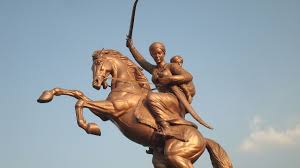
Ok, so what is all this a lead-up to? Well, my latest library read— ‘The Last Queen of India’, by well-known author Michelle Moran. I have read a few other works by her—‘Madam Tussaud’ and ‘Cleopatra’s
Daughter’.
This is NOT a review. It may even be a very unfair piece. Because I
stopped at page 50. It was really irritating. I know that Ms. Moran is
a conscientious writer, and moreover one who is married to a person of
Indian origin, and through that, does know India. And that the
publisher is a very reputed one. So it intrigues me more than ever why
the flavor just didn’t come out right.
Just a few things about the book about Rani Laxmibai, and hence
essentially set before 1857:
1. A reference to yellow and orange carnations decking a local
temple: Very unlikely in MP of the mid-1800s. Maybe they meant
marigolds?
2. A reference to a priest wearing a crown of neem leaves. I
have not met any priest ever wearing a crown of any leaves, and
definitely not neem leaves.
3. A Kshatriya father runs a carpentry shop and does the
wood-working himself. Again, not sure how common that would be.
4. The grandmother from a poor but seemingly once-upon-a-time
middle class family decides that they are very poor and
cannot afford to get the grand-daughter married. Her immediate
solution is to try to sell the girl to a temple to become a devadasi.
I don’t think that would have at all been the reaction!
5. It would seem as if every little temple in every little town
had devadasis. The grandmother is bargaining with a temple priest of
an Annapoorna temple and says that if he does not agree to her terms,
she will take the girl down the street to another one which will offer
a better price.
6. The price they agree on for the girl is Rs. 13,000. In today’s terms,
compounding at the rate of 4%, that would be Rs 1 crore. Does not
sound right (and yes, one of the things to be taken care of in
historical fiction is the time-value of money).
7. The grandmother and the grand-daughters go to the mother’s
funeral pyre. I am pretty sure that it could not have been so. Up
until recently, women did not go to the ghats.
8. The daughters, in mourning wore white for 13 days. I am not
aware of any such custom.
Quibbling? Nit-picking? Hair-splitting? When I should have focused on
the spirit of the book, the heroism of the principals, the writing,
the overall sense?
Maybe. But I find I cannot read if the little details intrude and
don’t ring true. And they didn’t!
–Meena

 y for an environmental educator whose work and mantra for over three decades had been ‘connecting children with nature’. Environmental education as we believed was learning in the environment, learning through the environment, and for the environment. More than anything else, this was true for nature education. Based on this conviction we worked with passion and imagination to create hands-on teaching-learning experiences–from stepping outside the classroom to observe a single tree, to a camping experience of immersion in natural surroundings. These were experiences that engaged not just the head, but all the five senses—seeing, hearing, smelling, tasting and feeling—and thence the heart. We believed that it was the heart and not the head which would create a new generation of sensitive, informed and able champions of the environment.
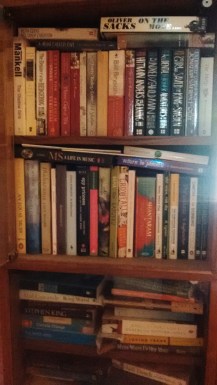 ies, just to pick up a book. One went to feast on the shelves lined with books, to run one’s eye across and up and down, pulling out a familiar name, or a new unfamiliar one; to peruse the blurbs on the cover to get a taste of what was within. One went in, sometimes with the certainty of coming out with a specific title, but equally the expectation of discovering new authors, or new works by familiar authors. It was the exploration that was the real fun, not so much the final selection.
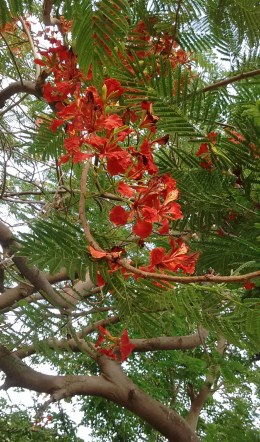
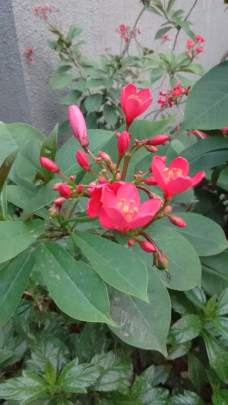 hile these are great to reach out to other humans, they are also a wonderful opportunity to be inside looking out, at nature. One does not have to be in the countryside to see Nature. Even in the midst of the urban jungle, look from the same balcony or window, and you will discover—a bird, a butterfly a bumblebee, a spider. A patch of sky and a puff of cloud. The branches of a tree with fresh green leaves, a bird call, a shaft of sunlight on a wall, or the stars on a clear night.
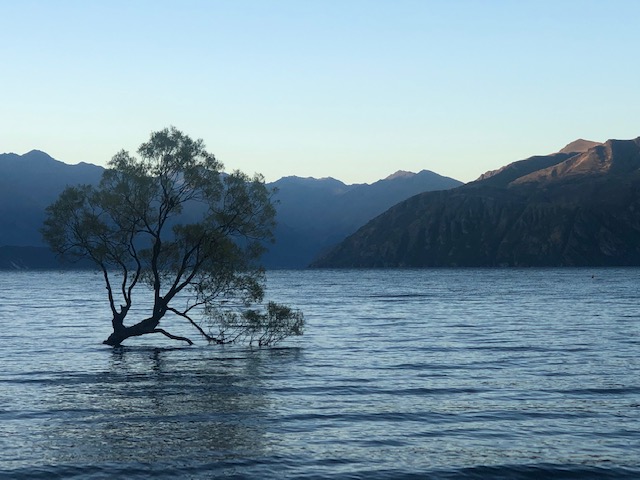 The connection is a tree that is reputed to be the most instagrammed tree in New Zealand, almost a symbol of NZ tourism. On a recent trip there, we were urged to set aside time to see the tree, specifically around sunset. So we worked around our program to ensure we got to the spot—a stretch of a beach—well ahead. We drove past a few times, keenly looking at the beach. We could see some people, but nothing special in the way of trees. We asked natives and tourists alike, and they all pointed us to the same area which our GPS had shown us, and which we had passed, looking in vain for a landmark. We decided to make our way down to the beach anyway. Lo and behold, there were many, many people there, jostling for some spot (we could not figure out what the spot was for), all setting up professional looking camera equipment. It came to a pass when we had to ask a friendly-looking lady what everyone was waiting to photograph, where the famous tree was, and what it was about. She kindly pointed to this spindly willow tree, standing a few feet into the waters of the beautiful Wanaka Lake, against a beautiful background of majestic mountains. But the tree itself? In my mind, this will forever define and exemplify ‘under-whelming’. ‘Why is the tree famous’, we asked many around us in bewilderment. While there was some story of how it was part of a fence and had survived in the water for several years, the general consensus was that it was famous because it was famous! So famous , it even has its own insta handle #ThatWanakaTree.
