What Will 2021 Mark?

Hopefully, safe and effective vaccines against COVID, a fair, equitable and swift distribution of the same, and life back to normal!

It will also mark, as decided by the international community, several other things:

World Health Organization has appropriately designated 2021 as the International Year of Health and Care Workers in recognition of the dedication and sacrifice of the millions of health and care workers at the forefront of the Covid-19 pandemic, unanimously

United Nations (UN) has, through various resolutions, decided that 2021 shall be marked as:

  • International Year of Peace and Trust
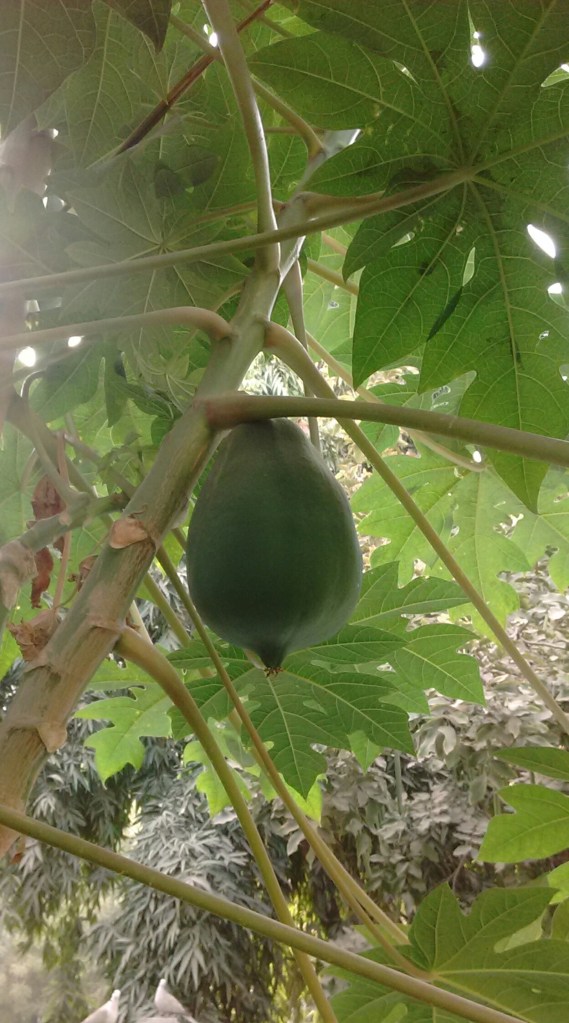
  • International Year of Fruits and Vegetables  
  • International Year for the Elimination of Child Labour
  • International Year of Creative Economy for Sustainable Development 

The first three are self-evident, and much needed, especially in the post-Covid world. But I was not familiar with the fourth—i.e., what is a Creative Economy?

Well, it seems that Creative Economy is not easy to define, and there are about 27 definitions floating around. Apparently the term was introduced by Peter Coy in 2000, and at its crux, it is an economy driven by “the growing power of ideas.”  John Howkins was the next to define it, and referred to it as ‘a new way of thinking and doing that revitalizes manufacturing, services, retailing, and entertainment industries.’ Ana Carla Fonseca  says that creative economy is about ‘products and services that rely on creativity to generate innovation, added value and differentiation”.  According to UNESCO and Ernst and Young, as of 2015, about 3% of the world’s GDP (more than US$ 2.25 trillion in revenue) pertained to creative economy.

As per a fairly accepted classification, there are four major sectors of the creative economy:

Media

– Editorial (books, magazines and digital content)

– Audiovisual (video content, television schedule and broadcast in general)

Consumption

– Architecture (building, landscape and environmental design, space planning)

– Design (products and visual and multimedia content)

– Fashion (clothing design)

– Advertising (creation of publicity pieces, marketing, market research and event organization)

Culture

– Arts and Cultural Heritage (museology, cultural production and heritage sites)

– Music (recording, edition, creation and music interpretation)

– Performing arts (acting, production and direction of shows)

– Cultural expressions (handcraft, folklore, cuisine and festivals)

Technology

– Research and Development (academic research)

– Biotechnology (bioengineering and lab research)

– Information technology (software, systems development and robotics).

Well, I suppose that doing a blog is a creative enterprise. So I shall count myself as a part of the creative economy (though sadly this one adds nothing to the GDP nor our personal bank accounts, so I wonder if it is an economic activity!).

And on a more serious note, this blog shall do its best and its bit to mark the other themes– Peace and Trust; Fruits and Vegetables; Elimination of Child Labour; and Health and Care Workers.

Happy 2021. May it be Peaceful and Healthy!

–Meena

Time on Pause

This week, as we think about, and even celebrate, microbes, it is all of 2020 that will be go down in history as the Year of the Microbe. Or the year when a microbe put the world on ‘pause’.

While scientists created microbe art in petri dishes, the pause created by the microbe led to the burgeoning of creativity in homes across the world. From home baking (yes using one of the friendly microbes!) to painting, embroidery, composing music, to innovative ways of virtual communication—this year was indeed one of activity amidst inactivity.

This is the time of year when much is being written about how people’s lives changed in this ‘year in pause’. The underlying point that comes through is that we all became much more aware about Time than we had probably done before.

We also learned to use time in ways that we had not done so earlier. While most of us were accustomed to thinking of time in the Fast Forward mode, the Pause mode made us also look back to reflect and reminisce, to unwrap long forgotten memories, and most importantly slowly sip, and savour the Present. In doing so we could explore our immediate surroundings and discover things which were ‘hidden in plain sight’ as it were. While not being obliged to be in a continual ‘planning ahead’ mode, we could stop and stare, and look around with new eyes.  

Picture courtesy Daksha Raval

As Rabindranath Tagore once put it:

I was tired and sleeping on my idle bed
and imagined all work had ceased.
In the morning I woke up
and found my garden full with wonders of flowers.

On the other hand it was a year when time seemed to slow down. When each day was counted in slowly ticking minutes and hours, as weeks telescoped into months… and here we are, at the end of a never-before year.

As Arik Fletcher, a poet, has succinctly summed up, it has been…

a time to cheer, a time to cry,
a time to live, a time to die,
a time to sleep, a time to wake,
a time for real, a time for fake,


a time for truth, a time to lie,
a time to laugh, a time to sigh,
a time to stand, a time to fall,
a time for one, a time for all,


a time for love, a time for hate,
a time to run, a time to wait,
a time to stay, a time to flee,
a time for you, a time for me.

And so here we go…
Bidding adieu

A year that crawled at the pace of a snail

Leaving behind indelible marks.

–Mamata

When Social Responsibility was Risky Business!

Philanthropy has been garnering headlines in the world media for some years now, with the most successful entrepreneurs speaking more about their giving initiatives than their businesses. And it has indeed set off a virtuous cycle.  

But lest we think giving by industrialists is a new phenomenon …

In continuation of last week’s blog which marked 13 November (designated as World Kindness Day), and November 16 (International Day for Tolerance and Peace), here is a look at a few examples of Indian industrialists whose philanthropy exhibited a sense of enlightenment and responsibility that was path-breaking . The critical thing to remember is that most industrialists of the late 18th and the early 19th centuries saw building up India’s industry and infrastructure and supporting the freedom movement as their most critical social responsibilities. They were flying in the face of the Raj in doing this, and the Raj had the power to destroy them! But that did not stop them.

The Vision of Jamsetji Tata

Shri Jamsetji Tata was a pioneer in setting India on the path to industrial self-reliance. But it was not just about technology. His vision for the well-being of his workers was truly enlightened. Way back in the 1880s, he offered facilities like crèches for workers in his mills, as well as short working hours, properly ventilated workspaces, fire safety, etc. In 1886 he instituted a Pension Fund, and in 1895, began to pay accident compensation.

The story of Jamshedpur is another testimony to his vision. The work on this township for housing the workers of the Steel Mills was commenced in 1908. Shri Jamsetji dreamt of more than basic housing for his workers. He wanted to build a proper modern planned city. His instructions regarding the city were:  “Be sure to lay wide streets planted with shady trees, every other of a quick-growing variety. Be sure that there is plenty of space for lawns and gardens; reserve large areas for football, hockey and parks; earmark areas for Hindu temples, Muslim mosques and Christian churches.”

It was private philanthropy that led to the creation of institutions like the Indian Institute of Science (IISc), Bangalore and Tata Institute for Fundamental Research, Mumbai. It is said that Jamsetji mooted the idea of contributing to an institute like IISC as early as 1898, long before Carnegie’s endowment to set up a Technical School (today Carnegie Mellon University).

From Temples to Gods, to Temples of Education

Shri G.D. Birla was a strong supporter of Gandhiji and gave considerable resources to the freedom struggle. Many of us would have at some time or other visited a Birla Mandir–many a large town in India boasts one. Apart from this charitable activity of temple-building, a landmark contribution of Shri Birla is the creation of one of India’s best higher educational institutions—the Birla Institute of Technology. This was started as a school for G.D. Birla and R.D. Birla by their grandfather in 1901. It grew into a high school  in the 1920s. In the forties, the Birla Education Trust was founded and the institution went from strength to strength, adding degree and post-graduate courses in a variety of disciplines.  In 1964, taking advantage of a Ford Foundation grant, the institute formed a partnership with Massachusetts Institute of Technology (MIT), USA, and was well on the path to leading India’s achievements in technical education.

Gandhi Ashram is Saved!

When Gandhiji  first came to Ahmedabad, he set up his Ashram at Kochrab. He invited a Dalit family– Dudabhai and Danibehn–to come and live at the Ashram. This led to considerable agitation among the Ashram’s neighbours as well as many funders, leading to a financial crisis, which forced Gandhiji to think of shifting the Ashram.

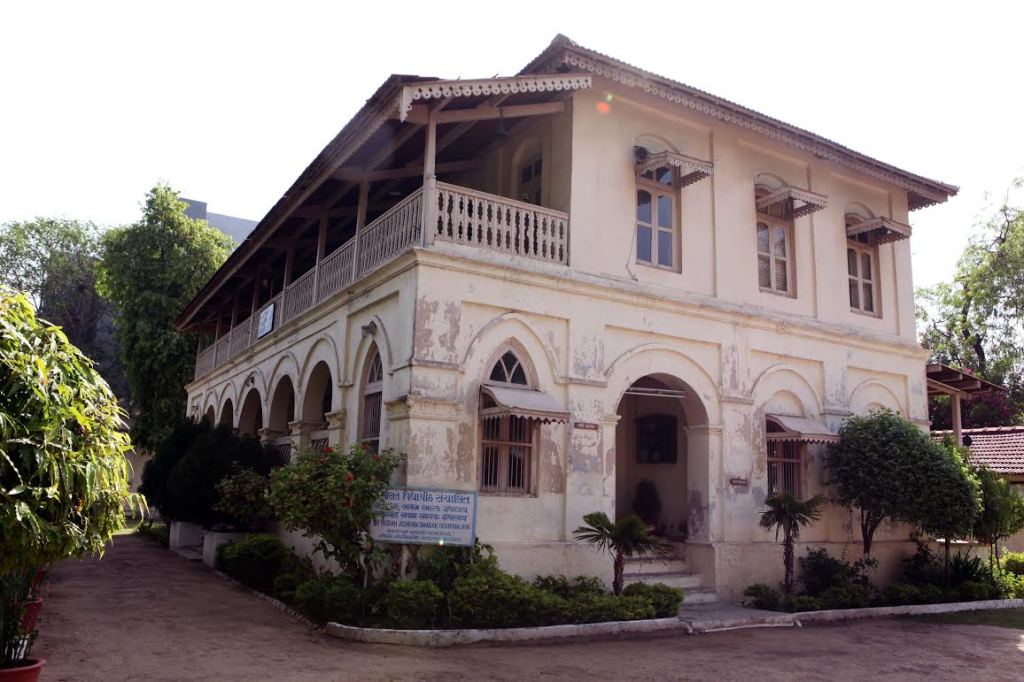
Kochrab Ashram

And then one day, in Gandhiji’s words: “A car drew up near our quarters and the horn was blown. The children came with the news. The sheth did not come in. I went out to see him. He placed in my hands currency notes to the value of Rs 13,000 and drove away. I had never expected this help, and what a novel way of rendering it!”

This gift saved the Ashram. It is well-known that the ‘Sheth’ was Shri Ambalal Sarabhai, one of the foremost industrialists of the time. However, neither he nor Gandhiji ever admitted this!

Jamnalal Bajaj: Exemplary Patriotism

Jamnalal Bajaj was considered Gandhiji’s fifth son, and adopted all his values—from Ahimsa to his dedication to the poor to his commitment to locally made goods and his patriotic spirit. He fought for admission of Harijans into temples, and in the face of strong objections, opened up his own family temple in Wardha—the first temple in the country to do this.

Shri Bajaj was an active member of the Congress Party, and gave up the Rai Bahadur title conferred on him by the British Government and joined the non-cooperation movement.


Importantly, Jamnalalji, in line with the trusteeship concept propounded by Gandhiji, felt that inherited wealth was a sacred trust to be used for the benefit of the people, and dedicated most of his wealth for the poor and under-privileged.

On the shoulders of giants….

–Meena

 www.tata.com

https://jamnalalbajajfoundation.org/jamnalal-bajaj/about

Of the Children, For the Children

A recent article titled What We Want Our Parents to Know was a poignant reminder of the difference between what adults think they know about children, and how children perceived adults. Written by a child psychologist, with specific reference to the impact that the corona-imposed lockdown is having on the mental health of children, it reflected some of the (often unheard) pleas of children to be heard and respected.

The profound idea that children are not just objects who belong to their parents and for whom decisions are made, or adults in training; rather, they are human beings and individuals with their own rights got international recognition when world leaders came together and made a promise to every child to protect and fulfil their rights. This was by adopting an international legal framework that laid down that children have their unique set of rights, and that these need to be articulated, advocated, protected, and implemented.

On 20 November 1989 this commitment was officially endorsed when the United Nations General Assembly adopted the United Nations Convention on the Rights of the Child (UNCRC).

The Convention says that childhood is separate from adulthood, and lasts until the age of 18 years. This is a special, protected time, in which children must be allowed to grow, learn, play, develop and flourish with dignity.

The Convention views children not as objects of compassion or pity, but as subjects of human rights under international law. It protects children’s rights by setting standards in health care, education, and legal, civil and social services. It sees children as active participants in their own development and agents of change.

The four core principles of the Convention are: Non-discrimination; devotion to the best interests of the child; the right to life, survival and development, and respect for the views of the child.

The UNCRC is a detailed document with an explicit list of 54 articles covering a wide variety of rights all children automatically enjoy, regardless of where or when they are born. Broadly these rights fall under four main categories–rights to:

  • Life, survival and development
  • Protection from violence, abuse or neglect
  • An education that enables children to fulfil their potential
  • Be raised by, or have a relationship with, their parents
  • Express their opinions and be listened to.

The Convention provides a universal set of non-negotiable standards to be adhered to by all countries. These were negotiated by governments, non-governmental organizations, human rights advocates, lawyers, health specialists, social workers, educators, child development experts and religious leaders from all over the world, over a 10-year period. The standards set minimum entitlements and freedoms that should be respected by governments. They are founded on respect for the dignity and worth of each individual, regardless of race, colour, gender, language, religion, opinions, or origins.

The Convention obliges the State and other responsibility holders (parents, guardians, care-givers, civil society, etc.) to address the needs and interests of children as entitlements or rights.

The UNCRC has become the most ratified international human rights treaty in history, now signed by 196 countries. But as with most international treaties, while the intentions are noble, there is often a wide gap between intent and implementation. It has been thirty-one years since the Convention came into force, yet every day one hears and reads of children in tragic situations—from the home to the school; from the homeless to those deprived of education; from those who are suppressed and exploited in so many ways–from the local to the global.

The time is well past the Victorian norm of “children should be seen and not heard.” It is the time when children should be heard. And while governments and non-government organisations continue efforts towards protecting and ensuring these rights, it is the family, as the fundamental group of society and the natural environment for the growth and well-being of all its members, where children should experience the empowerment of having rights, and not just the onus of having duties. And it is for every parent to remember that these rights need to be respected.

India celebrates Children’s Day on 14 November, and November 20 is marked across the globe as World Children’s Day. A good week to remind ourselves of the UNCRC.

–Mamata

Reading ‘Judgmentally’

India has its fair share of Book Fests and Lit Fests. Some generic, some specific to a genre or a language. A well-known one among these is the Bangalore BizLitFest—as the name suggests, an event devoted to the Business Literature genre.

The 6th edition of this Fest, held online (of course) this year, concluded this weekend. While I have attended this Fest over the years, this time I had a special role—as one of the panel of judges to pick the best Business Book of the Year. This award was instituted in 2017, by the family of the universally-known academic Prof CK Prahalad (of ‘Bottom of Pyramid’ fame). The CK Prahalad Best Business Book Award is given to ‘the most original, impactful and thought-provoking business book written by an Indian author’.

It never ceases to amaze me how many contenders there are every year!  The competition process is a multistage one. Out of the business books published in the previous calendar year, a longlist of the top 25 is made based on ratings and reviews. Of these, the five which get the top ratings and number of reviews on Amazon, Goodreads and Flipkart in the first six months of the current  year are shortlisted. And a jury selects from among these, using two major criteria: Originality of theme, and second, Potential of the book as a game-changer, inspiration and influencer.

I was in the distinguished company of Prof Rishikesha Krishna (IIM-B), Manish Sabarwal (Teamlease), Narayan Ramachandran (formerly Morgan Stanley, writer, social entrepreneur) in the Jury Panel.

The five shortlisted books were:

Saying No to Jugaad: TN Hari, MS Subramanian

Bridgital Nation: N Chandrasekaran with Roopa Purushottaman

How I Almost Blew It: Sidharth Rao

The CEO Factory: Sudhir Sitapathy

Big Billion Startup: Mihir Dalal.

The unanimous winner was Mihir Dalal’s Big Billion Startup, the story of Flipkart.

For me, there were two levels of learning through the process:

Each book was a fascinating journey and provided enormous learning! Four of them were the story or stories of specific enterprises or entrepreneurs told so as to offer lessons to any manager or entrepreneur. Bridgital Nation was different in that it provided a broader framework of using IT to solve the nation’s problems.

At the second level, I realized that reading as a judge was a different ballgame from just reading. One has to read much more consciously, comparing and contrasting, articulating what works and what does not work. One has to be aware of content and style. Whether the ‘lessons’ are coming out clearly. And whether it will work for the audience it is meant for. While I have graded student essays and evaluated children’s fiction, judging business books was a new experience of reading ‘judgmentally’!

One comment I have on the books is that most mention dozens of names. While completely necessary to acknowledge and bring out the contribution (or otherwise) of all concerned in the making of the company, it is quite confusing for the reader who does not know any of these people. At times, I found myself going back and forth to figure out who a person was, more than even in a Russian novel!

All in all, a very interesting experience, and I thank BBLF for it.

Look forward to the next edition in Sept/Oct 2021!

–Meena

A-Rated History

I am living in 40 BC. Or the 13th, or 15th, or the 18th century. Really depends on which series I am watching at the moment. And my favourite ones are all set way, way back.

And boy, am I learning! Whether it is the Roman Empire, or the Mongols, or the Medicis, or South America, here is the most interesting way to get a feel of the time, the place, the world-changing events. Fully of course realizing that as per reviews (and my own shaky knowledge of history), these series range in accuracy from about 80% (Boilvar), to about 30% (Marco Polo). But I suppose it is up to me to read more authentic scholarly accounts and get my facts straight. I have started on Marco Polo: The Travels. But that, I suppose is not really very factual either. Marco Polo and his co-author have reports on the most fantastical things, whose authenticity is very much in doubt. But nevertheless the television series got me eager to read it.

The point I am coming around to is that this may be the best way to get young people interested in history. Just as David Attenborough and Jacques Cousteau used television and film to bring nature into the house, and thus awaken a whole generation to interest in the environment, here is an opportunity to do the same with history.

And there are several, several such popular serials which can lend themselves to this. My question is: why are they made such that the 13 and 14-year olds who I really feel would be inspired by them, cannot watch them? I understand the Romans had their orgies, the Mongols their harems, and all of them their bloody wars and brutality. But is there no way to bring them into the family room to be family watching? Surely, there can be a way to avoid so much frontal nudity, explicit sex and the level of gore that is shown. Creative film-making is about that!

This is not a plea for censorship. It is to only reiterate that more than soap-value, these topics have educational value. And as an educator, it saddens me when the opportunity is missed. Billions of dollars and so much creative talent spent. But no teacher dealing with these topics in classroom can prescribe these as required watching. Because of the nudity, sex, strong language, drug use and violence, they are not rated for this age group.

If producers feel that their core audience is not this age group, and only putting in a lot of this will bring in the audience and generate revenues, maybe expurgated student-friendly versions available in the daytime?

There MUST be a way around. Surely technology can find a fix!

–Meena

Looking and Seeing

A couple of months after the lockdown started there was a spurt of pieces and pictures about different aspects of the natural world that people had started noticing around them—the variety of birds and insects; the hues of the sunsets and sunrises; the vegetation with its changing cycles; the diverse sounds of nature, and much more. True that these became more evident as the relentless activity and cacophony of urban life became more muted. But perhaps, more likely, it was the fact that we humans have had more time to ‘stop and stare’ as it were.  

If we were to stop a moment and think about it, we are always ‘looking’ at things but how often are we really ‘seeing’ something? We use our eyes, but our gaze is glancing, merely considering the objects, people and scenes that pass before our eyes. Things appear as they are at first glance, and we move on, not stopping to take in the image in all its dimensions and depths.

The dictionary says that to look means to direct your eyes in a particular direction, while in order to see, you must notice or become aware of someone or something. Seeing is not only noticing that something is, but understanding it, attending to it, and looking past the obvious to enjoy its more subtle nuances. It means noticing not only the details but also how those details are part of a whole.

Thus seeing is not just a function of the eyes but rather a combined effort of the eyes and the brain, which work together to sort out visual input and arrange it into meaningful images, within a context, and with significance to detail.

How do an artist and a scientist ‘look at’ and ‘see’ the same thing? Two beautiful passages bring these together on the same canvas.

Georgia O’Keeffe a 20th-century American painter and pioneer of American modernism best known for her canvases depicting enlarged flowers explained why she did this: A flower is relatively small. Everyone has many associations with a flower–the idea of flowers. You put out your hand to touch the flower–lean forward to smell it–maybe touch it with your lips almost without thinking–or give it to someone to please them. Still–in a way–nobody sees a flower—really–it is so small–we haven’t time– and to see takes time, like to have a friend takes time. If I could paint the flower exactly as I see it no one would see what I see because I would paint it small like the flower is small. So I said to myself–I’ll paint what I see–what the flower is to me but I’ll paint it big and they will be surprised into taking time to look at it–I will make even busy New-Yorkers take time to see what I see of flowers.

Nobel-winning physicist Richard Feynman sees more than the aesthetic. As he said: I have a friend who’s an artist and has sometimes taken a view which I don’t agree with very well. He’ll hold up a flower and say “look how beautiful it is,” and I’ll agree. Then he says “I as an artist can see how beautiful this is but you as a scientist take this all apart and it becomes a dull thing,” and I think that he’s kind of nutty. First of all, the beauty that he sees is available to other people and to me too, I believe…

I can appreciate the beauty of a flower. At the same time, I see much more about the flower than he sees. I could imagine the cells in there, the complicated actions inside, which also have a beauty. I mean it’s not just beauty at this dimension, at one centimeter; there’s also beauty at smaller dimensions, the inner structure, also the processes. The fact that the colors in the flower evolved in order to attract insects to pollinate it is interesting; it means that insects can see the color. It adds a question: does this aesthetic sense also exist in the lower forms? Why is it aesthetic? All kinds of interesting questions which the science knowledge only adds to the excitement, the mystery and the awe of a flower. It only adds. I don’t understand how it subtracts.

As the great French novelist, playwright, essayist, and filmmaker Marguerite Duras said “The art of seeing has to be learned”. This takes time, patience, and attention. And having learnt it, a skill that continually needs to be honed.

Today we are inundated with fast moving visual images that grab our eyeballs as they flash across our screens. But our attention spans are continually decreasing, as is our attention to detail. We do spend most of our times with our eyes wide open, but how much of that time do we spend in seeing? What better time than now, to start practicing the art of seeing?

Look! Can you see what I did?

As I look at my little garden blooming after the rains, aflutter with multi coloured butterflies, and vibrant with the hum of the bees, I rejoice in ‘seeing’ it with new eyes each day.

–Mamata

Between the Headlines

This image has an empty alt attribute; its file name is newspaper-reading-lady.jpg

I am a newspaper person. My day does not begin until I have perused my three morning papers. Even during the first Covid Lockdown when newspaper vendors stopped home-delivering newspapers, and after a week of serious withdrawal symptoms, my husband and I found an enterprising footpath vendor who braved the police to provide newspapers to addicts like us.  

In the last couple of weeks a lovely poem by Gulzar is doing the rounds, which beautifully captures this addiction. Called Newspaper Mornings, it opens with the line Bina akhbar ke, chai subah ki adhoori lagti hai (the morning tea feels incomplete without the newspaper).

 An article related to this succinctly sums up the charm of the printed newspaper vis-à-vis the blizzard of 24/7 TV channels and Social Media that relentlessly batters our senses and our lives. The newspaper does not try to recruit you to its agenda, it puts you in control. …The important thing is that you get to choose. You comment on a headline, smile at a cartoon, match wits with the crossword, eyeball a celebrity, pore over the sports statistics. …And then there is the pleasure of serendipity. You discover what you didn’t know before, you learn new things at random.

Exactly how I relate to newspapers! I often miss the headlines, but I very much enjoy reading the little items tucked away among the big news. From the mundane to the bizarre, these tidbits add the spice to my chai!

Here is a random taste from the last one month’s newspapers.

Uplifting News: People attending a kite festival in Taiwan were left looking on in horror after a three-year-old girl was lifted high into the air by powerful winds after she got entangled in the strings of a gigantic kite. The child hovered above throngs of spectators and was zipped around by strong winds for a heart-stopping 30 seconds amid inflatable pandas and astronauts as screams erupted from spectators. The girl, who was identified only by her last name Lin, landed mostly unscathed, except for abrasions around her neck and face. 

Lip-smacking News: Waking up to a town coated in chocolate powder sounds like a childhood fantasy, but for some residents in Olten, Switzerland, it was a reality on Friday morning, when it started snowing particles of cocoa powder. Popular chocolate company Lindt & Sprüngli has confirmed local reports that there was a defect in the cooling ventilation for a line of roasted cocoa nibs in its factory; as a result of which the fine chocolate dust escaped. Combined with strong winds the powder spread across the town, leaving a fine cocoa dusting on everything.

Missing News: At least 513 animals have been reported as having gone “missing” from Marghazar Zoo in Islamabad, a report said on Sunday. In July 2019 there were a total of out of 917 animals in the zoo. But by July 2020 the number came down to 404. The animals are suspected to have been stolen.

Chilling News: Austrian athlete Josef Koeberl broke the world record for longest time spent submerged in ice. He lasted more than two hours in the box, wearing nothing but a swimsuit. Koeberl took on the challenge in front of Vienna’s main train station, fully submerged up to his shoulders in a clear box filled with ice cubes. Over the course of the two hours, his temperature was monitored, and afterward, his health was checked by medical officials in an on-site ambulance. Josef Koeberl beat the previous record for full-body contact, which he set himself last year, by over 25 minutes.

Searing News: A couple’s plan to reveal the gender of their baby-to-be-born went up not in blue or pink smoke but in flames when the device that they used sparked a wildfire that burned thousands of acres and forced people to leave from a city east of Los Angeles in California. The couple went into a field and fired a device which was to let out the coloured smoke, but an errant spark quickly ignited the tall grass there, leading to the disaster. This was as part of a trend where confetti, coloured smoke, and balloons are used to announce the coming baby’s gender.

Educational News: Surat, Gujarat’s Diamond City is creating a new benchmark in green learning with its innovative approach to promote cycling among young children. To pedal up its efforts the local civic body has designed a course ‘Cyclology’. The subject will be a ten-hour course for which books have already been printed. Students will be taught history of bicycle, traffic rules, along with environmental, health, social and financial benefits in the course.  “If we teach them early kids will develop a habit for life.”

(NB No mention of whether kids will actually have to learn cycling!)

DIY for Dummies News: Whether you have hundreds of gigabytes or boxes of decades-old albums here are some simple ways to catalogue and organise your images. Cathi Nelson founder of a global community of photo organisers uses a prioritisation system she calls ABCS. Album (photos worthy of a physical or online album), Box or Backup (photos you want to keep in some form but don’t need access to), Can (as in trash can) and Stories (photos that conjure up a great memory and are thus worth holding on to). She further advises “Don’t get too lost—you only want to look at each photo for two or three seconds, max.”

Vocal for Local News: The red-purple dragon fruit that has helped Kutchi farmers make a killing may soon get a new name—kamalam (lotus). Officials and farmers say that the shape and external appearance of the fruit has a striking resemblance to a lotus. Kutch farmers have already started branding the fruit as ‘kamalam’ in the local markets.  

Breaking News: In a daring loot near Surat, burglars stole an entire ATM weighing at least 500 kg, and took it to an isolated spot in a farm about 150 feet away. They used cutters to break open the cash tray, and took away nearly Rs 8 lakh from it, in the early hours of Wednesday. They escaped leaving the damaged machine behind.

News That You Can Use: All of the above. I just did!

–Mamata

How (Not) to be Grandparents

With a Special Day for almost everyone and everything, how can we leave Grandparents behind! Yes, 13 September is marked as Grandparents Day. As with all Days it is the marketing hype that takes over. We are reminded that it is the time to show our love for our grandparents with cards and gifts. Having just recently come to know about this day, it got me thinking about grandparents.

I never really knew three out of my four grandparents. My mother’s father died much before I was born. My father’s father is a very hazy memory. My paternal grandmother is an image of a little old lady in white sitting in a large chair in the family home. The only one that I remember clearly is my mother’s mother—equally tiny, fastidious, and scolding; one whose sharp tongue we children were wary of. Not exactly grandparents like the ones we read about in storybooks–roly-poly grannies who cuddled, and baked cookies and cakes, and indulgent grandfathers who told awesome stories.

As years went by, we, the grandchildren grew up and, moving ahead, had our own children. Suddenly our own parents became grandparents. I wonder what memories our children have of their grandparents–Hazy, clear, happy, unhappy, or more complex. More years whizzed by, and now, our children have grown and married, and have children of their own. And believe it or not, we find ourselves being bestowed with the exalted title of Grandmother and Grandfather! How did that happen?

As one writer humorously put it: Except for the fact of our birth, grandparenthood is probably the only state of adult being that is thrust upon us without our permission or concurrence. We choose a husband, we decide on a child, we become a doctor, lawyer or Indian chief. Only on the grandparent level we are suddenly and arbitrarily informed of what has been done to us after there is no undoing it.

I must admit that I have not yet been officially conferred the title, although I am delighted to be an honorary Nani. But as my contemporaries take on this new role, I have been observing, and thinking about, changes in the role and function of grandparents. As a bystander I may have a different perspective on things, and I beg to be excused if I am way off the mark.

Most of my generation grew up to be career women. While we did not live in joint families, we did seek the comfort and succour of our parents or in-laws’ home when it was time for our babies to be born. Yes we did read our Benjamin Spock and had some notion of child rearing, but we more or less went with the wisdom and experience of our mother or mother-in-law, especially in matters of infant care. Today’s generation of young career parents have much more access to information, much wider exposure to a range of theories on child rearing, and definitely clearer ideas on the subject. At the same time our own generation is not quite the ‘waiting at home for the daughter’s confinement’ one. We are, ourselves, reaching almost the peak of our own careers, but gladly taking the time out for getting into our new roles, just as our daughters take time out from their rising careers to take on motherhood.

Interestingly this has created new challenges for all three generations—children, parents and grandparents. And along with How to be a Good Parent guidebooks, there were also numerous advisories on How to be (or not) a Good Grandparent! There are reminders to grandparents to NOT do just what their parents did, and hints on how to tiptoe gently around the protocols established by the parents!

The battle between the generations will go on as long as there are different generations. As will the special role that grandparents play in a family. The fact is that we all need each other. And children especially do need grandparents to care for them and comfort them, to provide role models and role alternatives for them, and to create a living link between the past and the present.

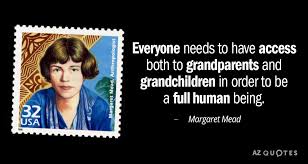
Margaret Mead, one of the most eminent cultural anthropologists of the twentieth century describes this important connection in a passage she wrote in 1966, and which rings just as true even today.

This image has an empty alt attribute; its file name is grandparents.jpg
Margaret Mead Source Google

In a changing society, grandparents themselves change. Far from representing what is stubbornly old-fashioned, they are men and women who in the contemporary world have the greatest experience in incorporating new ways and ideas. Very often their daughter is mired down in a thousand details of baby care and housekeeping and their sons are struggling to establish themselves in the world but grandparents have the leisure to follow up what is most modern and new. And unlike their own parents who grew old early under physical stress, today’s grandparents generally have years of vigorous living ahead.

More often than we realise, grandparents who move away from the homes where they brought up their own children are not settling into ‘retirement’ but are instead into new activities. Some of them have—and more could have a very important role in their grandchildren’s lives. Because as adults they have lived through so much change—the first talkies and television, the first computers and satellites—they may well be the best people to teach children about change.

With a lifetime of experience of how far we have come and how fast, grandparents can give children a special sense of sureness about facing the unknown in the future. Having experienced so much that is new, they can keep a sense of wonder in their voices as they tell their grandchildren how something happened, what it was like the first time, and open their grandchildren’s eyes to the wonder of what is happening now and may happen soon. And as men and women who are making new beginnings, developing new interests they can demonstrate to children that growing up is only a stage in a lifetime of growth. As in the past they represent continuity. But now, in a changing society this continuity includes the future and the acceptance of the unknown.  Margaret Mead: Some Personal Views   June 1966

–Mamata

Teacher Teacher   

My father-in-law will be 96 years old this month. He trained as an artist, but spent his career teaching machine drawing in a government polytechnic. He has now been retired for more years than he taught a subject that he was not passionate about. But what he was passionate about was reaching out to his students, not driven by any great philosophy or mission, but his innately sociable and open personality.  Even today, he gets phone calls from his old (literally—some are 75 years and over!) students, just for them to say that they remember him fondly. Till a couple of years ago he clearly remembered names and attributes of so many of his students. It is that life force which continues to energize him even today.

The word Teacher itself is loaded with so much meaning. After all teachers were the key players in the long drama of one’s school (and college) life, with distinct characters, roles and parts. As a part of the student audience, and at times, minor characters in the crowd scenes, we spent a great deal of time and emotion on ‘adoring’, ‘hating’, ‘fearing’, ‘hero worshipping’,  ‘imitating’, or ‘buttering up’ our teachers.

Teachers were a necessary evil that dominated every ‘period’ of our school days.­­­­­­­­­­­ It is when we were older (and perhaps a wee bit wiser) that we could look back with nostalgia and remember those teachers. This was also when we realized the lasting impressions and influences that different teachers had left on us. Not all of these were related to the subject they taught. More often, it was how they taught, or what they said and did, or even what they wore, and how they behaved. We could now see these as individuals with distinct personalities and persuasions. For some of us, the older we get, the more sentimental we get. And Teachers Day, celebrated in India on 5 September, revives many such memories.

In the good old school days, the run up to T-Day was exciting. This was the day that the tables were turned, as it were. It was the one day when students turned into teachers! This was how Teachers Day was celebrated in many schools.

This year for the first time perhaps in memory, the Covid wave has meant that educational institutions across the world are closed. In just a few months, our age-old understanding of educational spaces, classroom transactions, and players has been turned on its head. The e-learning revolution is sweeping across the globe.

Children of all ages (starting from nursery and kindergarten) passively face a small screen which reflects other small faces and a bigger face. It is in this virtual classroom that lessons are communicated (rather than taught). The day is divided into sterile time slots, rather than a time table in which the best parts were the time-outs for rowdy recesses and roistering assemblies. The Teacher is just a talking head who pops up at a designated time. As the young eyes and ears strain to keep alert and awake, the other senses lie dormant. Missing are the smells from the tiffin boxes, the touch of the dog-eared books and scarred desks, the jostling camaraderie of classmates, the fights and the making-up, the shared secrets, and playful antics…and with it the range of emotions that mark the gamut of relationships among the students, and between the teacher and the taught.itscalledreading (1).gif

I must confess that I have no current and direct experience of e-learning, as a teacher, learner, or parent. But as Teacher’s Day approaches, I cannot help wondering and worrying about this new model of teachers and teaching. Yes, we have no alternative at this moment when safety and health is the priority. True that technology has enabled a safer and more widespread route to reaching out. Agreed that there are examples of inspiring innovations and models. But what will a child of the Age of Corona and Era of E-learning remember of her classroom, her classmates and above all, her teacher? What stories will he share with his children? Who will she remember with a smile or a grimace on another Teacher’s Day?

One looks back with appreciation to the brilliant teachers, but with gratitude to those who touched our human feelings. The curriculum is so much necessary raw material, but warmth is the vital element for the growing plant and for the soul of the child.   Carl Jung

–Mamata