Lockdowns have seen people taking up a plethora of hobbies and
pastimes. Non-cooks have become chefs; non-housekeeping types are Mary
Kondoing; those who have never noticed a bird are becoming meticulous
bird watchers.
Here is my Lockdown craft saga:
Since school, I have, to put it politely, been craftily-challenged. My
needlework teacher systematically made me rip out my homework every
week and re-do it; when we had an assignment to crotchet a sweater in
Std. 8, I started by trying to make one for myself, but ultimately, it
was large enough to fit my pleasantly-plump mother; when we had to
make a tea-cosy (yes, such things were used and we had to make them,
in the days of yore!), it vaguely resembled a small cushion whose
shape did not have a geometrical name.
But my burning ambition has always to been to do fine-embroidery! Such
is the way of the heart, that it yearns for things unattainable!
So when everyone was doing creative things in Lockdown, I thought I
should do something vaguely connected with fabric and needles. I have
by now reached the age to know what I simply cannot do. So laying
aside my ambition, I decided to work on a concept level (a slightly
stronger suit than my craft skills).
The idea was to re-purpose things which I was not using. Clearing out
cupboards and drawers was definitely something all of us have been
doing in these times, and I had done my share. I found well over a
dozen dupattas which I hadn’t used in years. They were all very pretty
and in good condition. The dresses they went with had died long ago,
but when do we ever discards dupattas? We keep tucked away in some drawer,
sure we will be able to match them with another dress in the future.
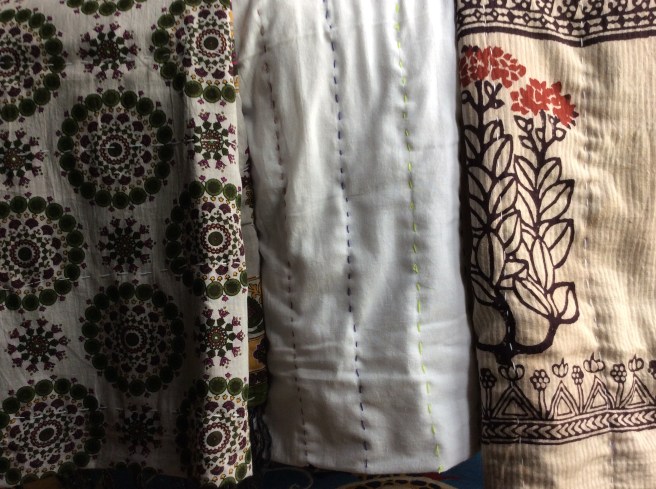 So I thought I would turn these into baby quilts. My interpretation of
quilting is to tack folds of materials together into something
resembling a rectangle. Tacking is the most low-down of stitches one
can do—simply put the needle in through the folds and draw it out at
an interval of 0.5 cm or whatever. Repeat.
And so I have turned a dozen dupattas into 6 baby quilts, because I
fold one into another, to make the quilts soft and warm. My tacking
wanders a little drunkenly across the quilts, and stiches are not of
uniform length (overall defining the word ‘tacky’). But they are going to serve the purpose (partly because the poor infants will have no say in what they are going to be draped in). Babies are not going to judge me for the quality of my
handiwork! I they will like soft coverlets made of pre-loved cloth.
I have run out of babies I know even remotely. My next step is going
to be to look for avenues for donating these—maybe through some NGO or
institution.
The exercise has definitely given me a good-feel on many counts.
Unused things are being turned into something useful. And some babies
will feel a bit warmer, thanks to my efforts. And there is nothing
like a physical, tangible product at the end of a few hours of effort.
If enough people take it up, it could become a movement for children who will need these in the coming colder months.
Any takers for the idea? If I can do it, anyone can!
–Meena
 next few days the hype will build up. There will be a marketing blitz reminding us that Friendship Day nears, and that the best way to be friends is by buying and gifting for each other, and that the proof of friendship is the number of cards and presents that one gets.
 Today, All India Radio is the largest radio network in the world, and one of the largest broadcasters i in terms of the number of languages broadcast (23 languages and 179 dialects!), and the range of audiences it serves. This is done through 420 stations located across the country, reaching nearly 92% of the country’s area and 99.19% of the population. AIR also operates close to 25 FM stations.
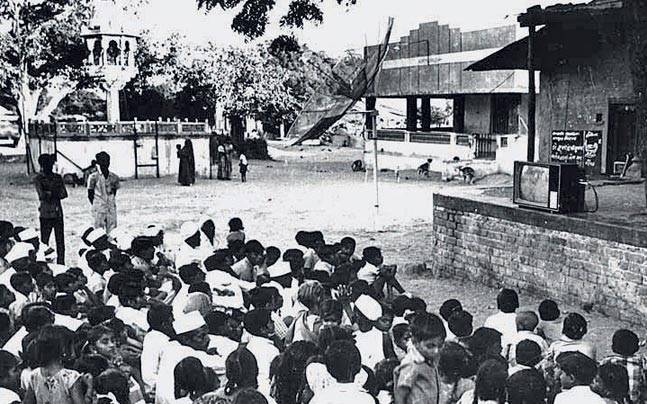 The programs were broadcast for a few hours a day, and hundreds of
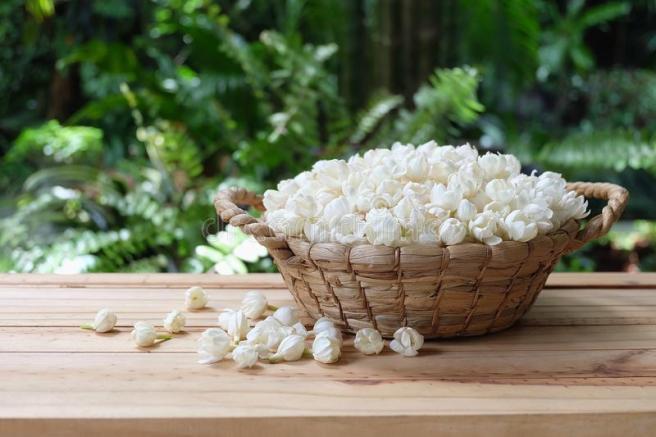 On the day of the challenge, Amaravathi positioned herself behind a curtain, out of sight of her lover. She had at her side two baskets. One was empty and the other had a hundred beautiful blossoms (I visualize them to be jasmine). The idea was that as Ambikapathy finished a verse, she would transfer one flower from the filled basket to the empty one. When the basket was empty, she would know that he had finished his 100 verses and she could appear before him.