
The Indian summer is when our trees put up the most spectacular flower shows. Flame of the Forest—Butea monosperma whose flowers arrive in blazing orange. Different in tone, is the gulmohar—Delonix regia, with its wide, umbrella-like canopy and bright red blooms. The golden counterpart to these reds is the amaltas—Cassia fistula. Long cascades of yellow flowers hang down in late spring and early summer. The ubiquitous neem–Azadirachta indica has small white flowers which are easy to miss, but their scent. And they are an important part of New Year celebrations in many states.
Among all these are the purples. Three of them are commonly seen–the Pride of India, the loosely termed Indian Princess Tree, and the jacaranda form a quiet sequence of lilac and violet. Less flamboyant, but with gravitas.
The Pride of India or Lagerstroemia speciosa, is both widespread and rooted. Native to the subcontinent, it thrives across peninsular and eastern India, and is deliberately planted in northern cities. It is a familiar presence along older avenues, institutional campuses, and residential roads—part of an earlier approach to urban planting that valued seasonal change as much as shade.
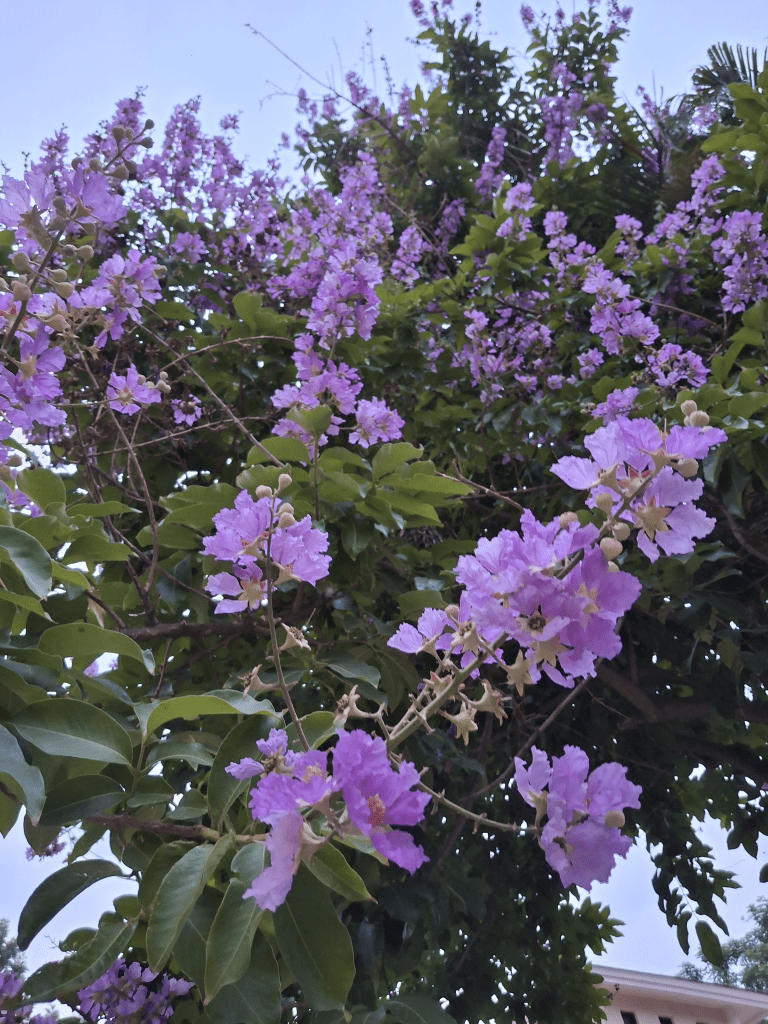
It flowers in dense clusters of lilac, mauve, and pink when most trees recede. The effect is immediate. A single tree can alter the look of a street. The name reflects thatm rather than any scientific classification—an attempt to capture abundance and presence.
After flowering, it produces dry capsules that split open to release light, winged seeds, dispersed by wind. The process is largely unnoticed but effective, allowing the tree to regenerate in suitable conditions. Its flowers attract insects; in turn, birds move through its branches while foraging. Species such as the Red-vented Bulbul and Common Myna are frequent visitors, while others use it as a perching and nesting site, especially in dense urban areas where such cover is limited. In peak summer, its canopy becomes a resting space—shade functioning as habitat.
There is another layer to its presence. The leaves of Lagerstroemia speciosa—often called banaba—are used in traditional medicine, particularly in managing Type 2 Diabetes. They are associated with blood sugar regulation, as well as anti-inflammatory and antioxidant properties. This makes the tree unusual among urban ornamentals: it is not only seen and inhabited, but also used.
The Indian Princess Tree, often linked to Paulownia tomentosa, sits less comfortably in place. Despite the name, it is not native to India and is only sporadically seen—mainly in cooler hill regions or curated landscapes. The “Indian” prefix reflects randomness in naming rather than origin.
Its appeal lies in its restraint. Pale violet flowers, broader leaves, and a more open form create a softer effect than the Pride of India. The “princess” is probably drawn from this visual delicacy.
Its biology, however, is less restrained. After flowering, it produces capsules filled with thousands of fine, papery seeds, designed for long-distance wind dispersal. Given open ground and the right climate, these seeds germinate quickly. The tree grows fast, which explains both its horticultural appeal and its reputation, in some regions, as invasive. In India, its presence fortunately remains controlled and limited.
Ecologically, it plays a lighter role, probably because it is non-native. Its flowers attract insects, and birds may use it for cover or occasional nesting, but it is not a significant food source.
Between these two sits the Jacaranda—Jacaranda mimosifolia—not native, but now visually embedded in cities such as Bengaluru. Its lavender-blue flowers arrive earlier, often bridging spring and summer. For a brief period, roads are edged and sometimes carpeted with fallen blooms, before other trees come into flower.
Jacaranda’s role is largely aesthetic, but not only. Its spreading canopy provides filtered shade, and like the others, its flowering attracts insects, drawing in birds that follow.
Together, these trees complicate their own names. One is called “of India” and is largely at home. One is called “Indian” and is not. One carries no such label and yet feels entirely part of the Indian landscape. Naming suggests belonging; ecology tells a more precise story.
These three trees also differ in how they are encountered. The Pride of India tends to define a street, its flowering visible from a distance. The Princess Tree, where it appears, is noticed more gradually—through proximity, through shade. Jacaranda sits between the two, its colour spreading outward, often first seen on the ground before it is traced back to the tree.
What they share is timing. Each blooms when the landscape offers little else. Their flowering is staggered, creating a sequence rather than a single event. Jacaranda fades as the Pride of India strengthens; elsewhere, other species take over. The effect is not continuous bloom, but continuity of change.
In older Indian neighbourhoods especially in Bangalore, such trees point to a different planning logic. Streets were planted not just for shade but for variation—for shifts in colour, density, and light across months. As urban density increases and tree cover becomes more functional than expressive, these older plantings remain as records of that intent.
A shift in colour. A canopy that briefly interrupts heat. And, overhead, a dry capsule opening—unseen, but already carrying the next season forward. That is the Indian summer.
–Meena

