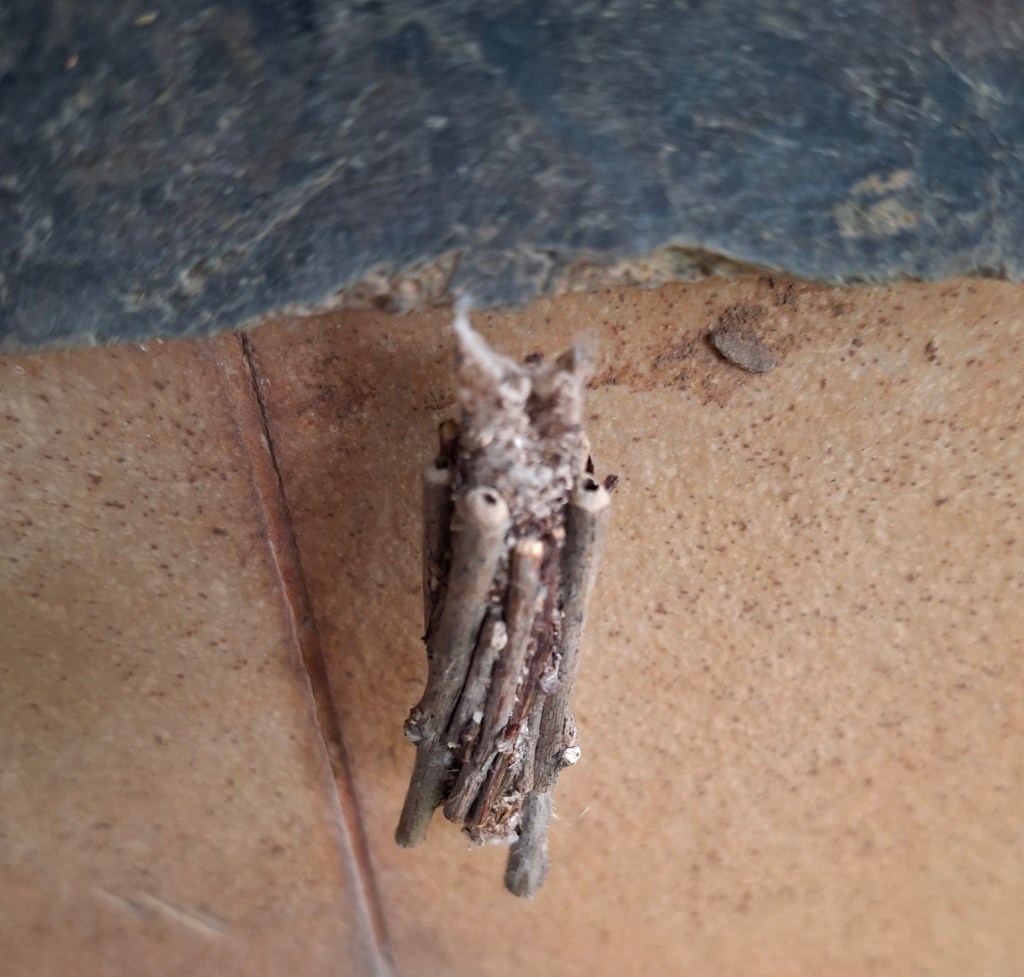
At first glance, it looks like a tiny piece of dried grass crawling across a wall.
Or perhaps a bundle of twigs that has mysteriously come to life.
Look closely, and you may be witnessing one of nature’s most ingenious engineers—the bagworm moth.
Bagworm moths belong to the family Psychidae, a group of over 1,300 species found across the world. India alone is home to more than a hundred recorded species, many of which remain little known outside scientific circles. Despite their modest size, these insects display a level of architectural skill that would put many builders to shame.
A House You Can Carry
Unlike most caterpillars, a bagworm larva begins life by building itself a portable home.
Using silk as mortar, it gathers whatever materials lie nearby—tiny twigs, dry leaves, grass blades, bark flakes, seeds, even grains of sand. Every species has its own choice of materials and characteristic style. Some create neat spindle-shaped cases, others make rough bundles of sticks, while tropical species may construct surprisingly elaborate structures.
The result is a camouflage masterpiece.
To an unsuspecting bird, the moving caterpillar looks like nothing more than a fragment of the tree itself.
And unlike a snail that outgrows its shell, the bagworm keeps enlarging its home as it grows, carefully adding fresh material throughout its larval life.
India’s Hidden Diversity
Bagworms occur throughout India—from the Himalayan foothills to the Western Ghats, from dry deciduous forests to urban gardens.
Entomologists from the Zoological Survey of India have documented more than 106 Indian species, although many more almost certainly await discovery, especially in biodiversity hotspots like the Western Ghats and Northeast India.
Several Indian species belong to genera such as Eumeta, Cryptothelea, Clania, Mahasena and Eumasia. Many feed on a wide range of plants, while others specialise on lichens growing on tree trunks.
People commonly refer to them simply as “bag caterpillars,” “case moths,” or by descriptive names equivalent to “leaf-bag insects” or “twig-case worms.” In Hindi, for instance, ‘jhola illi’ may be used; in Marathi, ‘pishvi ali’; in Kannda, ‘chila ulu’; in Tamil, ‘pai or kuudu puzhu’, etc. Generally, they are recognised more by the little bags hanging from trees than by the moth itself.
The Caterpillar That Never Really Leaves Home
The story becomes even stranger when adulthood arrives.
Male bagworms emerge as small, winged moths with feathery antennae, flying actively in search of mates.
Many females, however, never develop wings at all. Females of these species spend virtually their entire lives inside the protective case they built as caterpillars. They neither fly nor wander. Instead, they remain inside the bag while releasing pheromones that attract males. After mating, they lay eggs within the same case, and the next generation begins life inside the home built by their mother.
Nature has produced many unusual lifestyles, but few are as remarkable as an adult moth that never truly leaves its childhood home.
Forest Engineers in Miniature
The bag is much more than camouflage.
It protects the caterpillar from birds, parasitic wasps, spiders and sudden changes in temperature. Some cases are even pretty rain-proof.
Researchers believe the bags also reduce water loss during hot weather and provide insulation against cold nights.
The silk itself is extraordinarily strong. Scientists have noted that bagworm silk possesses impressive durability, making it of interest in materials research.
Friends…and Occasionally Foes
Most Indian bagworms quietly recycle plant material and form part of healthy forest ecosystems.
A few species, however, can become agricultural or horticultural pests when their numbers increase dramatically. They feed on leaves of ornamental plants, fruit trees and plantation crops, occasionally causing noticeable defoliation. Fortunately, such outbreaks are relatively uncommon, and natural predators usually help keep populations under control.
More to Come!
As recently as 2023, researchers described a previously unknown bagworm, Eumasia venefica, from Kerala. Unlike many relatives, its larvae have a close association with lichens and possess unusual case-building habits, reminding us that India’s insect diversity still contains many surprises.
Watch out for those walking twiggy bundles! Who knows if you will stumble on a new one!
–Meena
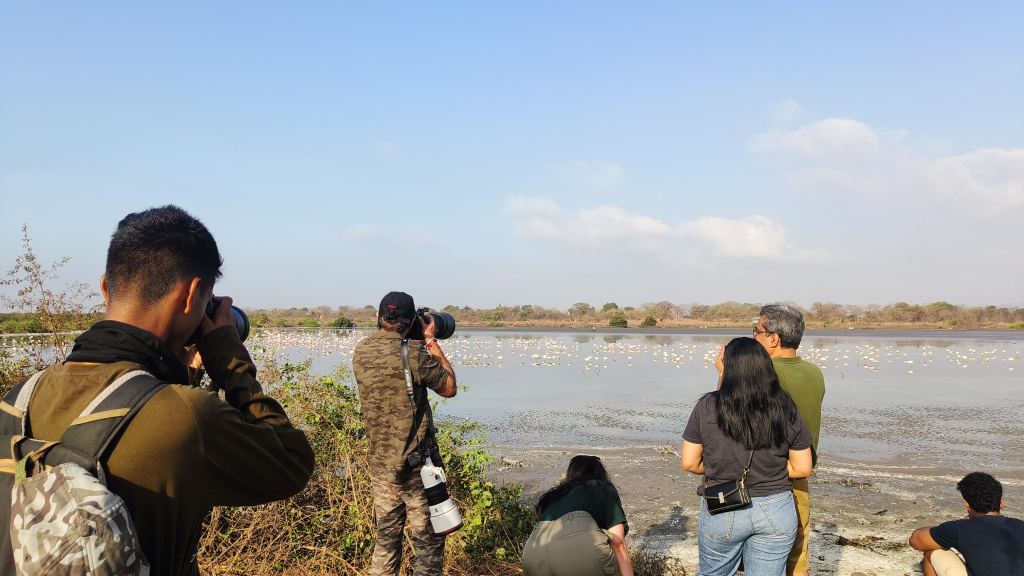



 The connection is a tree that is reputed to be the most instagrammed tree in New Zealand, almost a symbol of NZ tourism. On a recent trip there, we were urged to set aside time to see the tree, specifically around sunset. So we worked around our program to ensure we got to the spot—a stretch of a beach—well ahead. We drove past a few times, keenly looking at the beach. We could see some people, but nothing special in the way of trees. We asked natives and tourists alike, and they all pointed us to the same area which our GPS had shown us, and which we had passed, looking in vain for a landmark. We decided to make our way down to the beach anyway. Lo and behold, there were many, many people there, jostling for some spot (we could not figure out what the spot was for), all setting up professional looking camera equipment. It came to a pass when we had to ask a friendly-looking lady what everyone was waiting to photograph, where the famous tree was, and what it was about. She kindly pointed to this spindly willow tree, standing a few feet into the waters of the beautiful Wanaka Lake, against a beautiful background of majestic mountains. But the tree itself? In my mind, this will forever define and exemplify ‘under-whelming’. ‘Why is the tree famous’, we asked many around us in bewilderment. While there was some story of how it was part of a fence and had survived in the water for several years, the general consensus was that it was famous because it was famous! So famous , it even has its own insta handle #ThatWanakaTree.
 ife Day. This marks the day of signature of the Convention on International Trade in Endangered Species of Wild Fauna and Flora (CITES) in 1973. Every year on this day, events are held around the world to celebrate and raise awareness of the world’s wild animals and plants.